
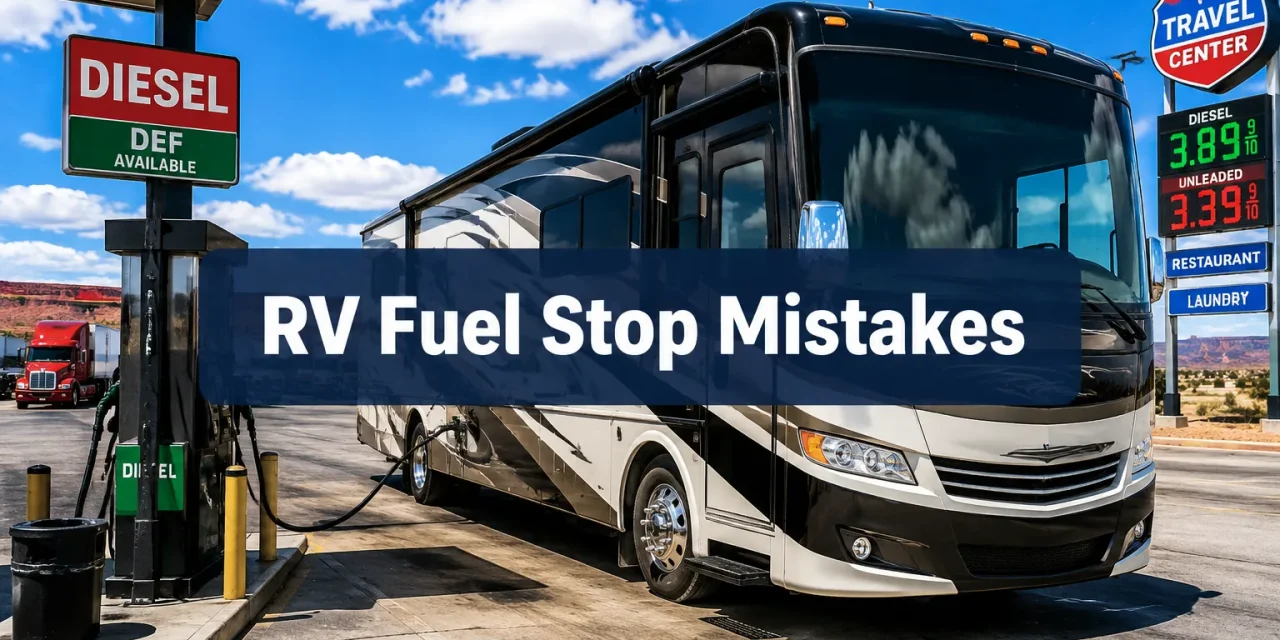
Every year, thousands of RV trips grind to a halt, not because of engine failures or bad weather, but because of entirely preventable fuel stop blunders. A 2023 survey by the RV Industry Association found that fuel-related issues rank among the top five causes of roadside breakdowns for new RV owners. The 13 rookie RV fuel stop mistakes that can ruin the day are shockingly common, and most of them take less than 60 seconds to avoid once you know what to watch for.
Whether someone is driving a Class A diesel pusher or a compact Class C gas rig, the fuel stop is where things go sideways fast. This guide breaks down every major mistake, explains why it happens, and gives practical fixes so the next fuel stop is smooth, safe, and stress-free. 🚐⛽
Key Takeaways
- Wrong fuel type is one of the costliest mistakes an RV owner can make, always verify diesel vs. gasoline before inserting the nozzle.
- Low canopy clearance at standard gas stations can damage rooftop AC units, antennas, and vents, always check height before pulling in.
- Skipping a walk-around after fueling is a leading cause of driving away with hoses still attached or slides left open.
- Poor lane selection at fuel stops can trap a large rig for 30+ minutes, always scout the exit before committing to a pump.
- Fuel cost planning matters: skipping price research on a 500-mile trip in a 40-gallon tank can cost $30,$60 extra per fill-up.
Why the 13 Rookie RV Fuel Stop Mistakes That Can Ruin the Day Happen to Everyone
Would you like to save this article?
It’s tempting to think fuel stop mistakes only happen to first-timers on their maiden voyage. The truth? Experienced RVers slip up too, especially when tired, distracted, or in an unfamiliar rig. Understanding why these mistakes happen is the first step to stopping them.
Most errors come down to three root causes:
- Complacency, treating an RV fuel stop exactly like a car fuel stop
- Size blindness, forgetting how big the rig actually is until it’s too late
- Rushing, trying to fuel up quickly during a busy travel day
💡 “An RV is not a minivan. The moment you treat it like one at a fuel stop, the day gets expensive.”
Here’s a look at all 13 mistakes in detail.
Mistake #1: Pumping the Wrong Fuel Type
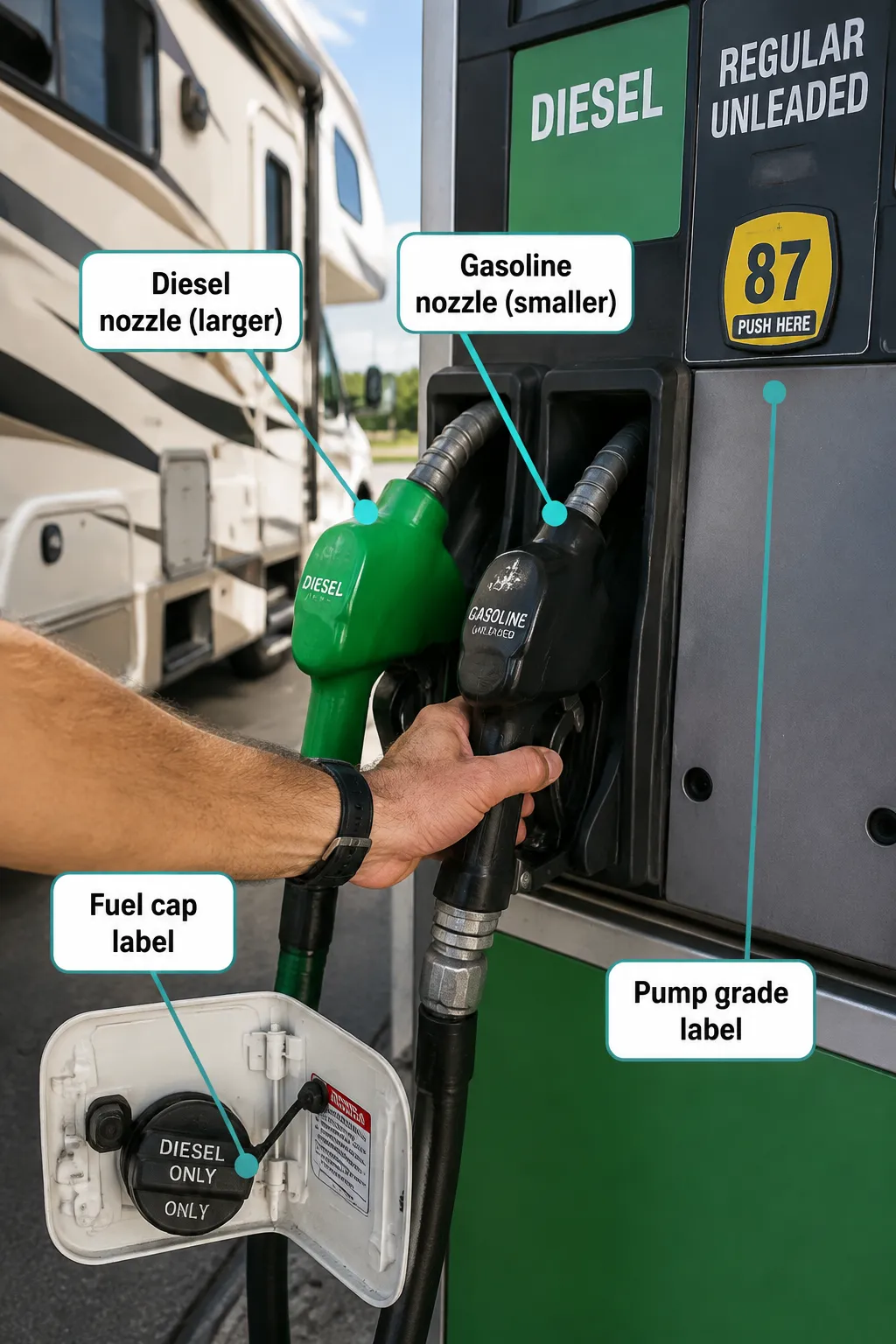
This is the nightmare scenario. Putting gasoline into a diesel engine, or vice versa, can cause catastrophic engine damage costing $5,000 to $30,000+ to repair.
How to avoid it:
- Read the fuel cap label every single time
- Check the pump label before inserting the nozzle
- Use a bright sticker on the dash that says “DIESEL ONLY” or “GAS ONLY”
| Fuel Type | Nozzle Color (US) | Nozzle Size |
|---|---|---|
| Diesel | Green | Larger |
| Gasoline (regular) | Black | Smaller |
| Gasoline (premium) | Yellow/Red | Smaller |
Mistake #2: Ignoring Canopy Height Clearance
Standard gas station canopies are often 13-14 feet high. Many Class A and Class C rigs with rooftop AC units, antennas, or solar panels stand 12-13.5 feet tall. That margin is razor-thin.
Damage risk: Rooftop AC units, TV antennas, and vents can be sheared off in seconds.
✅ Fix: Know the rig’s exact height. Write it on a sticky note on the dashboard. When in doubt, use truck stops, they’re built for tall vehicles.
Mistake #3: Choosing the Wrong Fuel Station Entirely
Not every station can handle an RV. Tight driveways, low canopies, and short pump islands make many suburban gas stations a bad fit for anything over 25 feet.
Better options for RVers:
- Pilot Flying J, long pull-through lanes, DEF available
- Love’s Travel Stops, wide diesel islands, RV-friendly
- Flying J, dedicated RV lanes at many locations
- Camping World, propane and dump stations too
Mistake #4: Not Checking the Exit Before Pulling In
Pulling into a fuel station and then realizing there’s no way out is one of the most stressful 13 rookie RV fuel stop mistakes that can ruin the day. A sharp 90-degree exit, a low curb, or parked semis can trap a rig for a long time.
Rule of thumb: Always drive past the station first, scout the exit, then loop back if it looks safe.
Mistake #5: Forgetting to Retract Slides and Awnings
This one hurts. Driving away with a slide-out extended or an awning deployed causes immediate and expensive damage. It happens more often than anyone wants to admit, especially after a long driving day when the brain is on autopilot.
Checklist before leaving any fuel stop:
- All slide-outs retracted
- Awning fully rolled in and latched
- Steps retracted
- Exterior storage bays closed and locked
- Fuel cap replaced and secured
Mistake #6: Disconnecting Shore Power Without Checking
Some RVers fuel up at campgrounds or RV parks that offer fuel. Driving off while still connected to shore power rips the power cord right out of the pedestal, and sometimes out of the RV’s inlet too.
✅ Fix: Add “SHORE POWER DISCONNECTED?” to the pre-departure checklist.
Mistake #7: Skipping DEF (Diesel Exhaust Fluid) Checks
Diesel RVs built after 2010 use DEF to reduce emissions. Running out of DEF doesn’t just trigger a warning light, it eventually limits engine power and can cause the engine to go into limp mode.
DEF facts every diesel RV owner needs:
- DEF consumption is roughly 2-3% of diesel consumption
- Most truck stops carry DEF in jugs and at pump islands
- Always carry a spare gallon in the basement storage
Mistake #8: Ignoring Fuel Price Apps
On a 40-gallon diesel tank, a $0.50/gallon price difference equals $20 wasted at a single fill-up. Over a two-week trip with five fill-ups, that’s $100 gone.
Top fuel price apps for RVers:
| App | Best For | Free? |
|---|---|---|
| GasBuddy | Gas & diesel prices | ✅ Yes |
| Trucker Path | Diesel at truck stops | ✅ Yes |
| Roadtrippers Plus | Route + fuel planning | Paid |
| Waze | Real-time gas prices | ✅ Yes |
Mistake #9: Fueling With the Generator Running
Many RV owners run the generator while fueling to keep the AC going. This is dangerous. Fuel vapors and a running engine are a fire hazard, and many stations explicitly prohibit it.
✅ Fix: Turn off the generator before approaching the pump. The few minutes of warmth or cool air are not worth the risk. 🔥
Mistake #10: Not Accounting for Fuel Weight on Load Limits
A full 100-gallon diesel tank adds roughly 700 pounds to the rig’s total weight. New RV owners often forget this when calculating their Gross Vehicle Weight Rating (GVWR).
⚠️ Important: Exceeding GVWR is illegal, dangerous, and voids most warranties. Always factor fuel weight into load calculations.
Quick weight reference:
- Diesel: ~7 lbs per gallon
- Gasoline: ~6.1 lbs per gallon
- Fresh water: ~8.3 lbs per gallon
Mistake #11: Leaving Pets or People in the RV While Fueling
Most fuel stations prohibit passengers from remaining in vehicles during fueling. Beyond the rules, fuel vapors can accumulate quickly inside an enclosed RV, especially dangerous for pets and small children.
✅ Fix: Everyone out of the rig during fueling. Use the stop as a stretch break. 🐕
Mistake #12: Not Knowing the Fuel Tank Location
This sounds basic, but on a new or rented rig, many RVers pull up to the wrong side of the pump because they don’t know which side the fuel cap is on. On some Class A coaches, the fuel fill is on the driver’s side, opposite of most passenger vehicles.
Quick fix: Check before the first trip. Mark it with a small arrow sticker near the fuel gauge.
Mistake #13: Skipping the Post-Fuel Walk-Around
The walk-around is the single most important 60 seconds at any fuel stop. It catches every other mistake on this list before they become disasters.
Post-fuel walk-around checklist:
- ⬜ Fuel cap secured
- ⬜ Fuel door closed
- ⬜ No pump hose still attached (yes, this happens)
- ⬜ All tires look properly inflated
- ⬜ No fluid leaks under the rig
- ⬜ Slides and awnings confirmed retracted
- ⬜ All bays closed
A Smarter Fuel Stop Routine: Avoiding All 13 Rookie RV Fuel Stop Mistakes That Can Ruin the Day
Building a consistent routine is the single best defense against all 13 rookie RV fuel stop mistakes that can ruin the day. Think of it like a pilot’s pre-flight checklist, it only takes a few minutes, but it prevents catastrophic errors.
The 5-Step RV Fuel Stop Routine
Step 1, Plan Ahead (While Driving)
- Open GasBuddy or Trucker Path 20-30 miles before the tank hits half
- Identify a truck stop or RV-friendly station with pull-through lanes
- Note the canopy height if available in reviews
Step 2, Scout Before Committing
- Drive past the station first
- Check canopy height, exit lanes, and pump island length
- Confirm diesel or gas availability
Step 3, Safe Approach
- Retract nothing yet, just pull in carefully
- Turn off the generator
- Choose the widest lane available
Step 4, Fuel Safely
- Confirm fuel type on cap AND pump
- Stay outside the rig during fueling
- Check DEF level on the dash display
Step 5, Walk-Around Before Leaving
- Complete the full checklist above
- Do a slow 360° walk around the entire rig
- Only then start the engine and pull out slowly
Bonus Tips: Saving Money and Time at Every RV Fuel Stop
Beyond avoiding mistakes, a few smart habits can turn every fuel stop into an efficient, money-saving pit stop.
💰 Save Money on Fuel
- Join fuel rewards programs, Pilot Flying J’s myRewards Plus and Love’s Connect both offer cents-per-gallon discounts
- Use a fuel credit card, some cards offer 3-5% cashback on fuel purchases
- Fill up on Mondays and Tuesdays, GasBuddy data consistently shows these are the cheapest days of the week for fuel
- Avoid highway exit stations, prices are typically 10-20 cents higher than stations 1-2 miles off the exit
⏱️ Save Time at the Pump
- Pre-pay inside to avoid pump authorization holds on debit cards (many pumps cap authorization at $75,$100, not enough for a large diesel fill)
- Use truck stop apps to check pump wait times before arriving
- Fuel during off-peak hours, early morning (6-8 AM) or late evening avoids the midday rush
🛠️ Make the Stop Count
Every fuel stop is a great opportunity to:
- Check tire pressure (cold pressure, before driving)
- Inspect windshield for new chips
- Empty the cab trash
- Grab water and snacks for the next leg
Common Questions About RV Fuel Stop Mistakes
Q: What happens if diesel is accidentally put in a gas RV?
Diesel in a gasoline engine will cause the engine to misfire, stall, and eventually stop running. The fuel system must be professionally drained and flushed. Costs typically range from $400,$1,500.
Q: How often should DEF be refilled?
For most diesel RVs, DEF needs to be topped off every 5,000-8,000 miles depending on driving conditions and engine load. Check the DEF gauge at every fuel stop.
Q: Are there RV-specific fuel station apps?
Yes! Apps like RV LIFE Trip Wizard, Campendium, and iOverlander include RV-friendly fuel stop filters. Trucker Path is also excellent for finding diesel at truck stops with tall canopies.
Q: Can a diesel pusher use truck stop diesel lanes?
Absolutely, in fact, truck stop diesel lanes are ideal for large diesel pushers. They’re designed for vehicles up to 75 feet long with high canopies (typically 16+ feet).
Conclusion: Turn Fuel Stops From a Headache Into a Habit
The 13 rookie RV fuel stop mistakes that can ruin the day are all preventable with the right knowledge and a consistent routine. From pumping the wrong fuel to driving off with the awning out, every mistake on this list has one thing in common: it happens fast and costs dearly.
Actionable next steps:
- 📋 Print or save the walk-around checklist and laminate it near the driver’s seat
- 📱 Download GasBuddy and Trucker Path before the next trip
- 📏 Write the rig’s exact height on a sticky note on the dashboard, today
- 🔑 Join one fuel rewards program (Pilot myRewards Plus is free and easy)
- 🗺️ Plan fuel stops in advance using RV-specific trip planning apps
A great RV adventure is built on hundreds of small, smart decisions. Making the fuel stop a smooth, safe, and efficient part of the journey means more time enjoying the destination, and less time stranded on the shoulder wondering what went wrong. Happy travels! 🚐🌄
References
- RV Industry Association. (2023). Annual RV Owner Survey: Roadside Breakdown Causes. RVIA.
- GasBuddy. (2022). Best Days of the Week to Buy Gas. GasBuddy.com.
- Pilot Flying J. (2023). myRewards Plus Program Overview. PilotFlyingJ.com.
- U.S. Department of Energy. (2022). Diesel Exhaust Fluid (DEF) Basics. Energy.gov.
- Love’s Travel Stops. (2023). RV Services and Amenities Guide. Loves.com.


