
Every year, roughly 3.1 million American households hit the road full-time in an RV, and millions more make seasonal trips. Yet for many families, the biggest challenge isn’t the destination. It’s surviving the journey with kids who are bored, restless, and asking “Are we there yet?” before the campground is even out of sight.
The good news? Travel days don’t have to be a grind. The 14 Clever Travel-Day Traditions Kids Actually Look Forward To explored in this guide transform ordinary driving hours into moments kids genuinely anticipate. These aren’t just distractions, they’re rituals that build family identity, create lasting memories, and make the road itself part of the adventure.
Whether the family is a weekend warrior crew or a full-time RV tribe, these traditions are easy to start, simple to maintain, and powerful enough that kids will remind you when it’s time to begin them.
Key Takeaways
- 🎯 Rituals beat distractions, purposeful traditions reduce travel-day meltdowns far better than screens alone.
- 🗺️ Anticipation is half the fun, traditions that build excitement before departure make kids eager for travel days.
- 🍿 Sensory variety matters, mixing food, games, creativity, and movement keeps different types of kids engaged.
- 🏅 Milestone rewards create ownership, when kids track progress themselves, they invest emotionally in the journey.
- 🔄 Consistency is the secret ingredient, the more reliably a tradition is repeated, the more kids look forward to it.
Why Travel-Day Traditions Work So Well for RV Families
Before diving into the full list of 14 Clever Travel-Day Traditions Kids Actually Look Forward To, it helps to understand why traditions work so effectively in an RV context.
Would you like to save this article?
Child development research consistently shows that predictable rituals reduce anxiety and increase a child’s sense of control. When kids know what to expect, even on a chaotic moving day, their nervous systems settle. The road becomes familiar, not frightening.
“Rituals give children a sense of continuity and belonging. They signal ‘this is who we are as a family.'”, Dr. Barbara Fiese, Family Ritual Research
For RV families specifically, travel days can stretch 4 to 10 hours. That’s a long stretch of time in a small space. Traditions create natural time anchors, moments kids can look forward to and count down to, which makes the hours feel shorter and more meaningful.
Here’s a quick look at what makes a travel-day tradition stick:
| Quality | Why It Matters |
|---|---|
| Repeatable | Kids anticipate it every trip |
| Sensory | Engages multiple senses for deeper memory |
| Kid-driven | Gives children agency and ownership |
| Low-prep | Parents actually do it consistently |
| Scalable | Works for toddlers and tweens alike |
The Full List: 14 Clever Travel-Day Traditions Kids Actually Look Forward To
Here are 14 road-tested traditions that RV families swear by. Mix and match based on the kids’ ages and the family’s style.
1. 🎒 The Mystery Bag Reveal
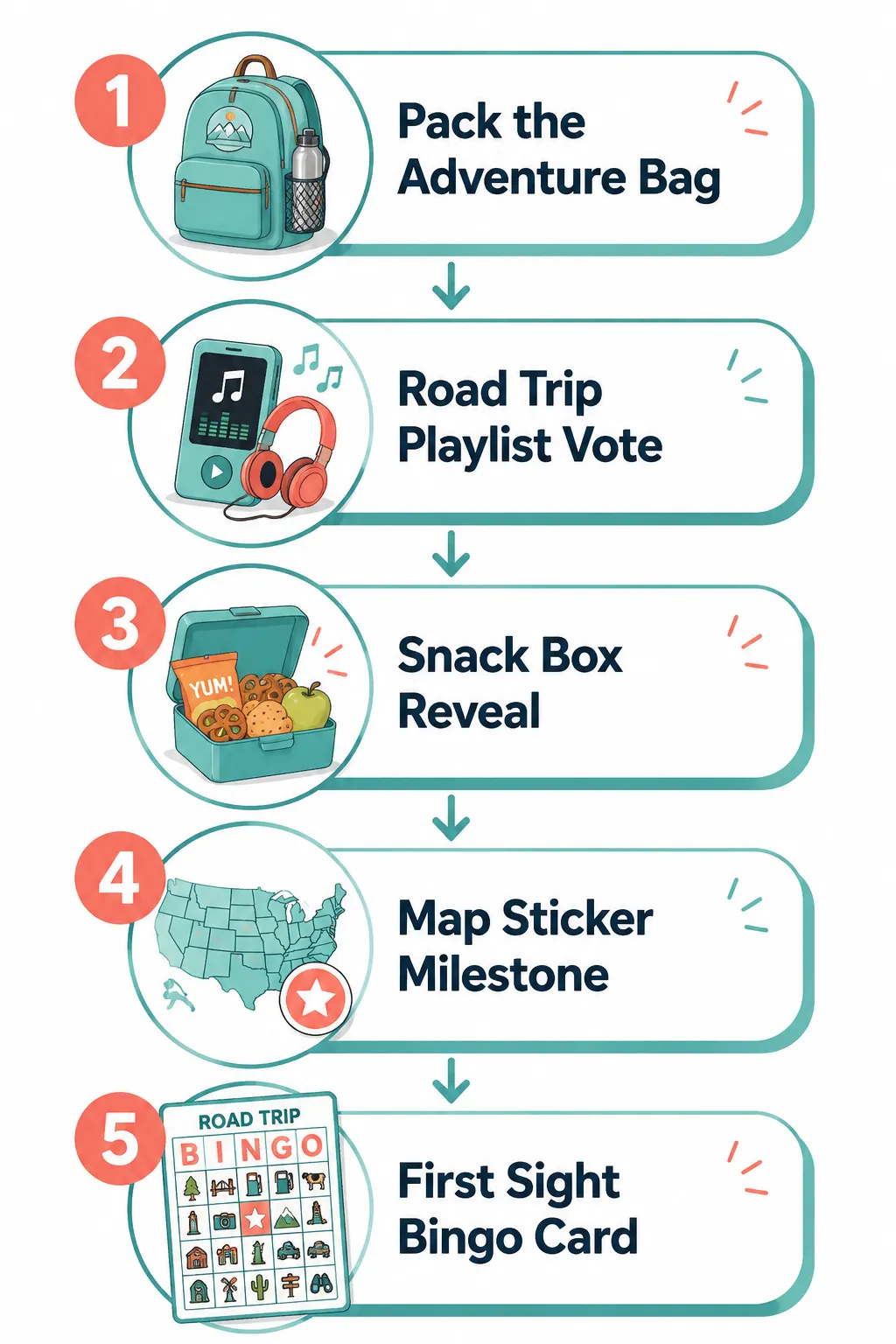
Pack a small bag the night before and don’t reveal the contents until the RV is rolling. Include a new small toy, a novelty snack, a mini activity book, or a funny trinket from a dollar store.
Why it works: Anticipation starts the night before. Kids go to bed excited about travel day, not dreading it.
Pro tip: Let older kids help pack the mystery bag for younger siblings. It builds empathy and doubles the excitement.
2. 🗺️ The Scratch-Off Map Moment
Hang a USA scratch-off map in the RV. Every time the family crosses into a new state or reaches a new campground, the kids get to do the scratch. That’s it. Simple, tactile, and deeply satisfying.
Why it works: It makes progress visible. Kids can see the journey building over time, which turns every trip into a chapter of a bigger story.
3. 🎵 The Playlist Vote
Before departure, every family member, including the youngest who can point, nominates one song for the road trip playlist. No vetoes allowed. The playlist plays in nomination order.
Why it works: Kids feel heard and valued. Even a 4-year-old who picks the same Moana song every time is exercising real choice.
Bonus: This tradition naturally starts conversations about music, memories, and why certain songs matter to people.
4. 🍿 The Snack Box Surprise
Prepare a special “travel day only” snack box that kids never get at home or at the campsite. Think: a specific candy, a fun cheese cracker combo, or a themed treat tied to the destination (cowboy jerky for a Texas trip, for example).
The rule: The snack box only opens once the RV is moving. This single rule makes departure exciting rather than stressful.
5. 📍 The Mileage Milestone Badge
Set mileage milestones before the trip, say, every 100 miles. When the odometer hits each milestone, kids earn a small sticker, stamp, or badge for their travel journal.
Age range: Works especially well for ages 5-12.
Materials needed:
- A simple notebook or binder as a “travel journal”
- Sticker sheets (state shapes, animals, vehicles)
- A visible odometer or a phone app showing distance
6. 🎙️ The Road Trip Podcast Recording
Give kids a small voice recorder or use a phone app to let them record a “travel day podcast.” They interview family members, narrate what they see out the window, and share predictions about the destination.
Why it works: It channels natural chattiness into something creative. Kids who might otherwise drive everyone crazy with questions become journalists instead.
Long-term payoff: These recordings become irreplaceable family archives. Hearing a 7-year-old’s voice describing a mountain pass years later is priceless.
7. 🔭 The Window Bingo Game
Create custom bingo cards based on things likely to be spotted along the route, a red barn, a water tower, a horse trailer, a state welcome sign. Print new cards for each trip or laminate reusable ones.
Customization ideas by region:
| Region | Bingo Items to Include |
|---|---|
| Southwest | Saguaro cactus, roadrunner, dust devil, adobe building |
| Pacific Northwest | Logging truck, osprey, covered bridge, ferry boat |
| Midwest | Grain silo, combine harvester, wind turbine, county fair sign |
| Southeast | Spanish moss, shrimp boat, peach stand, kudzu vine |
8. 📖 The Audiobook Cliffhanger
Start a family audiobook series that is only played during travel days. The rule: it pauses the moment the RV stops. Kids cannot listen at the campsite.
Why it works: This tradition single-handedly makes kids want to get back in the RV. It’s one of the most powerful travel-day traditions in this entire list.
Great series for RV families:
- The Ranger’s Apprentice series (ages 8+)
- Hilo graphic novel audiobooks (ages 6+)
- The Phantom Tollbooth (ages 8+)
- Diary of a Wimpy Kid (ages 7+)
9. 🏆 The Destination Prediction Game
The night before departure, everyone writes down three predictions about the next campground or destination. What will the bathrooms look like? Will there be a playground? What will the view be? Sealed in an envelope and opened upon arrival.
Scoring:
- Exact match: 3 points
- Close guess: 1 point
- Wildly wrong: 0 points (but gets the biggest laugh)
The winner picks the first activity at the new site. This tradition builds geography awareness and destination research skills naturally.
10. 🎨 The Travel Journal Spread
Each child gets a dedicated travel journal. The travel-day tradition is simple: spend 15 minutes at the start of the drive drawing or writing what they remember about the last destination before moving to the next one.
Why this timing works: Doing it at the start of travel day, while memories are fresh, means kids capture details they’d otherwise forget. It also settles everyone down after the busy departure morning.
Supplies to keep in the RV:
- Watercolor pencils (mess-free, vibrant)
- Washi tape for adding ticket stubs or receipts
- A glue stick
- Fine-tip markers
11. 🌄 The First Sight Shout
Whoever spots the destination first, the campground sign, the mountain, the ocean, gets to shout a designated phrase. Every family picks their own. Some families use “LAND HO!” Others use the campground’s name in a silly voice.
Why it works: It transforms arrival from a logistical moment into a celebration. Kids press their faces to the windows for the last 20 miles, watching eagerly.
Reward options for the winner:
- First pick of bunk beds
- First shower slot
- Choice of the first campfire snack
12. 🧩 The Travel Day Challenge Card
Before each trip, write 5 to 7 small challenges on index cards and put them in a jar. During the drive, kids draw one card every hour or so.
Sample challenge ideas:
- Spot 5 different license plate states
- Write a haiku about what you see outside
- Name 10 animals that live in the state you’re driving through
- Draw a portrait of the person sitting next to you
- Make up a story that starts with “One time, in this exact spot…”
This tradition works brilliantly for mixed-age groups because challenges can be tailored to each child’s level.
13. 🌮 The Destination Meal Countdown
Research one food that the destination region is famous for. Announce it before departure as the “arrival meal.” Talk about it during the drive. Look up the restaurant or recipe together. Build genuine anticipation.
Examples:
- Heading to Louisiana? Tonight’s arrival meal is beignets.
- Driving into New Mexico? Green chile cheeseburgers are waiting.
- Rolling into Maine? Lobster rolls are on the horizon.
The psychology: Anticipating a specific pleasure actually increases enjoyment of the experience itself. Kids who talked about beignets for 6 hours enjoy them more than kids who discovered them by accident.
14. 🌟 The Gratitude Rock Exchange
At the start of each travel day, every family member picks up one small rock from the current campsite. During the drive, each person shares one thing they’re grateful for from the last stop. At the new campsite, the rocks are placed in a small jar or pouch kept in the RV.
Why it works: It closes the loop on each destination emotionally, helping kids process transitions rather than resist them. Over a full season of RVing, the rock collection becomes a tangible, beautiful record of everywhere the family has been.
Long-term bonus: After a year on the road, that jar of rocks tells a story no photo album can fully capture.
How to Build These Traditions Into Every Trip Without Burning Out
The biggest mistake families make is trying to implement all 14 traditions at once. That’s a recipe for exhaustion, not joy.
Instead, use this simple 3-Phase Approach:
Phase 1, Foundation (First 2-3 trips):
Pick 2 or 3 traditions that feel natural and low-effort. The Snack Box Surprise, the Playlist Vote, and Window Bingo are great starters. Get those locked in until they feel automatic.
Phase 2, Expansion (Trips 4-8):
Add 2 or 3 more traditions. The Audiobook Cliffhanger and the Scratch-Off Map are powerful additions that build on the foundation.
Phase 3, Personalization (Ongoing):
Let the kids start inventing their own variations. A 9-year-old who turns the Destination Prediction Game into a full spreadsheet scoring system is doing exactly what these traditions are designed to inspire.
Quick Reference: Traditions by Age Group
| Age Group | Best Traditions to Start With |
|---|---|
| Toddlers (2-4) | Snack Box Surprise, First Sight Shout, Playlist Vote |
| Early Elementary (5-8) | Window Bingo, Mileage Milestone Badge, Scratch-Off Map |
| Tweens (9-12) | Road Trip Podcast, Audiobook Cliffhanger, Travel Day Challenge Card |
| Teens (13+) | Destination Meal Countdown, Gratitude Rock Exchange, Destination Prediction Game |
| Mixed Ages | Travel Journal Spread, Mystery Bag Reveal, Gratitude Rock Exchange |
Common Questions About Starting Travel-Day Traditions
What if kids resist new traditions at first?
Totally normal. Give any new tradition at least 3 trips before evaluating. The first time is novel, the second time is familiar, and the third time is theirs.
What if the drive is only 2 hours?
Short travel days are perfect for a single focused tradition. The Snack Box Surprise or the First Sight Shout work beautifully for quick hops.
How do traditions survive when kids get older?
The best traditions evolve. A 6-year-old who loved Window Bingo might become the 12-year-old who designs the bingo cards for younger cousins. That evolution is the tradition maturing, not dying.
What’s the most budget-friendly tradition on the list?
The Gratitude Rock Exchange costs nothing. The Playlist Vote costs nothing. Most of these traditions are nearly free, the investment is attention, not money.
Conclusion
The 14 Clever Travel-Day Traditions Kids Actually Look Forward To shared in this guide aren’t magic tricks. They’re intentional choices to make the journey as meaningful as the destination, which is, after all, the whole philosophy behind the RV lifestyle.
Actionable next steps to start today:
- ✅ Pick just ONE tradition from this list that feels immediately doable.
- ✅ Announce it to the kids before the next trip so anticipation can build.
- ✅ Commit to it for 3 consecutive trips before deciding if it sticks.
- ✅ Let kids customize it, their ownership makes it last.
- ✅ Document it, a photo or voice note of the first time a tradition happens becomes gold years later.
The road is long, the RV is small, and kids are wonderfully, exhaustingly human. But families who build deliberate travel-day rituals don’t just survive the drive, they look back on those rolling hours as some of the richest time they ever spent together. 🚐✨
References
- Fiese, B. H., Tomcho, T. J., Douglas, M., Josephs, K., Poltrock, S., & Baker, T. (2002). A review of 50 years of research on naturally occurring family routines and rituals. Journal of Family Psychology, 16(4), 381-390.
- RV Industry Association. (2023). RV industry annual report: Ownership and usage trends. RVIA.
- Dunlop, W. L., & Tracy, J. L. (2013). Sobering stories: Narratives of self-redemption predict behavioral change and improved health among recovering alcoholics. Journal of Personality and Social Psychology, 104(3), 576-590. (Referenced for narrative/ritual psychology framework)
- Fiese, B. H. (2006). Family routines and rituals. Yale University Press.
- KOA (Kampgrounds of America). (2023). North American camping report. KOA.


