
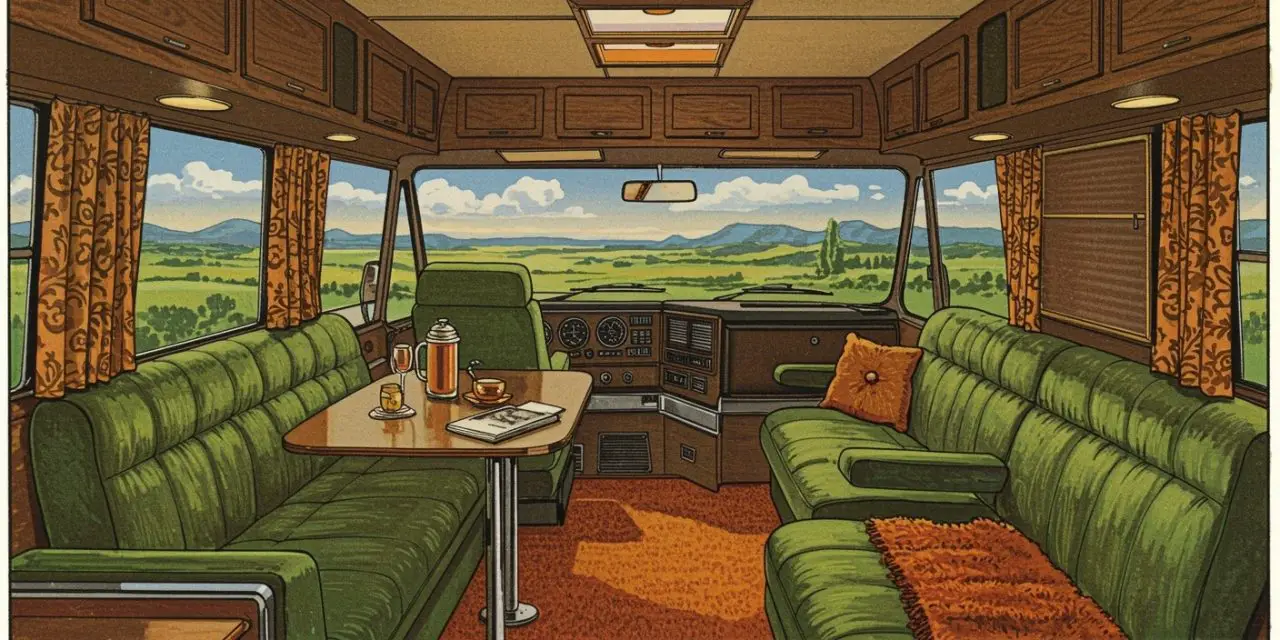
The 1970s was a decade of innovation and forward-thinking design, especially in the recreational vehicle industry. Among the crowded field of boxy, truck-based RVs, one particular model stood out like a futuristic time traveler: the GMC Motorhome.
Built from 1973 to 1978, this revolutionary vehicle wasn’t just another camper—it was a bold statement from General Motors, America’s largest automaker. What made the GMC Motorhome special was that it was designed and manufactured entirely in-house by GM, the only time a major car company committed to producing a complete motorhome under its own engineering and design teams. With its sleek, aerodynamic profile, panoramic windows, and technology that was decades ahead of its competitors, this iconic RV continues to captivate enthusiasts even today.
Let’s explore the seven incredible features that made the GMC Motorhome a vehicle that truly belonged to the future.
1. Revolutionary Front-Wheel Drive System
The GMC Motorhome featured a front-wheel drive system borrowed from the Oldsmobile Toronado, a personal luxury car introduced by GM in 1966. This innovative drivetrain included a longitudinally mounted 455 cubic inch (7.5L) Rocket V8 engine paired with a Turbo Hydramatic 425 automatic transmission, delivering power directly to the front wheels.
This engineering decision eliminated the need for a traditional drive shaft and rear differential, allowing for a completely flat floor throughout the cabin and a lower center of gravity. The absence of a rear drivetrain made the vehicle more stable and improved handling significantly compared to traditional motorhomes.
The Numbers:
- Engine: 455 cubic inch (7.5L) Rocket V8
- Transmission: 3-speed Turbo Hydramatic 425 automatic
- Configuration: Front-wheel drive
I bet the engineer who pitched this idea got a lot of “You want to put WHAT in a motorhome?” looks in the GM boardroom. Imagine explaining to the old-school truck guys that you’re building an RV with a luxury car’s drivetrain. Bold move, GM, bold move!
2. Aircraft-Inspired Body Construction
The body of the GMC Motorhome was built using a technique more common in aircraft and high-end sports cars than recreational vehicles. The exterior featured fiberglass reinforced plastic panels bonded to an aluminum frame, creating a smooth, aerodynamic shape that stood in stark contrast to the boxy designs of traditional RVs.
This innovative construction method not only gave the motorhome its distinctive futuristic appearance but also provided significant practical benefits:
- Reduced overall weight
- Improved fuel efficiency
- Enhanced aerodynamics
- Superior durability and corrosion resistance
- Lower center of gravity for better handling
What’s truly impressive is that this construction method remains advanced even by today’s standards, with many modern premium RVs only now adopting similar lightweight composite materials.
If this RV were a person, it would be that one friend who showed up to the 1973 disco in what everyone else would be wearing in 1990. Meanwhile, other RVs were basically wooden crates on wheels. Talk about fashion-forward!
3. Unique Tandem Rear Wheel Air Suspension
While most RVs of the era used traditional leaf spring suspensions, the GMC Motorhome featured a sophisticated air suspension system for its four rear wheels. This design was adapted from GM’s city buses and provided several advantages:
- Independent swing arm suspension with airbags for the rear wheels
- Automatic load-leveling capability to maintain consistent ride height
- Significantly smoother ride quality over varying road surfaces
- Better weight distribution and stability
The six-wheel configuration (two front, four rear in tandem pairs) allowed the motorhome to maintain a smoother, more controlled ride that was often compared to a large passenger car rather than a typical motorhome.
GMC Motorhome vs. Standard 1970s RVs:
| Feature | GMC Motorhome | Standard 1970s RVs |
|---|---|---|
| Suspension | Air suspension with independent rear wheels | Leaf springs on solid axles |
| Ride Quality | Car-like smoothness | Truck-like bouncing |
| Height Adjustment | Automatic leveling | Manual stabilizers |
| Road Handling | Stable with minimal body roll | Top-heavy with significant sway |
The first time someone rode in one of these, they probably checked to make sure they were actually in an RV and not accidentally boarding a luxury cruise ship. “Wa