
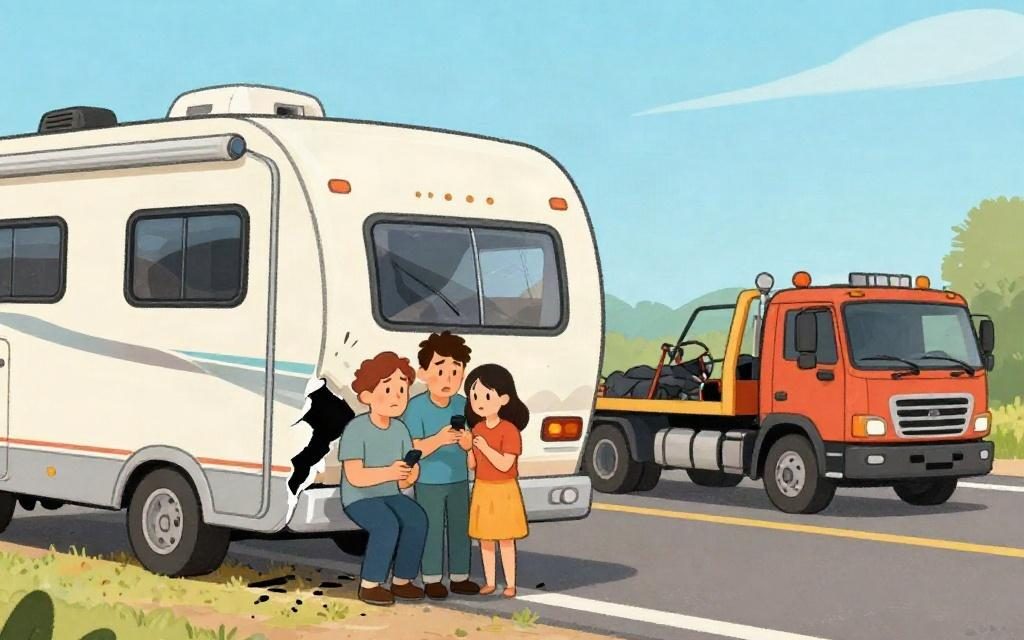
Ever found yourself stranded on the side of a highway, waiting for roadside assistance to arrive, wondering if they forgot about you? You’re not alone. Thousands of RVers face this frustrating scenario every year, and the wait times can feel endless. But what’s really happening behind the scenes after you make that desperate call for help?
Jerry Aldridge, the founder of Coach-Net, pulls back the curtain on the RV roadside assistance industry to reveal why getting help for your rig isn’t as simple as calling a tow truck for your car. Spoiler alert: Your RV is basically a circus elephant, and finding someone who knows how to handle it takes special skills, special equipment, and yes, special time.
In this article, we’re diving into the surprising realities that every RVer needs to understand before they break down miles from home.
Would you like to save this article?
1. Your RV Is A “Circus Elephant” – And Most Dispatchers Have No Idea What To Do With It
Here’s the reality that’ll make you rethink everything: 95% of roadside assistance calls are for regular automobiles. When your 40-foot fifth wheel or Class A motorhome needs help, it’s a complete anomaly to most dispatch centers.
According to Jerry Aldridge, who started Coach-Net at just 27 years old back in 1986, the typical dispatcher handles cars all day long. Then your call comes in, and suddenly they’re dealing with a specialized vehicle that requires completely different equipment, knowledge, and expertise.
Think about it this way: you wouldn’t call a veterinarian who only treats house cats to help with an elephant, right? The same principle applies here. Your RV has unique components – Cummins engines, Allison transmissions, Rockwell axles, specialized hydraulic systems – that require technicians who actually understand them.
If you thought any old tow truck could handle your rig, think again. The average dispatcher’s database is built for sedans and SUVs, not 14,000-pound homes on wheels. That’s why your wait time is longer than your neighbor’s who just needed a jump start for their Honda.
2. The “Specialized Equipment” They Need Isn’t Just Sitting Around Waiting For Your Call
Here’s what nobody tells you about RV towing: the equipment needed to safely move your rig costs a fortune, and tow companies can’t afford to have multiple specialized units sitting idle.
When you break down in New Orleans and need to get to a Cummins warranty station, the dispatch center has to locate a tow truck with the specific capabilities to handle your particular RV. We’re not talking about the standard flatbed that picks up your neighbor’s sedan.
These specialized rigs are super expensive investments for towing companies. If they had too many sitting around unused, they’d go out of business. So yes, you might have to wait 45 minutes to an hour and a half for the right equipment to become available, then another 45 minutes for it to actually reach you.
But here’s the alternative: Some companies will send any tow truck just to say they got someone there in 45 minutes. Sounds great, right? Wrong. That truck shows up, looks at your 40-foot diesel pusher, and has absolutely no way to safely move it. Now you’re still stranded, still frustrated, and you’ve wasted another hour.
You don’t want speed. You want the RIGHT truck. Even if it takes longer.
3. Most Roadside Services Have Become A “Commodity” – And You Definitely Get What You Pay For
Remember when customer service actually meant talking to a knowledgeable human being? Those days are fading fast in the roadside assistance world.
Jerry Aldridge reveals that the industry has shifted dramatically toward becoming a commodity service. Many companies now use AI-driven systems instead of trained technicians who understand RVs. You might not even speak to a real person who knows the difference between a fifth wheel and a travel trailer.
Back when Coach-Net was being built, they did something radical: they trained their staff. Winnebago would literally bring motorhomes to their facility and leave them for months while employees learned every system. Staff members were sent to Fleetwood, Thor, and other manufacturers to understand new products inside and out.
This meant that when you called, the person on the phone could tell you, “No, Mike, that clicking sound your furnace makes before it ignites is totally normal.” They could save you from an expensive and unnecessary service call because they actually knew your RV.
Today? It’s become about price shopping. The cheapest service wins, and specialized knowledge gets sacrificed at the altar of affordability. As Jerry bluntly states, “I firmly believe that you get what you pay for.”
4. The Biggest Misconception: It’s Not About Finding A Tow Truck – It’s About Finding The Right Tow Truck
Let’s bust the myth right now: the delay isn’t because nobody cares about you. The delay is because identifying the proper specialized equipment to safely tow your specific vehicle takes time.
This is the number one misconception according to Jerry Aldridge, who built an entire company around solving this exact problem. When you’re in Sapulpa, Oklahoma with a dead battery, sure, a regular service truck can jump-start you quickly. But when your engine fails? That’s a completely different story.
The dispatch center has to ask critical questions:
- What type of RV do you have?
- How much does it weigh?
- What’s the wheelbase?
- Does it have slide-outs extended?
- What kind of hitch system does it use?
Each answer narrows down which towing companies in the area have the capability to help. Then they have to confirm that company has insurance, will accept the service contract as payment, and most importantly, has the right equipment available RIGHT NOW.
Other companies will brag about their 45-minute response times. But if that response is a truck that can’t actually do anything for you, what’s the point? It’s not about speed. It’s about solving your problem safely.
5. Technical Expertise Is The Secret Weapon Most Services Don’t Have (But Should)
Here’s something that’ll change how you choose a roadside assistance plan: the majority of calls to specialized RV services aren’t even for towing.
When Coach-Net was in its heyday under Jerry’s leadership, they had ASE-certified technicians, Cummins experts, Allison transmission specialists, and technicians who understood every component – from Thetford toilets to Coleman air conditioners to Massey Ferguson hydraulic pumps.
This meant that many “emergencies” could be solved over the phone. A brand-new RV owner panicking because their furnace made a weird noise before igniting? That’s normal. Someone worried about their refrigerator sounds? Also normal. A knowledgeable tech could talk you through it and save you hours of waiting and hundreds of dollars in service fees.
But here’s the kicker: this level of technical support requires companies to invest in training and expertise. They need to bring in actual RVs for training. They need to send staff to manufacturer facilities. They need to hire people who understand the difference between a diesel pusher and a gas Class C.
Most modern “vanilla” services skip all that. They’re marketing companies that outsource the actual work. You’re getting 90% generic automobile service applied to your specialized RV. And that’s why you end up frustrated, waiting, and wondering why nobody seems to understand your problem.
6. Dead Batteries Are Your Most Common Enemy (Not Engine Failures)
Surprise! The most common roadside assistance call for RVs isn’t a catastrophic engine failure or a blown tire. It’s something much simpler: dead batteries needing a jump start.
This might seem anticlimactic after all the talk about specialized equipment and circus elephants, but it reveals an important truth: most RV emergencies are preventable with basic maintenance.
RVs have complex electrical systems – house batteries, chassis batteries, solar panels, inverters, converters – and it’s easy for something to drain them without you realizing it. Maybe you left a light on, or the refrigerator stayed in 12V mode overnight, or a parasitic draw you didn’t know about slowly killed your battery bank.
The good news? A jump start is one of the easier services to provide. You don’t need that specialized heavy-duty towing equipment. A standard service truck can handle it.
But here’s the lesson: if you maintain your batteries properly, check connections regularly, and understand your RV’s electrical system, you can avoid being that statistic. Carry a portable jump starter, keep your batteries charged, and you might never need to make that call at all.
7. If You’re Buying From A “Marketing Company,” You’re Getting Vanilla Service – Not Specialized RV Care
Here’s the insider secret that could save you thousands of dollars and hours of frustration: not all roadside assistance memberships are created equal, and some aren’t even provided by the company whose name is on the card.
Jerry Aldridge drops this truth bomb: if you buy a roadside assistance program from someone at a rally who’s selling hats and memberships, and they’re not the ones actually providing the service, you’re going to get whatever generic, “90% vanilla service” their contracted provider delivers.
Think about it: You signed up with “Bob’s RV Club” at a rally. Bob’s company is really just a marketing operation. When you break down, Bob’s company calls their contracted service provider, who handles mostly automobiles, and that’s who dispatches help to you.
You’re three layers removed from anyone who actually understands RVs. No wonder you’re waiting forever and getting frustrated.
Compare that to a company like Coach-Net, which was built from the ground up specifically for RVs. They contracted directly with towing companies, verified their equipment and insurance, built relationships with RV-specific repair facilities, and trained their own staff on RV systems.
The difference? One is a company that happens to offer RV service. The other is an RV service company. The distinction matters enormously when you’re stranded on the side of the road at 9 PM on a Saturday night.
The Bottom Line: Set Realistic Expectations And Choose Your Provider Wisely
The truth about RV roadside assistance is simple: it’s complicated. Your RV isn’t a car, the equipment needed to help you is specialized and expensive, and the expertise required to diagnose and solve problems takes real training and investment.
Everybody’s upset when they break down. It’s always a bad day. But understanding what’s happening behind the scenes can help you set realistic expectations and choose a service provider who actually has the knowledge, equipment, and commitment to help you properly.
As Jerry Aldridge reminds us: you’re not dealing with a commodity. You’re dealing with a circus elephant. And finding someone who knows how to handle that elephant safely takes time – but it’s worth the wait.
SOURCES:
RV Lifestyle Podcast – Episode 636: “Why RV Roadside Help Can Take So Long” featuring Jerry Aldridge, founder of Coach-Net
https://www.youtube.com/watch?v=JyEhcin7cAI
RV Podcast Official Website – Complete Show Notes
https://RVPodcast.com
The Road To Coach Net (Book) by Jerry Aldridge
https://amzn.to/3SeIfBk
RV Lifestyle Maintenance Tracker
https://RVLifestyle.com/Maintenance
RV Lifestyle Official Website
https://rvlifestyle.com/plan


