
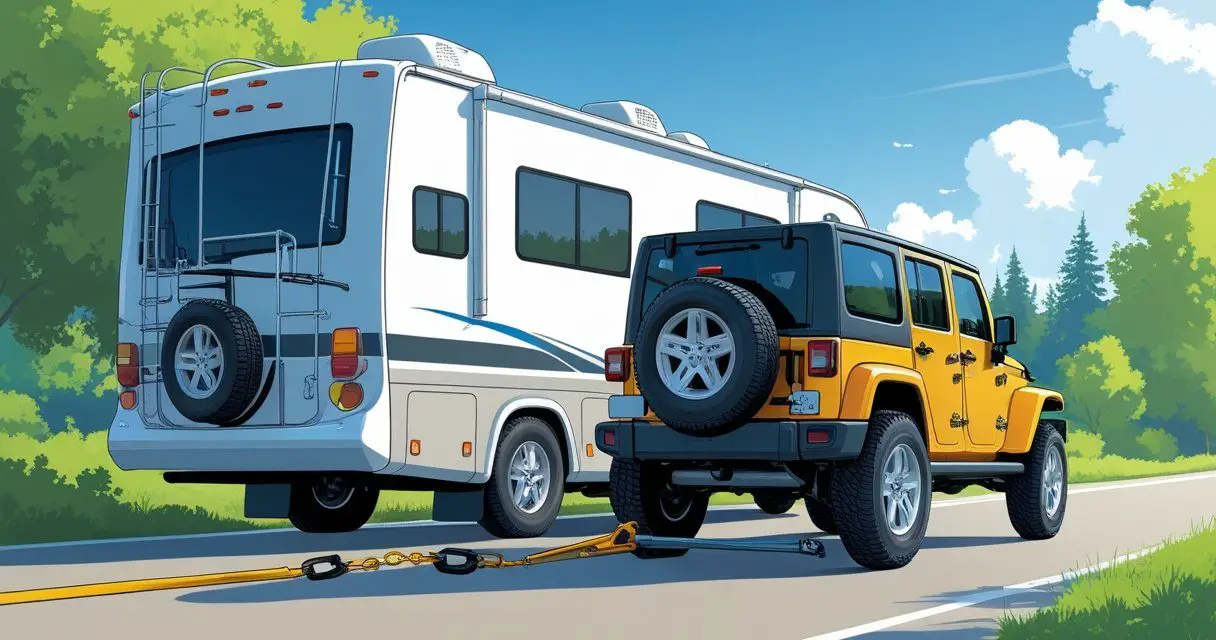
If you travel by RV, bringing a Jeep along can make every stop more flexible and fun. You don’t need to worry about being stuck at the campsite when you want to explore nearby trails, towns, or parks.
Yes, you can tow many Jeep models behind an RV, but only if they are properly equipped and set up for flat towing.
Not every Jeep is tow-ready, so you need to confirm your model and transmission allow it. Some Jeeps, like the Wrangler and Gladiator, are designed for this purpose with a transfer case that can shift into neutral.
With the right tow bar, base plates, and safety gear, you can connect your Jeep to your RV and be on the road in minutes. Flat towing offers a simple way to bring your Jeep without the hassle of a trailer, but it requires the correct equipment and setup to stay safe and legal.
Key Takeaways
- Many Jeep models can be towed behind an RV if properly equipped
- The right equipment and setup are required for safe towing
- Knowing the correct steps prevents damage and ensures smooth travel
Can I Tow a Jeep Behind My RV?
You can tow certain Jeep models behind an RV, but not every model is built for it. The method you use, along with weight limits and manufacturer rules, determines whether your setup is safe and legal.
Which Jeep Models Are Towable
Not all Jeeps can be flat towed (also called dinghy towing).
Towable models include:
- Jeep Wrangler (all trims, manual or automatic)
- Jeep Gladiator (with proper setup)
- Jeep Patriot 4×4 models
- Jeep Liberty (4WD, or 2WD with driveshaft removed)
- Some Jeep Grand Cherokee trims with Quadra-Trac I, II, or Quadra-Drive II
- Some Jeep Cherokee trims with Active Drive II
Models like the Jeep Compass and Jeep Renegade cannot be safely flat towed because of their drivetrain and transmission design.
When choosing a Jeep to tow, always compare its curb weight to your RV’s towing capacity. Many Class C RVs max out around 5,000 lbs, which may rule out heavier trims of the Gladiator or Grand Cherokee.
Flat Towing Versus Other Towing Methods
Flat towing means all four wheels stay on the ground. This method is simple and popular for Jeeps like the Wrangler because of their transfer case design that allows the drivetrain to disengage.
Other options include:
- Tow dolly: Lifts the front wheels off the ground. Works best for front-wheel-drive vehicles, not most Jeeps.
- Flatbed trailer: Carries the entire Jeep on a platform. This adds trailer weight, which counts against your RV’s towing limit.
Flat towing is lighter and quicker to set up, but it only works on models engineered for it. If your Jeep isn’t approved for flat towing, you’ll need a dolly or trailer to avoid drivetrain damage.
Manufacturer Guidelines and Restrictions
You must follow the instructions in your Jeep’s owner’s manual before towing. Manufacturers outline exact steps such as shifting the transfer case into Neutral (N) and placing the transmission in Park or Gear, depending on the model.
If you ignore these directions, you risk damaging the transmission or voiding the warranty. For example, the Jeep Gladiator and Grand Cherokee require very specific flat towing procedures.
Always check:
- Weight ratings (RV tow limit vs. Jeep curb weight)
- Transfer case requirements
- Warranty notes on towing practices
By sticking to the manufacturer’s rules, you protect both your RV and your Jeep from costly mistakes.
Towing Methods for Jeeps
You can move your Jeep behind an RV in three main ways. Each method has its own equipment needs, setup process, and impact on cost, convenience, and safety.
Flat Towing (Dinghy Towing)
Flat towing, also called dinghy towing or four-down towing, keeps all four of your Jeep’s wheels on the ground. This method is popular because many Jeep models, like the Wrangler, are designed to handle it without major modifications.
To use this method, you need a tow bar, base plates, safety cables, and a supplemental braking system. Wiring is also required so your Jeep’s lights work in sync with your RV.
Flat towing is quick to hook up and doesn’t require hauling a trailer. It also saves storage space at campsites.
However, not every Jeep trim or transmission type can be flat towed, so you must check your owner’s manual for instructions.
Using a Tow Dolly
A tow dolly lifts the front wheels of your Jeep off the ground while the rear wheels roll freely. This method works best if your Jeep cannot be flat towed or if you want to avoid adding base plates and other hardware.
The dolly itself is a separate piece of equipment you must own or rent. You’ll also need tie-down straps to secure the front wheels.
Many states require brake lights and safety chains on the dolly for legal use. While a tow dolly can be more flexible for different vehicles, it adds weight and takes up extra space when not in use.
Loading and unloading can also take more time compared to flat towing.
Trailer Towing With a Flatbed
A flatbed trailer carries your Jeep with all four wheels completely off the ground. This method works for any Jeep model, regardless of drivetrain or transmission, since the vehicle doesn’t roll during transport.
Flatbed trailers provide the most protection for your Jeep’s drivetrain and tires. You secure the Jeep using wheel straps or chains, and some trailers include built-in ramps for easier loading.
The trade-off is the added size and weight. A flatbed trailer requires more storage space, increases fuel use, and may need a larger RV with higher towing capacity.
Still, it’s the most universal and secure method if your Jeep cannot be flat towed or dolly towed.
Essential Equipment for Towing
When you set up your Jeep for towing behind an RV, you need reliable components that connect the two vehicles, keep them secure, and ensure safe braking. The main items include the connection hardware, backup safety links, and a braking system that works in sync with your RV.
Tow Bars and Base Plates
The tow bar is the main link between your RV and Jeep. It locks into place on both vehicles and carries the pulling force.
A high-quality tow bar should match your Jeep’s weight rating and be easy to connect and disconnect. Base plates mount directly to your Jeep’s frame and provide the secure attachment points for the tow bar.
They are vehicle-specific, so you need the correct set for your Wrangler, Gladiator, or other model. Professional installation is often recommended because base plates must be aligned and bolted tightly to the frame.
Once installed, they provide a strong and stable foundation for towing.
Key tips:
- Choose a tow bar rated above your Jeep’s curb weight.
- Verify compatibility between the tow bar and base plates.
- Inspect mounting bolts for tightness before every trip.
Safety Cables and Chains
Safety cables or chains act as a backup if the tow bar disconnects. They keep your Jeep attached to the RV long enough for you to stop safely.
Cables usually have a spring-like coil design to prevent dragging. Chains are heavier but equally effective.
Both should cross under the tow bar when connected, which helps keep the Jeep aligned if a failure occurs. Check the break strength rating of your cables.
For most Jeeps, a minimum of 7,500 lbs is recommended. Always replace frayed or kinked cables.
Checklist for cables and chains:
- Cross them under the tow bar.
- Use quick-link connectors rated for towing.
- Inspect for wear before every trip.
Braking Systems and Controllers
A supplemental braking system reduces stopping distance and stress on your RV’s brakes. It applies the Jeep’s brakes in proportion to the RV’s braking force.
Portable systems like pedal-mounted units are easy to set up, while permanently installed systems tie directly into the Jeep’s vacuum and brake lines. Both types require a power source, often the Jeep’s battery.
Some systems use a brake controller in the RV to regulate braking force. This ensures smoother stops