
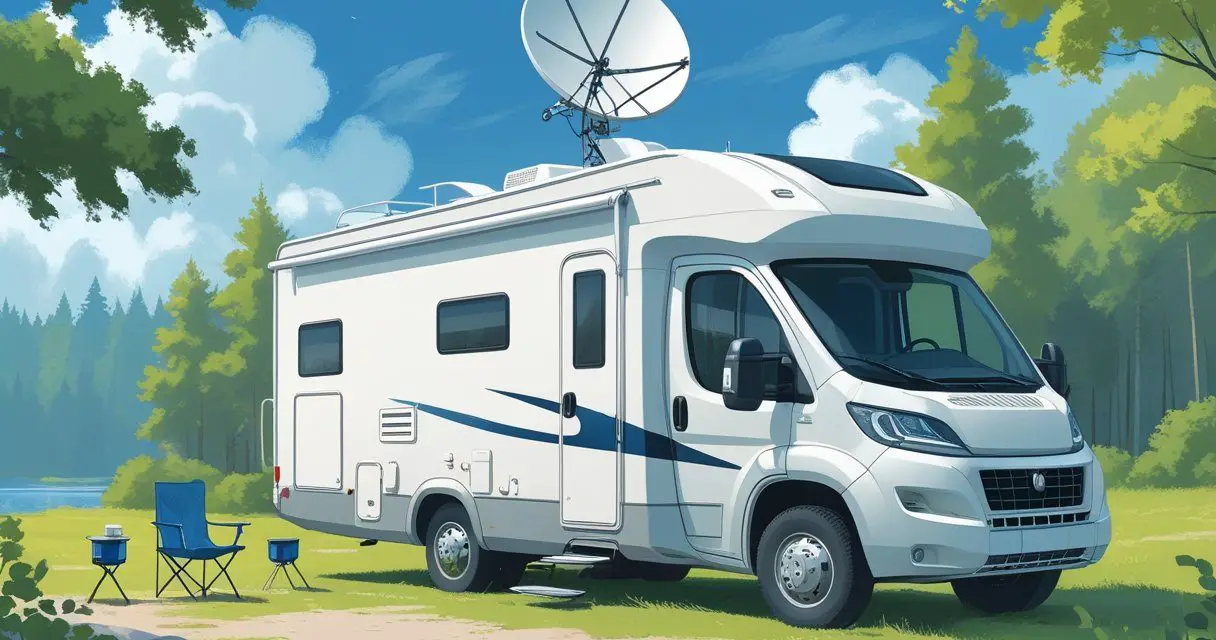
Traveling in an RV doesn’t mean giving up your favorite shows or live TV. You can bring DISH Network along with you, but it requires the right setup.
Yes, you can use DISH Network in your RV, but you’ll need compatible equipment and the correct service plan to make it work smoothly.
You can move a home receiver into your RV, but it isn’t always practical since service is tied to your home address. A better option is a DISH mobile receiver with a compatible satellite antenna, which gives you flexibility and reliable coverage across the lower 48 states.
Pay-as-you-go plans also make it easy to activate service only when you travel.
With the right equipment, you can watch live TV, record shows, or even stream apps like Netflix on certain receivers.
Whether you want a permanent setup or a portable antenna you can move around, DISH offers options that fit different travel styles and budgets.
Key Takeaways
- You can use DISH Network in an RV with the right receiver and antenna.
- Service plans allow flexible options, including pay-as-you-go.
- Setup and coverage depend on equipment choice and location.
Can I Use Dish Network in My RV?
You can use Dish Network while traveling in your RV, but the setup and service depend on the equipment you choose and how you plan to connect.
Some people move their home receiver into the RV, while others use pay-as-you-go RV service designed for mobile use.
How Dish Network Works for RVs
Dish Network offers satellite TV that works through a receiver and a satellite dish.
In an RV, you need a portable or roof-mounted satellite antenna that can lock onto the signal.
Options include manual tripod dishes or automatic tracking antennas.
With Dish’s Pay-As-You-Go program, you only pay for months you use the service.
This is helpful if you only travel part of the year.
You can stop and restart service without extra fees.
If you want to watch TV while driving, you need an in-motion satellite antenna.
These cost more but allow continuous viewing on the road.
For parked use, a stationary antenna is usually enough and more affordable.
Dish receivers like the Wally or 211k are commonly used in RV setups.
They are lightweight, easy to connect, and can support DVR functions with an external hard drive.
Differences Between Home and RV Use
At home, your Dish receiver is tied to your service address.
This determines which local channels you receive.
In an RV, if you move to a new region, your local stations may not match your current location.
To see local channels while traveling, you can:
- Use an over-the-air antenna for local stations.
- Update your service address with Dish when you change locations.
- Add distant networks if eligible through a pay-as-you-go RV account.
Another difference is equipment.
Home systems often use the Hopper DVR, but this device is not always compatible with RV antennas.
Smaller receivers like the Wally are better suited for mobile use.
You may also need multiple receivers if you want service on more than one TV in your RV.
Some antennas support this, but not all.
Eligibility and Requirements
To use Dish Network in your RV, you need a compatible satellite antenna and receiver.
Portable antennas such as the Winegard or King models are popular choices.
Roof-mounted antennas provide convenience but usually cost more.
If you already have Dish at home, you can add an RV receiver to your account for a small monthly fee.
This lets you use the same programming package in your RV.
If you prefer flexibility, you can open a separate Pay-As-You-Go RV account.
This is often the better option if you don’t want to change your home service address each time you travel.
For DVR service, you can connect an external hard drive to certain RV receivers.
This requires a one-time activation fee but no ongoing monthly charges.
Your setup must also have a clear line of sight to the southern sky.
Trees, tall buildings, or mountains can block the satellite signal, so parking location matters.
Equipment Needed for Dish Network in an RV
To use Dish Network in your RV, you need the right mix of satellite equipment and a compatible receiver.
The setup depends on whether you want a portable antenna, a roof-mounted system, or a dome-style unit that can track satellites while you drive.
RV-Specific Satellite Antennas
You cannot use a standard home satellite dish in most RV setups.
RV-specific antennas are designed to be smaller, easier to set up, and able to handle frequent movement.
Common RV antennas include:
- Winegard Playmaker
- Dish Tailgater
- Pathway X2
These antennas are built to lock onto Dish satellites and give you access to the same programming you get at home.
Many are plug-and-play, requiring only a coax cable connection and a clear view of the southern sky.
Some models support multiple TVs, while others are single-TV units.
You should check compatibility with your Dish receiver before purchasing.
Portable vs. Mounted Antennas
Portable antennas sit on the ground outside your RV and can be moved to find the best line of sight.
They are ideal if you often camp in wooded areas where trees block the signal.
Roof-mounted antennas are permanently installed on your RV.
They save space and are easier to use since you don’t need to place them each time you park.
Key differences: