
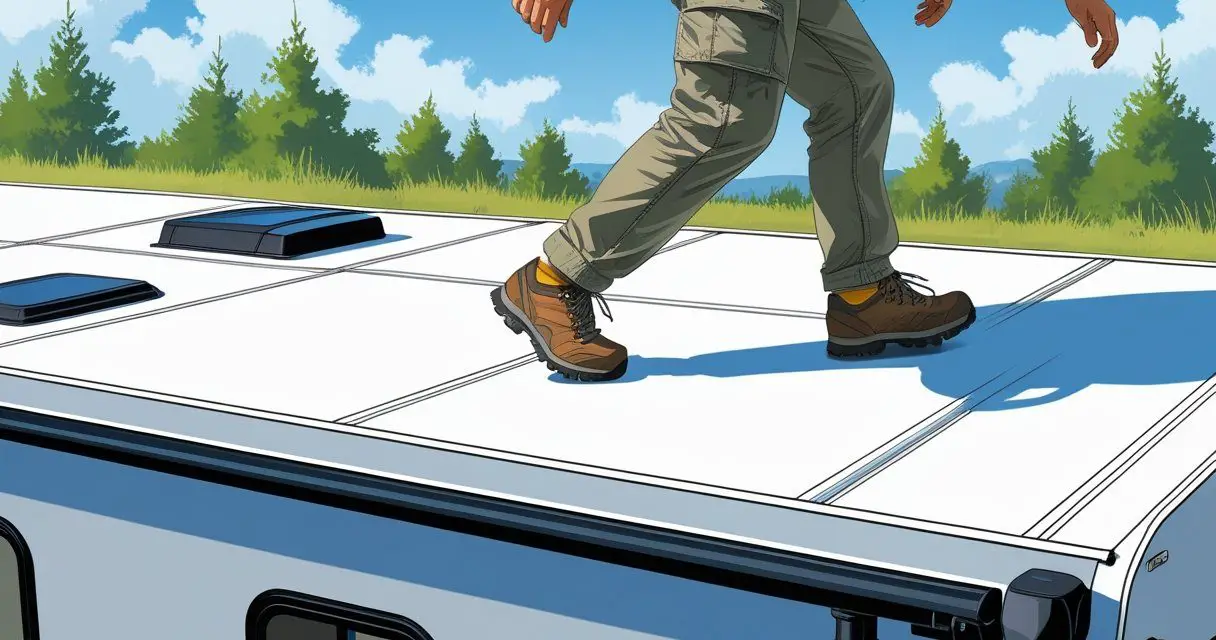
Walking on your Keystone RV roof isn’t always as simple as climbing up and stepping across. Some models are built to handle light foot traffic for cleaning and inspections, while others are not designed for it at all.
Whether you can safely walk on your roof depends on the specific model and how it was constructed.
You need to know what type of roof your Keystone RV has before taking that step. Fiberglass roofs often provide better support, while certain wood or metal frame designs may only handle limited weight.
Ignoring these differences can lead to costly damage or even personal injury. Understanding where you can safely step and how to move across the surface makes all the difference.
With the right knowledge, you can handle inspections, maintenance, and cleaning without risking damage to your RV or yourself.
Key Takeaways
- Know your RV roof type before stepping on it
- Walk only when the roof design supports foot traffic
- Use safe techniques to protect both you and the roof
Determining If Your Keystone RV Roof Is Walkable
Not every Keystone RV roof is designed to hold a person’s weight. The ability to walk on it depends on the roof’s construction, the presence of support features, and the manufacturer’s stated guidelines.
Manufacturer Guidelines and Weight Limits
The most reliable way to know if your Keystone RV roof is walkable is to check the manufacturer’s documentation. Keystone provides weight ratings for many of its models, and these limits vary based on roof design.
Some are rated for a single adult, while others are labeled no-walk roofs. Most RV roofs support around 200–250 pounds, but this is not universal.
Your exact model may have a different limit. If you exceed the rating, you risk structural damage or voiding your warranty.
When in doubt, call Keystone directly with your model information. Ask for the roof’s maximum load capacity and whether it is intended for foot traffic.
Identifying Factory-Installed Roof Ladders
A simple way to check if your Keystone RV roof is walkable is to look for a factory-installed ladder. Keystone typically installs ladders only on models with roofs designed to support weight.
If your RV has a ladder attached at the rear, it usually means the roof can handle at least one adult for maintenance tasks. However, this does not mean unlimited use or heavy loads are safe.
If no ladder is present, the roof may not be designed for walking. In that case, you should avoid climbing up unless you use plywood or planks to distribute your weight and reduce stress on the roof panels.
Model Variations and VIN Inquiry
Keystone builds many different RV models, and not all share the same roof construction. For example, some Passport units have no-walk roofs, while larger fifth wheels may include reinforced structures.
Because of these differences, you should use your VIN (Vehicle Identification Number) when contacting Keystone. The VIN allows the company to identify the exact build of your RV, including the roof type and its walkability rating.
This step is especially important if you bought your RV used or do not have the original owner’s manual. It provides a direct answer about whether your specific roof can safely support you.
Understanding Keystone RV Roof Construction
The design of your Keystone RV roof affects how much weight it can handle, how long it lasts, and whether it is safe for you to walk on it. The type of roofing material, the support structure underneath, and the way the roof is built all play an important role.
Common Roof Materials Used in Keystone RVs
Keystone RVs often use TPO (Thermoplastic Olefin) or EPDM (Ethylene Propylene Diene Monomer) membranes. These are flexible rubber-like materials that protect the roof from water and UV damage.
Both require routine inspection and resealing around seams and vents. Some higher-end Keystone models feature a fiberglass RV roof.
Fiberglass is more rigid and durable than TPO or EPDM. It usually resists punctures better and can handle light foot traffic more reliably.
However, fiberglass can still crack if stressed by heavy weight or sharp impacts. Another factor is the thickness of the roof decking under the membrane.
Even when the material itself is strong, a thin or weak deck may not support your weight. This is why the same roofing surface can behave differently depending on the model.
Structural Support and Roof Decking
Beneath the roof membrane, Keystone RVs use either wood framing or metal framing. Wood framing often consists of 1×1 or 2×2 rafters, while metal framing uses lightweight steel trusses.
The spacing between these supports determines how much weight the roof can hold. The decking material, usually plywood or OSB (Oriented Strand Board), is fastened to the frame.
Thicker decking provides a sturdier surface, while thin panels may flex under pressure. You should also consider how the decking is attached—glued and stapled panels may not be as strong as screwed or reinforced panels.
If you notice sagging or soft spots when pressing on the roof, the support structure may already be weakened. In that case, walking on it could cause damage or even collapse.
Differences Between Walkable and Non-Walkable Roofs
Not every Keystone RV roof is designed to be walked on. Walkable roofs typically have closely spaced rafters, thicker decking, and stronger membranes like fiberglass.
These designs allow you to safely access the roof for cleaning or maintenance. Non-walkable roofs often use lighter framing and thinner decking.
While they can support mounted equipment such as air conditioners or solar panels, they are not intended to hold the full weight of an adult. Walking on them may cause cracks, punctures, or structural failure.
A quick way to check is to review your owner’s manual or contact Keystone with your VIN. This gives you exact details about the roof’s construction and its rated weight capacity.
Types of RV Roof Materials and Their Walkability
Different RV roof materials handle weight and foot traffic in different ways. The strength of the surface, the type of support underneath, and how the roof is maintained all affect whether you can safely walk on it.
Fiberglass RV Roof Strengths and Weaknesses
A fiberglass RV roof is usually one of the most durable options. Fiberglass is molded into a solid sheet, which gives it fewer seams and a smoother surface.
This reduces the risk of leaks and makes it easier to clean. You can often walk on fiberglass roofs because they distribute weight more evenly.
Many higher-end Keystone RV models use this type for its strength. Still, you should confirm the roof’s weight rating since not all fiberglass builds are the same.
The main drawback is weight and cost. Fiberglass is heavier than other materials, which can add to overall RV weight.
Repairs can also be more expensive if cracks form. If you choose to walk on it, wear shoes with good grip and avoid standing near edges where support is