
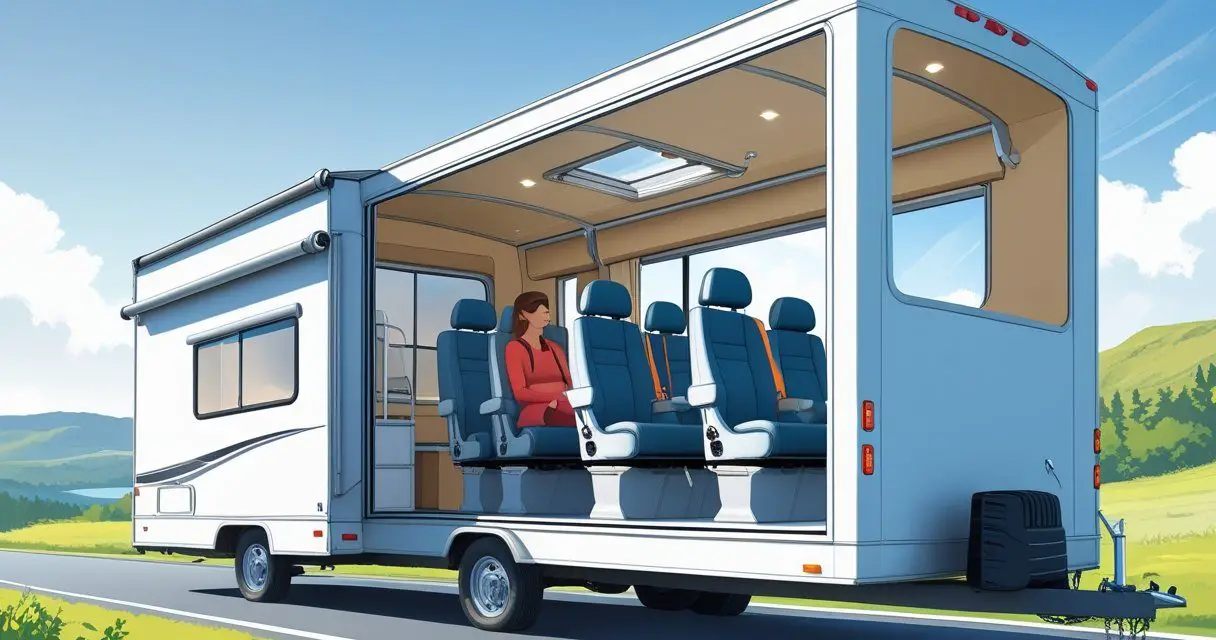
Riding in an RV trailer might sound like a convenient way to travel, but the answer isn’t as simple as yes or no. In most states, you cannot legally ride in a travel trailer while it’s being towed, and even where it is allowed, strict rules and safety concerns apply.
Knowing the laws before you head out can save you from fines, accidents, and unnecessary risks.
You’ll find that some states do allow passengers inside certain types of trailers, but requirements vary. In some places, the trailer must have proper safety features like seat belts or communication systems with the driver.
Even if it’s legal, many experts warn that trailers are not built to protect passengers in a crash or sudden stop.
Key Takeaways
- Laws on riding in RV trailers vary by state
- Safety risks exist even when it is legal
- Safer travel options are usually recommended
Is It Legal for Passengers to Ride in an RV Trailer?
Whether passengers can ride inside a moving RV trailer depends on the type of trailer, the state you are traveling in, and the safety requirements that apply. There are no broad federal rules, but many states set their own laws that separate travel trailers, fifth wheels, and truck campers.
Federal Laws and Regulations
At the federal level, there are no laws that directly allow or ban passengers from riding in a travel trailer, fifth wheel, or truck camper while being towed. The federal government mainly regulates vehicle safety standards, such as manufacturing requirements, lighting, and braking systems.
That means the decision about whether you can ride in a trailer is left to individual states. Federal rules only step in when it comes to highway safety standards for vehicles in general, not passenger rules inside trailers.
Because of this, you must look at state-specific laws before assuming it is legal. For example, what may be acceptable in Arizona may not be legal in Ohio.
When crossing state lines, the new state’s rules apply immediately, even if you were legal in the previous state.
State-by-State Legal Differences
State laws vary widely, and this is where most confusion comes in. Some states allow riding in travel trailers, while others restrict it to fifth wheels or truck campers only.
A few states ban riding in towable RVs altogether.
Here are examples of states that permit passengers in some form of trailer:
- Arizona, Indiana, Iowa, Kansas, Maryland, Michigan, Minnesota, Missouri, Nebraska, North Carolina – allow riding in travel trailers.
- California, Montana, New York, Oregon, Pennsylvania, Wisconsin – allow riding only in fifth wheels.
Even in states that permit it, there are often conditions. You may need safety glass windows, an open exit, or a two-way communication system between the driver and passengers.
Age restrictions may also apply in certain states.
Because laws change, you should always confirm the current rules with the state’s Department of Motor Vehicles or highway patrol before traveling.
Travel Trailer vs. Fifth Wheel and Truck Camper
Not all RV trailers are treated the same under the law. Travel trailers are the most restricted because they usually lack built-in safety features like seat belts or reinforced frames.
Many states prohibit riding in them for this reason.
Fifth wheels are more commonly allowed for passengers. Some states permit riding in them if safety requirements are met, such as proper windows and communication devices.
They tend to be larger and more stable than travel trailers, which is why laws are often more flexible.
Truck campers—units mounted in a pickup bed—are often legal for passengers in many states. Since they are directly attached to the truck, they are considered safer than a towed trailer.
Still, seat belt use and proper seating remain important.
When planning your trip, you need to know which category your RV falls into, since the rules are not interchangeable. A law that allows passengers in a fifth wheel does not automatically apply to a travel trailer or truck camper.
States Where Riding in a Travel Trailer Is Allowed
Some states permit passengers to ride in a travel trailer, while others only allow it under limited conditions. Rules can differ depending on whether you are in a travel trailer or a fifth wheel, and they often change once you cross into another state.
States Permitting Passengers in Travel Trailers
You can legally ride in a travel trailer in several states, but the list is not the same everywhere. States that allow it include Arizona, Indiana, Iowa, Kansas, Maryland, Michigan, Minnesota, Missouri, Nebraska, North Carolina, and Tennessee.
Other states only allow passengers in fifth wheels rather than standard travel trailers. Examples include California, Montana, New York, Oregon, Pennsylvania, South Dakota, Wisconsin, and North Dakota.
The District of Columbia also permits riding in a travel trailer. Because laws vary, you should always confirm the current rules before planning a trip.
Specific Requirements by State
Even where riding in a travel trailer is legal, states often set conditions. Some require two-way communication between the driver and passengers, usually through radios or intercoms.
Others mandate approved safety glass windows or that the trailer’s entry door remain clear and unlocked.
For example:
- California allows passengers in fifth wheels but not in standard travel trailers.
- Pennsylvania requires safety glass and communication devices.
- Oregon and South Dakota limit the rule to fifth wheels only.
Many states do not require seat belts in trailers, but installing them is strongly recommended. The laws focus on basic safety measures, not on making travel trailers as secure as passenger vehicles.
Crossing State Lines and Changing Laws
When you travel across state borders, the law of the state you enter applies immediately. If you start in Arizona, where riding in a travel trailer is legal, and drive into Colorado, where it is not, passengers must move into the tow vehicle.
Because rules differ so widely, you need to check each state’s motor vehicle code before your trip. Laws can also change over time, so relying on old information may put you at risk of breaking the law.
Planning ahead helps you avoid unexpected stops and ensures your passengers remain safe and legal while on the road.
Safety Concerns for Passengers in RV Trailers
Riding in travel trailers while they are being towed exposes you to risks that are very different from riding in a car or motorhome. These risks come from missing safety equipment, weaker crash protection, and stability problems that affect how the trailer handles on the road.
Lack of Safety Features and Seat Belts
Travel trailers are not built with the same passenger protections as standard vehicles. You will not find seat belts, airbags, or reinforced seating areas.
Without these, you have no restraint system to keep you in place during sudden stops or sharp turns.
If the tow vehicle brakes quickly, you could be thrown against walls, furniture, or other people. Even a minor swerve can cause you to lose balance and fall.
Loose items inside the trailer also create hazards. Dishes, tools, or camping gear can shift and hit you during travel.
In a car, these items are usually secured in trunks or compartments, but in trailers they are often left in open areas.
The absence of built-in safety systems means you rely only on the trailer’s basic structure, which is not designed for passenger protection.
Structural Integrity and Crash Risks
Travel trailers are lighter and less reinforced than passenger vehicles. They use thin walls and lightweight frames to reduce towing weight.
This design makes them more vulnerable in a crash.
In a collision, the trailer can crumple or separate from the tow vehicle. Unlike cars, trailers lack crumple zones, side-impact beams, or rollover protection.
You face a higher chance of serious injury if the trailer tips or collapses.
Windows in many trailers are made from standard glass, not laminated safety glass. If broken, sharp shards can cause cuts and other injuries.
Some states require safety glass and emergency exits, but not all trailers meet these standards.