
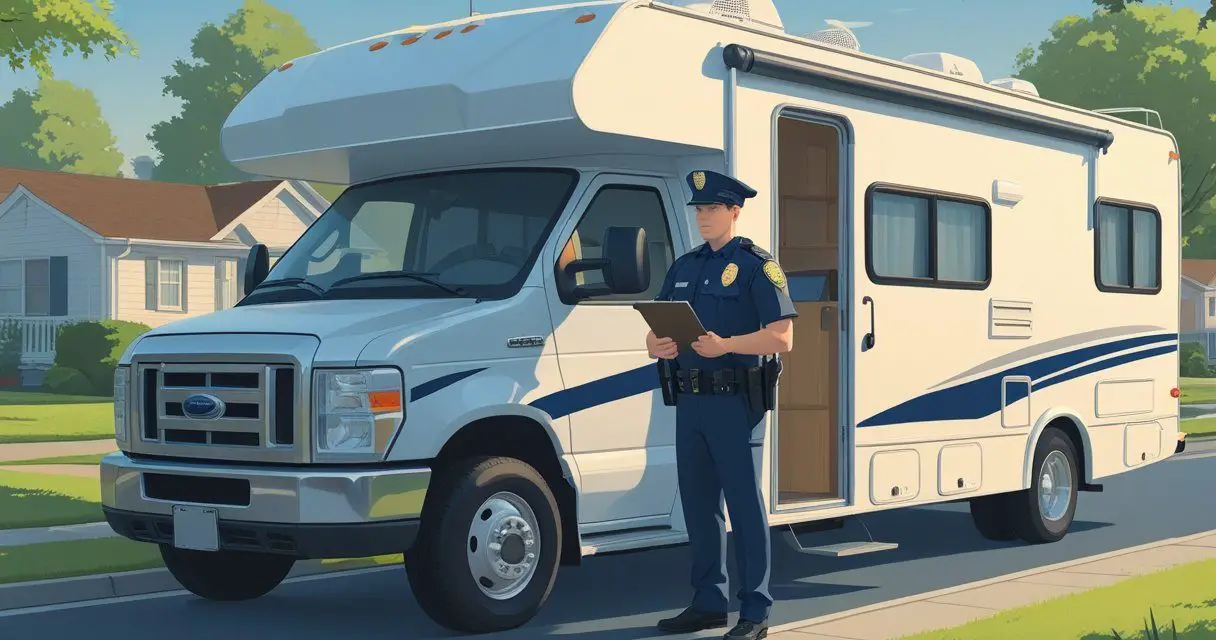
Traveling in an RV gives you freedom and flexibility, but it also raises unique legal questions. One of the most important is whether police can search your RV without a warrant.
Police can search your RV without a warrant if it is treated as a vehicle and they have probable cause. If it functions as a home, they usually need a warrant.
The difference depends on how and where you use your RV. If it’s parked on a public road and ready to drive, the law often treats it like a car.
If it’s set up at a campsite with hookups or used as a residence, the law is more likely to treat it as a home with greater privacy protections.
Key Takeaways
- RV searches depend on whether it is treated as a vehicle or a home
- Police need probable cause or an exception to search without a warrant
- How and where you use your RV affects your privacy rights
Understanding RV Searches and the Fourth Amendment
When police search an RV, the law treats it differently depending on whether it functions as a vehicle or a home. Your rights under the Fourth Amendment remain, but how they apply depends on mobility, location, and how the RV is being used.
Fourth Amendment Protections for RV Owners
The Fourth Amendment protects you from unreasonable searches and seizures. In most cases, police need a warrant supported by probable cause to search your property.
Police cannot stop and search your RV at random. They must have a valid reason, such as evidence of a crime or a lawful traffic stop.
Even then, they usually need probable cause before they can look inside without your consent.
There are a few exceptions. For example, if you give voluntary consent, officers may search without a warrant.
If something illegal is in plain view, such as drugs or weapons visible through a window, they can seize it.
A search may also follow a lawful arrest if it is limited to the area within your reach.
If police conduct an illegal search, the evidence may be excluded in court.
How RVs Are Classified Under the Law
Courts decide whether your RV is treated like a vehicle or like a home. This classification matters because vehicles fall under the “automobile exception,” which allows warrantless searches if police have probable cause.
Homes, on the other hand, usually require a warrant.
Key factors include:
| Factor | Treated as Vehicle | Treated as Home |
|---|---|---|
| Mobility | On wheels, ready to drive | On blocks, not operational |
| Location | Public road or parking lot | RV park or long-term site |
| Utilities | No hookups | Connected to water, power, sewer |
| Appearance | Looks like transport | Looks like residence (awnings, furniture) |
For example, if you park your motorhome in a public lot and it can drive away at any time, police may classify it as a vehicle. But if it is hooked up to utilities at a campground and used as a residence, it is more likely to be treated as a home.
This distinction determines whether officers can rely on the automobile exception or must first obtain a warrant.
When Can Police Search an RV Without a Warrant?
Police may search an RV without a search warrant in certain situations tied to how the RV is being used, where it is located, and whether law enforcement has legal justification. These situations often involve probable cause, voluntary consent, or urgent conditions that make waiting for a warrant impractical.
Probable Cause and the Automobile Exception
If your RV is treated as a vehicle, police may rely on the automobile exception to the warrant requirement. This rule allows officers to search a vehicle without a warrant when they have probable cause to believe it contains evidence of a crime.
Courts look at whether the RV is mobile and being used for transportation. For example, an RV parked on a public road and capable of driving away is usually considered a vehicle.
In this case, the reduced expectation of privacy in vehicles applies.
Probable cause must be based on specific facts, not just suspicion. Smelling drugs, seeing illegal weapons through a window, or observing contraband in plain view can give officers the authority to search without first getting a judge’s approval.
If your RV is stationary, connected to utilities, or set up like a home, the automobile exception may not apply.
In those cases, police usually need a search warrant unless another exception is present.
Consent to Search
Police can also search your RV if you give voluntary consent. This means you agree to let them look inside without requiring a warrant.
Consent must be clear and not the result of threats, coercion, or misleading statements.
You have the right to refuse consent. If you say no, officers must rely on another legal basis, such as probable cause, to proceed.
Simply asking to search does not give them authority by itself.
It is important to understand that once you grant consent, officers can search areas that fall within the scope of your permission. For example, if you allow them to “look around,” that could include cabinets, storage compartments, and other spaces inside the RV.
Exigent Circumstances
Another situation where a warrant is not required is when exigent circumstances exist. These are urgent conditions where waiting for a warrant might cause evidence to be destroyed, a suspect to escape, or someone’s safety to be at risk.
For instance, if officers believe evidence inside your RV is about to be destroyed, they may act immediately. Similarly, if they suspect someone inside poses a danger, they can enter without a warrant.
Exigent circumstances are narrowly applied and must be justified by the facts at the time. Courts review these situations carefully to ensure law enforcement did not bypass the search warrant requirement without a valid reason.
This exception is not based on convenience. It is only used when urgent risks make it unreasonable to delay for judicial approval.
Key Legal Precedents and Court Cases
Courts have shaped how the Fourth Amendment applies to recreational vehicles through specific rulings. These decisions explain when an RV is treated as a vehicle and when it is considered more like a home, affecting whether police need a search warrant.
California v. Carney and Motorhome Searches
In California v. Carney (1985), the U.S. Supreme Court ruled that a motorhome parked in a public lot could be searched without a warrant under the automobile exception. The Court reasoned that the motorhome was “readily mobile” and similar to a car rather than a fixed residence.
This case set the standard for how courts decide if your RV is a vehicle or a home. Judges often look at mobility, location, and appearance.
For example:
- Mobile and on wheels → treated as a vehicle.
- Stationary with hookups → treated as a residence.
If your RV is parked on a street and ready to drive, police may rely on this precedent to justify a warrantless search with probable cause. But if it looks like a residence with utility connections, courts may require a warrant.
Impact of Other Supreme Court Decisions
Other cases reinforce the rules for RV searches. In Carroll v. United States (1925), the Court first created the automobile exception, allowing warrantless searches of vehicles if police have probable cause.
Later, in Pennsylvania v. Labron (1996), the Court confirmed that mobility plus probable cause is enough to search a car without a warrant.
These rulings apply to RVs when they function as vehicles. If you are driving your motorhome and police smell drugs or see contraband in plain view, they can search without first getting a warrant.
However, the Court has also emphasized limits. Police must still show probable cause and cannot rely on vague suspicion.