
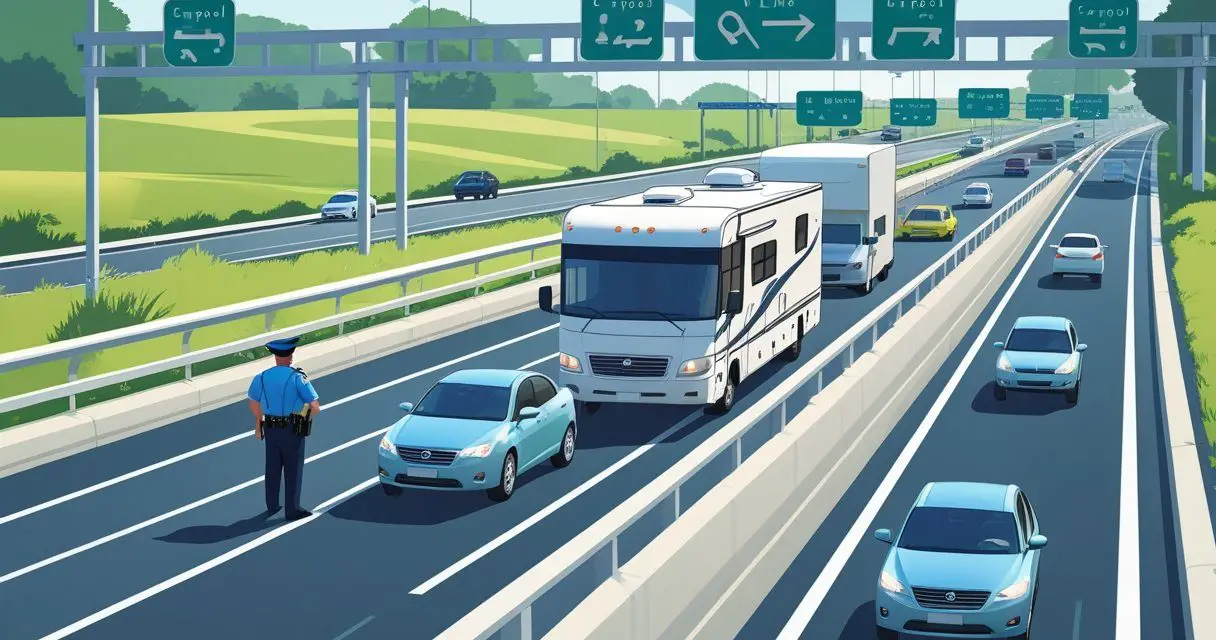
Driving an RV on the highway often raises the question of whether you can use the carpool lane. You can drive an RV in the carpool lane if it meets the passenger requirements and local rules, but restrictions apply based on size, weight, and towing.
Knowing these details before your trip helps you avoid costly mistakes.
Not every state treats RVs the same way, and some have strict limits that keep larger motorhomes or towing setups out of the lane. Even when allowed, your RV must keep up with posted speeds to avoid slowing traffic.
Paying attention to signs and local laws ensures you stay compliant and safe.
Key Takeaways
- RVs can use carpool lanes if they meet passenger and vehicle rules
- Towing or exceeding weight and size limits usually blocks access
- Following posted laws prevents fines and keeps travel safe
Carpool Lane Basics for RVs
Carpool lanes, also called HOV lanes, have specific rules that affect whether your RV can use them. These rules focus on who qualifies, why the lanes exist, and how they differ from the rest of the highway.
What Is a Carpool Lane
A carpool lane, or High-Occupancy Vehicle (HOV) lane, is a lane set aside for vehicles carrying more than one person. The minimum is usually two people, but in some regions it can be three or more.
Signs along the highway mark these lanes with a diamond symbol (◇) and list the passenger requirement. Some HOV lanes only operate during peak hours, while others are enforced 24/7.
You must meet the posted rules to drive legally in these lanes. For RVs, this often means carrying the right number of passengers and following any size, weight, or towing restrictions.
Purpose and Benefits of HOV Lanes
HOV lanes exist to reduce traffic congestion and encourage ride-sharing. By moving more people in fewer vehicles, they help cut down on fuel use and lower emissions.
These lanes often allow for faster travel times during rush hour because they carry fewer vehicles than general lanes. This can make a noticeable difference on busy urban highways.
For RV drivers, the benefit is less about daily commuting and more about avoiding long delays on crowded roads. If your RV qualifies, you may save time and fuel while traveling through congested areas.
Key Differences Between Carpool and General Lanes
Carpool lanes have occupancy rules that general lanes do not. You cannot enter an HOV lane alone unless you drive a vehicle with special approval, such as some electric cars with permits.
Another difference is enforcement. Police monitor HOV lanes closely, and fines for violations can be steep. In California, for example, the penalty can reach several hundred dollars.
Carpool lanes may also have vehicle restrictions. Large or heavy RVs, or those towing trailers, are often excluded for safety reasons. General lanes do not carry these limits, so you must pay close attention to posted signs before merging into an HOV lane.
Regulations for RVs in Carpool Lanes
Rules for driving an RV in a carpool lane depend on where you are, how many people are inside, and the weight or size of your vehicle. You need to check both state laws and posted signs before entering an HOV lane to avoid fines or safety violations.
State-by-State Differences
Carpool lane laws vary across the United States. In California, the California Vehicle Code and CHP (California Highway Patrol) enforce strict limits.
Vehicles towing trailers cannot use HOV lanes, and large motorhomes must stay in the right lane unless passing. In Virginia, RVs may use HOV-3 lanes if three or more people are inside and the vehicle weighs less than 10,000 pounds.
Florida and Colorado also allow RVs in carpool lanes if they meet the minimum occupancy rule, usually two or more people. Some states, such as Connecticut, prohibit RVs from using HOV lanes entirely.
Always confirm local rules through the state’s Department of Transportation before traveling.
| State | Allowed in HOV Lane | Notes |
|---|---|---|
| California | Yes, if not towing | Must meet occupancy rule |
| Virginia | Yes | Weight under 10,000 lbs |
| Connecticut | No | RVs prohibited |
| Florida | Yes | Two or more occupants required |
Occupancy Requirements for RVs
Carpool lanes exist to reduce traffic by encouraging shared rides. Most states require two or more occupants (HOV-2), while some urban areas use HOV-3.
You must count only people seated inside the motorhome. Pets and mannequins do not qualify.
Law enforcement, including the CHP, checks for visible occupants during enforcement periods. If you travel alone in an RV, you cannot use the carpool lane even if the vehicle is large.
Violating occupancy rules can result in fines that often exceed $400 in states like California. Always look for posted signs showing the current HOV requirements and hours of operation.
Vehicle Size and Classification Rules
RVs fall under different classifications depending on their gross vehicle weight (GVW) and whether they tow another vehicle. States often restrict long or heavy RVs from using left or HOV lanes due to safety and speed differences.
In California, vehicles towing trailers must stay in the right lane. The CHP enforces this to prevent slow-moving traffic in faster lanes.
Smaller Class B campervans that keep up with traffic may be permitted in carpool lanes if they meet occupancy rules. Check your RV’s registration for its official classification.
Knowing whether your vehicle is considered a passenger vehicle or a commercial-type motorhome helps determine if it qualifies for HOV use.
Towing and Trailers: Critical Restrictions
When you tow a trailer with your RV, your access to the carpool lane changes. State laws often limit where towing vehicles can drive, and these limits exist to maintain safety and traffic flow.
Rules for RVs Towing Trailers
If you tow a trailer, you generally cannot use the carpool (HOV) lane. In California, the Vehicle Code and DMV Handbook state that vehicles towing trailers must stay in the right-hand lanes.
This rule applies even if you have multiple passengers. The reason is tied to the 55 MPH towing speed limit.
Since vehicles towing trailers must travel slower, they can disrupt faster-moving HOV traffic. Law enforcement monitors these lanes closely, and violations can result in fines.
Other states follow similar restrictions. For example, most interstate highways prohibit any vehicle towing a trailer from driving in the left or HOV lanes, except when turning or avoiding obstacles.
Always check posted signs because some areas may have additional weight or length limits.
| Restriction | Applies To | Typical Rule |
|---|---|---|
| Towing a trailer | All RV types | No HOV lane use |
| Speed limit | Towing vehicles | 55 MPH (CA) |
| Lane use | Multi-lane highways | Right or middle lanes only |
Impact on Lane Access and Safety
Towing changes how your vehicle handles. The added weight increases stopping distance and reduces acceleration.
These factors make it unsafe to drive in faster lanes, including carpool lanes, where speeds often exceed 65 MPH. The California Highway Patrol (CHP) enforces these limits to prevent collisions and maintain lane consistency.
A slower, heavier vehicle in the HOV lane can cause sudden braking or lane changes by other drivers. Using the correct lane improves safety for everyone.
You reduce the risk of sway, jackknifing, or losing control on curves. Staying in slower lanes also makes it easier to exit or pull over if your trailer needs attention.