
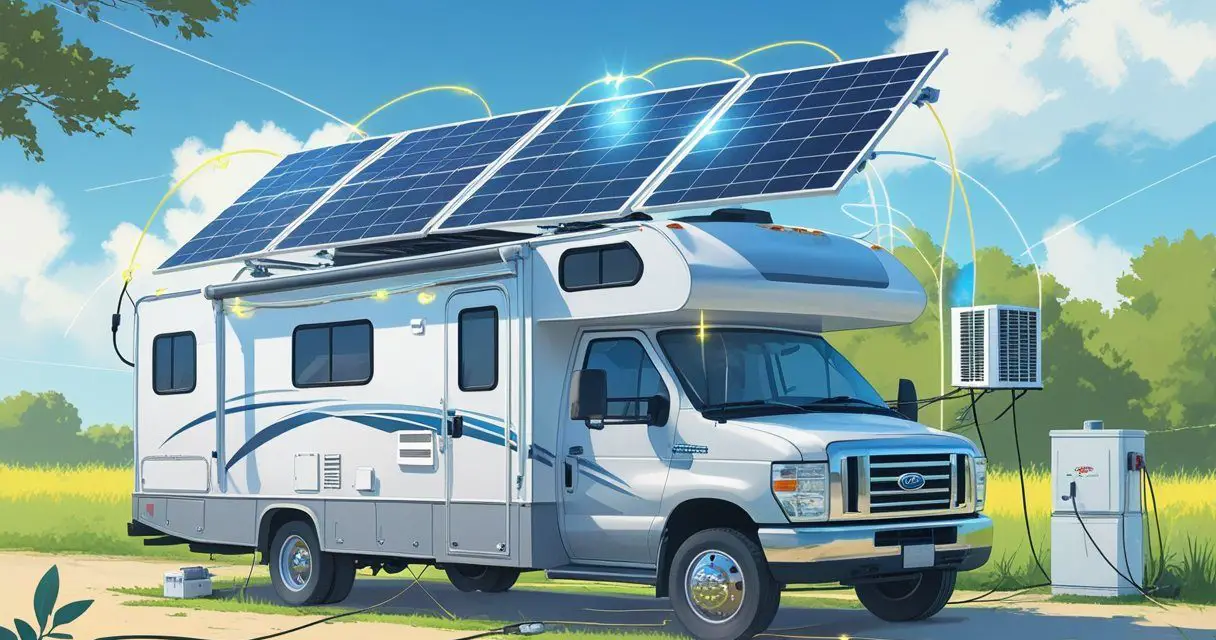
Many RV owners wonder if they can escape crowded campgrounds and high electric hookup fees by powering their air conditioner with solar panels. The good news is that this dream of off-grid comfort is achievable with the right setup and realistic expectations.
Yes, RV solar panels can run an air conditioner, but it requires a substantial solar system with adequate panels, batteries, and an inverter sized to handle the AC unit’s power demands. Most RV air conditioners need between 1,700 and 3,500 starting watts and 600 to 1,500 running watts.
This means a typical setup requires at least 1,800 watts of solar panels and 700-800 amp hours of battery storage to run an AC unit for about 8 hours per day. The reality is that running RV AC on solar power involves significant upfront costs and careful planning.
Factors like available roof space, daily sunlight hours, and your cooling needs all play crucial roles in determining whether a solar-powered AC system makes sense for your RV lifestyle.
Key Takeaways
- RV solar panels can power air conditioners but require substantial investment in panels, batteries, and inverters.
- A typical system needs at least 1,800 watts of solar panels and 700-800 amp hours of battery capacity for 8 hours of daily AC use.
- Success depends on proper system sizing, adequate sunlight exposure, and realistic expectations about power limitations.
Can RV Solar Panels Power an Air Conditioner?
RV solar panels can power an air conditioner, but it requires a substantial system with adequate panels, batteries, and inverters. The feasibility depends on the AC unit’s power consumption, available solar capacity, and usage patterns.
Typical Power Demands of RV Air Conditioners
Most RV air conditioners consume between 1,000 to 1,500 watts during operation. Standard units rated at 13,500 or 15,000 BTUs typically use 1.0 to 1.5 kilowatt-hours (kWh) per hour of runtime.
A 13,500 BTU unit draws approximately 12-13 amps at 120 volts. This equals about 1,560 watts when starting up and 1,200-1,300 watts during continuous operation.
Power Requirements by AC Size:
- 9,000 BTU: 900-1,100 watts
- 13,500 BTU: 1,200-1,400 watts
- 15,000 BTU: 1,300-1,500 watts
The compressor uses most of this power. It cycles on and off to maintain the set temperature, creating variable power demands throughout the day.
Feasibility of Running AC on Solar Power
Running an RV air conditioner on solar requires a complete system with panels, batteries, charge controller, and inverter. For a typical 1,200-watt AC unit running 3 hours daily, the system needs:
Minimum System Requirements:
- 615+ watts of solar panels
- 400 amp-hours of lithium batteries (or 640 Ah lead-acid)
- 30-amp MPPT charge controller
- 2,000-4,000 watt inverter
Each hour of AC operation requires about 200 watts of solar panels to offset the energy used. Running AC for 5 hours daily would need 1,000-1,500 watts of solar panels.
Battery storage becomes critical since AC often runs when solar production is low. Lithium batteries work better than lead-acid due to deeper discharge capability and faster charging.
Comparing Solar Power to Shore Power for AC Use
Shore power delivers unlimited electricity directly from the grid, making it ideal for continuous AC operation. RVers can run their air conditioner as long as needed without worrying about power limits.
Solar power has constraints based on panel capacity, battery storage, and weather conditions. Cloudy days reduce solar production significantly, limiting AC runtime.
Shore Power Benefits:
- Unlimited power supply
- No battery concerns
- Consistent voltage delivery
- Lower upfront costs
Solar Power Limitations:
- Weather dependent
- High initial investment ($3,000-8,000+ for AC-capable systems)
- Limited runtime without sun
- Complex system requirements
Solar works best for partial AC use during peak sun hours. Shore power remains more practical for extended cooling needs or extreme temperatures.
Essential Components for Running RV AC on Solar
Running an RV air conditioner on solar power requires four main components that work together as a complete system. The solar panels generate electricity, batteries store that power for when it’s needed, and an inverter converts the stored DC power to AC power for the air conditioner.
Solar Panels and Solar Array
A typical RV air conditioner needs 1,000 to 1,500 watts of solar panels to run effectively. Most RVers need at least 600-800 watts of solar capacity for moderate AC use.
The exact number depends on your location and daily usage hours. If you run AC for 3 hours daily, expect to need around 615 watts minimum in sunny areas like Utah.
Monocrystalline panels work best for RVs because they produce more power in smaller spaces. Roof space limits how many panels you can install.
Most RV roofs can fit 400-800 watts of panels depending on size. You’ll need to balance panel capacity with available roof space and other equipment.
Solar panels alone cannot run AC directly. They charge batteries during sunny hours while the AC runs off stored battery power.
Battery Bank and Battery Options
The battery bank stores solar energy for AC use during cloudy weather and nighttime hours. Most RV AC setups need 400-800 amp hours of battery capacity.
Lithium iron phosphate batteries are the best choice for RV solar systems. They last longer and charge faster than lead-acid batteries.
A typical setup uses 4-8 lithium batteries rated at 100Ah each. This provides enough stored power to run AC for several hours without sunlight.
| Battery Type | Amp Hours Needed | Typical Cost |
|---|---|---|
| Lithium | 400-600 Ah | $2,000-$4,000 |
| Lead-Acid | 800-1,200 Ah | $1,000-$2,000 |
Lithium batteries can discharge to 20% capacity safely. Lead-acid batteries should only discharge to 50% to avoid damage.
Inverter Selection and Sizing
The inverter converts 12V DC battery power to 120V AC power that air conditioners need. RV air conditioners require either 2,000W or 4,000W inverters depending on the AC unit size.
Most 13,500 BTU RV air conditioners need at least a 3,000W inverter. Larger 15,000 BTU units often require 4,000W inverters to handle startup power surges.
Soft start devices can reduce inverter size requirements by 30-50%. These devices limit the initial power draw when the AC compressor starts up.
Pure sine wave inverters work best with air conditioners. Modified sine wave inverters can cause efficiency problems and equipment damage over time.
The inverter must handle both running watts and surge watts. AC units draw 2-3 times their running power during the first few seconds of operation.
System Sizing and Power Calculations
Proper system sizing requires understanding your air conditioner’s power demands and converting those needs into specific solar equipment requirements. The key is calculating exact energy consumption and accounting for system inefficiencies.
Calculating Energy Needs for AC
RV air conditioners consume significant power that varies by BTU rating and runtime. A 13,500 BTU air conditioner typically uses 1,200 to 1,500 watts while running.
A 15,000 BTU unit draws 1,500 to 1,800 watts. Starting watts are much higher than running watts. The compressor needs 2 to 3 times more power to start.
A unit running at 1,500 watts might need 3,000 to 4,500 watts to kick on. Daily energy needs depend on runtime hours.
An RV solar setup must account for total watt-hours consumed. For example, running a 1,500-watt AC for 6 hours requires 9,000 watt-hours per day.
System losses reduce available power by 15 to 25 percent. Inverters, batteries, and wiring create inefficiencies. Add this buffer to your calculations for realistic sizing.
Understanding Watts, Volts, and Amps
These three measurements work together in solar power systems. Watts equal volts multiplied by amps. This relationship helps determine battery and inverter requirements.
Most RV systems operate at 12 volts DC for batteries and solar panels. Air conditioners run on 120 volts AC, requiring an inverter for conversion.
Battery capacity is measured in amp-hours (Ah). To find needed capacity, divide daily watt-hours by system voltage. A 9,000 watt-hour need requires 750 amp-hours at 12 volts.
Inverter sizing depends on both continuous and surge power needs. The inverter must handle the AC’s starting watts without shutting down.