
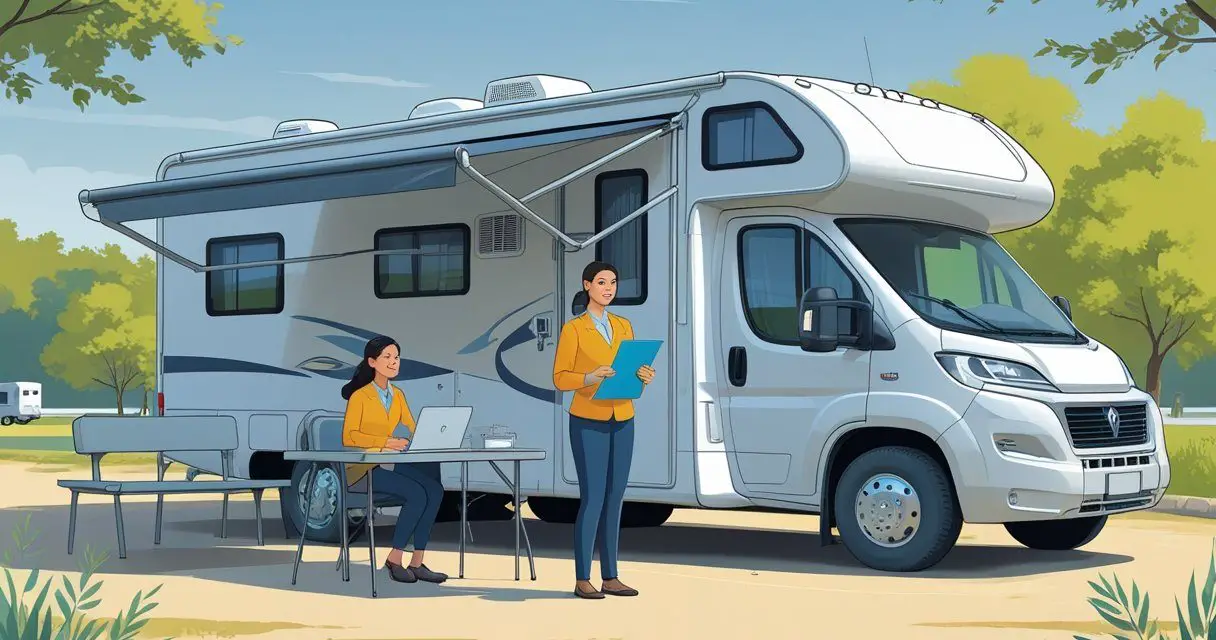
Living in an RV doesn’t automatically stop someone from getting food stamps. Many people worry that living in a recreational vehicle makes them ineligible for SNAP benefits, but that’s not true.
RV residents can qualify for SNAP benefits as long as they meet the same income, resource, and work requirements as anyone else applying for the program.
The key challenge for RV dwellers is proving residency in the state where they apply. SNAP requires applicants to live in the state where they submit their application.
People without a fixed address can still show residency through documents like vehicle registration, a mail forwarding service address, or statements from service providers. The state needs to see that the applicant intends to stay there, even without a traditional home.
Understanding how RV ownership affects SNAP eligibility can be confusing. The value of the RV might count as a resource, and some states have limits on how much someone can own and still get benefits.
There are exceptions and rules that often work in favor of RV residents, especially when the vehicle serves as their primary home.
Key Takeaways
- RV residents can get SNAP benefits if they meet income, resource, and work requirements like other applicants
- Applicants must prove residency in their state using documents like vehicle registration or mail forwarding addresses
- The value of an RV may count toward resource limits, but exceptions often apply when it serves as a primary residence
SNAP Eligibility for RV Residents
Living in an RV does not automatically disqualify someone from receiving SNAP benefits. The program treats RVs as valid residences when they serve as a person’s primary home, and eligibility depends on meeting income limits, resource requirements, and proving state residency.
How SNAP Defines an RV as a Residence
SNAP considers an RV a legitimate residence when someone uses it as their primary living space. The program does not require applicants to live in traditional housing like apartments or houses.
An RV counts as a home if the household members living in it purchase and prepare meals together. The vehicle itself typically does not count toward the resource limit if it serves as the primary residence.
Most states exclude one vehicle per household from resource calculations when determining eligibility. The value of an RV used as a home usually receives the same treatment as a traditional house.
This means the RV won’t count against the standard resource limit of $3,000 for most households or $4,500 for households with elderly or disabled members. Some states have eliminated asset tests entirely, making vehicle ownership irrelevant to eligibility.
State Variations in SNAP Rules for RV Dwellers
Each state runs its own SNAP program under federal guidelines, which creates differences in how they handle RV residents. Some states have more flexible rules about proving residency than others.
States define residency for people without traditional addresses by looking at intent to remain in the state and physical presence. An applicant must apply in the state where they currently live.
Some states accept broader forms of proof for RV dwellers, while others require more documentation. Key state-level differences include:
- Requirements for physical address verification
- Acceptance of mail forwarding services as proof of residency
- Treatment of temporary versus permanent state residence
- Processing times for applications from mobile residents
RV residents who travel frequently should establish residency in one state before applying. States cannot deny benefits solely because someone lacks a fixed address.
Documentation Needed to Prove Residency
RV dwellers must provide proof they live in the state where they apply for SNAP. Standard documents like utility bills or lease agreements may not be available to mobile residents.
Acceptable forms of residency proof include:
- Vehicle registration showing the state
- RV title or ownership documents
- Mail forwarding service address within the state
- Utility bills from campgrounds or RV parks
- Statements from service providers or shelters
- Affidavits from people who can confirm state presence
- Driver’s license or state ID card
Applicants should gather multiple forms of documentation when possible. A combination of documents creates stronger proof of residency intent.
Some states accept verbal statements during the application interview if written documentation is limited. The state agency evaluates whether the applicant genuinely intends to remain in the state.
Short-term visits or passing through do not establish residency for food stamps purposes.
Asset Limits and the Resource Test

SNAP eligibility depends partly on countable resources, which include bank accounts, cash, and certain vehicles. Most households must keep total countable assets under $2,750, while households with elderly or disabled members face a $4,250 limit.
What Counts Toward the SNAP Resource Limit
The resource test measures all countable assets a household owns when applying for SNAP. Bank accounts, savings accounts, cash on hand, and some investments all count toward this limit.
The standard limit is $2,750 for most households. Certain assets receive automatic exclusions.
The primary home does not count, regardless of its value. Household items and personal belongings like furniture, clothing, and appliances are also excluded.
Most retirement accounts, including 401(k)s and IRAs, do not count toward the resource limit. Some states have eliminated asset tests entirely through broad-based categorical eligibility policies.
In these states, households do not need to meet resource limits at all. Other states maintain the federal limits but apply vehicle exemptions generously.
Treatment of Vehicles and the Fair Market Value Rule
Vehicle value calculations follow specific federal guidelines, though states can adopt more lenient policies. Under federal rules, one vehicle per household is typically excluded entirely.
Additional vehicles may count toward the resource limit based on their fair market value. The fair market value is the amount a vehicle could sell for on the open market.
If this value exceeds $4,650, the excess amount counts as a resource. However, many vehicles qualify for exemptions even if they exceed this threshold.