
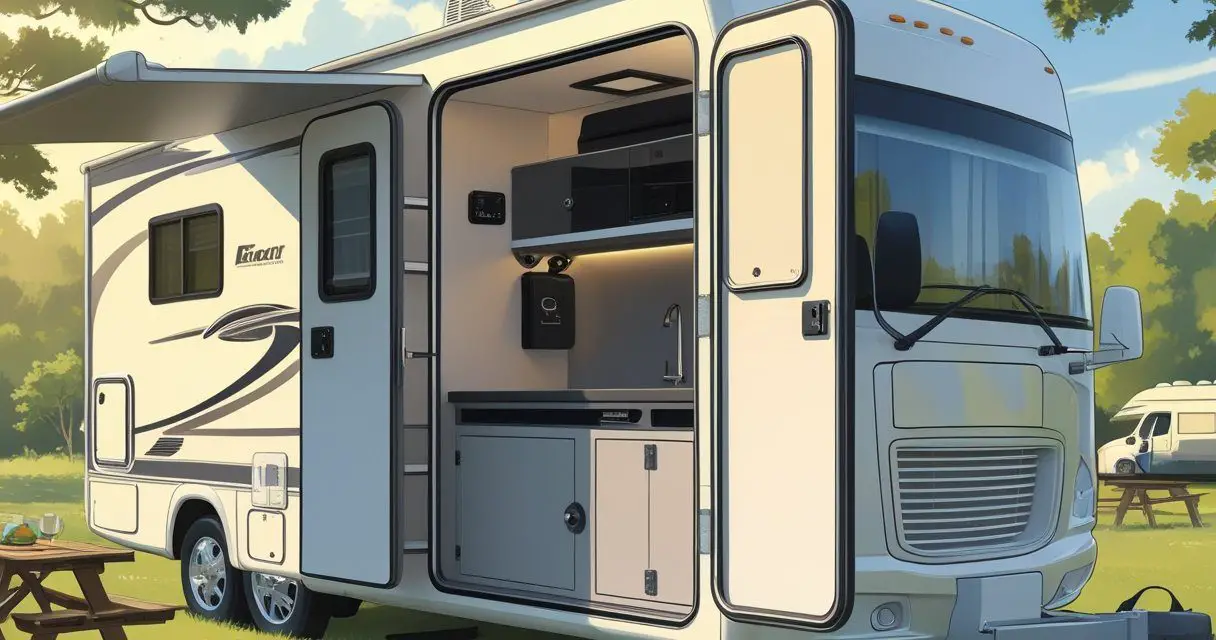
Yes, you can legally have a gun in your RV, but the answer depends on whether your RV is considered a vehicle or a temporary home, which state you’re in, and whether you’re driving or parked. The rules change every time you cross a state line.
What’s legal in one state might be a serious crime in another.
Understanding these laws is not optional for RV owners who travel with firearms. Some states treat a parked RV like a home, letting you keep a loaded gun inside without a permit.
Other states always consider an RV a motor vehicle, requiring the gun to be unloaded and locked away. Federal law offers some protection when you’re passing through restrictive states, but only if you follow specific rules.
This guide breaks down what RV owners need to know about traveling with firearms. It covers federal regulations, state-by-state differences, storage requirements, and the rules for national parks and campgrounds.
Key Takeaways
- Whether you can have a gun in your RV depends on state laws, how the RV is being used, and whether you’re driving or parked
- Federal law allows transporting firearms through restrictive states if the gun is unloaded and locked in a container that’s not easily accessible
- Each state has different rules about firearms in RVs, and you must follow the laws of every state you enter or pass through
Is It Legal to Have a Gun in Your RV?
The legality of having a gun in an RV depends on whether the RV is classified as a vehicle or a residence, and which state laws apply at any given time. State regulations differ significantly, making it essential for RV owners to understand the rules of each jurisdiction they enter.
Differences Between Vehicles and Residences
An RV’s legal classification changes based on its use. When driving on public roads, the RV is legally a vehicle.
All state laws for transporting firearms in motor vehicles apply during transit. Once parked at a campground and set up for living, many states treat the RV as a temporary dwelling.
States with Castle Doctrine laws often extend home defense rights to parked RVs. This allows owners to keep a loaded, accessible firearm inside without a permit.
Some states always classify an RV as a motor vehicle regardless of how it’s being used. In these jurisdictions, firearms must remain unloaded and stored in locked containers at all times.
This stricter standard applies even when the RV is parked and being used as a residence. The distinction matters because vehicle laws are typically more restrictive than home possession laws.
State-by-State Laws on Firearms in RVs
Each state maintains its own regulations for firearms in RVs. Constitutional carry states do not require permits for firearm possession.
Shall-issue states must grant permits to applicants who meet legal requirements. Restrictive states impose stringent requirements and may not recognize permits from other states.
Concealed carry permits from one state are not universally recognized. Reciprocity agreements vary widely between states.
An RV owner must research the specific laws of every state on their route, including states they only pass through. Official state government websites provide the most reliable information on current firearm laws and permit reciprocity.
Before crossing any state line, travelers should verify whether their permits are valid and what storage requirements apply. Violating state firearm laws can result in serious legal penalties.
Federal Laws for RV Gun Owners
Two key federal laws protect RV owners who travel with firearms: the Firearm Owners Protection Act provides safe passage through restrictive states, while the Gun Control Act of 1968 establishes the basic framework for lawful interstate transport.
Firearm Owners Protection Act (FOPA) and Safe Passage
The Firearm Owners Protection Act, found in 18 U.S.C. § 926A, creates a legal shield for RV owners traveling through states with strict gun laws. FOPA allows a person to transport a firearm from one location where they can legally own it to another location where possession is also legal.
Requirements for FOPA protection:
- The firearm must be unloaded
- The firearm and ammunition must be stored where they are not readily accessible from the passenger area
- Both must be kept in a locked container (not a glove box or console)
- The traveler must be in continuous transit through the restrictive state
In an RV, this means storing the unloaded firearm in a locked case in a rear storage compartment or cargo bay. Ammunition should be kept separate, ideally in its own locked container.
Brief stops for gas or food are acceptable, but extended stays or sightseeing trips can void FOPA protections. Some states interpret this law narrowly, so strict compliance is important.
The Gun Control Act of 1968
The Gun Control Act of 1968 established the federal foundation for transporting firearms across state lines. This law permits law-abiding citizens without felony convictions or mental health disqualifications to transport firearms on a “peaceable journey” between states.
The act does not override state laws. Each state maintains authority to regulate firearms within its borders.
RV owners must still comply with the specific requirements of every state they enter or pass through. The Gun Control Act simply ensures that federal law does not prohibit interstate transport for qualified individuals.
Traveling Across State Lines With Firearms
Moving between states with firearms requires careful attention to both federal and state laws. Each state has different rules about how guns must be stored and transported, and some states have much stricter laws than others.
Reciprocity and Concealed Carry Permits
Concealed carry permits from one state may or may not be valid in another state. This depends on reciprocity agreements between states.
Some states recognize permits from many other states, while others only accept a few or none at all. RV travelers should research which states honor their concealed carry permit before crossing state lines.
States like Arizona and Florida issue permits to non-residents, which can provide broader recognition across the country. Constitutional carry states allow gun owners to carry without a permit, but this only applies to residents in most cases.
Gun owners can use reciprocity maps or apps to check where their permits are valid. The Concealed Carry app and usconcealedcarry.com both offer updated information about which states accept specific permits.
Laws change regularly, so checking current information before each trip is important. Some states require specific training or background checks for their permits.
These requirements don’t transfer to other states automatically, even with reciprocity agreements.
Transporting Firearms Through Restrictive States
Federal law allows gun owners to transport firearms through states with strict gun laws under the Firearm Owners Protection Act. The gun must be unloaded and locked in a container that passengers cannot easily reach.
Ammunition must be stored separately from the firearm. States like California, New York, New Jersey, and Massachusetts have some of the most restri