
Picture this: You’re parked at a stunning campsite with mountain views, coffee in hand, and you need to hop on a video call or stream your favorite show. The question isn’t whether you should have internet in your RV—it’s absolutely possible, and millions of RVers are doing it right now in 2026. Can you have internet in an RV? The short answer is a resounding yes, and you’ve got more options than ever before to stay connected while living the nomadic dream.
The digital nomad lifestyle has exploded in recent years, and RV manufacturers have taken notice. Whether you’re a full-time RVer working remotely, a weekend warrior who likes to stream movies, or someone who just needs to check email occasionally, reliable internet access has become as essential as running water and electricity for modern RV living.
Key Takeaways
- Multiple internet options exist for RVers, including cellular data, satellite internet, WiFi extenders, and campground WiFi—each with distinct advantages and limitations
- Cellular networks remain the most popular choice for RV internet in 2026, with 5G coverage expanding rapidly and unlimited data plans becoming more affordable
- Starlink and other satellite services have revolutionized remote connectivity, offering high-speed internet even in the most isolated locations
- Your internet needs determine your solution—casual browsing requires different setups than full-time remote work or 4K streaming
- Redundancy is key for reliable connectivity—successful RVers often combine multiple internet sources to ensure they’re never completely offline
Understanding Your RV Internet Options 🚐
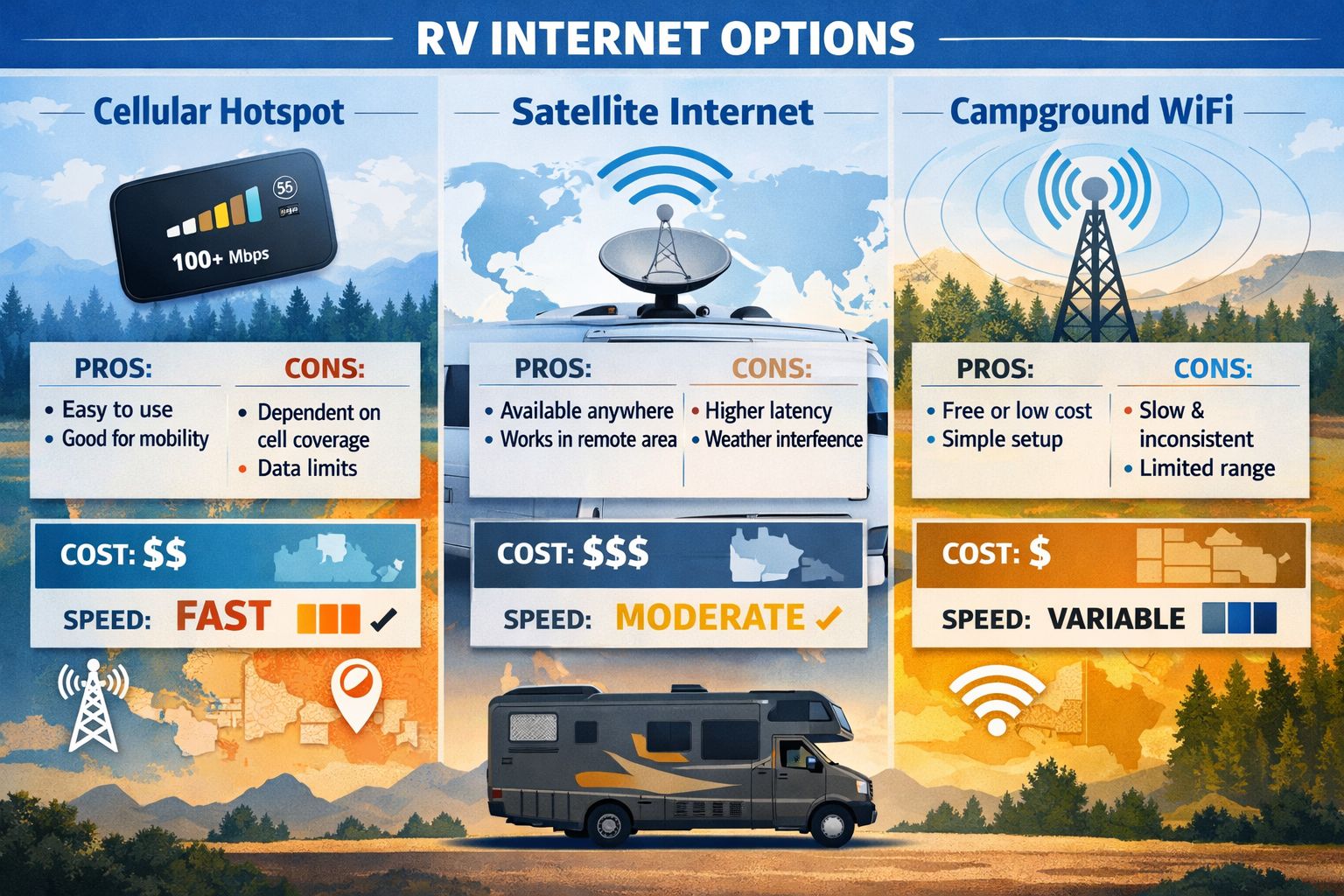
When exploring whether can you have internet in an RV, it’s crucial to understand that you’re not limited to a single solution. The beauty of RV internet in 2026 is the variety of options available, each suited to different needs, budgets, and travel styles.
Cellular Data and Mobile Hotspots
Cellular internet remains the go-to choice for most RVers, and for good reason. The infrastructure has improved dramatically, with 5G networks covering approximately 60% of the United States as of 2026[1]. Here’s what makes cellular data so appealing:
- Convenience: Use your smartphone as a hotspot or invest in a dedicated mobile hotspot device
- Flexibility: Works anywhere with cell coverage
- Speed: 5G networks can deliver speeds exceeding 100 Mbps in optimal conditions
- Cost-effectiveness: Unlimited plans from major carriers range from $50-$100 monthly
The major carriers—Verizon, AT&T, and T-Mobile—all offer RV-specific plans. Many full-timers carry multiple carrier SIM cards because coverage varies significantly by region. What works perfectly in Colorado might leave you disconnected in rural Montana.
Satellite Internet Solutions
The satellite internet landscape has transformed completely since Starlink entered the market. Can you have internet in an RV in the middle of nowhere? Absolutely, thanks to satellite technology.
Starlink for RVs has become incredibly popular, offering:
- Download speeds of 50-200 Mbps
- Low latency suitable for video calls and gaming
- Coverage across North America and expanding globally
- Mobile priority plans starting at $150/month
Traditional satellite providers like HughesNet and Viasat still serve the RV community, though they typically offer slower speeds and higher latency compared to Starlink’s low-earth orbit constellation[2].
Campground WiFi and WiFi Extenders
Most RV parks and campgrounds offer WiFi, but the quality varies wildly. Some provide blazing-fast fiber connections, while others offer barely functional service that can’t handle basic email.
WiFi extenders and boosters help capture weak campground signals:
- Roof-mounted antennas can pick up signals from 300+ feet away
- Amplify weak signals for usable connectivity
- Cost ranges from $200-$500 for quality systems
- Brands like WiFiRanger and Winegard dominate this space
“Having a good WiFi extender has saved us countless times when campground WiFi was technically available but practically unusable from our site.” — Full-time RVer testimonial
Setting Up Internet in Your RV: Practical Steps
So you’ve determined that yes, can you have internet in an RV, but how do you actually set it up? The process varies depending on your chosen solution, but here’s a comprehensive roadmap.
Assessing Your Internet Needs
Before spending money on equipment, honestly evaluate your usage:
Light Users (email, social media, basic browsing):
- Smartphone hotspot or basic cellular plan
- Campground WiFi with a simple extender
- Budget: $50-100/month
Moderate Users (video streaming, regular video calls):
- Dedicated mobile hotspot with unlimited data
- WiFi extender for backup
- Budget: $100-150/month
Heavy Users (remote work, large file transfers, 4K streaming):
- Dual cellular carriers for redundancy
- Satellite internet backup
- Signal boosters and professional antennas
- Budget: $200-400/month
Essential Equipment and Installation
Here’s what you’ll need for a robust RV internet setup:
| Equipment | Purpose | Price Range |
|---|---|---|
| Mobile Hotspot Device | Primary cellular internet | $200-$400 |
| Cell Signal Booster | Amplify weak cellular signals | $300-$700 |
| WiFi Router | Distribute internet to devices | $100-$300 |
| WiFi Extender | Capture campground WiFi | $200-$500 |
| Satellite Dish | Remote area connectivity | $500-$2,500 |
Installation tips:
- Mount antennas high: Roof-mounted equipment gets the best signal reception
- Use quality cables: Poor cables lose signal strength
- Weatherproof everything: RVs experience extreme conditions
- Plan for power: Internet equipment needs reliable 12V or 120V power
- Test before traveling: Ensure everything works while still at home