

You’re standing at the crossroads of RV ownership, and the age-old debate is raging in your mind: fifth wheel or travel trailer? This isn’t just about picking a camping companion – you’re choosing a lifestyle that will define your adventures for years to come. Both options have passionate followers who swear by their choice, and for good reason.
Travel trailers offer lightweight flexibility and budget-friendly access to the RV lifestyle, while fifth wheels deliver luxury living with smooth towing and spacious interiors. The decision you make will impact everything from your towing vehicle to your campground options, and even your wallet. Let’s dive into the seven crucial differences that will help you make the right choice for your unique camping dreams.
The Market Share Reality Check
Before we dive into the specifics, let’s look at what your fellow RVers are actually choosing. Travel trailers dominate the market with approximately 70% of towable RV sales, while fifth wheels claim about 30%. This isn’t surprising when you consider that travel trailers are the gateway drug to RV life – they’re more affordable and accessible to first-time buyers.
According to the RV Industry Association, travel trailer shipments increased by 17.4% in 2024, while fifth wheel shipments grew by a more modest 2.1%. This data tells a story: more people are getting into RVing than ever before, and they’re starting with travel trailers.
Here’s the thing though – market share doesn’t necessarily mean “better.” It just means more accessible. Fifth wheels might have a smaller slice of the pie, but they’re serving up some seriously luxurious camping experiences that travel trailers simply can’t match.
1. Towing Requirements: Your Truck Matters More Than You Think
The biggest difference between these two RV types comes down to what’s parked in your driveway. Travel trailers connect to a standard hitch ball under your rear bumper, which means you can tow many models with SUVs, minivans, or even some large sedans. Fifth wheels, however, require a kingpin hitch mounted in your truck bed, which means you’ll need a full-size or heavy-duty truck.
This isn’t just about convenience – it’s about thousands of dollars in vehicle costs. A quality half-ton truck starts around $35,000, while heavy-duty trucks can easily exceed $60,000. If you’re currently driving a Honda Pilot or Toyota Highlander, you might be able to tow a travel trailer weighing 5,000-7,000 pounds, but you’ll need a truck upgrade for any fifth wheel.
The 80% rule is crucial here: experienced RVers recommend keeping your loaded trailer weight at 80% or less of your vehicle’s towing capacity. This helps prevent premature wear on your engine, transmission, and brakes.
The reality check is that most people underestimate how much their “stuff” weighs. Add water, food, clothes, and camping gear, and that advertised dry weight can increase by 2,000-3,000 pounds quickly.
2. Size and Storage: Where Fifth Wheels Shine
Fifth wheels are the kings of storage space, and it’s not even close. Most fifth wheels feature a drop-frame construction that creates massive basement storage compartments accessible from both sides. We’re talking about storage areas large enough to hold full-size lawn chairs, grills, and even bicycles.
Travel trailers, constrained by their single-level design, offer significantly less storage. You’ll typically find smaller exterior compartments and limited interior storage options. However, what travel trailers lack in storage, they make up for in maneuverability and campground access.
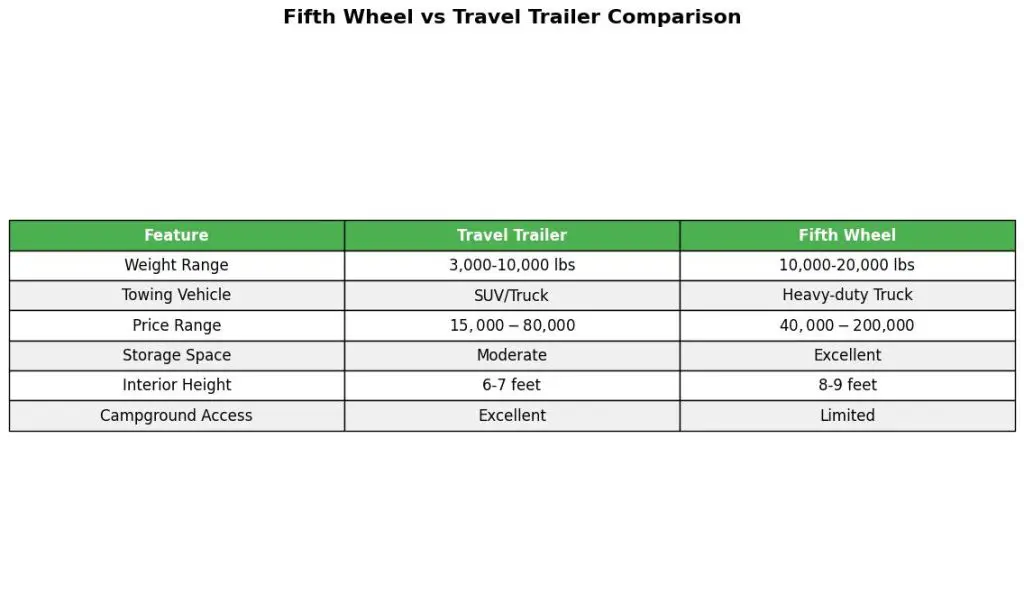
The interior space difference is equally dramatic. Fifth wheels often feature 8-9 foot ceilings compared to travel trailers’ 6-7 foot heights. This creates a more residential feel and allows for features like kitchen islands, washer/dryer hookups, and multiple sleeping areas.
Storage statistics show that the average fifth wheel offers 30-40% more storage space than a comparable-length travel trailer. This becomes crucial for full-time RVers or those planning extended trips.
3. Price Point: The Great Divide
Let’s talk numbers because your wallet is probably screaming right now. Travel trailers typically range from $15,000 for basic models to $80,000 for luxury units. Fifth wheels start around $40,000 for entry-level models and can easily exceed $200,000 for high-end luxury rigs.
But here’s what the sticker price doesn’t tell you: fifth wheels often include features that would be expensive upgrades in travel trailers. Things like residential appliances, solid surface countertops, and premium sound systems come standard in many fifth wheels.
The total cost of ownership includes more than just the RV purchase. You’ll need to factor in:
- Towing vehicle costs (potentially $20,000-$40,000 more for a capable truck)
- Insurance premiums (fifth wheels cost 15-25% more to insure)
- Maintenance and repairs
- Campground fees (some charge extra for larger rigs)
The budget reality is that getting into fifth wheel ownership typically requires a minimum investment of $80,000-$100,000 when you include the truck, while travel trailer ownership can start around $30,000-$40,000 total.
4. Campground Access: Size Matters
Travel trailers are the clear winners when it comes to campground flexibility. Many state parks and national parks have length restrictions of 30-35 feet, which eliminates m