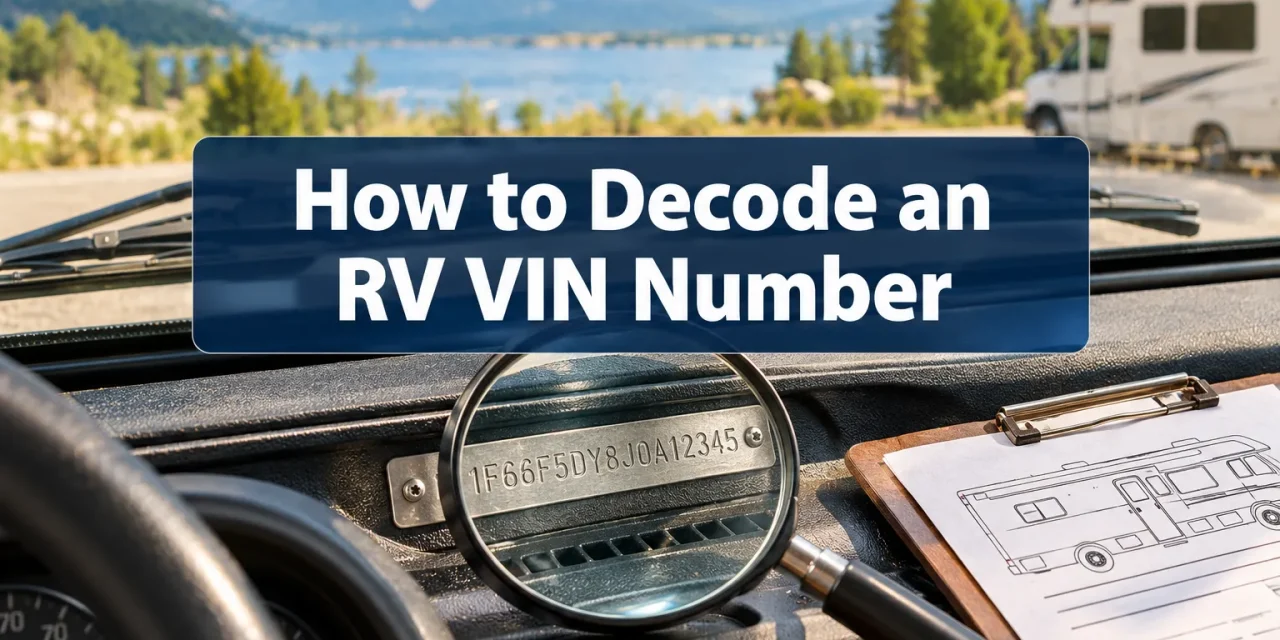
Seventeen characters. That’s all it takes to reveal the engine size, chassis weight class, build plant, and birth year of nearly any RV built since 1981. Yet most RV owners never look past the sticker price long enough to read the one code that tells them everything.
Learning how to decode an RV VIN number isn’t just a nerdy party trick for gearheads. It’s one of the fastest, cheapest ways to confirm you’re buying what the seller says you’re buying, before you sign a title or hand over a deposit. This complete RV specs and history lookup guide walks through every digit, every chassis quirk, and every free tool available in 2026 so you can decode a VIN like a dealership insurance adjuster would.
Key Takeaways
- Every RV built since 1981 carries a 17-character VIN, split into three zones: manufacturer ID, vehicle attributes, and a unique serial number [1][9].
- Motorhomes usually display the chassis builder’s VIN (Ford, Mercedes-Benz, Freightliner), not the coachbuilder’s, a detail that trips up most first-time buyers [3][4][6][10].
- Position 10 always reveals the model year. In recent VINs, K=2019 through T=2026, skipping letters like I, O, and Q [1].
- The NHTSA vPIC decoder is the most trusted free tool for confirming manufacturer, body class, and chassis details on any RV VIN [1][5][7].
- A full RV history lookup should check recalls, title status, accident history, and odometer records, not just the model year [1][5][7].
What Makes Up an RV VIN
An RV’s Vehicle Identification Number isn’t a random string. Federal law has required every motorhome and towable RV built since 1981 to carry a standardized 17-character VIN, and that structure hasn’t changed in over four decades [1][9].
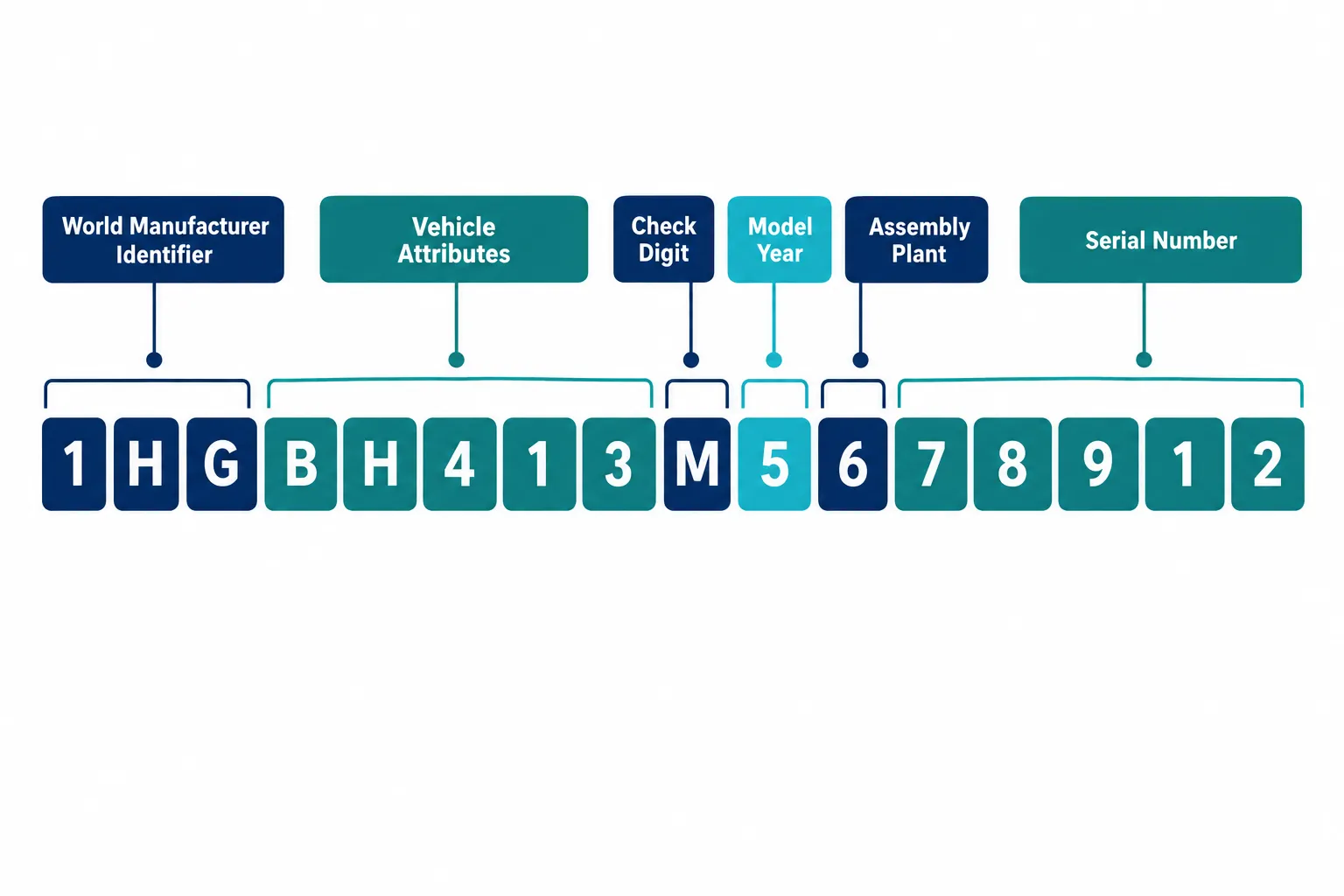
Here’s the big-picture breakdown:
- Characters 1-3: World Manufacturer Identifier (WMI), identifies the company that built the vehicle
- Characters 4-8: Vehicle Descriptor Section (VDS), describes body type, chassis, engine, and other attributes
- Character 9: Check digit, a mathematical safeguard that flags fake or mistyped VINs
- Character 10: Model year code
- Character 11: Assembly plant code
- Characters 12-17: Vehicle Identifier Section (VIS), the RV’s unique serial number
Think of it like a social security number for your rig. No two RVs, even identical floorplans rolling off the same line a day apart, share the same 17 characters [1][9].
How to Decode an RV VIN Number: Complete RV Specs & History Lookup Guide, Position-by-Position Breakdown
This is where the real decoding happens. Insurance companies use a slightly more detailed version of this map specifically for RVs, since campers and motorhomes encode information that regular passenger cars don’t, like axle count and RV type [9].
Here’s a simplified position-by-position table you can reference anytime you’re staring at a VIN plate:
| Position | What It Reveals |
|---|---|
| 1-3 | Manufacturing company (World Manufacturer Identifier) |
| 4 | Type of RV (motorhome, travel trailer, fifth wheel, etc.) |
| 5-7 | Model identifier or model line |
| 8 | Axle count |
| 9 | Check digit (validates the VIN is real) |
| 10 | Year of manufacture |
| 11 | Producing factory/plant |
| 12-17 | Unique serial number for that specific RV |
This structure comes from insurance industry guidance published in early 2026, which notes that RV VINs work like standard automotive VINs but pack extra RV-specific detail into those middle characters [9]. Federal regulation backs this up for trailers specifically, 49 CFR 565.15 Table VIII requires that positions 4 through 8 on a trailer VIN make the trailer type, body type, length, and axle configuration fully decipherable.
That regulation is the reason a legitimate RV VIN decoder can tell you a travel trailer’s approximate length and axle setup without you ever measuring the frame yourself.
A complete decoded report, the kind generated by a quality RV VIN lookup, typically returns far more than the year and manufacturer. Expect fields like:
- RV type (motorhome vs. towable)
- Chassis and engine type
- Fuel type
- Drive configuration (2WD/4WD)
- GVWR weight class
- Assembly plant location
Multiple RV VIN decoding platforms updated throughout 2026 confirm this is now the industry standard for a “complete” report, not just a bare-bones year and make [1][7][10].
Chassis Types, Engine Specs, and the Motorhome VIN Quirk
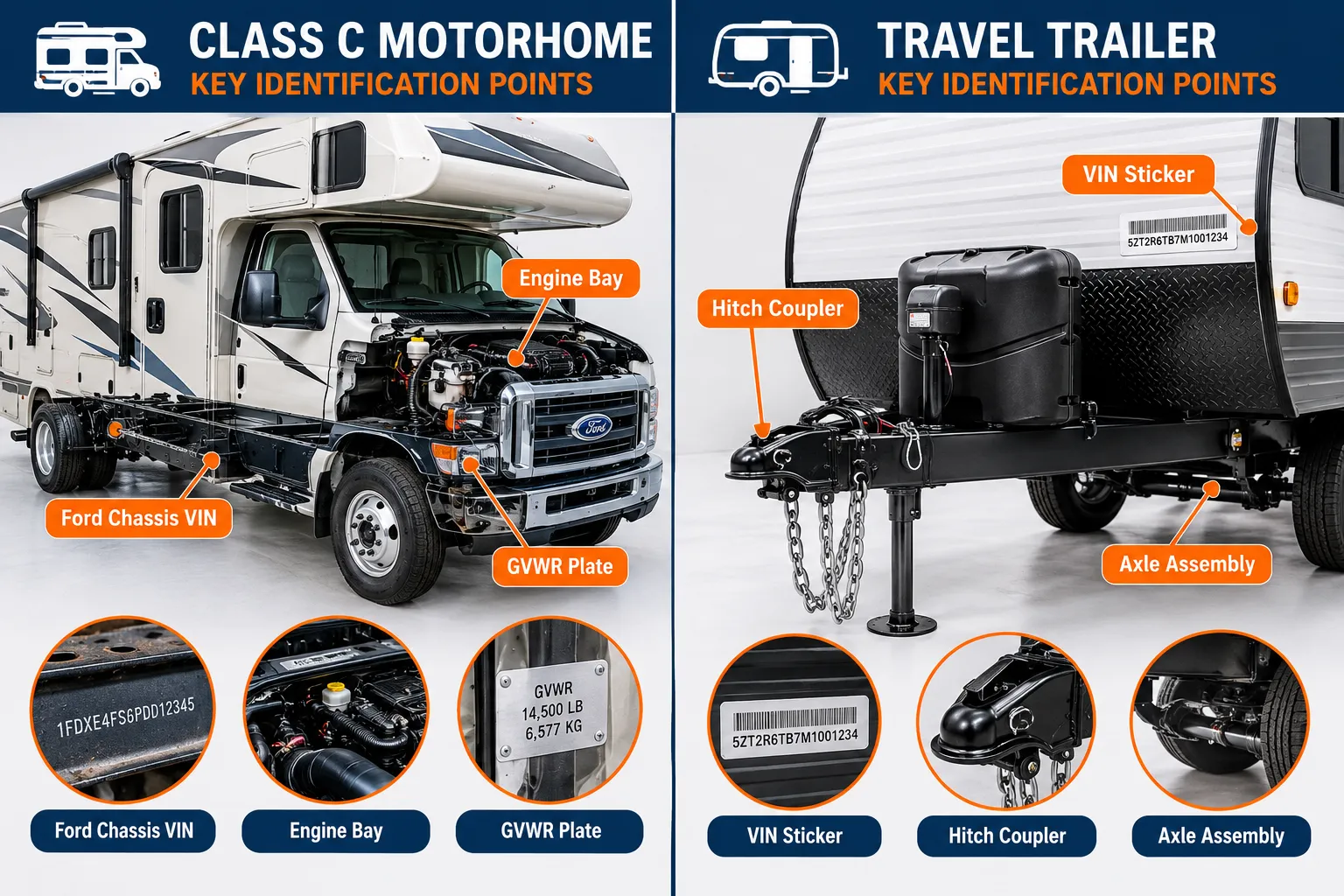
Here’s the part that confuses almost every first-time motorhome buyer: the VIN on your Class A, B, or C motorhome usually belongs to the chassis manufacturer, not the RV brand on the side of the coach [3][4][6][10].