

A five-year loan on an $80,000 motorhome at a 7.34% APR adds up to $15,704 in interest alone before a single gallon of propane gets purchased.[1] That number rarely shows up on the sticker, and it rarely shows up in a buyer’s mental math either. Most shoppers focus on the monthly payment and stop there, missing the bigger financial picture entirely.
This RV Loan Calculator Guide: Down Payment, APR, Term Length, and the True Monthly Cost of Ownership breaks down exactly how lenders structure RV financing in 2026, what online calculators actually measure, and what they leave out. Whether you’re eyeing a travel trailer or a diesel pusher, the math below will help you separate the loan payment from the real cost of keeping an RV on the road.
Key Takeaways
- Down payments on RV loans typically run 10% to 20% of the purchase price, with 20% standard for many bank loan programs.[1][2]
- Fixed APRs in late 2026 mostly sit between 7% and 9% at credit unions and regional banks, though some marketplace lenders advertise rates closer to 6%.[1][3]
- Loan terms now stretch from 5 to 20 years, with 8 to 15 years common for mid-size loans and longer terms reserved for amounts above $50,000.
- Standard RV loan calculators estimate principal and interest only, insurance, storage, maintenance, and fuel must be added separately to find your true monthly cost.[4][5][6][7][8]
- Refinance calculators updated in 2026 let owners re-model their loan mid-ownership to cut interest or lower monthly payments.[9][10]
🚐 RV Loan Calculator
Estimate your monthly payment and total loan cost
| Year | Principal Paid | Interest Paid | Remaining Balance |
|---|
How an RV Loan Calculator Works
Online RV loan calculators have become a standard first stop for shoppers. Nearly every major bank and credit union now offers one, asking for the same four inputs: purchase price, down payment, APR, and term length.[4][5][6][7][8] Plug those in, and the tool spits out an estimated monthly payment, along with total interest paid over the life of the loan.
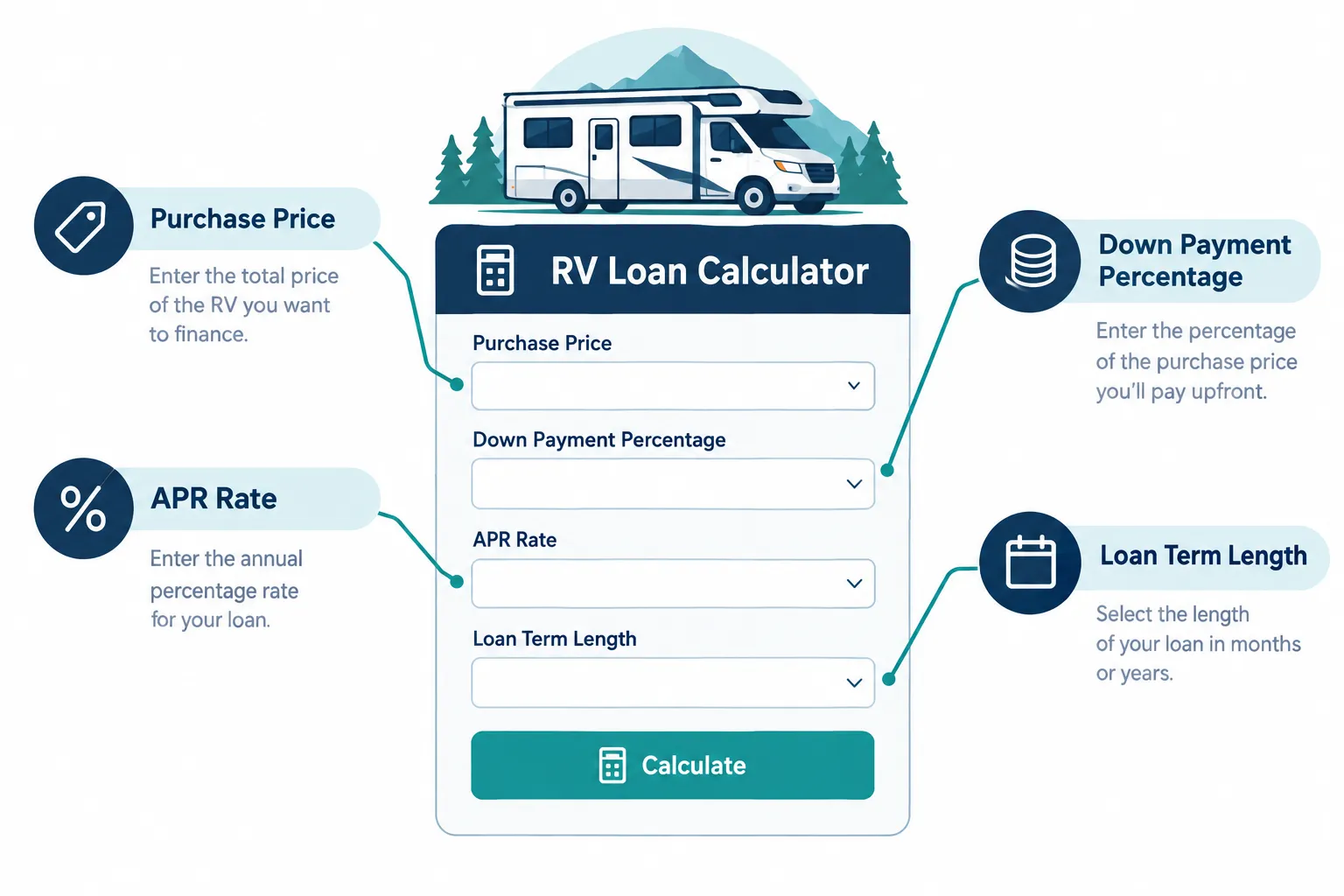
These calculators are marketed less as technical amortization tools and more as budgeting aids. Several lenders frame them around questions like “how much RV can you afford” or “how does this fit your monthly budget,” nudging buyers to think about affordability before they ever walk into a dealership.[4][6]
The more advanced versions go further. Some let you flip the equation, enter a desired monthly payment and see what loan amount that supports, or enter a loan amount and see the resulting payment, principal balance by payment, and a full amortization schedule.[5] Others let you toggle purchase price, down payment, trade-in value, APR, and term side by side to see how each variable shifts the total paid over time.[4][6]
Before running numbers, it helps to understand the vehicle you’re financing. The RV Buying, Ownership & Resale guide covers how motorhome values hold up over time, which directly affects loan-to-value decisions.
Down Payment: The 10-20% Rule in 2026
Down payment size is the single biggest lever buyers control before they even talk APR. Bank financing commonly requires 20% down plus tax, title, and registration fees.[2] Another major bank caps financing at 80% of the purchase price or appraised value, meaning the remaining 20% has to come from the buyer’s pocket, especially on larger coaches.[1]
RV-specific finance specialists report a slightly wider range, typically 10% to 20% down, with higher amounts sometimes required depending on the RV’s model year, mileage, and collateral type. Consumer guidance echoes this, placing most lender requirements in that same 10-20% band.
A bigger down payment does two things: it shrinks the financed amount, which lowers your monthly payment, and it reduces total interest paid over the loan’s life. It also protects you against being upside-down on the loan if the RV depreciates faster than you pay it off, a real risk discussed in detail in the RV Depreciation Calculator resource.
APR: What Rates Actually Look Like Right Now
Fixed RV loan rates in late 2026 cluster in a fairly tight band. One regional bank’s standard example uses a 7.29% interest rate with a $100 origination fee, producing a 7.34% APR on a five-year, $80,000 loan as of June 25, 2026.[1]
Credit unions show similar tiers, often scaled by term length:
| Term Length | Sample APR (as of 2026) |
|---|---|
| Up to 60 months | 7.49% |
| 61-84 months | 7.99% |
| 85-120 months | 8.49% |
| 121-144 months | 8.74% |
| 145-180 months | 8.99% |
Source: credit union rate sheet effective October 1, 2026. A separate credit union’s table shows 7.49% for 10-year terms and 7.74% for 15-year terms as of October 20, 2026.[3] Meanwhile, some lending marketplaces advertise starting APRs around 5.99-6.99% for well-qualified borrowers on extended terms, updated in October 2026.
Your actual rate depends heavily on FICO score, loan-to-value ratio, down payment size, RV age, and term length. A stronger credit profile doesn’t just lower your rate, it often unlocks longer, more flexible terms too.
Term Length: Short, Medium, and Long-Term Tradeoffs
Lenders increasingly sort RV loans into three buckets. One regional bank defines short-term loans as up to 48 months, medium-term as 49 to 84 months, and long-term as 85 to 180 months, explicitly noting that shorter terms mean higher payments but less total interest, while longer terms lower the payment at the cost of more interest over time.[2]
Industry-wide, terms now range from about 5 to 20 years. One RV lender offers terms from 6 to 20 years, with most loans landing between 10 and 15 years. A consumer finance guide pegs the average RV loan term around 84 months (8 years), while noting terms up to 240 months (20 years) exist for larger loans. A lending marketplace confirms terms typically run 60 to 240 months, with the longest terms generally reserved for loans above $50,000.
“Shorter terms mean higher monthly payments but lower total interest; longer terms lower the payment but increase overall interest cost.”, standard lender guidance on RV loan structuring[2]
This tradeoff is the heart of using an RV Loan Calculator Guide: Down Payment, APR, Term Length, and the True Monthly Cost of Ownership approach correctly, you’re not just picking a payment you can afford today, you’re choosing how much extra you’ll pay the bank over the next decade or two.
Running the Real Numbers: Interest, Fees, and Total Cost
Numbers make this concrete. A bank’s own example for an $80,000 RV loan at 7.29% fixed (7.34% APR) over 60 months produces 60 monthly payments of $1,595, with total interest of $15,704.[1] Stretch that same loan amount over a longer term and the monthly payment drops, but the interest bill climbs.
A credit union’s rate table offers smaller-scale comparisons: a $301 monthly payment at 7.49% APR over a 0-60 month term, versus $153 monthly at 8.99% APR stretched to 145-180 months. Another lender’s example uses a $30,000 RV loan at 8.252% APR over 84 months, landing at roughly $471.37 per month plus a one-time $250 processing fee, a reminder that origination fees quietly nudge the effective APR higher than the headline rate.[2]
These examples illustrate why serious calculators show more than just the monthly figure. The best ones display total payments and total interest paid across the loan’s life, alongside a payment-by-payment amortization table showing how much of each payment chips away at principal versus interest.[5][8] A specialized RV finance calculator positions this total-cost view explicitly, letting buyers see the full financing cost over the term rather than just the monthly snapshot.[8]
If you’re weighing a motorhome against other large purchases, the Mercedes-Benz G-Class buying guide and the Porsche and Mercedes-Benz used cars guide apply the same principal-and-interest logic to vehicle financing broadly, the mechanics of amortization don’t change by vehicle category.
Beyond the Loan: Calculating the True Monthly Cost of Ownership
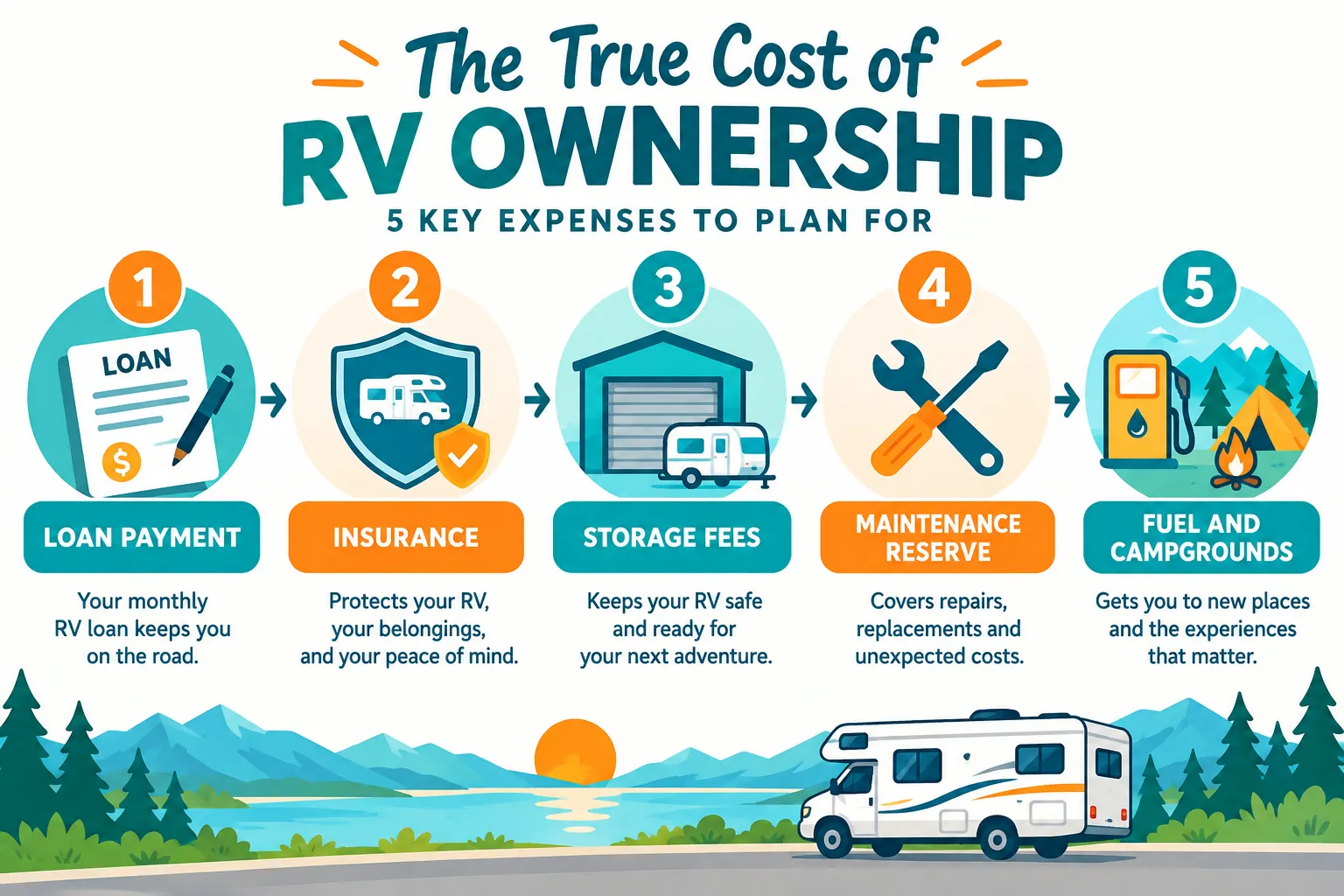
This is where most RV budgets go sideways. Standard loan calculators from banks and credit unions calculate principal and interest on the financed amount, plus the occasional fee, not ongoing operating costs.[4][5][6][7][8] That means insurance, campground and storage fees, routine maintenance, repairs, and fuel all live outside the calculator and have to be budgeted separately.

Here’s a simplified way to build your true monthly number:
| Cost Category | What to Estimate | Where to Find Guidance |
|---|---|---|
| Loan payment (P&I) | From your RV loan calculator output | Bank/credit union calculator[4][6] |
| Insurance | Quote based on RV class and usage | Comparable to auto/boat coverage |
| Storage or campground fees | Monthly or seasonal rate | Campground cost-saving guide |
| Routine maintenance | Annual estimate divided by 12 | RV Maintenance Guide |
| Fuel | Based on expected mileage | Varies by class and driving habits |
| Depreciation (non-cash but real) | Annual value loss | RV Depreciation Calculator |
Add these line items to your loan payment, and you get something much closer to the real monthly burden. Industry guides already stress factoring maintenance, insurance, and depreciation into the buying decision alongside financing terms, even though most calculators haven’t fully caught up to that holistic view yet. It’s a reasonable bet that future tools will add preset fields for these recurring costs, but for now, buyers need to do this math manually.
If you’re considering living in your RV full-time or part-time, the cost structure shifts again, see How Much Does It Cost To Live In An RV and the Full-Time RV Living guide for deeper breakdowns of ongoing lifestyle costs.
A Simple Affordability Worksheet for First-Time Buyers
Use this quick worksheet before you ever submit a loan application:
- Set your purchase price ceiling. Base it on what you’ve seen in real listings, not sticker dreams.
- Pick a down payment percentage. Start at 20% if you want the lowest total interest; 10% if cash flow is tight.[2]
- Estimate your APR tier. Use 7-9% as a realistic 2026 baseline unless your credit profile is exceptional.[1][3]
- Choose a term length deliberately. Shorter terms save money; longer terms protect your monthly cash flow.[2]
- Run the loan calculator for monthly payment and total interest.[5][8][10]
- Add non-loan costs: insurance, storage, maintenance reserve, and fuel.
- Compare the total monthly number against your actual take-home budget, not your approved loan amount.
Avoiding costly missteps at this stage matters. The RV Mistakes That Cost You Thousands and Big RV Mistakes guides cover common financing and budgeting errors worth reviewing before you sign anything.
Refinancing: Recalculating Mid-Ownership
RV loan math isn’t locked in forever. Refinance calculators, like one major bank’s tool updated in September 2026, let existing borrowers plug in their current loan details and model alternative monthly payments, APRs, and terms. That particular program requires a minimum refinance amount of $10,000 and generally covers RVs up to 12 model years old.[9][10]
Refinancing lets owners run two common scenarios: shortening the term to cut total interest once income improves, or extending the term to lower monthly payments during a tighter financial stretch. Either way, it’s the same core calculator logic applied a second time, mid-ownership, to recalibrate the true cost going forward.[9][10]
Conclusion
The math behind an RV loan is more forgiving to understand than it looks, but it only works in your favor if you look past the monthly payment number. Down payment size, APR, and term length interact to determine not just what you pay each month, but how much extra you hand the lender over the life of the loan, and that’s before insurance, storage, maintenance, and fuel enter the picture.
Start by running your numbers through a reputable RV loan calculator using realistic 2026 rate assumptions, then build out the full ownership worksheet above before you commit. If you already own an RV and current rates have shifted, check a refinance calculator to see whether restructuring your loan now makes financial sense. Treat the calculator as the starting point of your budget, not the final answer.
References
- Rv Loans. firstcitizens.com.
- Rv Loans. seacoastbank.com.
- Rv Loans. americafirst.com.
- Rv Boat Loans. cccu.com.
- Payment Calculator. nuvisionfederal.com.
- Rv Loan Calculator. peopledrivencu.org.
- Rv Loan Calculator. seacoastbank.com.
- Rv Loan Calculator. loans.goodsam.com.
- Rv Refinance Calculator. usbank.com.
- Rv Payment Calculator. usbank.com.