
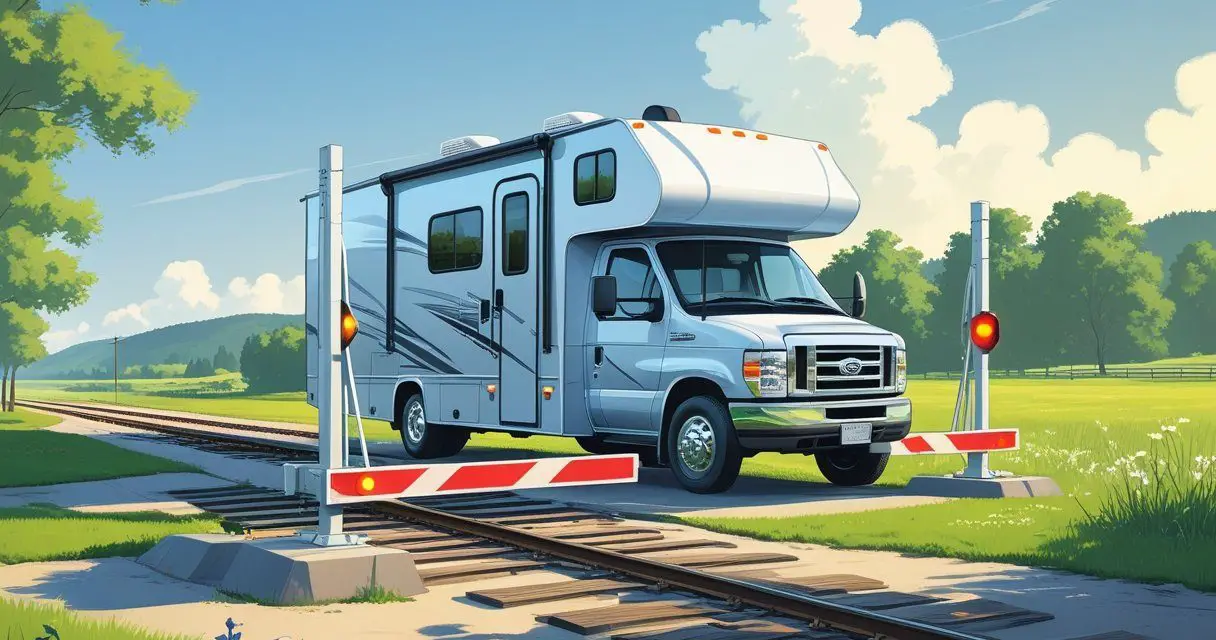
You’re cruising down the highway in your dream RV, windows down, music playing, living your best nomadic life. Suddenly, you spot those familiar railroad crossing signs ahead. Most RVers roll right over those tracks without a second thought – but what you don’t know about railroad crossings could literally be a matter of life and death.
According to Operation Lifesaver, every 3 hours in the United States, a vehicle or person is hit by a train. That’s 8 collisions every single day! Even more startling? Over half of these collisions happen at crossings equipped with lights and gates, meaning drivers are actively ignoring or underestimating the warning systems designed to protect them.
As RVers, you’re driving vehicles that are longer, heavier, and slower than typical cars – making you especially vulnerable to these deadly encounters.
1. Your RV is a 30,000-Pound Sitting Duck (And Trains Don’t Care)
Here’s something that might blow your mind: that “small” Class A motorhome you’re driving can weigh up to 30,000 pounds when fully loaded. Compare that to the average passenger car at around 4,000 pounds, and you’re essentially driving a small building down the highway. But here’s the kicker – while your RV might feel massive and unstoppable, it’s absolutely nothing compared to a freight train.
The average freight train weighs between 12 to 20 million pounds and often pulls around 100 cars. To put this in perspective, your 30,000-pound RV is 400-600 times lighter than the train barreling down those tracks. When a train traveling at 55 mph hits the brakes, it can take over a mile to come to a complete stop – that’s nearly 18 football fields!
| Vehicle Type | Average Weight | Stopping Distance at 55 mph |
|---|---|---|
| Passenger Car | 4,000 lbs | 300-400 feet |
| Class A RV | 20,000-30,000 lbs | 400-500 feet |
| Freight Train | 12-20 million lbs | 5,280+ feet (1+ mile) |
You might think your massive RV gives you some protection, but physics doesn’t negotiate. When an unstoppable force meets a movable object, guess which one wins?
2. That Optical Illusion is Literally Playing Tricks on Your Brain
Ever wonder why so many people think they have “plenty of time” to beat a train across the tracks? Your brain is being hijacked by a deadly optical illusion. A locomotive stands about 17 feet high and 10 feet wide – when viewed from an angle at a crossing, this massive object actually appears to be moving slower than it really is.
The parallel rails create what experts call “size-distance misjudgment,” making trains seem further away than they actually are. Modern trains are also surprisingly quiet, especially compared to the rumbling diesel beasts of decades past. You literally cannot trust your eyes and ears when it comes to judging a train’s speed and distance.
According to Federal Railroad Administration statistics, 2,260 highway-rail grade crossing collisions occurred in 2024, resulting in 261 fatalities and 762 injuries. Many of these accidents happen because drivers genuinely believe they have enough time to cross safely.
You’ve probably made this exact mistake before – seeing a train in the distance and thinking “I’ve got this.” Your brain is literally wired wrong for this situation, so don’t trust it with your life.
3. Your RV’s “Tail” Could Get You Killed (Even When You Think You’re Safe)
Here’s a terrifying fact most RVers never consider: even if your wheels clear the tracks, you might not be safe. Your RV’s rear end overhangs beyond the axle, sometimes by several feet. That fancy bike rack, spare tire, or rear storage compartment could still be in the train’s path even after your wheels have crossed.
Operation Lifesaver recommends at least 15 feet of clearance between the rear of your vehicle and the f