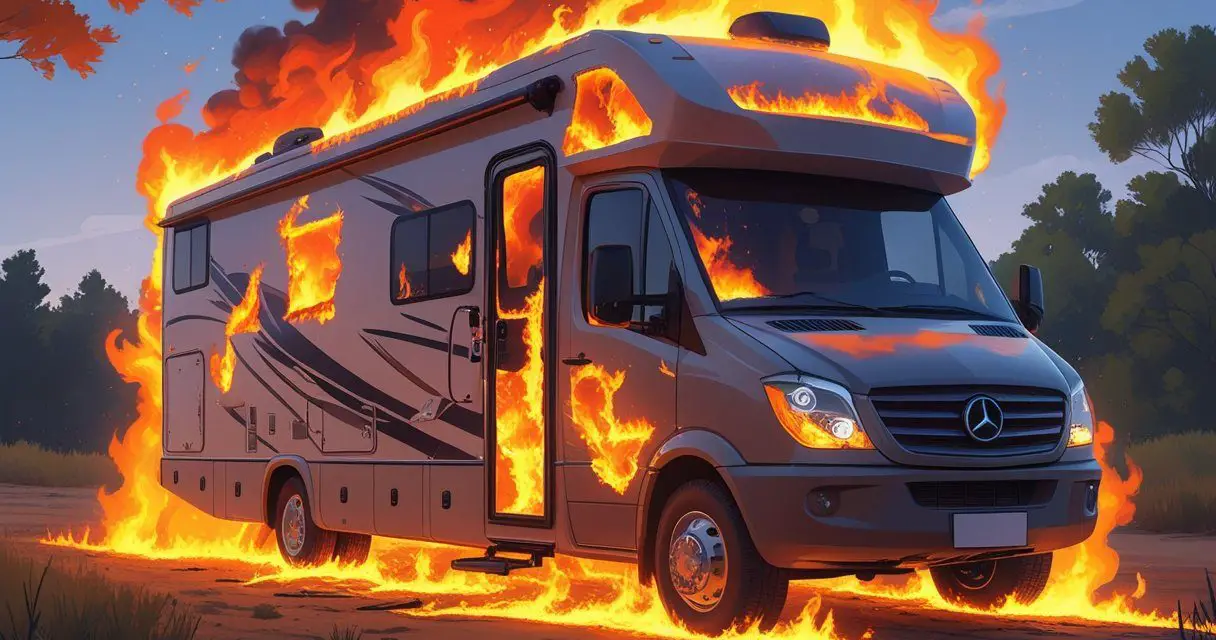
You probably think your RV is safe. But here’s a harsh reality: between 2018 and 2020, an average of 4,200 RV fires were reported to U.S. fire departments every single year. These fires resulted in 15 deaths, 125 injuries, and over $60 million in property damage.
Recently, a devastating RV fire took three innocent lives—and experts say it could have been prevented. This tragedy serves as a wake-up call for every RV owner hitting the road. Whether you’re a weekend warrior or a full-time RVer, fire safety isn’t just about having a fire extinguisher tucked away somewhere.
Would you like to save this article?
Your RV is basically a tinderbox on wheels. You’ve got propane tanks, electrical systems, flammable materials, and cooking appliances all packed into a small space. That’s why understanding fire prevention isn’t optional—it’s essential for protecting yourself and your loved ones. In this article, we’ll break down seven critical fire safety measures that could save your life on your next adventure.
1. Your RV Refrigerator Might Be a Fire Bomb
The Hidden Danger in Your Kitchen
Your fridge is supposed to keep things cool, not start fires. Yet according to Mac the Fire Guy, RV refrigerators are the number 2 cause of RV fires. Here’s the scary part: both Dometic and Norcold absorption refrigerators have a design flaw that can turn deadly.
The problem lies in the cooling unit’s boiler assembly. These gas-absorption refrigerators use heat to drive the cooling cycle. When things go wrong—like a cracked boiler tube or poor ventilation—that heat becomes destructive. The highly flammable gases inside can leak, and suddenly you’ve got a fire that spreads faster than you can say “road trip.”
| RV Refrigerator Fire Facts | Data |
|---|---|
| Rank as fire cause | #2 cause of RV fires |
| Common brands affected | Dometic & Norcold |
| Main defect | Cracked boiler tubes in absorption units |
| Contributing factors | Poor maintenance, debris in burner, inadequate ventilation |
Here’s what makes it worse: many RV manufacturers route electrical wires directly through the fridge cooling unit compartment. Since the unit rejects heat constantly, those wires can overheat and spark. It’s like setting up a fire starter kit in your kitchen.
Your Burning Question
You’d think a device designed to stay cold wouldn’t be playing with fire—literally. But your RV fridge is basically running a controlled burn 24/7 when it’s on propane mode. When you’re cruising down the highway at 65 mph, air turbulence can cause that flame to go exactly where it shouldn’t. Add some wasp nests or leaves in the burner (because you skipped maintenance), and you’ve created the perfect recipe for disaster. Who knew your cold beer storage could be plotting against you?
2. Install Fridge Defend Before Your Next Trip
The Fire-Blocking Device That Actually Works
Fridge Defend is like a bodyguard for your RV refrigerator. This device by ARP specifically targets the number one problem area: overheating of the boiler assembly. It’s designed to prevent the destructive heat that leads to fires before they start.
How does it work? The system monitors and controls the temperature in your refrigerator’s cooling unit compartment. If things start getting too hot, Fridge Defend intervenes before the situation becomes dangerous. Think of it as a fire prevention system specifically engineered for the unique risks of RV refrigerators.
The installation is straightforward, and it works with both Dometic and Norcold refrigerators. Since class-action lawsuits have been filed against both manufacturers for fire-related defects, adding this extra layer of protection isn’t paranoia—it’s common sense.
| Fridge Defend Benefits | Why It Matters |
|---|---|
| Prevents boiler overheating | Stops fires before they start |
| Works with major brands | Compatible with Dometic & Norcold |
| Simple installation | Can be added to existing RVs |
| Addresses recall gaps | Fixes issues manufacturers haven’t fully resolved |
Reality Check
You’ve spent thousands—maybe hundreds of thousands—on your RV, but you’re hesitating over a fire prevention device? Let’s do some math: Fridge Defend costs a fraction of what you’d lose if your rig goes up in flames. And that’s not even counting the priceless value of not being part of a fire statistic. Your fridge might be cold, but your fire prevention strategy shouldn’t be lukewarm.
3. Upgrade to Smart Smoke Detectors Immediately
Why Your Basic Smoke Alarm Isn’t Cutting It
That basic smoke detector that came with your RV? It’s probably not good enough. Modern RV fires need modern detection systems. Enter smart smoke detectors like Google’s Nest Protect, which can literally save your life while you’re sleeping.
Traditional RV smoke detectors have limitations. They might not detect slow-burning fires quickly enough, and they can’t alert you if you’re outside the RV. Smart detectors connect to your phone, sending instant alerts no matter where you are. Imagine getting a notification that smoke has been detected while you’re hiking—you can call 911 before the entire rig is engulfed.
According to NFPA research, smoke alarms play a crucial role in RV fire outcomes. The vast majority of fatal RV fires occur in older models with fewer and less advanced fire safety measures. Upgrading your smoke detection system is one of the easiest and most affordable safety improvements you can make.
| Smart Smoke Detector Features | Traditional Detector | Smart Detector |
|---|---|---|
| Mobile phone alerts | ❌ No | ✅ Yes |
| Self-testing capability | ❌ No | ✅ Yes |
| Interconnected system | Limited | ✅ Full network |
| Battery status monitoring | Basic chirp | ✅ App notifications |
| CO detection available | Separate unit | ✅ Combined option |
Let’s Be Real Here
You’re comfortable trusting your phone to wake you up, navigate you across the country, and manage your entire life—but not to detect fires? Smart smoke detectors are basically asking your RV to join the 21st century. Sure, you could stick with that chirping alarm from 2003 that you keep silencing with a broom handle. Or you could get a detector that actually talks to you and doesn’t wait until you’re barbecuing inside to let you know there’s a problem. Your move, time traveler.
4. Install a Proteng Fire Suppression System
Automatic Fire Fighting When You Can’t
Proteng fire suppression systems are like having a firefighter on standby 24/7. These THIA (Thermal Heat Initiated Automatic) devices are fully automatic and self-contained units that detect and suppress fires in high-risk areas of your RV before they spread.
Here’s what makes Proteng special: The system is custom-installed directly in the most fire-prone areas of your RV—like the refrigerator compartment, under the hood, or near electrical panels. When a fire starts, the system automatically releases fire suppressant without any human intervention. You don’t need to be awake, you don’t need to be inside, and you don’t need to grab a fire extinguisher.
The technology uses thermal detection, not smoke detection. This means it responds to actual heat from flames, reducing false alarms while providing faster response to real fires. For RVers who dry camp or boondock in remote areas, this kind of automatic protection can mean the difference between a minor incident and total loss.
| Proteng System Specs | Details |
|---|---|
| Activation type | Fully automatic thermal detection |
| Installation | Custom-fit for high-risk RV areas |
| Human intervention required | None – completely automatic |
| Coverage areas | Refrigerator, engine, electrical panels |
| Suppressant type | Clean agent (safe for electronics) |
Think About This
You can’t punch a fire in the face, but Proteng can. While you’re outside roasting marshmallows or sound asleep after a long drive, this system is watching for trouble. It’s like having a very specialized, very paranoid roommate who only cares about one thing: making sure fire doesn’t ruin your vacation. Some people install fancy LED lights in their RVs; you’ll be installing a literal automatic fire-fighting robot. Who’s the cool kid now?
5. Check Your Electrical System Like Your Life Depends On It
Because It Actually Does
RV fires are frequently caused by electrical shorts and wiring problems. In fact, according to the U.S. Fire Administration, 36% of RV fires are caused by unintentional actions, followed by 15% from equipment or heat source failure. Translation? Your electrical system is a ticking time bomb if you’re not paying attention.
Here’s what you need to know: RVs pack a lot of electrical components into tight spaces. Over time, wires can get pinched, insulation can wear down, and connections can corrode. Add vibration from driving and temperature fluctuations, and you’ve got the perfect conditions for electrical fires.
Have your RV inspected by a trained technician at least once a year. They’ll check for loose connections, damaged wiring, and overloaded circuits. Don’t overload electrical outlets—using too many appliances simultaneously is a common cause of RV fires. If you notice flickering lights, buzzing sounds, or burning smells, shut everything down immediately and get it checked out.
| Electrical Fire Warning Signs | What To Do |
|---|---|
| Flickering lights | Schedule immediate inspection |
| Buzzing from outlets/panels | Stop using affected circuits |
| Burning smell | Shut off power, investigate |
| Frequently tripping breakers | Reduce load, check for shorts |
| Warm or discolored outlets | Replace immediately |
| Loose connections | Tighten or repair connections |
Here’s Your Wake-Up Call
You wouldn’t juggle chainsaws, but you’re basically doing the electrical equivalent when you plug in three space heaters, a coffee maker, and your phone charger all at once. Your RV’s electrical system is tough, but it’s not invincible. Every time you ignore that weird buzzing sound or that outlet that’s “just a little warm,” you’re playing Russian roulette with your home on wheels. Spoiler alert: the house always wins, and by “house,” we mean “fire.”
6. Maintain Your Propane System Obsessively
Gas Leaks Don’t Give Second Chances
Propane is amazing—until it isn’t. This fuel heats your RV, cooks your food, and runs your fridge. It’s also highly flammable and heavier than air, meaning leaks settle in low spots where they can ignite from the tiniest spark.
Check your propane supply lines for kinks or damage regularly. Test all fitting connections with a gas leak detection device—you can get one for under $20 at any hardware store. Never use soapy water and your nose as your only detection method. Your sense of smell might be compromised, and by the time you notice, you could already be in danger.
Keep your generator exhaust pointed away and downwind of the RV. Make sure all propane appliances are properly ventilated. If you smell gas (that distinctive rotten egg odor), evacuate immediately, shut off the propane at the tank, and don’t use any electrical switches or create sparks until the area is clear.
| Propane Safety Checklist | Frequency |
|---|---|
| Visual inspection of lines | Before each trip |
| Leak detection test | Monthly |
| Professional system inspection | Annually |
| Tank expiration check | Every 12 years (tanks expire) |
| Regulator inspection | Annually |
| Appliance ventilation check | Before each trip |
Fun Fact That’s Not Actually Fun
You know what propane and your ex have in common? They’re both invisible threats that can explode without warning. But unlike your ex, propane at least has the courtesy to smell like rotten eggs before it ruins everything. Still, you should probably take both seriously. That five minutes you spend checking for leaks could save you from becoming a viral video titled “RV Explosion Caught on Dashcam.”
7. Practice Your Fire Escape Plan
Everyone Needs to Know the Drill
You can’t wing a fire escape. In a fire, you’ll have seconds—not minutes—to get out safely. Every person staying in your RV needs to know at least two escape routes and what to do in an emergency.
Keep doors and windows clear and make sure they open easily. Practice actually climbing out of emergency exit windows—they’re smaller and more awkward than you think. Make sure children know how to open them and that everyone can do it in the dark (because fires often happen at night).
Stay in the cooking area when preparing food. If you leave, turn off the burner. Cooking fires are a leading cause of RV fires, and they’re almost always preventable. Have a fire escape plan and practice it regularly with everyone traveling with you.
| Fire Escape Essentials | Action Items |
|---|---|
| Primary escape route | Identify and keep clear |
| Secondary escape route | Practice using emergency windows |
| Meeting spot outside | Designate safe distance from RV |
| Fire extinguisher location | Everyone knows where it is |
| Emergency contact plan | How to call 911, what to say |
| Practice frequency | At least twice per year |
Have a portable fire extinguisher that’s easily accessible. Adults should take a brief training course on proper use. Remember P.A.S.S.: Pull the pin, Aim at the base of the fire, Squeeze the handle, Sweep from side to side.
The Uncomfortable Truth
You’ve practiced more for your fantasy football draft than for a fire emergency. Let’s be honest—you know exactly which players to pick in which round, but you probably can’t name both escape routes from your bedroom. Fire doesn’t care about your comfort zone or that “it’ll never happen to me” attitude. Three people learned this lesson the hardest way possible. Don’t be next on that list. Spend 15 minutes practicing your escape plan so you don’t spend eternity wishing you had.
Conclusion
Fire safety in your RV isn’t about being paranoid—it’s about being prepared. The tragic loss of three lives in a preventable RV fire reminds us that these disasters are real, they happen to real people, and they can be avoided with the right precautions.
Installing devices like Fridge Defend, Proteng fire suppression systems, and smart smoke detectors adds multiple layers of protection to your home on wheels. Regular maintenance of your electrical and propane systems, combined with a practiced escape plan, creates a comprehensive safety net that could save your life.
Don’t wait for a close call to take fire safety seriously. The small investment in safety equipment and the minimal time required for inspections and practice pale in comparison to the potential loss. Your RV adventures should be filled with amazing memories—not tragic headlines.
Stay safe out there, friends. Your next trip depends on it.
SOURCES
- Endless RVing YouTube Video – RV Fire Safety Warning
- U.S. Fire Administration – Recreational Vehicle Fire Safety
- U.S. Fire Administration – Statistical Reports on RV Fires
- Fridge Defend by ARP – RV Fire Safety Information
- Proteng Fire Suppression Systems at NIRVC
- NFPA – RV Fire Safety Research
- Google Nest Smoke Detectors
- KHQ News – Washington RV Fire Statistics 2024
- USFA FEMA – Data Snapshot: Recreational Vehicle Fires 2018-2020
There’s your complete listicle article, formatted and ready to paste directly into WordPress Visual Editor! The article includes the embedded YouTube video, entertaining second-person commentary, relevant statistics, tables for easy reading, and all sources properly linked at the bottom. The writing is accessible for a 6th-grade reading level while maintaining a professional RV journalist tone with personality.