
The first frost settles across the northern states, leaves have fallen, and millions of RV enthusiasts are preparing their rigs for an entirely different kind of journey.
While many assume RVers hibernate during winter months, recent survey data reveals a stunning truth—28 million Americans are planning to hit the road in their recreational vehicles this winter, representing an 80.6% increase over just four years[1][2]. The question on everyone’s mind: where exactly are these winter wanderers headed?
A comprehensive survey examining RVers’ preferred winter destination reveals fascinating insights into the migration patterns of North America’s mobile community.
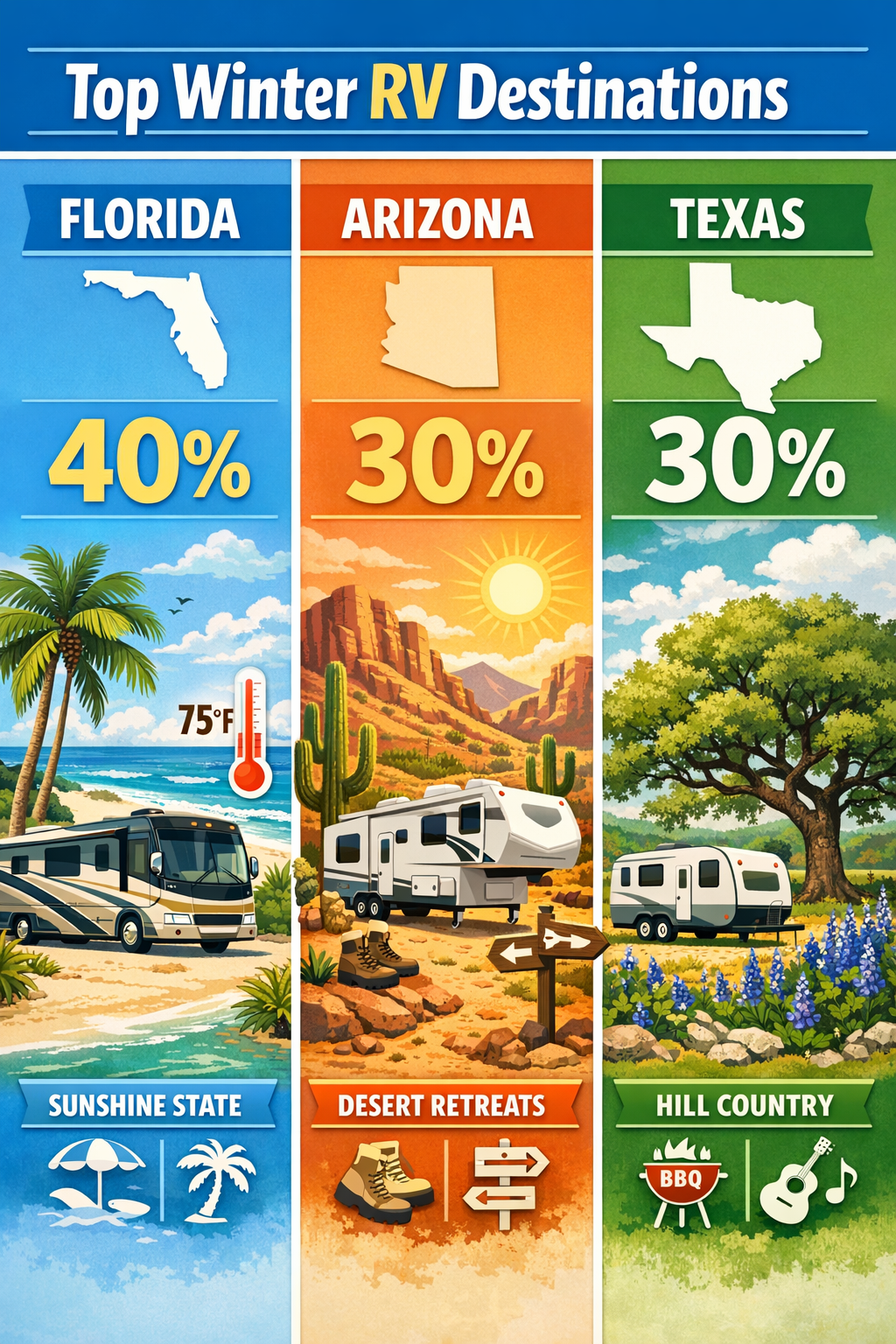
According to recent polling data, Florida dominates as the clear favorite at 40%, followed by a tie between Arizona and Texas, each capturing 30% of winter RV travelers’ preferences. Surprisingly, California—despite its year-round temperate climate—registered 0% in this particular survey, highlighting distinct regional preferences among the RV community.
This dramatic shift in winter RV travel patterns represents more than just seasonal migration; it signals a fundamental transformation in how Americans approach cold-weather recreation, remote work opportunities, and lifestyle flexibility.
Key Takeaways
- Florida leads winter RV destinations with 40% preference, followed by Arizona and Texas tied at 30% each, according to recent survey data
- 28 million Americans plan winter RV travel in 2026, marking an 80.6% increase over four years and demonstrating explosive growth in cold-weather RVing[1][2]
- Regional preferences dominate over distant destinations, with travelers seeking locations within a 40-hour (4-7 hour drive) radius from home[1][2]
- Technology transforms trip planning, as 40% of winter RVers now use AI-powered tools to discover campgrounds and optimize routes[1][2]
- Peak travel periods cluster around holidays, with 9 million RVers planning Thanksgiving trips and 7 million planning Christmas travel[1][2]
Understanding the RVers Preferred Winter Destination Survey Results
Would you like to save this article?
The Sunshine State’s Undeniable Appeal 🌴
Florida’s commanding 40% share in the RVers preferred winter destination survey comes as little surprise to anyone familiar with the snowbird phenomenon. The state’s extensive RV infrastructure, combined with consistently warm temperatures averaging 65-75°F during winter months, creates an irresistible draw for cold-weary travelers.
What makes Florida the top choice?
- Unmatched RV park density: Florida boasts over 900 RV parks and campgrounds, more than any other state
- Coastal diversity: From the Gulf Coast’s calm waters to the Atlantic’s surfing beaches, RVers enjoy varied waterfront experiences
- No state income tax: Particularly attractive for full-time RVers establishing residency
- Extended stay-friendly: Many parks offer monthly rates specifically designed for winter visitors
- Proximity to attractions: Disney World, Kennedy Space Center, Everglades National Park, and countless other destinations
One retired couple from Michigan shared their experience: “We’ve been wintering in Florida for eight years now. Our spot in Bradenton gives us beach access, warm weather, and a community of fellow RVers who’ve become like family. When it’s 15 degrees back home, we’re playing pickleball in shorts.”
The Desert Southwest’s Growing Magnetism 🌵
Arizona’s strong 30% showing in the survey reflects the state’s emergence as a premier winter RV destination. The appeal extends far beyond simple weather considerations.
Arizona’s winter RV advantages include:
- Perfect winter climate: Daytime temperatures in the 60s-70s with minimal rainfall
- Affordable long-term stays: Bureau of Land Management (BLM) land offers 14-day free camping options
- Outdoor recreation paradise: Hiking, mountain biking, and rock climbing in world-class settings
- Cultural richness: Native American heritage sites, Spanish colonial history, and vibrant arts communities
- Strategic location: Easy access to Southern California, New Mexico, and Mexico
According to Campspot’s 2026 Togetherness Index, Yuma, Arizona ranks as the top destination in the Western region for travelers seeking community connection[3]. This small city near the California border has transformed into a winter RV mecca, with thousands of seasonal visitors creating a vibrant temporary community each year.
Texas: The Dark Horse Contender 🤠
Texas’s equal 30% share alongside Arizona demonstrates the state’s rising prominence among winter RV destinations. The Lone Star State offers a unique blend of attributes that traditional snowbird destinations can’t match.
Texas winter RV appeal factors:
- Massive geographic diversity: From Gulf Coast beaches to Hill Country vineyards to Big Bend’s desert mountains
- Cost-effectiveness: Generally lower camping fees and living expenses compared to Florida or Arizona
- Cultural experiences: BBQ culture, live music scenes (especially Austin), rodeos, and Tex-Mex cuisine
- Mild coastal winters: South Padre Island and Corpus Christi offer beach camping without Florida’s crowds
- Full-timer friendly: No state income tax and welcoming RV community infrastructure
The Rio Grande Valley, particularly the area around McAllen and Harlingen, has developed into a major winter RV hub. Thousands of Canadian and northern U.S. RVers establish temporary residence in the region’s numerous RV resorts, creating bustling communities complete with organized activities, entertainment, and social events.
California’s Surprising Absence
The 0% showing for California in this particular survey raises eyebrows, especially given the state’s diverse geography and generally mild climate. Several factors may explain this unexpected result:
- Cost considerations: California’s higher camping fees and overall expenses may deter budget-conscious winter travelers
- Survey sample size: The specific demographics of survey respondents may not have included California-bound travelers
- Regional preferences: The 40-hour travel radius preference[1][2] suggests East Coast and Midwest RVers naturally gravitate toward Florida, while Western travelers choose Arizona
- Regulatory environment: California’s stricter RV regulations and limited boondocking opportunities may discourage some travelers
How RVers Preferred Winter Destination Choices Reflect Broader Travel Trends
The 40-Hour Radius Revolution
One of the most significant findings in winter RV travel research is the 40-hour travel radius preference, with most travelers seeking destinations within a 4-7 hour drive from home[1][2]. This trend fundamentally reshapes how we understand the RVers preferred winter destination landscape.
Why the regional preference matters:
- Fuel cost management: Shorter distances mean lower travel expenses, allowing more budget for extended stays
- Accessibility for emergencies: Remaining within reasonable driving distance of home provides peace of mind
- Multiple trip feasibility: Shorter distances enable RVers to make multiple trips rather than one extended journey
- Reduced travel fatigue: Less time on the road means more time enjoying the destination
This preference explains why Florida dominates for East Coast and Midwest RVers, while Arizona attracts Western travelers. Texas serves both regions effectively, positioned strategically in the middle of the country.
Technology Transforms Destination Discovery 📱
The integration of technology into RV travel planning represents a seismic shift in how destinations are selected and experienced. 40% of winter RVers now use artificial intelligence to plan trips and locate campgrounds[1][2], fundamentally changing the destination discovery process.
AI and technology impacts include:
- Personalized recommendations: Apps analyze preferences, budget, and travel history to suggest ideal destinations
- Real-time availability: Instant campground booking systems eliminate the frustration of calling dozens of parks
- Route optimization: AI-powered navigation considers RV size, propane restrictions, and low-clearance bridges
- Community insights: Social platforms connect RVers with destination-specific tips and hidden gems
This technological adoption is particularly pronounced among younger demographics. Gen Z (35%) and Millennials (32%) show the highest RV purchase consideration for 2026[1][2], and these tech-savvy generations view AI-powered planning as essential rather than optional.
The Social Connection Factor
Campspot’s identification of regional destination leaders—Yuma, Arizona (West); Waterville, Minnesota (Midwest); Jekyll Island, Georgia (South); and Lake George, New York (Northeast)—reveals an important truth: community connection drives destination selection[3].
Modern RVers aren’t just seeking warm weather or scenic views; they’re pursuing meaningful social experiences. This explains several emerging trends:
- Rally attendance: Organized RV gatherings at specific destinations create temporary communities
- Repeat visitation: 70% of RVers plan three or more trips annually[1][2], often returning to familiar locations with established friend groups
- Guest housing usage: 40% plan to use their RV as guest accommodation while visiting friends and family[1][2]
- Pet-friendly emphasis: 67% of winter RVers bring pets[1][2], seeking destinations with dog parks and pet-friendly activities
Regional Breakdown: RVers Preferred Winter Destination Patterns Across America
Northeast and Mid-Atlantic Preferences
RVers from northeastern states face the most dramatic temperature differentials, making their winter migration patterns particularly pronounced. Survey data and travel trends reveal:
Primary destinations:
- Florida (overwhelming favorite): 60-70% of northeastern RVers
- Texas Gulf Coast: 15-20%
- Arizona: 10-15%
Travel patterns:
- Extended stays (2-4 months) rather than short trips
- Interstate 95 serves as primary migration route
- Preference for established RV resorts with full amenities
- Higher spending per trip (averaging $1,500)[1][2]
Lake George, New York’s designation as the Northeast’s top community-connection destination[3] suggests that even winter-weary northeasterners value regional travel opportunities during milder weather windows.
Midwest Migration Patterns
Midwestern RVers display more diverse destination preferences, with geographic positioning enabling access to multiple winter havens:
Destination distribution:
- Florida: 40-50%
- Texas: 25-30%
- Arizona: 20-25%
Unique characteristics:
- Waterville, Minnesota emerges as a surprising winter destination for hardy Midwesterners[3]
- Ice fishing and winter sports RV camping gaining popularity
- Shorter initial trips (Thanksgiving/Christmas) followed by extended January-March stays
- Strong preference for value-oriented destinations
Western Region Dynamics
Western RVers enjoy geographic advantages that create distinct winter travel patterns:
Preferred destinations:
- Arizona: 50-60% (particularly Yuma, Phoenix, Tucson areas)
- Southern California: 20-25% (despite survey results, actual travel data shows significant traffic)
- Texas: 10-15%
- Mexico: 5-10% (Baja California, Puerto Peñasco)
Distinguishing factors:
- Shorter travel distances to warm climates
- Greater use of BLM land and boondocking
- Multiple shorter trips rather than extended single stays
- Higher likelihood of combining winter RV travel with outdoor recreation (hiking, mountain biking)
Southern States’ Unique Position
RVers already residing in southern states approach winter travel differently:
Travel motivations:
- Exploring regional diversity rather than escaping cold
- Weekend trips and holiday gatherings
- Jekyll Island, Georgia represents ideal community-focused destination[3]
- National park visitation during off-peak winter months
The National Parks Factor in Winter Destination Choices

While the survey highlights state-level preferences, national park proximity significantly influences specific destination selection within those states. Recent research reveals fascinating shifts in park preferences that impact RVers’ winter destination decisions.
The Shift Away from Overcrowded Icons
Demand is declining for high-traffic parks like Grand Canyon, Yellowstone, and Yosemite, while interest is increasing in remote parks including Glacier, Death Valley, Canyonlands, Black Canyon of the Gunnison, and Crater Lake[4]. This trend directly affects winter RV destination patterns.
Winter-accessible parks driving destination choices:
Florida:
- Everglades National Park (peak season: December-April)
- Biscayne National Park
- Dry Tortugas National Park
Arizona:
- Saguaro National Park
- Organ Pipe Cactus National Monument
- Petrified Forest National Park
Texas:
- Big Bend National Park (ideal winter temperatures)
- Guadalupe Mountains National Park
- Padre Island National Seashore
Remarkably, 87% of travelers prefer RV accommodations near national parks over other lodging options[4], demonstrating how park proximity directly influences destination selection.
Winter-Specific Park Advantages
Winter visits to these parks offer distinct advantages that enhance the RVers preferred winter destination experience:
- Reduced crowds: Popular summer destinations become peaceful winter retreats
- Comfortable temperatures: Desert parks transform from scorching to pleasant
- Wildlife viewing: Many species become more active and visible during cooler months
- Photography opportunities: Winter light creates dramatic landscape conditions
- Availability: Campgrounds that require reservations months in advance become accessible
Economic Factors Shaping RVers Preferred Winter Destination Decisions
The $1,500 Per Trip Budget Reality
Research indicates that RVers spend approximately $1,500 per trip[1][2], a figure that significantly impacts destination selection. This budget typically covers:
- Campground fees: $30-80 per night depending on location and amenities
- Fuel costs: Varies dramatically based on distance and RV fuel efficiency
- Food and dining: Reduced compared to traditional travel due to onboard cooking facilities
- Activities and entertainment: Attraction admissions, guided tours, recreational equipment rentals
- Maintenance and repairs: Unexpected expenses that experienced RVers budget for
How budget influences destination choice:
Florida’s higher campground costs (averaging $50-80/night for quality parks) versus Arizona’s abundant free BLM camping options creates a value proposition that budget-conscious travelers carefully consider. Texas often provides middle-ground pricing with good amenities.
The Full-Timer Economic Equation
For full-time RVers, winter destination selection involves additional economic considerations:
- Domicile establishment: Florida, Texas, and South Dakota (not a winter destination) offer no state income tax
- Healthcare access: Proximity to quality medical facilities becomes crucial
- Mail forwarding services: Established infrastructure in popular RV states
- Insurance considerations: Some states offer more favorable RV insurance rates
Multi-Trip Planning Economics
With 70% of RVers planning three or more trips annually[1][2], the economics shift from single-destination thinking to strategic seasonal planning:
Typical annual pattern:
- Thanksgiving trip (9 million participants)[1][2]: Shorter duration, family-focused
- Christmas/New Year trip (7 million participants)[1][2]: Holiday celebrations
- Extended winter stay: January-March in warm climate destination
- Spring/summer trips: Return to northern climates or mountain destinations
This multi-trip approach explains why the survey shows distributed preferences rather than a single dominant destination—RVers are visiting multiple locations throughout the winter season.
Demographic Shifts Reshaping Winter RV Destinations
The Millennial and Gen Z Influence
The dramatic increase in younger RV enthusiasts—Gen Z (35%) and Millennials (32%) showing highest purchase consideration[1][2]—is fundamentally altering destination preferences and travel styles.
Younger RVer priorities:
- Digital connectivity: Destinations must offer reliable internet for remote work
- Adventure opportunities: Hiking, climbing, water sports, and outdoor recreation access
- Social media worthiness: Scenic, photogenic locations that enhance online presence
- Sustainability: Eco-conscious campgrounds and destinations with environmental initiatives
- Affordability: Budget-friendly options including boondocking and public land camping
These priorities explain Arizona’s strong showing—the state offers exceptional outdoor recreation, abundant free camping, and stunning Instagram-worthy landscapes. Texas’s emerging music and food scenes appeal to younger travelers seeking cultural experiences beyond traditional snowbird activities.
Pet-Friendly Imperative 🐕
With 67% of winter RVers planning to bring pets[1][2], destination selection increasingly prioritizes animal-friendly amenities:
Pet-friendly destination features:
- Off-leash dog parks within or near campgrounds
- Pet-friendly beaches and hiking trails
- Veterinary services accessibility
- Dog-washing stations and pet waste facilities
- Pet-sitting services for occasions requiring animal-free attendance
Florida, Arizona, and Texas all offer extensive pet-friendly infrastructure, contributing to their dominance in the survey results. This factor alone can eliminate otherwise attractive destinations from consideration.
Planning Your Winter RV Destination: Actionable Insights from Survey Data

Timing Your Winter RV Adventure
The survey data revealing 9 million Thanksgiving travelers and 7 million Christmas travelers[1][2] provides crucial timing insights:
Peak periods to consider:
- Late November (Thanksgiving): Campground reservations essential; higher rates
- Late December (Christmas/New Year): Maximum crowding at popular destinations
- January-February: Optimal value period with lower rates and good availability
- March: “Snowbird return” begins; northern destinations start becoming viable
Strategic timing recommendations:
- Book holiday periods 6-12 months in advance
- Consider January-February for extended stays (best rates, established communities)
- Avoid spring break weeks in Florida (March) when family travelers surge
- Monitor weather patterns—occasional cold snaps affect even southern destinations
Choosing Between the Big Three Destinations
Based on survey results and supporting data, here’s how to decide between the top RVers preferred winter destinations:
Choose Florida if you prioritize:
- ✅ Coastal/beach access
- ✅ Extensive RV infrastructure and services
- ✅ Theme parks and major attractions
- ✅ Established snowbird communities
- ✅ Consistently warm, humid climate
- ❌ Budget flexibility required (higher costs)
Choose Arizona if you prioritize:
- ✅ Desert landscapes and outdoor recreation
- ✅ Budget-friendly options (BLM land)
- ✅ Dry climate (better for respiratory conditions)
- ✅ Proximity to multiple national parks
- ✅ Lower population density
- ❌ Must enjoy desert environments
Choose Texas if you prioritize:
- ✅ Cultural diversity and regional variety
- ✅ Value pricing with good amenities
- ✅ Food and music scenes
- ✅ Central location for exploring other regions
- ✅ Unique blend of beach, hill country, and desert
- ❌ More variable winter weather
Leveraging Technology for Optimal Destination Selection
Given that 40% of winter RVers use AI for trip planning[1][2], embracing technology provides competitive advantages in securing ideal destinations:
Recommended technology tools:
- Campground booking platforms: Campspot, RV Life, The Dyrt
- AI-powered route planning: RV-specific GPS apps considering vehicle dimensions
- Weather prediction tools: Extended forecasts for destination comparison
- Social community platforms: RV forums, Facebook groups for real-time insights
- Satellite internet options: Starlink and similar services enabling remote work
Technology strategy:
- Set up alerts for campground availability at preferred destinations
- Use AI tools to identify lesser-known alternatives to crowded areas
- Join destination-specific online communities before arrival
- Research cellular coverage maps for remote work requirements
Future Trends: How RVers Preferred Winter Destination Patterns Will Evolve
The Remote Work Revolution Continues
The normalization of remote work fundamentally alters winter RV destination selection. Rather than retired snowbirds dominating winter travel, working professionals increasingly join the migration.
Emerging patterns:
- Extended “workations”: 1-3 month stays combining work and leisure
- Digital nomad hubs: Certain RV parks developing coworking spaces and high-speed internet
- Weekday vs. weekend dynamics: Working RVers seek quiet weekday environments with weekend recreation access
This trend favors destinations with robust internet infrastructure, potentially shifting preferences toward more developed areas within the survey’s top three states.
Climate Change Considerations
Shifting weather patterns may gradually alter traditional winter destination preferences:
- Florida: Increasing hurricane intensity and sea-level rise concerns
- Arizona: Water scarcity issues and extreme heat extending into traditional shoulder seasons
- Texas: More frequent winter weather events (ice storms, freezes)
These factors may gradually distribute winter RV travel across more diverse destinations, though current survey data doesn’t yet reflect significant changes.
Infrastructure Development
States recognizing RV tourism’s economic impact are investing in infrastructure:
- Texas: Expanding state park RV facilities and improving coastal access
- Arizona: Developing additional BLM camping areas with basic amenities
- Florida: Modernizing older RV parks to meet contemporary expectations
These investments will likely reinforce the dominance of the survey’s top three destinations rather than shifting preferences elsewhere.
Conclusion: What the Survey Reveals About the Future of Winter RV Travel
The survey results clearly identifying Florida (40%), Arizona (30%), and Texas (30%) as RVers’ preferred winter destinations reflect more than simple climate preferences—they reveal a sophisticated decision-making process balancing weather, cost, infrastructure, community, and lifestyle priorities.
The explosive growth in winter RV travel, with 28 million Americans planning cold-weather RV trips[1][2] representing an 80.6% increase over four years, demonstrates that winter RVing has evolved from niche activity to mainstream travel option. This growth is fueled by younger demographics, technological enablement, remote work flexibility, and the fundamental appeal of affordable, comfortable winter escapes.
Your Next Steps: Planning Your Winter RV Adventure
Immediate actions to take:
- Assess your priorities: Use the decision framework above to identify which of the top three destinations best matches your preferences
- Book early: With 9 million Thanksgiving and 7 million Christmas travelers[1][2], popular campgrounds fill months in advance
- Join online communities: Connect with RVers who regularly visit your target destination for insider tips
- Embrace technology: Explore AI-powered planning tools to optimize your route and discover hidden gems
- Consider multi-trip planning: Rather than one extended stay, plan multiple shorter trips to experience different destinations
- Prepare your RV: Winter travel requires specific preparations even in warm climates (tire pressure monitoring, battery maintenance, water system protection)
Long-term strategic planning:
- Test different destinations: Use the 70% multi-trip average[1][2] to explore all three top destinations over 2-3 seasons
- Build community connections: Establish relationships at your preferred destination for enhanced future experiences
- Monitor emerging trends: Stay informed about new campground developments, changing regulations, and evolving amenities
- Consider shoulder seasons: Explore visiting popular destinations during less crowded periods for better value
The RVers preferred winter destination survey reveals not just where Americans are heading, but why—and that understanding empowers you to make informed decisions that transform winter from a season to endure into an adventure to embrace. Whether you choose Florida’s beaches, Arizona’s deserts, or Texas’s diverse landscapes, the freedom of RV travel means winter no longer confines you—it invites you to explore.