Let’s be honest, RVing is just a glamorous way to test your problem-solving skills while living in a moving house. The question of what we’re willing to spend to prepare for those inevitable roadside “adventures” is a telling one. We recently posed this very query to our community to peek into their financial preparation for chaos. This topic goes to the heart of the RV lifestyle, balancing optimism with the harsh reality of a blown tire or a mysterious leak. The poll was conducted in our weekly newsletter, where our readers weigh in on the big issues. Make sure you’re subscribed to vote in future polls and be a part of the results and findings!
Here’s how the budget breakdown for impending doom shook out.
| Repair Kit Value Tier | Percentage of RVers |
|---|---|
| Under $100 | 6% |
| $100 – $300 | 67% |
| $300 – $500 | 11% |
| Over $500 | 16% |
Would you like to save this article?
The “Hope and a Prayer” Budget
A brave 6% of you are cruising with a sub-$100 kit. We see you, rolling with duct tape, a multi-tool, and an unshakeable faith in the roadside assistance gods. This is the “I’m sure it’s just a loose wire” level of preparedness. It’s minimalist, it’s hopeful, and it probably includes a lot of positive thinking.
The Sweet Spot of Sanity
A commanding 67% of RVers have landed in the $100-$300 range. This is the pragmatic majority, the masters of the “just enough” philosophy. Your kit likely has the serious basics: a quality jack, proper tools, and perhaps even a fancy tire plug kit you’ve watched three YouTube tutorials on. You’re prepared for the common crises without mortgaging the actual house to save the house-on-wheels.
This tier understands that a good emergency kit isn’t about fixing everything. It’s about being able to safely limp to a real mechanic without sobbing. You’ve invested in peace of mind, but you also know when to call in the professionals. Mostly because you already tried the duct tape and it didn’t work.
The “I Am the Professional” Premium Tiers
Then we have the 11% in the $300-$500 range and the 16% over $500. These are the rolling workshops. We suspect your “kit” is actually a curated collection of heavy-duty tools and obscure parts. You don’t just have a socket set; you have a socket set specifically for your chassis brand. Your “emergency repair” could involve repacking your own wheel bearings before lunch.
You are the heroes other RVers desperately text pictures to when something weird breaks. Your rig might be worth less than the contents of your storage bay. But when the zombie apocalypse hits, the rest of us are heading straight to your campsite. We’ll bring the canned goods if you handle the mechanical failures.
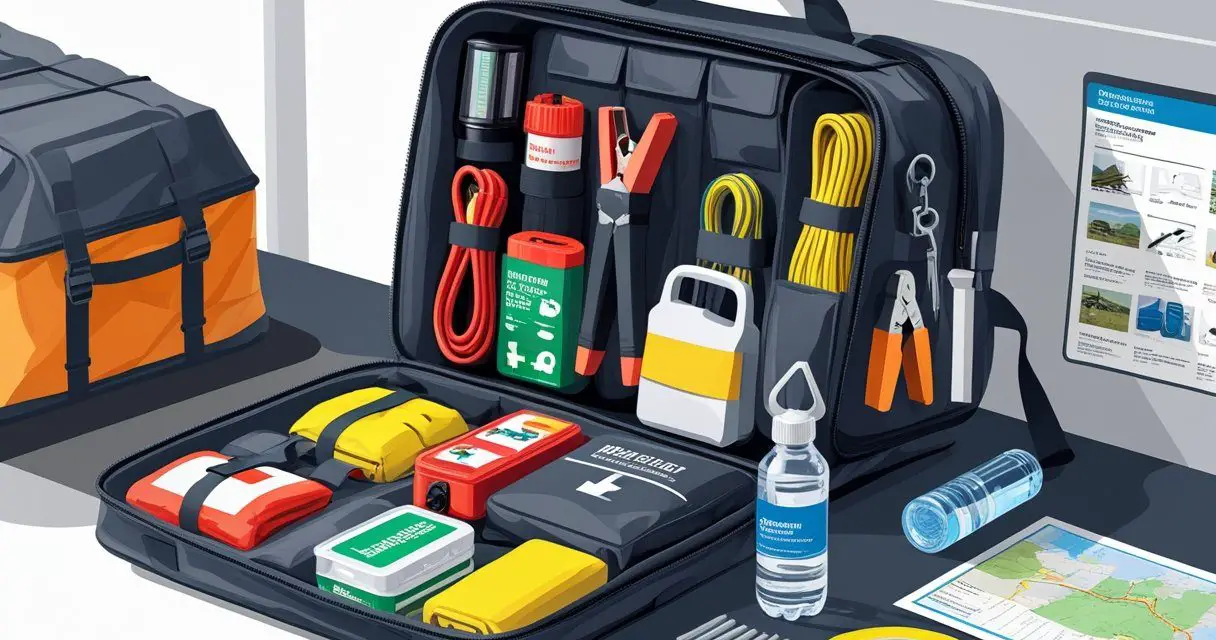
Build Your $100-$300 “Sweet Spot” Kit: 5 Must-Have Items
Inspired by our poll’s winning category? Here’s how to build a kit that provides maximum peace of mind without requiring a second loan.
1. Invest in a Tire Savior Kit First.
This is non-negotiable. A quality tire pressure monitoring system (TPMS) and a heavy-duty tire repair/plug kit with a reliable air compressor are your #1 defense. They prevent disasters and fix the most common show-stopper. This combo alone can eat up half your budget but saves thousands.
2. Buy Tools for Your Specific Rig.
Don’t just get a generic wrench set. Know what size sockets fit your lug nuts, water heater anode, and battery terminals. A dedicated tool for your unique awning crank or leveling jack is worth its weight in gold when you’re frustrated on the side of the road.
3. Prioritize “Trip-Saver” Items Over “Full Repairs.”
Your goal is to get to safety, not rebuild the engine. Focus on items that mitigate damage and allow movement: electrical tape and connectors for a short, sealants and putty for sudden leaks, and fuses for every amp your rig uses. These small items solve big, immediate problems.
4. Include a “Digital Tool” in Your Budget.
Allocate $20-$50 for premium access to a reliable RV-specific repair manual or a trusted online forum. The right information is a tool. Knowing the exact location of your fuse box or the torque spec for your wheel can be more valuable than the fanciest wrench.
5. Practice Your Most-Likely Emergency.
The most expensive tool is one you don’t know how to use. In your driveway, practice using your jack and changing a tire. Try out your tire plug kit on an old tire. This rehearsal is free and ensures your monetary investment actually works when panic strikes.
Why We Think The Results Rolled In This Way
The overwhelming consensus in the $100-$300 range is a fascinating reflection of the modern RVer’s mindset. We believe this sweet spot dominates because it represents a practical balance between two powerful forces: the terrifying reality of repair costs and the eternal optimism of the open road. RVers are practical people; they know a single tow bill can eclipse $300, so investing in a kit that can prevent that makes clear financial sense. However, they are also adventurers at heart, and pouring thousands into “what-if” scenarios can feel like it defeats the purpose of a carefree journey.
The results show that most people are buying specific solutions for high-probability, high-inconvenience issues like tire problems, minor electrical faults, and leak-stopping. The premium tiers likely include full-timers, remote boondockers, or former mechanics for whom self-reliance isn’t a choice but a necessity. Meanwhile, the minimalist group embodies the rookie’s hope or the seasoned traveler’s sheer luck. Ultimately, the poll reveals that for the majority, the goal isn’t to carry a mobile garage, but to carry just enough leverage to turn a potential trip-ending disaster into a mere anecdote for the campfire.