Your RV is supposed to give you freedom, not surprise you with rules. But this video shows that some everyday items can cause real trouble when you travel. A few can break federal rules, some can break state laws, and others can get you turned away from a campground. Some can even make a bad accident much worse. That is why a simple check of your gear before you leave can save you money, stress, and a giant vacation headache.
Important note: laws, campground rules, and safety codes can change by state, park, and property, so you should always double-check the rules for where you are going.
| Item | Why it can cause trouble | Smarter move |
|---|---|---|
| Fireworks | Fire danger and park bans | Leave them at home |
| Old or wrong propane tanks | Safety and refill problems | Check for proper stamps and dates |
| Unsecured firearms | State laws vary fast | Lock and store them correctly |
| Cannabis on federal land | Federal law still applies | Keep it off federal property |
| Bad gas cans | Fire and vapor risks | Use approved fuel containers |
| DIY lithium battery setups | Heat and fire risk | Use a safe, properly installed system |
| Radar jammers | Federal law bans them | Drive the speed limit instead |
| Unregistered drones | FAA and park rule problems | Register and check airspace rules |
| Household space heaters | Fire and overload risk | Use RV-safe heating gear |
| Commercial cooking gear | Code, power, and ventilation issues | Use RV-approved appliances |
1) Fireworks Can Blow Up More Than the Night Sky
Fireworks may sound like a fun camping treat, but they can create huge problems in parks and campgrounds. The National Park Service says fireworks are prohibited in park boundaries, and fire safety reports tied to that guidance noted 32,302 fireworks-caused fires in 2023, along with 14,700 injuries and 11 deaths. That is a lot of damage for something that lasts a few seconds.
You may love a grand finale, but your campsite does not need to star in its own disaster movie.
2) Propane Tanks Need More Than Good Luck
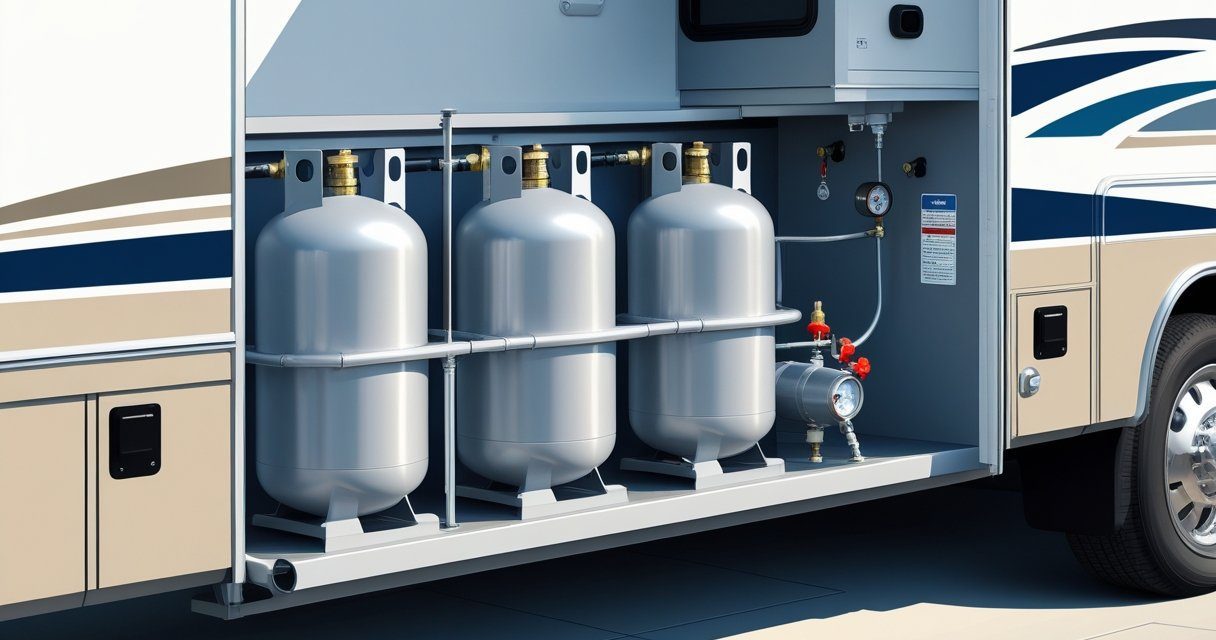
Propane keeps many RVs running, but not every tank is safe to carry or refill. Federal safety guidance says portable propane cylinders need periodic requalification, and many tanks need their first check 12 years after manufacture before later rechecks on a set schedule. If the collar stamp is missing, old, or wrong, your “good deal” tank can become a very bad idea.
You do not want your cookout powered by a tank that looks like it graduated from the dinosaur era.
3) Unsecured Firearms Can Turn a State Line Into a Problem Line
Firearm rules can change the moment you cross a border. Federal safe-passage law generally allows transport for lawful travel, but it says the firearm should be unloaded and not readily accessible, and in vehicles without a separate trunk it should be in a locked container that is not the glove box or console. That means your RV setup matters more than many travelers think.
You do not want your road trip turning into a pop quiz where every state has a different answer key.
4) Cannabis Can Still Be Illegal Where You Camp
Even if marijuana is legal in your home state, that does not mean it is legal everywhere your RV goes. The National Park Service says possession or use of marijuana is prohibited inside park units because federal law still controls on federal land. One gummy can become one giant mistake if you are parked in the wrong place.
You do not want your relaxing weekend to get tackled by a ranger and a rule book.
5) A Bad Gas Can Is a Tiny Problem With Big Flames
Extra gasoline may feel like a smart backup plan, especially when you head far from town. But fuel containers now need safety features like child-resistant closures and flame-mitigation devices because fuel vapors can ignite fast and cause serious burns. If the can looks flimsy, cracked, homemade, or too cheap to trust, it does not belong in your RV.
You do not need your gas can acting like a dragon every time you open the cap.
6) DIY Lithium Battery Setups Can Get Dangerous Fast
Lithium batteries are useful, but they can become scary when they overheat or are installed badly. Fire Safety Research Institute data from New York City reported 268 lithium-ion battery fires, 150 injuries, and 18 deaths in 2023 involving micromobility devices, and the research showed thermal runaway can move from visible smoke to explosion in just seconds. That study was not about RVs, but it is still a strong warning that battery systems need proper design, spacing, and protection.
You want your battery bank to power movie night, not audition for a rocket launch.
7) Radar Jammers Are a Terrible Shortcut
This one is simple. The FCC says federal law prohibits the operation, sale, and marketing of jamming devices, and penalties can include fines, seizure of the equipment, and criminal sanctions. Trying to trick enforcement tools is the kind of shortcut that usually makes the trip longer.
You do not need your dashboard turning into a villain lab from a cartoon.
8) Drones Need Rules Before They Need Wings
A drone is fun until you fly it where you should not. The FAA says drones that weigh 250 grams or more generally must be registered, and the National Park Service says many parks prohibit launching, landing, or operating them on park land. NPS also says violations can be treated as a misdemeanor, with penalties up to six months in jail and a $5,000 fine.
You want amazing travel footage, not a five-thousand-dollar memory card.
9) Household Space Heaters Are Not Always RV Friends
That old heater from the garage may look helpful on a cold night, but it may be the wrong tool for a tight RV. NFPA estimates heating equipment caused 44,210 home structure fires per year from 2016 to 2020, and space heaters were responsible for one-third of those fires plus most of the deaths and injuries in heating-equipment fires. In a small RV, the safer move is gear made for small spaces and proper power loads.
You want cozy socks and warm cocoa, not a toaster-sized fire monster in the corner.
10) Commercial Cooking Gear Can Push Your RV Too Far
A giant griddle or restaurant fryer may sound like camping at expert level, but RV systems are not built like restaurant kitchens. RVIA says its inspectors perform more than 2,000 unannounced plant inspections each year and check compliance with over 500 safety-related requirements, and many campgrounds look for the RVIA seal before allowing entry. If a big appliance is not installed to RV standards, you can run into power, ventilation, insurance, and code problems fast.
You may dream of being the campground burger king, but your RV kitchen is not a food truck with curtains.
Bottom line:
The big lesson from this video is simple. Items that seem normal at home can become legal or safety problems once they ride inside an RV. If you check your gear before every trip, you give yourself a much better chance of having the kind of adventure you actually want.
SOURCES
- YouTube video: 10 Common Items That Are ILLEGAL to Have in an RV in 2026 by Road Life Guide
https://www.youtube.com/watch?v=frSBsznAaoY - National Park Service: Fireworks safety and prohibition in park sites
https://www.nps.gov/articles/p52-hot-fireworks-independence-day.htm - PHMSA: Requalification guidance for propane cylinders
https://www.phmsa.dot.gov/sites/phmsa.dot.gov/files/docs/propane_en_v3.pdf - PHMSA: Is Your Cylinder Safe to Fill?
https://www.phmsa.dot.gov/sites/phmsa.dot.gov/files/2023-03/Is-Your-Cylinder-Safe-to-Fill-PHH50-0201-0323.pdf - Cornell Law School: 18 U.S. Code § 926A
https://www.law.cornell.edu/uscode/text/18/926A - National Park Service: Marijuana and Other Substances
https://www.nps.gov/bela/learn/management/marijuana.htm - EPA: Portable fuel container safety background
https://www.epa.gov/newsreleases/make-gas-cans-great-again-improving-flow - CPSC: Flame mitigation devices on gas cans and portable fuel containers
https://www.cpsc.gov/Newsroom/News-Releases/2023/CPSC-Requires-Lifesaving-Flame-Mitigation-Devices-on-Gas-Cans-and-Other-Portable-Fuel-Containers - Fire Safety Research Institute: Lithium-ion battery thermal runaway fire hazards
https://fsri.org/research-update/journal-article-quantifies-fire-hazards-lithium-ion-battery-fires-caused-thermal - FCC: Jammer enforcement
https://www.fcc.gov/general/jammer-enforcement - FAA: How to register your drone
https://www.faa.gov/uas/getting_started/register_drone - National Park Service: Uncrewed aircraft in national parks
https://www.nps.gov/articles/uncrewed-aircraft-in-the-national-parks.htm - NFPA: Home heating fires report
https://www.nfpa.org/education-and-research/research/nfpa-research/fire-statistical-reports/heating-equipment - RV Industry Association: Standards and regulations
https://www.rvia.org/standards-regulations