Buying a new RV should feel exciting. You expect comfort, safety, and the freedom to go where you want. But this YouTube feature tells a very different story.
A family bought a new Class A motorhome for more than $200,000 and hoped it would give them a safe place to live. Instead, they say they dealt with electrical trouble, smoke from an air conditioner, repeated repair visits, and months of stress. Their experience is a strong reminder that a shiny coach can still hide serious problems.
If you are shopping for a motorhome, this case gives you important lessons. It shows why careful inspections, strong paperwork, and fast action on safety concerns matter so much. Here are the biggest warning signs you should never ignore.
Quick Facts From This Case
| Detail | What was reported |
|---|---|
| RV type | New Class A motorhome |
| Price | Over $200,000 |
| Family setup | 2 adults, 3 children, and 4 pets |
| Buyer experience | First-time RV owners |
| Delivery walkthrough | 39 minutes |
| Early service trips | 3 to 4 visits in the first week |
| Major emergency | Smoke from the rear AC around 2 a.m. |
| Delay mentioned | More than 6 weeks without AC |
1. A Short Walkthrough Is a Big Warning Sign
A large Class A motorhome is not simple. You have power systems, leveling jacks, batteries, air conditioners, plumbing, and emergency shutoffs to learn. If you are a first-time owner, a quick handoff is not enough.
In this case, the family says they got only a 39-minute walkthrough for a nearly 40-foot coach. That is a very short lesson for a machine that may also serve as your home. You should leave the lot feeling prepared, not confused.
This matters because RV buying is still strong in the United States. The RV Industry Association says 8.1 million American households own an RV, and 16.9 million households are strongly interested in buying one within the next five years.
If a dealer explains a giant motorhome faster than a microwave dinner, your eyebrows should go up before the slide-outs do.
2. Early Electrical Trouble Should Never Be Excused Away
When a new RV starts having electrical problems right away, you should pay close attention. Flickering systems, sudden power loss, or failing air conditioners are not little annoyances when your safety depends on them.
The family says their coach had electrical trouble almost immediately. They also describe power shutting off and cooling problems during hot weather in Florida. That is not the kind of trouble you expect from a brand-new unit.
Federal fire data helps explain why this is serious. The U.S. Fire Administration says failure of equipment or a heat source played a role in 14.7% of RV fires reported from 2018 to 2020.
If your new RV acts possessed in week one, you should not let anyone call it “just part of the learning curve.”
3. Smoke From an AC Unit Means Get Out Fast
Smoke inside a motorhome is not a minor service issue. It is an emergency. If you smell burning or see smoke, your first job is to get everyone outside and shut off power if it is safe to do so.
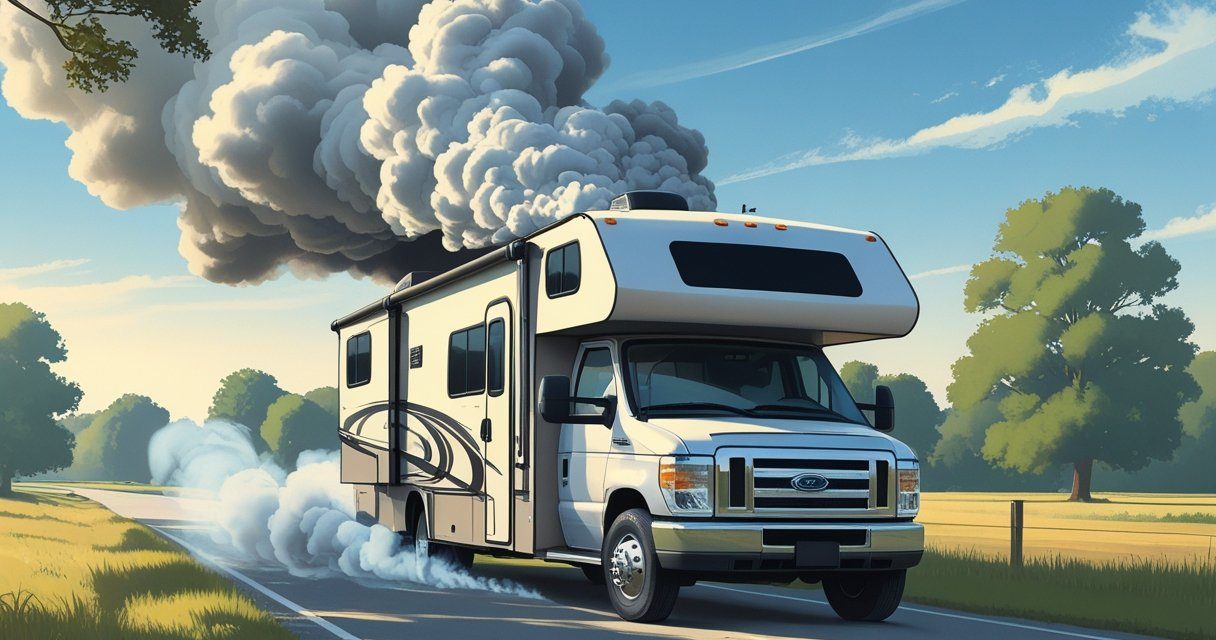
According to the family, smoke filled the coach in the middle of the night and appeared to come from the rear AC area. They had to get the children and pets out quickly. That kind of event can turn deadly fast in a tight living space.
The U.S. Fire Administration reports an average of 4,200 RV fires per year from 2018 to 2020. Those fires caused an average of 15 civilian deaths, 125 civilian injuries, and $60.3 million in annual property loss.
When smoke pours into your sleeping space at 2 a.m., that is not “RV life.” That is a sprint in pajamas.
4. A New RV Can Still Have a Dangerous Part
Many buyers think “brand-new” means fully safe. That is a comforting idea, but it is not always true. A new unit can still contain a part that fails, overheats, or becomes part of a recall.
In this case, the family says the trouble was linked to a recalled soft start component in the air conditioner. A 2024 NHTSA recall report says certain RV air conditioners using the ICM870-16A-BH5400 soft start device may fail, overheat, emit smoke or a burning odor, and increase the risk of fire.
That is why you should ask about open recalls on both the RV and its installed components. A chassis check alone may not tell the full story if the problem is tied to equipment added to the coach.
You can buy a luxury motorhome, but one bad little part can still behave like it wants its own action movie.
5. Long Repair Delays Can Crush the RV Dream
When an RV is also your home, long repair delays do more than waste time. They can disrupt school, work, sleep, travel, and your budget. A breakdown is hard enough, but a breakdown that drags on for weeks or months can be crushing.
The family says they went more than 6 weeks without AC and kept dealing with service delays, approvals, and unfinished repairs. They also describe major family disruption and ongoing payments while the unit still had serious issues.
That problem matters for the whole industry. The RV Industry Association says 71% of buyers choose new RVs, which means buyers have every reason to expect better quality control and faster support.
Paying for an RV and a backup place to live at the same time is the kind of math that makes your wallet cry.
6. Good Records Can Protect You When Trust Breaks Down
Once repair stories stop matching up, your paperwork becomes one of your best tools. Photos, repair orders, service dates, and written messages can help show exactly what happened and when it happened.
The family says they took pictures and tracked the repair history as they tried to get answers. That is smart. If you ever face a serious defect, clear records can help support your case with dealers, manufacturers, insurers, or legal counsel.
Safety devices matter too. NFPA says that in RV fires between 2008 and 2017, an average of 20 deaths per year happened in RVs with no smoke alarm present, while only one death per year happened in fires where working smoke alarms were present.
When the phone calls get slippery, your folder of receipts starts looking like the smartest thing in the whole campground.
RV Delivery Checklist You Should Use Before You Sign Off
| What to check | Why it matters |
|---|---|
| A full walkthrough with time for questions | You need to understand power, HVAC, plumbing, and emergency systems |
| Proof that recalls were checked | Safety issues may involve parts, not just the VIN |
| Test both AC units, outlets, lights, and batteries | Early electrical trouble should be found before delivery |
| Get all warranty contacts in writing | You need names and numbers if problems start immediately |
| Test smoke, propane, and CO alarms | Working alarms can save lives |
| Take pickup-day photos | They help document the RV’s condition from day one |
Final Take
This story is a hard lesson for any RV shopper. A high price tag does not guarantee high quality, and a new motorhome is still a machine that can fail in serious ways.
If you are buying an RV, slow the process down. Ask better questions, test every major system, and document everything. When your family’s safety is involved, “probably fine” is never good enough.
SOURCES
- YouTube feature: Family Trapped in Deadly RV
https://www.youtube.com/watch?v=MwTdcA8V3gw - U.S. Fire Administration: Recreational Vehicle Fires (2018–2020)
https://www.usfa.fema.gov/statistics/reports/where-fires-occur/snapshot-rv-fires.html - RV Industry Association: 2025 Go RVing RV Owner Demographic Profile
https://www.rvia.org/2025-go-rving-rv-owner-demographic-profile - National Fire Protection Association: RV Fire Safety
https://www.nfpa.org/news-blogs-and-articles/nfpa-journal/2021/04/12/rv-safety - NHTSA Recall Report: Part 573 Safety Recall Report 24V-831
https://static.nhtsa.gov/odi/rcl/2024/RCLRPT-24V831-6210.PDF