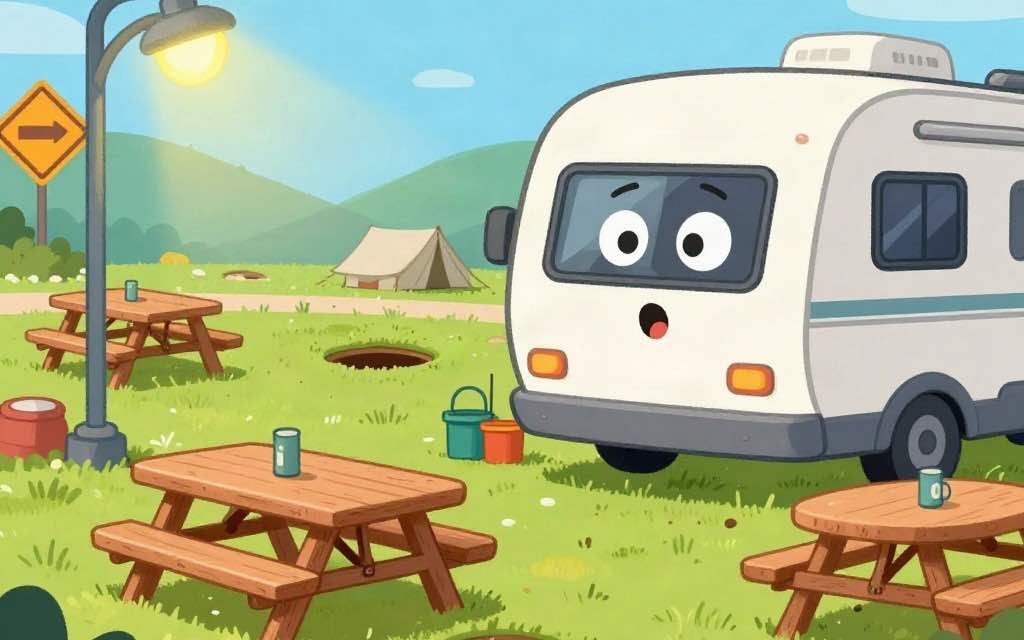
Camping sounds like the perfect escape—until you actually arrive. The glossy brochures promise peace, nature, and relaxation under the stars. But what they don’t tell you about are the pothole obstacle courses, questionable picnic tables, and that special place called the dump station that changes people forever.
According to the 2024 North American Camping Report, over 94 million households in the U.S. consider themselves campers, yet many first-timers abandon the lifestyle after just one trip. Why? Because no one warned them about what really happens at campgrounds.
If you’ve ever questioned your life choices while dodging craters in the entrance road or wondered why “rustic” sounded appealing when you booked online, this one’s for you. These are the camping experiences that absolutely deserve warning labels—but somehow, we all keep coming back for more.
1. The Entrance Road That Tests Your RV’s Warranty (And Your Sanity)
Warning: These roads might void your warranty and your will to continue the trip.
You’ll pull into what looked like a five-star campground online, only to immediately encounter an obstacle course that NASA could use for rover testing. The entrance road features potholes so aggressive they could reroute your GPS directly to the nearest chiropractor. It’s never just one bump—it’s a full gauntlet of craters, random gravel patches, and sections where the paving crew apparently gave up mid-job.
You’ll crawl along at 4 mph, staring at the ground like your tires are reading braille, desperately trying to pick a path that won’t launch your belongings into the front seat. Inside the RV, it sounds like someone put your entire life in a paint shaker and hit “extra vigorous.” Meanwhile, there’s always someone in a golf cart riding your bumper, silently judging you for not treating this death trap like a NASCAR qualifying lap.
The reality check: A study by the RV Industry Association found that nearly 40% of campground complaints involve road conditions and maintenance issues. Yet most campgrounds continue to treat entrance roads as “character-building experiences” rather than actual infrastructure.
Here’s the thing: You didn’t drive hundreds of miles just to treat your suspension system like it owes you money. But congratulations—you’re paying for the privilege. By the time you reach your actual site, you’re not excited anymore. You’re just relieved your vehicle is still legally considered one piece.
2. The Check-In Process That Feels Like a Time Warp
Warning: Check-in process may take longer than your actual stay.
You’ve booked online. You’ve paid online. You’ve checked in online three separate times. Yet somehow, you’re still standing at the campground office signing paperwork like you’re confessing to crimes you didn’t commit. There’s always a dusty bell on the counter that says “Ring for Service”—which is basically code for “nobody’s been here since last Tuesday.”
Ring once? No answer. Ring twice? You’re being aggressive. Third time? Now you’re officially a problem. When someone finally emerges, it’s never with urgency—more like you just interrupted a nap they’re not ready to admit they were taking.
Then comes the map. Oh, the map. A hand-drawn masterpiece that looks like it was sketched during a power outage, complete with squiggly lines and zero scale. “Just follow the road around,” they’ll say with complete confidence, as if that helps when there are seventeen roads and none of them make sense.
The numbers don’t lie: According to Campground Management Magazine, the average campground check-in takes 8-15 minutes, even with online pre-registration. That’s 15 minutes of your vacation spent deciphering hieroglyphics and wondering why technology exists.
Translation: You’re about to wander around like you’re on a treasure hunt, except the treasure is just the spot you already paid $60 to sleep in. Hope you packed your sense of adventure—and maybe a compass.
3. Your “Spacious” Site That Was Measured With Extreme Optimism
Warning: Your spacious site might be based on confidence, not measurements.
The photos online showed wide-open space, room to breathe, and maybe even some distance between you and other humans. You’re going to pull in and discover your site is basically one long, narrow decision you have to commit to immediately. There’s exactly one way to park, and you won’t realize what it is until you’ve already done it wrong.
You’ll stop, back out, look around, and start renegotiating your expectations in real-time. The fire pit and picnic table are placed with zero regard for physics, geometry, or human movement—just sitting there like they won a contest for “most inconvenient placement.”
Setup begins, and nothing lines up. Your hookups are simultaneously too far away and too close together. Your water hose is stretched to its absolute limit, testing its molecular bonds. Your electrical cord is pulled tighter than your patience.
| What the Website Promised | What You Actually Got |
|---|---|
| “Spacious 40-foot site” | A parking spot with ambition |
| “Private and secluded” | You can hear your neighbor sneeze |
| “Full hookups conveniently located” | A geometric puzzle with consequences |
| “Plenty of room for outdoor activities” | Don’t trip over the fire pit |
Real talk: The RV Consumer Group reports that nearly 35% of campers have arrived at a site that didn’t match its online description. Yet campgrounds continue to photograph their sites from angles that would make a real estate agent proud.
Bottom line: You’ll spend twenty minutes adjusting things by inches, convinced it’ll magically create more space. It won’t. There is no more space. By the time you’re done, you’re not relaxed—you’re just set up. And somehow, that feels like a victory worth celebrating.
4. The Picnic Table That Has Seen Things You Can’t Unsee
Warning: The picnic table may have lived several previous lives before meeting you.
These tables are never new. Ever. No campground in the history of outdoor recreation has ever said, “Let’s invest in new picnic tables.” These structures are inherited, passed down like family heirlooms—if your family actively hated you. You approach it cautiously and immediately conduct a visual inspection, not to see if it’s nice, but to assess what you’re actually dealing with.
Is it damp? Sticky? Is that tree sap or something that used to be food? You’ll never know, and honestly, you don’t want to. So you do that thing where you brush it off with your hand—a bold move, because now instead of the mystery substance being on the table, it’s stuck to you.
Then you sit down, and the entire structure shifts slightly, as if to remind you: “Hey, this isn’t exactly stable.” Every picnic table has that one bench that makes you feel like you’re being slowly folded in half. No matter where you sit, you’re at the wrong height—too low to eat comfortably, too high to relax, just perfectly adjusted to make your back scream.
The carved evidence: Look closely and you’ll find initials, dates, and declarations of love that absolutely didn’t last. Nothing says “romantic getaway” like eating dinner on top of someone else’s failed relationship timeline.
Reality check: You’ll adjust your drink three times, convince yourself it’s fine, and then watch it slowly drift toward the edge like it has somewhere else to be. At this point, trust nothing. Not the table, not the bench, not even gravity.
5. Craft Hour at 2 P.M.: The Event Nobody Asked For
Warning: Mandatory fun may cause emotional discomfort and glitter-related injuries.
You see it on the events board: “Crafts at 2:00 p.m.” You don’t want to go—not even a little. But something in your brain whispers, “What if this is incredible?” Spoiler alert: it’s not. You’ll show up to a folding table, three permanent markers that died in 2014, and one employee who looks genuinely irritated that you actually came.
“Oh, wow. A person,” they’ll mutter (metaphorically through their expression). Now you feel bad, so you sit down and commit. Minutes stretch like taffy. Somehow, everyone there is pretending this is the highlight of their week, and you start crafting not for art, but for survival.
The participation paradox: According to the American Camp Association, organized activities increase camper satisfaction by 23%—but only when they’re actually good. Nobody’s measuring the satisfaction drop from sad craft hour.
| What You Expected | What You Got |
|---|---|
| Fun family bonding | Existential questioning |
| Creative expression | Dried-out markers |
| Instagram-worthy crafts | Something your kid made in 2nd grade (worse) |
| Memories to cherish | Memories you’ll suppress |
The truth: Craft hour isn’t about creativity—it’s about endurance. If you make it out alive, congratulations. You’re officially a solid camper. This is your badge of honor, even if the badge is made of popsicle sticks and shame.
6. The Dump Station: Where Camping Humbles Everyone
Warning: This is where your personality changes.
At some point—whether you planned for it or not—you’ll visit the dump station. This is the most emotionally honest place on earth. Up until this point, camping has been friendly: people waving, smiling, asking where you’re from like you’re part of some happy community. Not here. Nobody makes eye contact at the dump station. Nobody.
You’ll pull up and discover there’s a line. Of course there’s a line. Your mood shifts instantly. This isn’t fun anymore—this is survival. People aren’t pretending to have a great time. Have you ever accidentally locked eyes with someone at the dump station? That’s not small talk. That’s a bond deeper than friendship. You’ve both seen things, and you’re never going to discuss them.
There’s always one person taking way too long. “Sir, what problem are you solving? This isn’t a puzzle. You don’t need to dismantle your entire plumbing system. Just commit and move on.” But you wait. And the longer you wait, the more you start rethinking your entire life.
The statistics are grim: The RV repair industry reports that improper dump station use causes over $2 million in damages annually. Yet still, we all show up unprepared and slightly terrified.
Cold, hard truth: There’s no warning label that could prepare you for this experience. It should just say, “This is the moment camping humbles everyone.” And it’s correct. By the time you leave, you’re a different person—wiser, more cautious, and deeply aware that this is the price of adventure.
7. Showing Up Late = Parking Lot Camping (The Pre-Game You Didn’t Want)
Warning: You paid for camping, but you’re getting a parking lot sleepover.
If you miss the check-in window, you might find yourself spending the night in the campground parking lot. The sign will cheerfully inform you of this, as if it’s a totally normal part of the experience. Nothing shifts your mood faster. You came for a weekend of nature and relaxation, and now you’re sitting in a parking lot next to a soda machine and a light that flickers like it’s auditioning for a horror movie.
You’re in your camper thinking, “This feels like hiding.” You start doing everything quietly for no reason—opening cabinets like you’re defusing a bomb, whispering to your family like the parking lot might hear you. Every car that pulls in makes you feel like you’ve been caught, even though you’re technically allowed to be there.
The parking lot stare-down: Ever locked eyes with another late-arrival camper at night? That’s worse than the dump station eye contact. It screams, “Oh, you didn’t plan this out either? Yeah, neither did we.” You’ll never speak of it. Morning will come, and everyone will pretend it didn’t happen.
Industry data: The National Association of RV Parks and Campgrounds notes that nearly 18% of campers arrive outside check-in hours, yet most campgrounds still don’t offer extended check-in options. Welcome to the parking lot club—membership is free, dignity is optional.
Final word: The next morning, you’ll finally pull into your actual campsite and think, “Yeah, this is the place we booked!” But remember everything we just talked about? Your adventure is only beginning. At least you survived the parking lot. That’s something.
Why We Keep Coming Back (Despite All of This)
Here’s the wildest part: despite the potholes, the paperwork, the wobbly picnic tables, and the emotional trauma of the dump station, millions of people keep camping every single year. According to KOA’s 2024 Camping Report, 40% of campers plan to camp more in the coming year, and first-time camper numbers continue to rise.
Why? Because buried beneath all the chaos is something genuinely special. The campfire conversations. The starry nights. The disconnection from everyday stress. The inside jokes that only fellow campers understand. We endure the warning-label moments because, somehow, they become the stories we tell later—the ones that make everyone laugh and nod knowingly.
Camping isn’t perfect. It’s not always Instagram-worthy. But it’s real. And maybe that’s exactly why we keep going back.
So pack your patience along with your camping gear, lower your expectations just a little, and remember: everyone else is out there surviving the same beautiful disasters. You’re not alone in this chaos—and that, somehow, makes it all worth it.
SOURCES
- North American Camping Report 2024, Kampgrounds of America (KOA)
- RV Industry Association, Campground Maintenance and Infrastructure Study
- Campground Management Magazine, Check-in Process Efficiency Report
- RV Consumer Group, Site Description Accuracy Survey
- American Camp Association, Activity Satisfaction Metrics
- RV Repair Industry Annual Report, Dump Station Damage Statistics
- National Association of RV Parks and Campgrounds, Check-in Hours Analysis
- KOA North American Camping Report 2024, Future Camping Trends