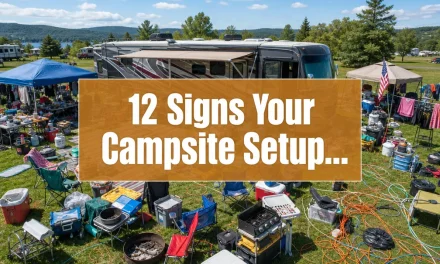
You pull into that perfect campsite, feeling confident and ready to set up your rig. But wait—are you really doing everything right?
Turns out, even experienced RVers have been making critical setup mistakes that could lead to embarrassment, costly damage, or downright disaster. The team at Grateful Glamper recently revealed the setup secrets they wish they’d known from day one, and trust me, you’ll want to pay attention. From avoiding the dreaded “poo pyramid” to preventing your RV from rolling away (yes, really), these tips will transform you from a rookie camper into a confident pro.
Would you like to save this article?
1. Positioning Your RV Like You’re Parking a Sedan
Here’s the deal: you can’t just back in and call it good. Your RV needs strategic positioning to maximize your campsite real estate and avoid slide-out catastrophes.
Think about it—you need space for your patio setup on the passenger side, room for that picnic table, and most importantly, clearance for all your slide-outs. One miscalculation and your slide could be kissing a fence, a tree, or a wooden post.
Pro RVers position their rig considering:
- Slide-out clearance on all sides
- Level ground distribution across the site
- Access to hookups without stretching hoses
- Room for outdoor living space
According to RV setup experts, improper positioning is one of the most common mistakes at campgrounds. State parks with natural obstacles make this even trickier. If you’ve got five slides like some luxury rigs, you’re basically solving a geometry puzzle every time you park.
The Cheeky Truth: You might think you’ve nailed the perfect spot until that slide comes out and—crunch—there goes your vacation vibe and possibly your wallet. Take the extra five minutes to assess your site like you’re planning a military operation. Your future self will thank you.
2. Skipping the Wheel Chocks (The “Rolling Disaster” Move)
If you’re towing a travel trailer or fifth wheel and you’re not chocking those wheels immediately, you’re one disconnection away from a viral fail video.
The Grateful Glampers witnessed this nightmare firsthand at a campground—someone rushed setup, skipped the chocks, disconnected their truck, and nearly watched their RV roll away. Heart-stopping doesn’t begin to cover it.
Here’s what you need:
- Rubber wheel chocks in front of the wheels
- X-chocks between dual wheels for extra stability
According to transportation safety data, chocking and blocking accidents are surprisingly common, with improper securing leading to equipment damage and injuries. While most statistics focus on commercial vehicles, the principle remains the same: an unsecured vehicle is a hazard.
The Reality Check: Thinking your RV will stay put on its own is like assuming your toddler won’t find the permanent markers. Physics doesn’t care about your optimism. Those chocks cost less than $50, but the damage from a rolling RV? We’re talking thousands. Do the math.
3. Treating Stabilizers Like Leveling Jacks (They’re NOT the Same Thing)
This mistake makes RV technicians cringe. Stabilizers are NOT designed to lift or level your RV. They’re designed to reduce bounce and movement after you’re already level.
Using stabilizers as jacks can:
- Damage your RV frame
- Bend the stabilizer jacks
- Create unsafe stress points
- Lead to expensive repairs
What you ACTUALLY need for leveling:
- Anderson leveling blocks or Camco stackable blocks
- A quality bubble level (the light-up Franklin Sensors level is clutch)
- Jack pads for uneven terrain
RV maintenance experts at Transwest confirm that using stabilizers incorrectly is one of the top five RV setup mistakes. A level RV isn’t just about comfort—it affects your refrigerator function, slide-out operation, and even your sleep quality.
The Straight Talk: Your stabilizers aren’t superhero jacks. They’re more like supportive friends who steady you after you’ve got your life together. Use them correctly, and they’ll keep your coffee from sliding off the counter. Use them wrong, and you’ll be explaining to your insurance company why your frame is bent.
4. Forgetting That Water Pressure Can Explode Your Pipes
Campground water pressure is like a box of chocolates—you never know what you’re gonna get. Except instead of nougat, you might get a burst water line flooding your RV.
This is why you MUST use a water pressure regulator. Period.
RV plumbing systems are designed for 40-50 PSI. Some campgrounds pump out 80-100 PSI or more. Your pipes aren’t built for that kind of pressure, and when they burst, you’re looking at water damage, mold issues, and a ruined trip.
Smart water hookup checklist:
- Adjustable water pressure regulator (lets you dial in the perfect pressure)
- Inline water filter (because who knows what’s in those campground pipes)
- Rinse your hose first (critters and debris love to hide in there)
| Setup Item | Why You Need It | Approximate Cost |
|---|---|---|
| Water Pressure Regulator | Prevents burst pipes from high pressure | $15-$40 |
| Inline Water Filter | Removes sediment and contaminants | $20-$60 |
| Quality RV Hose | Food-safe, no chemical taste | $25-$50 |
The Honest Take: You might feel invincible hooking up that hose, but campground plumbing is about as predictable as a toddler’s mood. One pressure surge and you’re dealing with soggy carpet and the lovely aroma of mildew. Spend the $30 on a regulator or spend $3,000 on water damage repairs. Choose wisely.
5. Plugging In Without a Surge Protector (The “$10,000 Oops”)
Picture this: you plug directly into the campground pedestal, and within seconds, a power surge fries your refrigerator, microwave, air conditioner, and all your electrical systems.
That’s not a horror story. That’s a Tuesday for RVers who skip the surge protector.
Campground pedestals can have:
- Reverse polarity
- Open grounds
- Voltage spikes
- Worn-out wiring
According to TechnoRV, a single voltage spike lasting a fraction of a second can destroy a modern inverter costing $2,000 or more. When you factor in all the electrical components in your RV, you’re looking at potential damage exceeding $10,000.
Recommended surge protectors:
- Watchdog Surge Protector (budget-friendly, reliable)
- Progressive Industries EMS (premium protection with diagnostics)
How it works:
- Plug surge protector into pedestal
- Plug RV cord into surge protector
- Flip breaker
- If there’s bad power, the unit turns red and blocks it
The Brutal Truth: Campground electrical systems have seen more years than your grandma’s cast iron skillet, and they’re about as reliable as a weather forecast. You wouldn’t stick your expensive electronics directly into a sketchy outlet at home, so why gamble with your entire RV? That $200 surge protector might seem pricey until you’re replacing every appliance in your rig.
6. Creating the Dreaded “Poo Pyramid” (We Need to Talk About This)
Okay, let’s address the elephant—or should we say pyramid—in the RV bathroom. If you leave your black tank valve open while connected to sewer, you’re engineering a disaster.
Here’s the gross science: when the valve stays open, liquids drain out but solids stay behind. Over time, they pile up into what RV techs call a “poo pyramid” or “pyramid plug.” It’s exactly as terrible as it sounds.
The correct method:
- Keep black tank valve CLOSED at all times
- Only open when actively dumping
- Use plenty of water with each flush
- Dump when tank is 2/3 to 3/4 full
According to the National RV Training Academy, the poo pyramid is one of the most common—and most preventable—RV maintenance issues. It requires deep cleaning or professional intervention to fix.
Gray tank controversy: Some RVers (like the Grateful Glampers) keep their gray tank open to prevent odors and keep things flowing. Others prefer to keep it closed. The key is monitoring for sewer flies and closing it the day before departure to build up flushing power.
| Tank | Valve Position | Why |
|---|---|---|
| Black Tank | Always CLOSED (except when dumping) | Prevents pyramid formation |
| Gray Tank | Personal preference (open or closed) | Open reduces odors; closed builds flushing power |
The Uncomfortable Reality: Nobody wants to talk about poop, but somebody’s got to. Keep that valve closed unless you want to spend your vacation with a stick (literally, as shown in the video) trying to break up a solid waste mountain. This is the camping version of “I told you so” that nobody wants to experience.
7. Not Checking Your Interior Systems (The “Cold Shower Surprise”)
You’ve done all the outside setup, you’re exhausted, and you skip the interior checks. Big mistake.
The next morning, you’re standing in the shower waiting for hot water that never comes. Or your stove won’t light. Or your fridge isn’t cooling your groceries.
Essential interior checklist:
✅ Test water pressure at sinks and shower
✅ Turn on water heater and verify it’s heating
✅ Test propane stove burners
✅ Check refrigerator is running properly
✅ Verify all outlets have power
According to RV setup experts, interior system failures are often discovered too late—usually when you’re already settled in for the night. A quick five-minute check can save hours of frustration.
The Smart Approach: You wouldn’t wait until you’re starving to check if your stove works or until you’re covered in soap to test the hot water. Walk through your RV like a pilot doing a pre-flight check. It takes five minutes and prevents the kind of vacation disruption that turns your relaxing getaway into a maintenance marathon.
8. Ignoring Your Electrical Adapter Needs (The “Wrong Plug” Disaster)
Not all campgrounds have the same electrical setup. If you have a 50-amp RV but the campground only has 30-amp service, you’re stuck without the right adapter.
What you need to carry:
- 50-amp to 30-amp “dog bone” adapter (for lower amperage sites)
- 30-amp to 110V adapter (for emergency charging at friend’s houses)
- Multiple adapter configurations for flexibility
The Grateful Glampers recommend Nilight adapters for reliability. With a 30-amp connection, you won’t be able to run heavy appliances like air conditioners or microwaves simultaneously, but you’ll have basic power for lights, fans, and charging.
Power limitations by connection:
| Connection Type | What You Can Run | Limitations |
|---|---|---|
| 50-amp | All systems, multiple AC units, all appliances | None |
| 30-amp | Most systems, one AC unit, careful appliance use | Can’t run everything at once |
| 110V (household) | Lights, fans, basic electronics | No AC, no microwave, no heavy appliances |
The Real Deal: Showing up to a campground without the right adapters is like arriving at a foreign country without the right power converter. You’ll be that person awkwardly asking neighbors if they have a spare adapter, or worse, making an emergency run to the nearest RV supply store. Keep a full adapter kit in your RV—it’s the difference between inconvenience and catastrophe.
Ready to Set Up Like a Pro?
There you have it—eight setup mistakes that have been plaguing RVers for years, along with the fixes that’ll make you look like a campground veteran.
The bottom line? RV setup isn’t rocket science, but it does require attention to detail and the right equipment. Invest in quality gear like wheel chocks, surge protectors, water regulators, and leveling blocks. Follow a systematic checklist every single time. And for the love of all things camping, keep that black tank valve closed.
Your future camping self will thank you when you’re sipping coffee in a level RV with working appliances, no electrical damage, and zero poo pyramids to deal with.
Now get out there and show that campground what a proper setup looks like! 🏕️
SOURCES
- Grateful Glamper YouTube Channel – “We Were Setting Up Wrong for Years! Here’s the Fix” – https://www.youtube.com/watch?v=uD0S6y15LjY
- Optimum RV – “Common RV Setup Mistakes” – https://www.optimumrv.com/posts/common-setup-mistakes
- Transwest – “5 RV Setup Mistakes & How to Avoid Them” – https://www.transwest.com/rv/blog/rv-setup-mistakes-how-to-avoid-them/
- RV Upgrade Store – “Why Leveling Your RV Matters: Comfort, Safety & Maintenance” – https://www.rvupgradestore.com/blog-why-leveling-your-rv-matters-s/1309.htm
- KOA Camping Blog – “Tips for Leveling an RV” – https://koa.com/blog/tips-for-leveling-an-rv/
- TechnoRV – “RV Electrical Surge Protection: Prevent Battery Damage from Bad Wiring” – https://technorv.com/blogs/news/rv-electrical-surge-protection-prevent-battery-damage-from-bad-wiring
- Go RVing – “Electric 101: How to Safely Hook Up Your RV Power at the Campsite” – https://www.gorving.com/tips-inspiration/expert-advice/electric-101-how-safely-hook-up-your-rv-power-campsite
- National RV Training Academy – “How to Eliminate a Poop Pyramid and Prevent One from Forming” – https://nrvta.com/how-to-eliminate-a-poop-pyramid-and-prevent-one-from-forming/
- ICW Group – “Chocking and Blocking Safety Stats and Facts” – https://icwgroup.safetynow.com/chocking-and-blocking-safety-stats-and-facts/
- Camping World Blog – “65 Biggest RV Mistakes to Avoid and How To Avoid Them” – https://blog.campingworld.com/learn-to-rv/65-biggest-rv-mistakes-to-avoid-and-how-to-avoid-them/