
Would you like to save this article?
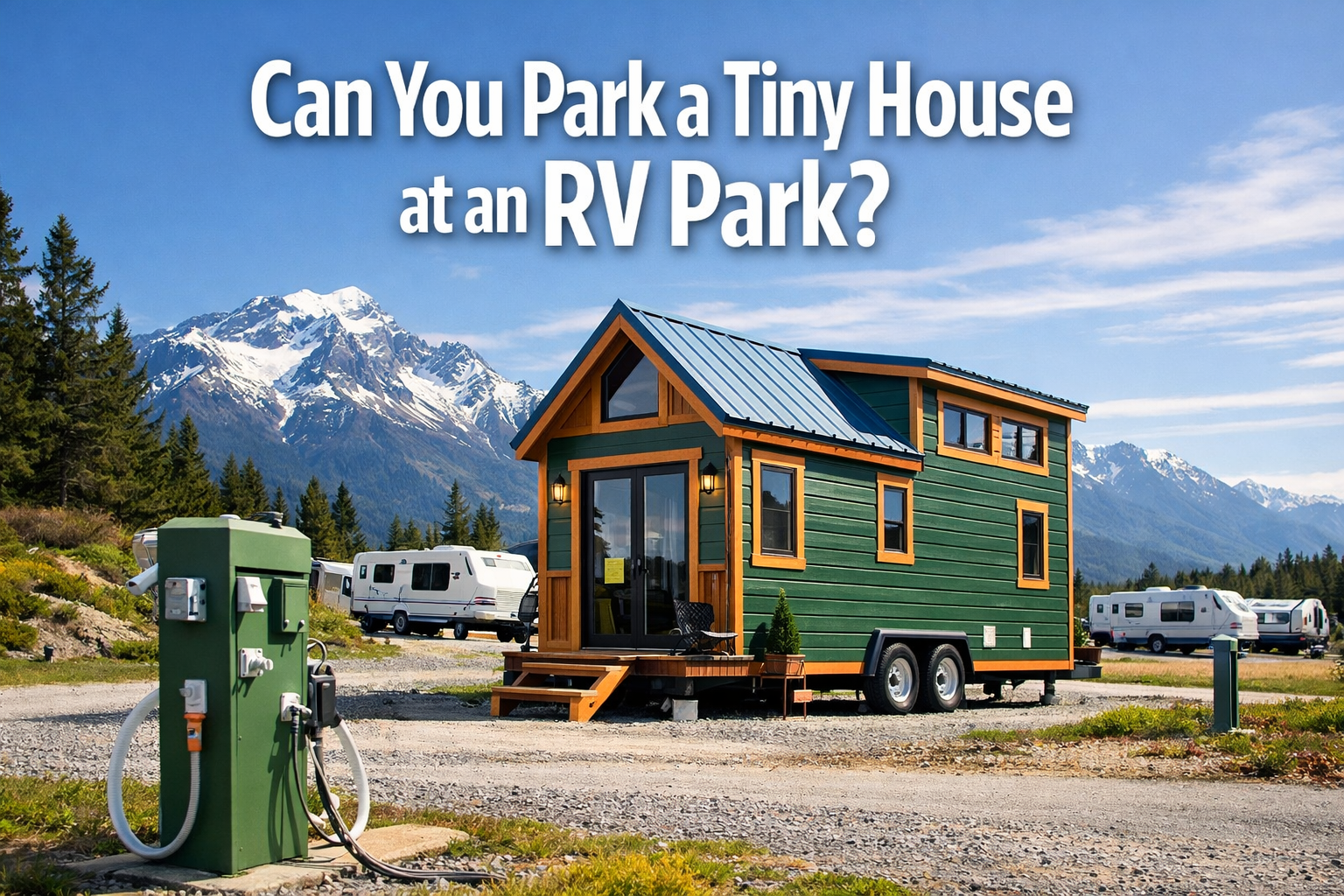
You’ve built or purchased your dream tiny house on wheels, and now you’re wondering where you can legally park it. The question “can you park a tiny house at an rv park?” has a surprisingly complex answer that depends on state laws, local regulations, park policies, and how your tiny home is classified.
Yes, you can park a tiny house at many RV parks in 2026, but only if your tiny home meets specific requirements. Most tiny houses on wheels are legally categorized as RVs, which means they must comply with local RV parking regulations that vary significantly by county and municipality.[1] Six states—Alaska, California, Florida, Texas, Oregon, and Tennessee—explicitly allow tiny homes in RV parks, though many require registration as residential dwellings to avoid enforcement action.[1]
Key Takeaways
- Most tiny houses on wheels qualify as RVs and can park at RV parks that accept them, but certification and local zoning matter significantly
- Six states explicitly permit tiny house parking in RV parks: Alaska, California, Florida, Texas, Oregon, and Tennessee
- RVIA certification opens more doors but is only available for manufactured tiny homes from certified companies, not owner-built structures
- Full-time living legality depends on local zoning codes, not just park policies—always verify municipal regulations before committing
- Written rental agreements are essential to protect both residents and landowners regarding utilities, duration, and responsibilities
What Makes a Tiny House Eligible for RV Park Parking?
A tiny house becomes eligible for RV park parking when it meets specific size, weight, certification, and hookup standards that align with recreational vehicle regulations. The primary requirement is that your tiny home must be built on a trailer chassis and remain mobile, which distinguishes it from permanent structures.[2]
Essential eligibility criteria include:
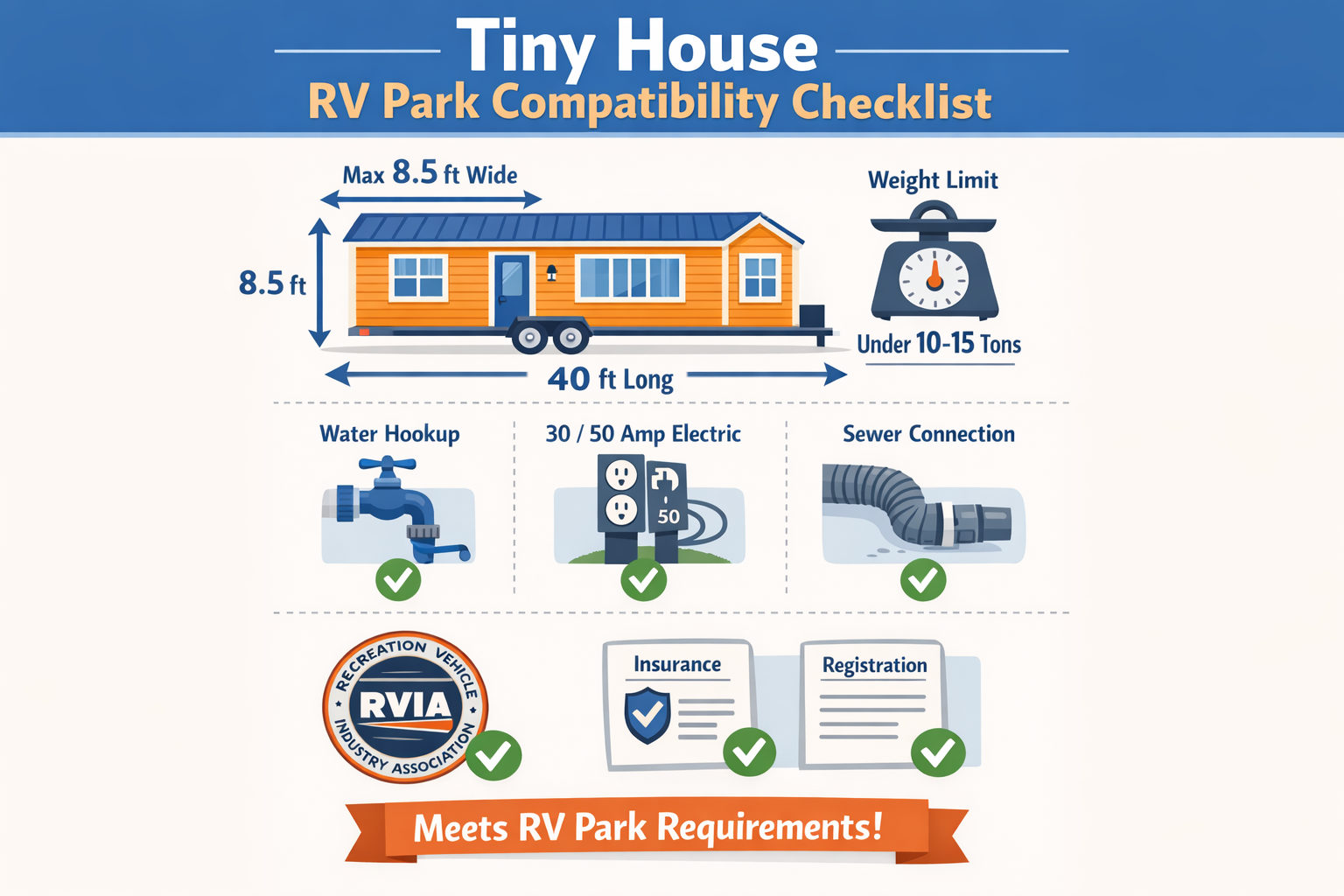
- Width limitations: Maximum 8.5 feet wide to comply with road transportation laws without special permits
- Length restrictions: Most RV parks cap length at 40 feet, though some allow up to 45 feet
- Weight considerations: Must not exceed the towing capacity of standard vehicles (typically under 10,000 pounds for most parks)
- Utility hookups: Must have standard RV connections for water, electric (30 or 50 amp), and sewer
- Road-ready condition: Wheels, axles, and trailer components must remain functional and attached
- Safety compliance: Working lights, reflectors, and proper tie-downs for highway travel
Choose RVIA certification if you want maximum acceptance at established RV parks. This certification from the Recreation Vehicle Industry Association enables parking in certain RV parks, but it’s only available for manufactured tiny homes from certified companies—not owner-built homes—and typically permits only short-term occupancy.[1][2]
A common mistake is assuming all tiny houses automatically qualify as RVs. If your tiny home exceeds standard dimensions, lacks proper hookups, or has been modified in ways that compromise road safety, many RV parks will refuse entry regardless of state laws.
Can You Park a Tiny House at an RV Park Long-Term?
Long-term parking of a tiny house at an RV park is possible but heavily regulated, with duration limits varying dramatically between public parks, private campgrounds, and individual state regulations. Full-time living legality is controlled by local zoning codes, requiring review of city and county land-use regulations, ADU ordinances, and RV parking rules before assuming any location will permit permanent residence.[3]
Duration limits typically break down as follows:
| Park Type | Typical Maximum Stay | Full-Time Living Allowed? |
|---|---|---|
| Public RV Parks | 14-30 days per visit | Rarely |
| Private RV Parks | 6-12 months | Sometimes (with restrictions) |
| RV Resorts | 12+ months | Often (in tiny-house-friendly states) |
| Campground Host Sites | Indefinite | Yes (in exchange for services) |
Public RV parks enforce stricter duration limits than private campgrounds, though exceptions exist for campground hosts who may park indefinitely in exchange for services.[4] Many municipalities use these time restrictions to prevent RV parks from becoming de facto residential communities without proper zoning approval.
Key factors that determine long-term eligibility:
- State-level regulations: The six tiny-house-friendly states offer more flexibility for extended stays
- Local zoning codes: Some cities explicitly prohibit using RVs (including tiny houses) as primary residences
- Park policies: Private parks set their own rules, which may be more permissive than local laws allow
- Residency vs. recreation: Parks designated for “recreational use only” cannot legally host full-time residents in most jurisdictions
The edge case to watch: some RV parks in tiny-house-friendly states have created dedicated “tiny house villages” within their properties, where extended stays are explicitly permitted and utility hookups are designed for year-round living rather than temporary camping.[3]
Where Can You Legally Park a Tiny House at RV Parks?
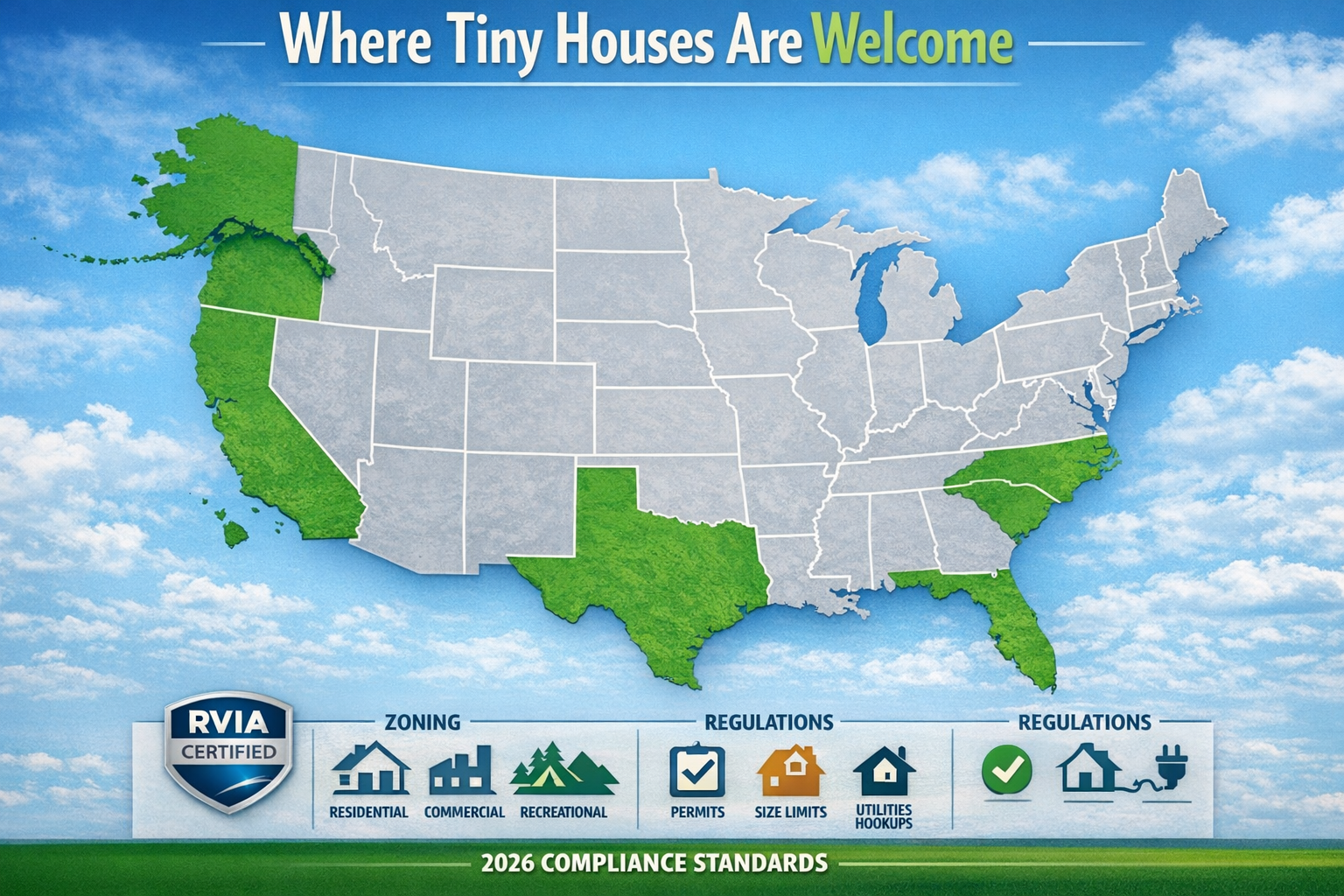
The six states that explicitly allow tiny homes in RV parks—Alaska, California, Florida, Texas, Oregon, and Tennessee—provide the clearest legal framework for tiny house parking, but even within these states, county and municipal regulations create significant variation.[1]
State-by-state breakdown for 2026:
Alaska: Permits tiny houses in RV parks statewide with minimal restrictions, though winter weather considerations make year-round living challenging in many locations.
California: Allows tiny house parking in RV parks, but many municipalities require registration as residential dwellings. ADU laws have expanded options significantly since 2020.
Florida: Welcomes tiny houses in RV parks, particularly in counties with high seasonal populations. Some parks cater specifically to tiny house owners.
Texas: Offers broad acceptance in RV parks, though unincorporated areas provide more flexibility than cities with strict zoning codes.
Oregon: Permits tiny house parking with strong support for alternative housing, but Portland metro area has specific size and certification requirements.
Tennessee: Allows tiny houses in RV parks, with particularly welcoming policies in rural counties and tourist areas.
Beyond these six states, finding parking depends heavily on personal connections rather than formal listings, with tiny house forums and social media groups being more reliable resources than conventional real estate sites.[3]
Choose private RV parks over public campgrounds if you need extended stays. Private operators have more flexibility to accommodate tiny houses and often welcome the stable, long-term revenue that tiny house owners provide compared to transient RV travelers.
What Are the Alternatives If RV Parks Won’t Accept Your Tiny House?
When RV parks reject your tiny house due to certification issues, size restrictions, or local regulations, several alternative parking options exist that may offer more flexibility and potentially lower costs.
Primary alternatives to RV park parking:
Private land rental: Renting space on private property is often the most flexible option. Written land rental agreements are essential, as they should clearly define utilities, access, responsibilities, and length of stay to protect both residents and landowners.[3] Many tiny house owners find these arrangements through personal networks, Craigslist, or tiny house-specific forums.
Backyard parking (ADU classification): Accessory Dwelling Unit classification offers an alternative path where tiny houses are treated as secondary residential structures on primary lots with permanent foundations, though restrictions typically include prohibition on rental and requirement for family occupancy.[1] Minimum square footage requirements vary by location, with most cities requiring a minimum of 200 square feet for indoor living areas when tiny homes have permanent foundations.[1]
Tiny house communities: Dedicated tiny house villages have emerged in many states, offering purpose-built infrastructure, community amenities, and clear legal standing. These communities typically charge monthly fees similar to RV parks but provide more stability and tiny-house-specific resources.
Mobile home parks: Mobile home classification is not a reliable option for most tiny houses, as HUD regulations require a minimum of 400 square feet—larger than many tiny homes—and mandate tire removal and ground securing.[4] However, some larger tiny houses (300-400 square feet) may qualify in certain jurisdictions.
Rural property purchase: Buying a small parcel in an unincorporated area often provides the most freedom, as county regulations tend to be less restrictive than city codes. This option requires more capital but eliminates monthly parking fees.
A common mistake is assuming that because you can’t park at an RV park, you can’t park anywhere legally. In reality, private land arrangements often offer more flexibility and fewer restrictions than commercial RV parks, particularly for full-time living.
How Much Does It Cost to Park a Tiny House at an RV Park in 2026?
Parking costs for tiny houses at RV parks in 2026 range from $300 to $1,200 per month depending on location, amenities, utilities included, and whether you’re negotiating a long-term rate versus paying nightly fees.
Typical cost breakdown:
- Budget RV parks: $300-$500/month (basic hookups, minimal amenities, often rural locations)
- Mid-range RV parks: $500-$800/month (full hookups, WiFi, laundry facilities, security)
- Premium RV resorts: $800-$1,200/month (resort amenities, pools, fitness centers, social activities)
- Tiny house villages: $400-$900/month (tiny-house-specific infrastructure and community)
Additional costs to factor in:
- Utilities: Some parks include all utilities; others charge separately for electric (typically $50-150/month based on usage)
- Deposits: First month plus security deposit (usually equal to one month’s rent)
- Registration fees: Annual RV registration if required by the park ($25-100)
- Insurance: RV or tiny house insurance ($300-800/year depending on value)
- Propane: If not on natural gas hookup ($30-80/month for heating and cooking)
Choose long-term contracts (6-12 months) if you want the best rates. Most RV parks offer 20-40% discounts for extended stays compared to their nightly or weekly rates. Always ask about seasonal pricing, as winter rates in warm climates and summer rates in northern states often command premium pricing.
The edge case: some RV parks offer free or heavily discounted parking in exchange for part-time work as campground hosts, maintenance helpers, or office staff. This arrangement works particularly well for remote workers or retirees who have flexible schedules.[4]
What Documentation Do You Need to Park a Tiny House at an RV Park?
RV parks require specific documentation to verify your tiny house meets safety standards, insurance requirements, and legal classifications before allowing you to park on their property. Having these documents prepared in advance significantly speeds up the approval process.
Essential documentation includes:
RVIA certification (if applicable): The Recreation Vehicle Industry Association certification proves your tiny house was built by a certified manufacturer and meets RV safety standards. This is the single most valuable document for gaining RV park acceptance, but it’s only available for factory-built tiny homes, not DIY projects.[1][2]
Vehicle registration: Your tiny house on wheels must be registered as either an RV or travel trailer in your state of residence. Registration proves legal ownership and road-worthiness.
Insurance certificate: Most RV parks require proof of liability insurance, and many also require comprehensive coverage. Policies should specifically cover your tiny house as either an RV or specialized dwelling.
Utility hookup specifications: Documentation showing your electrical system (30 or 50 amp), water connections, and waste systems meet RV industry standards helps park managers verify compatibility.
Driver’s license and personal ID: Standard identification for rental agreements and background checks that some parks conduct.
References or rental history: Some premium RV parks request previous landlord references or proof of good standing at other RV parks.
Written rental agreement: Once approved, the park will provide a rental agreement. Written land rental agreements are essential, as they should clearly define utilities, access, responsibilities, and length of stay to protect both residents and landowners.[3]
A common mistake is arriving at an RV park without documentation, assuming your tiny house will be accepted based on appearance alone. Park managers face liability issues and must verify compliance before allowing occupancy. Prepare a folder (physical and digital) with all required documents before beginning your search.
How Are Regulations for Tiny Houses in RV Parks Changing?
Municipal regulations continue evolving in 2026, with the International Code Council actively persuading US states to accommodate tiny homes as resource scarcity increases government incentives for alternative housing.[1] This trend toward acceptance represents a significant shift from the restrictive policies that dominated the 2010s.
Key regulatory trends in 2026:
Expanded ADU ordinances: California, Oregon, and Washington have led the way in updating accessory dwelling unit laws to explicitly include tiny houses. These changes allow tiny homes on permanent foundations in residential backyards, creating new parking options beyond RV parks.[7]
Tiny house appendix codes: Several states have adopted or are considering the IRC Appendix Q, which establishes minimum standards specifically for tiny houses (including those on wheels). This creates a distinct legal category separate from traditional RVs.
Zoning flexibility initiatives: Cities facing housing shortages are experimenting with overlay zones and special districts where tiny houses receive expedited approval for both temporary and permanent placement.
RV park reclassification: Some municipalities are creating “tiny house resort” or “alternative housing community” designations that allow RV parks to host long-term tiny house residents without violating recreational-use-only restrictions.
Insurance and financing evolution: As regulations clarify, insurance companies and lenders are developing products specifically for tiny houses, which indirectly supports their acceptance at RV parks by reducing liability concerns.
Choose locations in states actively updating their codes if you want long-term stability. The six explicitly tiny-house-friendly states continue expanding their frameworks, while states like Colorado, North Carolina, and Arizona are emerging as newly welcoming jurisdictions.
The regulatory landscape remains fragmented, with significant variation even between neighboring counties. Before committing to any location, verify current regulations directly with the local planning department rather than relying on outdated information or assumptions based on state-level policies.
What Should You Look for When Choosing an RV Park for Your Tiny House?
Selecting the right RV park for your tiny house requires evaluating factors beyond basic hookups and monthly rates, particularly if you plan extended stays or full-time living. The best parks for tiny houses offer infrastructure designed for residential use rather than short-term camping.
Critical evaluation criteria:
Tiny house acceptance policy: Explicitly confirm the park accepts tiny houses, not just traditional RVs. Ask about size limits, certification requirements, and any restrictions on owner-built versus manufactured units.
Utility infrastructure quality:
- Electric: 50-amp service is preferable for running multiple appliances, air conditioning, and heating simultaneously
- Water: Consistent pressure and quality (ask about well water vs. municipal supply)
- Sewer: Direct hookup vs. dump station access
- Internet: Reliable high-speed WiFi or wired connections if you work remotely
Duration policies: Verify maximum stay limits, renewal procedures, and any seasonal restrictions. Get written confirmation if the park allows stays beyond typical RV limits.
Location and accessibility:
- Proximity to employment, healthcare, and shopping
- Road conditions for entering/exiting (particularly important for larger tiny houses)
- Public transportation access if you don’t have a separate vehicle
- Climate considerations for year-round comfort
Community and amenities:
- Other tiny house residents (creates supportive community and signals park acceptance)
- Laundry facilities, showers, and bathhouses
- Package delivery and mail service
- Pet policies if applicable
Financial transparency:
- All-inclusive pricing vs. metered utilities
- Fee increase history and policies
- Refund policies for early departure
- Hidden fees (trash, WiFi, cable, maintenance)
Legal standing: Verify the park operates legally within local zoning codes. Parks operating in legal gray areas risk closure, which could force you to relocate unexpectedly.
Visit potential parks in person before committing. Photos and websites rarely show the full picture, and talking with current residents provides insights into management responsiveness, community dynamics, and whether the park truly welcomes tiny houses or merely tolerates them.
Frequently Asked Questions
Do all RV parks accept tiny houses?
No, not all RV parks accept tiny houses. Acceptance depends on park policies, state regulations, and whether your tiny house meets RV certification standards. Private parks have more flexibility than public campgrounds, and parks in the six tiny-house-friendly states (Alaska, California, Florida, Texas, Oregon, Tennessee) are most likely to welcome tiny homes.[1]
Can I live in my tiny house full-time at an RV park?
Full-time living in a tiny house at an RV park is legal only where local zoning codes permit it. Many RV parks are zoned for “recreational use only,” which prohibits permanent residence regardless of park policies. Always verify both park rules and municipal regulations before planning full-time occupancy.[3]
Do I need RVIA certification to park at an RV park?
RVIA certification is not universally required but significantly increases your acceptance chances at established RV parks. Only factory-built tiny homes from certified manufacturers can obtain RVIA certification—owner-built tiny houses cannot.[1][2] Some parks accept non-certified tiny houses, particularly in tiny-house-friendly states.
How long can I park my tiny house at an RV park?
Duration limits vary widely. Public RV parks typically allow 14-30 days per visit, while private parks may permit 6-12 months or longer. Some RV resorts in tiny-house-friendly states allow indefinite stays for qualified tiny houses. Always confirm maximum stay limits in writing before parking.[4]
What’s the difference between parking a tiny house and parking an RV?
Legally, most tiny houses on wheels are classified as RVs, so parking regulations are similar. However, tiny houses often face additional scrutiny regarding certification, long-term occupancy intentions, and compliance with residential building codes that don’t apply to recreational vehicles.[1]
Can I park my tiny house in a mobile home park instead?
Mobile home parks rarely accept tiny houses because HUD regulations require mobile homes to be at least 400 square feet, have wheels removed, and be secured to the ground. Most tiny houses don’t meet these specifications.[4] Some larger tiny houses (300-400 square feet) might qualify in specific jurisdictions.
What utilities are included when parking at an RV park?
Most RV parks include water, sewer, and trash service in monthly rates. Electric is sometimes included but often metered separately. Internet, cable, and propane are typically extra. Always clarify which utilities are included before signing a rental agreement to avoid surprise charges.[3]
Are tiny houses allowed in national or state park campgrounds?
National and state park campgrounds generally prohibit long-term parking and are designed for short-term recreational camping only. Maximum stays typically range from 7-14 days, and these parks rarely make exceptions for tiny houses. They’re suitable for travel but not residential parking.
How do I find RV parks that accept tiny houses?
Finding tiny-house-friendly RV parks requires research beyond standard RV park directories. Check tiny house forums, Facebook groups, and specialized websites like Tiny House Map. Contact parks directly to confirm their tiny house policies, as acceptance isn’t always advertised.[3]
What insurance do I need to park my tiny house at an RV park?
Most RV parks require liability insurance at minimum, with many also requiring comprehensive coverage. Your tiny house can typically be insured as either an RV or a specialized dwelling. Insurance costs range from $300-800 annually depending on your tiny house value and coverage level.
Can I build my tiny house at an RV park?
Most RV parks prohibit construction on-site due to liability, noise, and zoning concerns. Your tiny house should arrive complete and road-ready. Some parks may allow minor modifications or additions, but major construction work is typically forbidden in park rules.
What happens if local laws change after I park my tiny house?
If zoning laws change after you’ve legally parked your tiny house, you may be “grandfathered in” under previous regulations, but this isn’t guaranteed. Some jurisdictions require compliance with new codes within a specific timeframe. This risk makes written rental agreements and understanding local political climate important for long-term planning.[3]
Key Takeaways
- Tiny house parking at RV parks is legally possible in 2026, particularly in the six explicitly welcoming states (Alaska, California, Florida, Texas, Oregon, Tennessee), but requires meeting specific size, certification, and hookup standards
- RVIA certification dramatically improves acceptance rates at established RV parks but is only available for factory-built tiny homes from certified manufacturers, not owner-built structures
- Full-time living legality depends on local zoning codes, not just park policies—verify municipal regulations before committing to any location for extended stays
- Documentation is essential for smooth approval, including registration, insurance, utility specifications, and RVIA certification if available
- Costs range from $300-1,200 per month depending on location, amenities, and whether utilities are included, with long-term contracts offering significant discounts
- Private RV parks offer more flexibility than public campgrounds for both acceptance of tiny houses and duration of stays
- Alternative parking options exist when RV parks won’t accept your tiny house, including private land rental, ADU placement, and dedicated tiny house communities
- Regulations continue evolving favorably toward tiny house acceptance as housing shortages increase government interest in alternative housing solutions
- Personal research and direct contact with parks and planning departments is more reliable than online directories or assumptions based on state-level policies
- Written agreements protect both parties by clearly defining utilities, responsibilities, duration, and expectations for tiny house parking arrangements
Conclusion
The answer to “can you park a tiny house at an RV park?” in 2026 is a qualified yes—but success depends on choosing the right location, ensuring your tiny house meets RV standards, and thoroughly understanding both park policies and local regulations. The six tiny-house-friendly states offer the clearest path forward, while other locations require more careful research and often benefit from personal connections.
RV parks increasingly recognize tiny houses as a stable revenue source and welcome them when they meet basic RV specifications: proper dimensions (8.5 feet wide, under 40 feet long), standard utility hookups, and road-ready condition. RVIA certification opens the most doors but isn’t universally required, particularly at private parks in welcoming states.
Your next steps:
- Verify your tiny house specifications against RV park standards (width, length, weight, hookups)
- Research regulations in your target location at state, county, and municipal levels
- Gather documentation including registration, insurance, and certification if applicable
- Contact parks directly rather than relying on online information alone
- Join tiny house communities online to learn from others’ experiences in your target area
- Visit potential parks in person before committing to long-term agreements
- Get everything in writing including duration limits, utility arrangements, and fee structures
The tiny house movement continues gaining legal recognition, and RV parks represent one of the most accessible parking options for those seeking affordable, mobile living. With proper preparation and realistic expectations about regulatory requirements, parking your tiny house at an RV park can provide the flexibility, community, and cost savings that make tiny living appealing.
References
[1] Can Tiny Homes Be Parked In Rv Parks – https://offgriddwellings.com/can-tiny-homes-be-parked-in-rv-parks
[2] Tiny House Parking – https://tinyhousegiantjourney.com/2017/05/15/tiny-house-parking/
[3] Best Parking Locations For Tiny Homes In 2026 – https://truformtiny.com/best-parking-locations-for-tiny-homes-in-2026/
[4] Tiny House Parking Guide – https://www.tinyhomebuilders.com/learn/tiny-house-parking-guide
[7] Proposed Law Could Let You Downsize Your Way To Homeownership – https://www.kuow.org/stories/proposed-law-could-let-you-downsize-your-way-to-homeownership