

Nearly 70% of RV owners have never opened the service panel on their rooftop air conditioner — and most don’t need to. Yet “do RV AC need freon” is one of the most searched questions in the RV community, often sparked by a unit that’s blowing warm air on a scorching summer day. Before calling a technician or buying a refrigerant kit, it helps to understand exactly how your RV’s cooling system works and what actually causes it to stop cooling.
Key Takeaways 🏕️
- RV air conditioners are sealed systems — they do not consume or “use up” refrigerant (freon) during normal operation.
- If an RV AC is low on refrigerant, it almost always means there is a leak, not just normal depletion.
- Most RV AC problems that feel like “low freon” are actually caused by dirty filters, blocked coils, or electrical issues.
- Adding refrigerant without fixing a leak is a temporary fix that won’t solve the underlying problem.
- Refrigerant handling requires EPA certification — it’s not a DIY job in most cases.
How Does an RV Air Conditioner Actually Work?
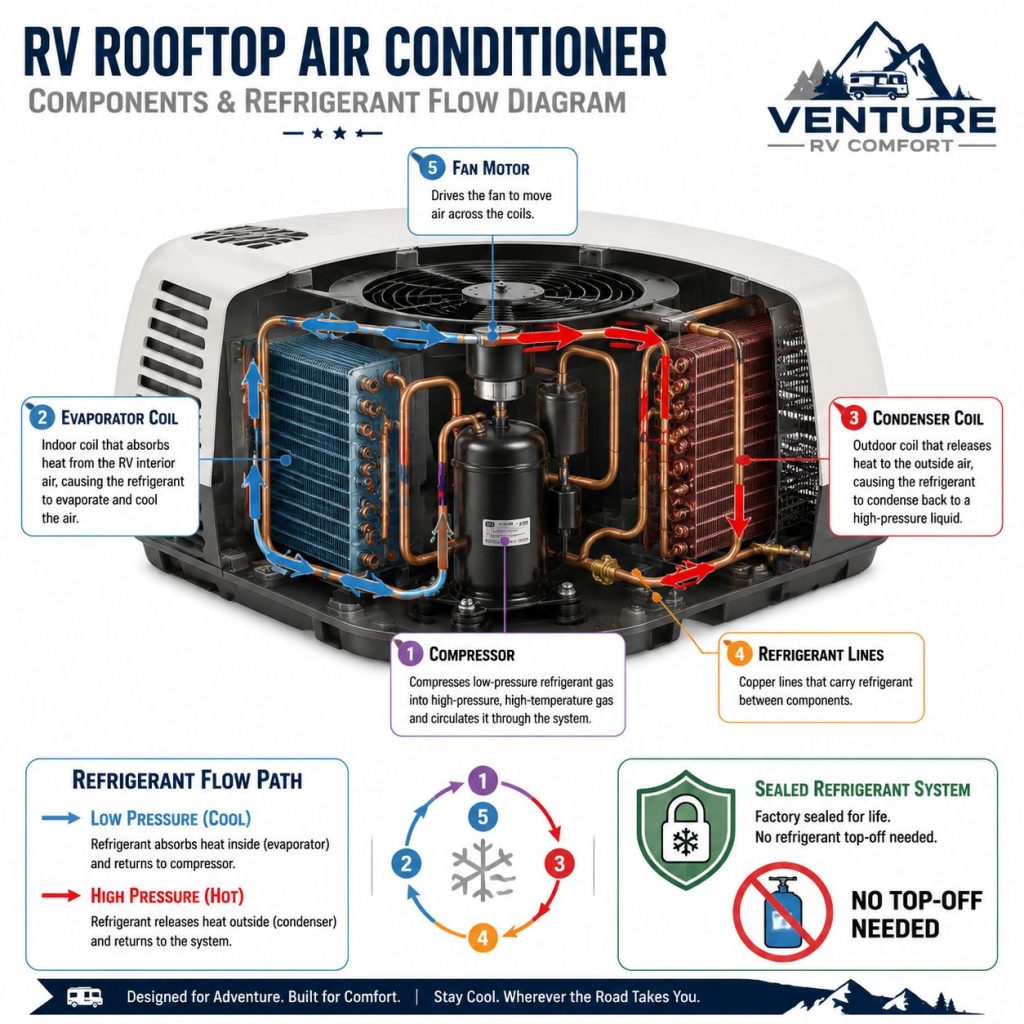
Before answering whether do RV AC need freon, it’s worth understanding the basics of how these units cool your rig.
RV air conditioners work on the same principle as home and car AC systems. A refrigerant (commonly called freon, though that’s technically a brand name) circulates through a closed loop inside the unit. Here’s the simple version:
- Warm air from inside the RV is pulled across the evaporator coil.
- The refrigerant inside the coil absorbs the heat, cooling the air.
- The now-warm refrigerant travels to the condenser coil on the outside of the unit.
- Heat is released outside, and the refrigerant cools down again.
- The cycle repeats — continuously, as long as the unit runs.
💡 Key insight: The refrigerant is never “used up.” It just keeps cycling. Think of it like water in a closed pipe — it doesn’t disappear.
What Type of Refrigerant Do RV AC Units Use?
Most modern RV air conditioners use R-410A refrigerant. Older units may use R-22 (the original “Freon”), which has been phased out due to environmental regulations. Some newer models are transitioning to R-32 or R-454B as the industry moves toward more eco-friendly options.
| Refrigerant | Common In | Status |
|---|---|---|
| R-22 | Older RV units | Phased out, expensive |
| R-410A | Most current RV AC units | Widely available |
| R-32 / R-454B | Newer models | Emerging standard |
Do RV AC Need Freon? Understanding the Sealed System
Here’s the straight answer: no, RV AC units do not need freon added as part of regular maintenance. They are factory-sealed systems designed to hold their refrigerant charge for the life of the unit.
So why do so many RV owners end up searching “do RV AC need freon”? Because a struggling AC unit feels like it might be low on refrigerant. The air coming out is warm, the unit runs constantly, and nothing seems to be working. But in the vast majority of cases, the real culprit is something else entirely.
Common Reasons Your RV AC Isn’t Cooling (That Aren’t Freon)
🔧 Dirty air filter — This is the #1 cause of poor cooling. A clogged filter restricts airflow and makes the unit work twice as hard for half the result.
🔧 Dirty evaporator or condenser coils — Dust and debris build up over camping seasons and reduce heat transfer efficiency dramatically.
🔧 Blocked return air vents — Furniture, curtains, or stored items blocking vents can choke the system.
🔧 Electrical issues — A failing capacitor is extremely common in RV AC units and causes the compressor to struggle or not start at all.
🔧 Extreme ambient heat — On very hot days (above 100°F), even a perfectly working RV AC may struggle to keep up.
🔧 Low voltage at the campsite — RV AC units need adequate amperage. Low shore power voltage causes weak performance.
🛑 Before assuming it’s a refrigerant issue, check these basics first. Cleaning filters and coils alone fixes the problem for the majority of RV owners.
When Does an RV AC Actually Need Refrigerant?
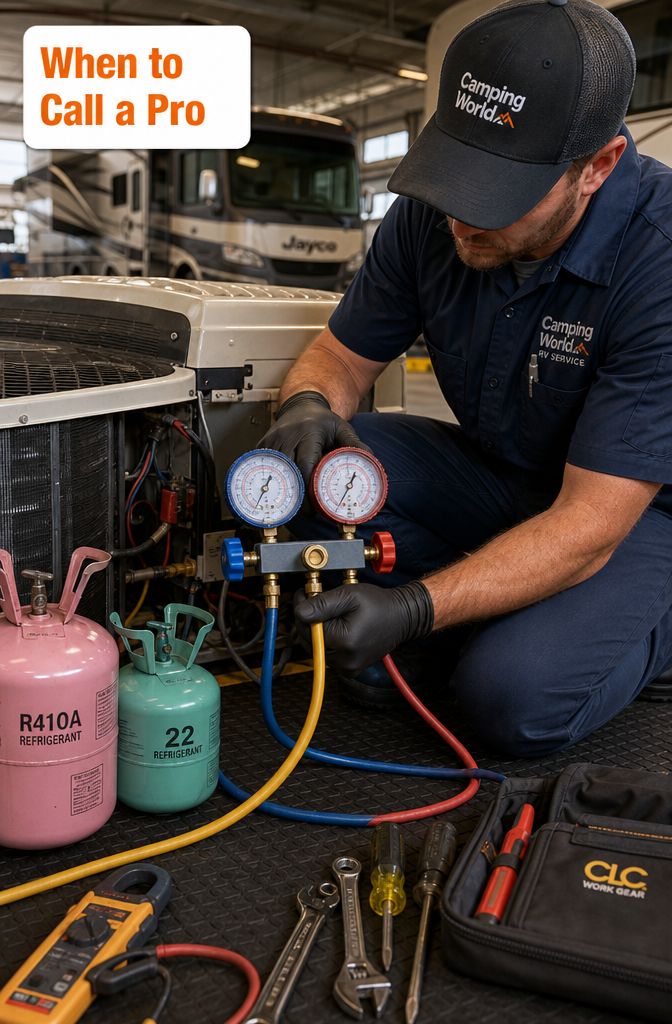
The only time an RV AC legitimately needs refrigerant added is when there is a leak in the sealed system. Refrigerant doesn’t evaporate or get consumed — if it’s low, it escaped somewhere.
Signs that a refrigerant leak might be the issue include:
- ❄️ Ice forming on the evaporator coil (paradoxically, this can indicate low refrigerant)
- 🌡️ Warm air blowing even after cleaning filters and coils
- 🔊 Hissing or bubbling sounds near the unit
- 💧 Oily residue around refrigerant line connections
What to Do If You Suspect a Leak
- Call a certified HVAC or RV technician. In the United States, handling refrigerants requires an EPA Section 608 certification. This is not a DIY task — selling or purchasing refrigerants without certification is illegal for most consumers.
- Have the system pressure-tested to locate the leak.
- Repair the leak first, then recharge the system. Adding refrigerant without fixing the leak is like filling a punctured tire with air — it’s only a matter of time before you’re back to square one.
- Evaluate the cost vs. replacement. If the leak is in the compressor or a major component, a new RV AC unit may be more cost-effective than a repair.
How Much Does RV AC Refrigerant Service Cost?
| Service | Estimated Cost Range |
|---|---|
| Leak detection | $75 – $150 |
| Refrigerant recharge (R-410A) | $150 – $300 |
| Compressor replacement | $400 – $900+ |
| Full RV AC unit replacement | $700 – $1,500+ installed |
Costs vary by region, unit brand, and labor rates.
Maintaining Your RV AC to Avoid Refrigerant Problems
The best way to never worry about whether do RV AC need freon is to keep the unit in top shape through regular maintenance. A well-maintained RV AC can last 10 to 15 years without ever needing a refrigerant service.
Simple RV AC Maintenance Checklist ✅
- Clean or replace the air filter every 30 days of use (or more often in dusty environments)
- Clean the evaporator and condenser coils at the start of each camping season
- Inspect the gasket/seal between the rooftop unit and the ceiling — a broken seal lets in heat and moisture
- Check for debris (leaves, insects, nests) in the condenser area
- Test the capacitor if the unit struggles to start — this is a cheap fix that many RVers do themselves
- Run the AC periodically even in cooler months to keep the compressor lubricated
- Cover the unit during winter storage to protect it from UV and debris
💬 “A $5 filter cleaning can save a $1,000 repair bill. The refrigerant is almost never the problem.” — Common advice from experienced RV technicians
Conclusion: The Bottom Line on RV AC and Freon
The short answer to “do RV AC need freon” is almost always no — not as a routine maintenance item, anyway. RV air conditioners are sealed systems that hold their refrigerant charge indefinitely under normal conditions. If yours is underperforming, start with the simple stuff: clean the filter, clear the coils, check the capacitor, and make sure you have adequate power at your campsite.
If you’ve ruled out all the common culprits and the unit still isn’t cooling, then — and only then — it’s time to call a certified technician to check for a refrigerant leak.
Actionable Next Steps 🚀
- Right now: Pull out your RV AC filter and check if it needs cleaning. Chances are, it does.
- This weekend: Inspect the coils and clear any debris from the condenser area.
- Before next camping season: Schedule a full AC tune-up with an RV service center.
- If problems persist: Contact an EPA-certified technician to test system pressure — don’t attempt to add refrigerant yourself.
Taking care of your RV’s air conditioner doesn’t require a refrigerant top-off — it requires a little attention and regular maintenance. Keep it clean, keep it running, and enjoy a cool rig no matter where the road takes you. 🏕️❄️
References
- U.S. Environmental Protection Agency. (2021). Section 608 Technician Certification. EPA.gov. https://www.epa.gov/section608
- Dometic Corporation. (2022). RV Air Conditioner Owner’s Manual. Dometic.com.
- Coleman-Mach. (2020). Air Conditioner Installation and Operation Manual. Airxcel Inc.
- U.S. Department of Energy. (2023). How Air Conditioners Work. Energy.gov. https://www.energy.gov/energysaver/air-conditioning
Tags: RV air conditioner, do rv ac need freon, RV AC maintenance, RV cooling problems, RV freon, R-410A refrigerant, RV HVAC, rooftop AC unit, RV appliance repair, refrigerant leak, RV tips, camping comfort