Would you like to save this article?
You’re cozy in your RV, sipping hot cocoa, when you glance outside and see snowflakes starting to fall. Your heart skips a beat—not from the beauty, but from worry. Should you stay put? Hit the road? Turn back? If you’ve ever felt this winter travel anxiety, you’re not alone. A fascinating new survey reveals exactly how RVers handle driving in the snow, and the results might surprise you. With 28 million Americans planning winter RV trips in 2026[4], understanding how the RV community approaches snowy conditions has never been more important.
Key Takeaways
- 74% of RVers avoid snow completely, making it the overwhelming preference among the RV community
- Only 10% of RVers love winter RVing, showing that snow enthusiasts are a small but passionate minority
- Open, exposed highways pose greater fear than busy roads, with drivers avoiding windswept routes where visibility drops[3]
- Light snow acceptance is limited, with just 16% willing to drive in minimal winter conditions
- Winter RV travel is surging, with participation up 80% over the past four years despite snow concerns[2]
Understanding the Survey: How Do RVers Handle Driving In the Snow?
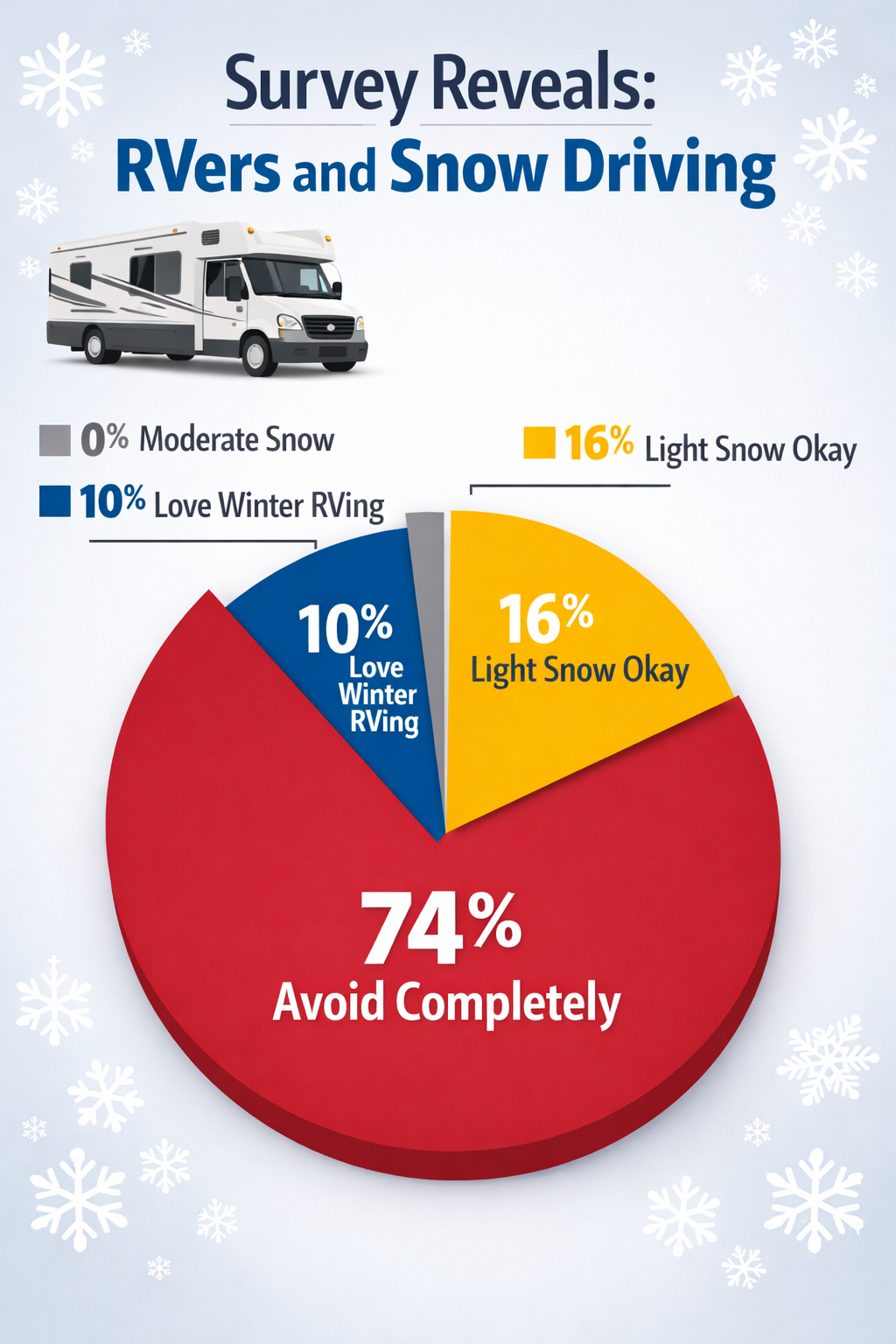
The numbers tell a clear story about RV snow driving preferences. When asked about their winter driving comfort levels, the RV community responded with striking clarity.
The Survey Results Breakdown
Here’s what RVers revealed about their snow experience preferences:
| Preference Level | Percentage | What It Means |
|---|---|---|
| Avoid completely | 74% | Nearly three-quarters refuse to drive in any snow |
| Light snow okay | 16% | Will venture out in minimal conditions only |
| Moderate snow | 0% | Nobody feels comfortable in moderate snowfall |
| Love winter RVing | 10% | Small group embraces winter adventures |
The most eye-opening finding? Zero percent of respondents feel comfortable driving in moderate snow conditions. This gap between “light snow” and “love winter RVing” shows that RVers either stay very cautious or go all-in on winter preparation.
Why These Numbers Matter
Understanding how RVers handle driving in the snow reveals important trends in the recreational vehicle community. Despite winter RV travel increasing by 80% over the past four years[2], most travelers are carefully choosing their routes and timing to avoid hazardous conditions entirely.
The survey methodology, based on 3,004 U.S. licensed drivers surveyed in January 2026[3], examined which roads people actively avoid during winter months. The findings show that RVers aren’t just concerned about snow—they’re worried about specific road conditions that make winter travel dangerous.
Why 74% of RVers Avoid Snow Completely
The overwhelming majority of RVers steering clear of snow isn’t about being wimpy—it’s about being smart. Let’s explore why nearly three-quarters of the RV community says “no thanks” to winter white stuff.
The Real Dangers of RV Snow Driving
❄️ Size and Weight Challenges
RVs aren’t your average vehicles. A Class A motorhome can weigh up to 30,000 pounds, and that massive weight doesn’t stop on a dime—especially on ice. The physics of stopping a rolling house on slippery roads makes even experienced drivers nervous.
🌬️ Wind and Exposure Risks
Here’s something interesting: drivers most fear open, elevated, mountainous, or windswept routes where snow blows back onto roads[3]. Even busy interstates appear on avoidance lists when they combine speed with exposure. This suggests that emptiness can feel more dangerous than congestion[3].
The tall profile of RVs makes them vulnerable to crosswinds, which get worse during winter storms. Getting pushed into another lane by a gust while driving on ice? That’s a nightmare scenario most RVers wisely avoid.
Financial and Practical Concerns
Repair Costs Add Up
One accident in winter conditions can mean:
- Expensive body damage to your RV
- Broken water lines from freezing
- Damaged slideouts from ice buildup
- Windshield replacement from flying ice chunks
Limited Help in Remote Areas
Breaking down in a snowstorm isn’t like calling AAA for your sedan. Finding a tow truck that can handle a 35-foot motorhome in winter conditions? Good luck. Many RVers avoid snow simply because the consequences of something going wrong are too serious.
Experience Levels Matter
Not everyone grew up driving in Minnesota winters. Many RVers come from southern states where snow is rare. Without years of experience handling vehicles in slippery conditions, the smart choice is avoiding those situations altogether.
The 16% Who Accept Light Snow Conditions
While most RVers avoid snow completely, a notable 16% are willing to drive in light snow. These folks represent a middle ground—not snow-phobic, but definitely not reckless.
What “Light Snow” Really Means
For most RVers in this category, light snow means:
✅ Flurries that aren’t sticking to the road surface
✅ Dry, powdery snow that blows off easily
✅ Daytime driving with good visibility
✅ Temperatures above freezing to prevent ice formation
✅ Short distances to the next safe stopping point
These drivers aren’t taking chances. They’re making calculated decisions based on specific conditions.
Safety Strategies for Light Snow Driving
RVers who accept light snow conditions typically follow strict safety protocols:
Before Hitting the Road:
- Check weather forecasts obsessively
- Have multiple escape routes planned
- Ensure all systems are winterized
- Pack extensive emergency supplies
- Communicate travel plans with others
While Driving:
- Reduce speed by at least 50%
- Increase following distance dramatically
- Avoid sudden braking or steering
- Watch for black ice on bridges
- Pull over if conditions worsen
Equipment Essentials:
- 🔧 Tire chains (and practice installing them)
- 📱 Satellite communication device
- 🔦 Extra batteries and flashlights
- 🧊 Ice melt and traction mats
- 🛏️ Cold-weather sleeping bags
The 10% Who Love Winter RVing
Now we’re talking about the adventurers! Ten percent of RVers actually love winter RVing, and they’re not crazy—they’re just extremely well-prepared.
What Sets Winter Warriors Apart
These winter enthusiasts share common characteristics:
Extensive Experience
Most winter-loving RVers have been doing this for years. They’ve learned through gradual exposure, starting with light conditions and building skills over time.
Specialized Equipment
Winter RVers invest in:
- Four-season RVs with superior insulation
- Heated water tanks and lines
- All-terrain or winter tires
- Diesel engines (better cold-weather performance)
- Upgraded heating systems
Different Destinations
Interestingly, 40% of travelers use AI for trip planning, seeking destinations within a 4-7 hour travel window[2][4]. Winter RVers often plan shorter trips to ski resorts, winter festivals, or southern snowbird destinations.
The Rewards of Winter RVing
Why do these folks brave the cold? The benefits are real:
🏔️ Fewer Crowds – Popular campgrounds sit nearly empty
💰 Lower Prices – Significant discounts on campsites and attractions
🌲 Stunning Beauty – Winter landscapes offer breathtaking views
🐾 Pet-Friendly – With 67% bringing pets along[4], winter camping means more space for furry friends
🎿 Unique Activities – Access to winter sports and seasonal events
Training and Preparation
Winter-loving RVers don’t just wing it. Many take:
- Defensive driving courses
- RV-specific winter driving classes
- Practice sessions in empty parking lots
- Gradual skill-building trips
They also join winter RVing communities, sharing tips and route information. The camaraderie among winter RVers is strong—they look out for each other on the road.
Roads RVers Avoid During Winter: Survey Insights
The survey examining roads actively avoided during winter reveals fascinating patterns about how RVers handle driving in the snow. Understanding which routes make drivers nervous helps explain the overwhelming preference for avoiding winter travel.
Most Feared Winter Routes
Mountain Passes 🏔️
Steep grades become ice slides. Even with chains, the combination of elevation, exposure, and sharp curves makes mountain passes the top avoided routes.
Open Interstate Sections
Surprisingly, even busy interstates appear on avoidance lists when they combine speed with exposure[3]. Long stretches through plains states where wind whips across the highway create whiteout conditions that terrify RV drivers.
Elevated Highways and Bridges
These freeze first and thaw last. Windswept routes where snow blows back onto roads[3] create constantly changing conditions that make safe travel nearly impossible.
Rural Two-Lane Roads
Limited visibility, no shoulders, and delayed snow removal make these routes particularly dangerous. If something goes wrong, help is far away.
Why Exposure Matters More Than Traffic
The survey revealed something counterintuitive: drivers most avoid open, elevated, mountainous, or windswept routes where ice lingers or visibility collapses[3]. This means RVers would rather deal with traffic on a protected urban highway than drive alone on an exposed rural route.
The reasoning makes sense:
- Other vehicles provide visual reference points
- More traffic means better road maintenance
- Help is available if needed
- Buildings and trees block wind
How Winter RV Travel Is Changing in 2026
Despite most RVers avoiding snow, winter RV travel is booming. The numbers tell an interesting story about how people are adapting their travel habits.
Explosive Growth in Winter Travel
28 million Americans plan to go RVing this winter[4], representing a 33% increase from the previous year[2]. Even more impressive, winter RV travel has jumped 80% over the past four years[2].
How can winter travel grow while most people avoid snow? The answer lies in where and how people travel.
Snowbird Migration Patterns
Many winter RVers aren’t driving through snow—they’re driving away from it. The snowbird phenomenon explains much of the winter travel growth:
Popular Snowbird Destinations:
- 🌵 Arizona (Phoenix, Tucson, Yuma)
- 🌴 Florida (entire Gulf Coast)
- 🏜️ Southern California (desert communities)
- 🌊 South Texas (Rio Grande Valley)
These travelers leave before the first snow and don’t return until spring. They’re technically winter RVers, but they’re avoiding snow completely.
Technology Changing Winter Travel
The rise of technology is reshaping how RVers plan winter trips. 40% of consumers use AI for trip planning[2][4], which helps them:
- Identify snow-free routes
- Monitor real-time weather conditions
- Find emergency services along routes
- Connect with other travelers for road updates
- Locate pet-friendly stops (important since 67% bring pets[4])
Shorter Trip Windows
The preference for destinations within a 4-7 hour travel window[4] reduces exposure to changing weather conditions. Shorter trips mean:
- Less chance of encountering unexpected snow
- Easier to turn back if conditions worsen
- More flexibility to wait out storms
- Lower risk overall
Essential Safety Tips for Any Winter RV Travel
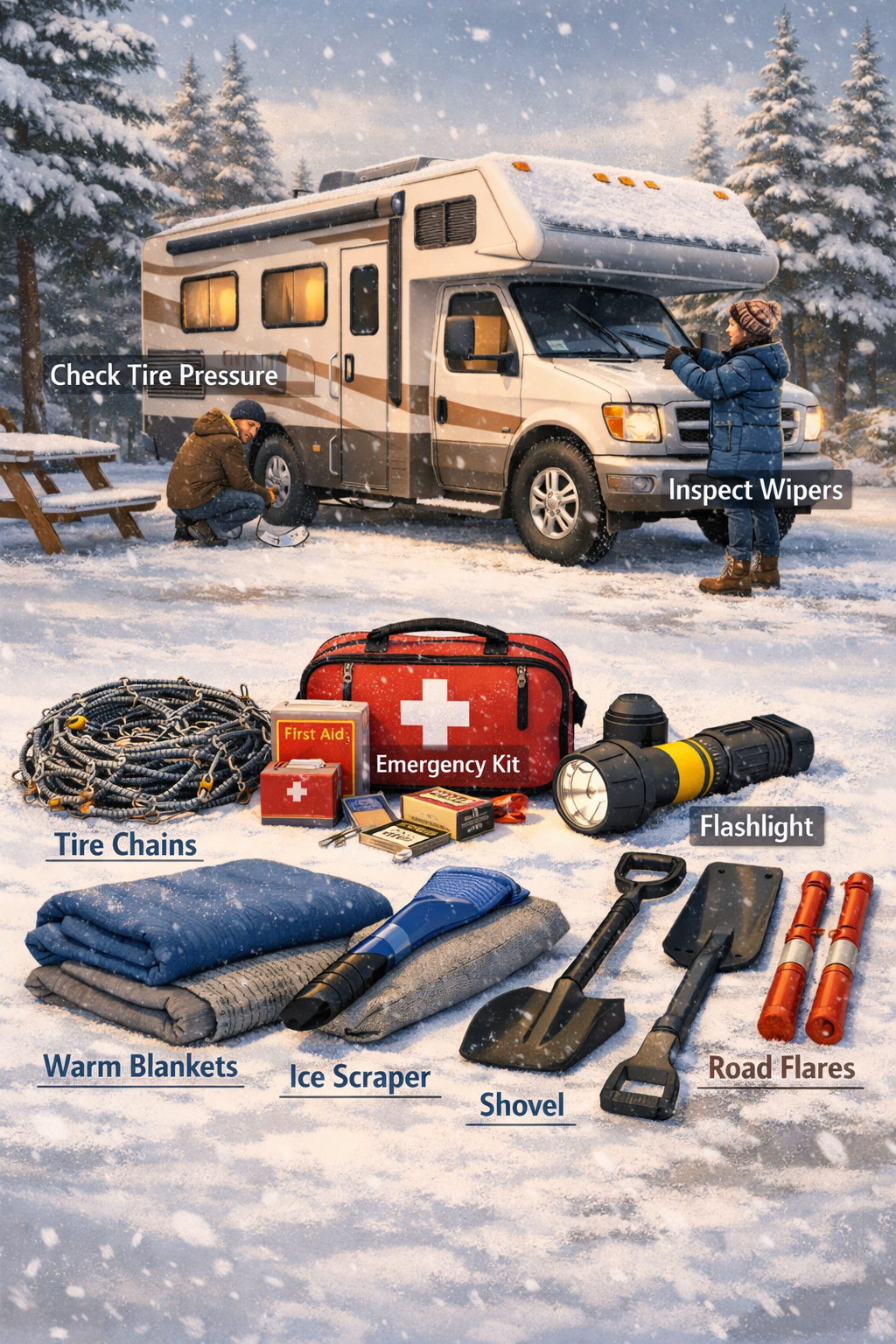
Whether you’re in the 74% who avoid snow, the 16% who tolerate light conditions, or the 10% who embrace winter, these safety tips apply to everyone.
Pre-Trip Planning
Weather Monitoring
Don’t just check the forecast once. Monitor conditions continuously:
- Check weather along your entire route
- Set up alerts for winter storm warnings
- Follow local DOT social media for road updates
- Have backup routes planned
Vehicle Preparation
Your RV needs winter-ready systems:
- ✓ Winterize all water systems (or use heated systems)
- ✓ Check tire tread depth and pressure
- ✓ Test battery strength (cold kills batteries)
- ✓ Verify heater functionality
- ✓ Inspect windshield wipers and washer fluid
- ✓ Ensure all lights work properly
Emergency Supplies Checklist
Every winter RVer should carry:
Food and Water:
- Three days of non-perishable food
- Extra water (stored where it won’t freeze)
- Hot beverage supplies
- High-calorie snacks
Warmth and Shelter:
- Cold-rated sleeping bags
- Extra blankets
- Hand and foot warmers
- Backup heating source (safe for indoor use)
Tools and Equipment:
- Tire chains (practiced installation)
- Shovel (full-size, not compact)
- Traction mats or kitty litter
- Ice scraper and snow brush
- Jumper cables or battery starter
Communication:
- Fully charged phone
- Portable charger/power bank
- CB radio or satellite communicator
- Emergency contact list
Driving Techniques for Winter Conditions
If you must drive in winter weather:
Speed Management
Slow down dramatically. The posted speed limit is for ideal conditions. In snow:
- Reduce speed by 50% minimum
- Go even slower on curves and hills
- Remember: stopping distance increases exponentially
Spacing and Following
Increase following distance to at least 8-10 seconds. Your RV needs much more room to stop than a car.
Smooth Inputs
Avoid sudden movements:
- Accelerate gently
- Brake early and softly
- Steer smoothly without jerking
Know When to Stop
The bravest decision is often pulling over. If conditions deteriorate:
- Find a safe parking area immediately
- Don’t wait until you’re in trouble
- Better to arrive late than not at all
Regional Differences in RV Snow Driving
How RVers handle driving in the snow varies significantly by region. Where you live shapes your comfort level and experience.
Northern RVers vs. Southern RVers
Northern States (Minnesota, Wisconsin, Michigan, etc.)
RVers from snow-country states show different patterns:
- More likely to attempt light snow driving
- Better equipped with winter gear
- More experienced with cold-weather systems
- Often own four-season RVs
- Still avoid moderate to heavy snow
Southern States (Florida, Texas, Arizona, etc.)
Southern RVers typically:
- Avoid any snow whatsoever
- Plan routes around winter weather
- Travel south for winter months
- Less equipped for cold conditions
- May not have winterized systems
Coastal vs. Mountain Communities
Coastal RVers deal with different challenges:
- Salt air and moisture
- Freezing rain more common than snow
- Wind as primary concern
- Milder temperatures overall
Mountain RVers face:
- Sudden elevation changes
- Extreme temperature swings
- Avalanche zones
- Limited route options
Understanding these regional differences helps explain why the survey shows such strong snow avoidance—many RVers simply aren’t from areas where winter driving skills develop naturally.
The Future of Winter RV Travel
Looking ahead, several trends are shaping how RVers will handle driving in the snow in coming years.
Improved RV Technology
Advanced Safety Features
Newer RVs are incorporating technology from passenger vehicles:
- Stability control systems
- Anti-lock braking improvements
- Traction control
- Backup cameras and sensors
- Tire pressure monitoring systems
Better Winterization
Manufacturers are responding to winter travel growth with:
- Improved insulation packages
- Heated underbelly systems
- Arctic packages as standard features
- More efficient heating systems
Climate Change Impacts
Changing weather patterns affect RV travel planning:
- Less predictable winter weather
- Sudden temperature swings
- Ice storms in unusual locations
- Extended shoulder seasons
These changes may push more RVers toward the “avoid completely” category as winter weather becomes harder to predict.
Growing Winter RV Community
Despite snow concerns, the winter RV community continues expanding. Online forums, social media groups, and apps connect winter travelers, sharing:
- Real-time road conditions
- Campground recommendations
- Safety tips and lessons learned
- Route planning assistance
This community support helps nervous RVers build confidence while respecting their limits.
Making Your Personal Snow Driving Decision
After reviewing how RVers handle driving in the snow through this survey, you might wonder where you fit. Here’s how to make smart decisions about your own winter RV travel.
Honest Self-Assessment
Ask yourself these questions:
Experience Level:
- How many years have you driven in snow?
- Have you driven large vehicles in winter?
- Do you panic when sliding starts?
- Have you practiced recovery techniques?
Equipment Reality:
- Is your RV designed for winter?
- Do you own proper safety equipment?
- Can you afford potential damage?
- Do you have reliable communication devices?
Risk Tolerance:
- What’s your comfort level with uncertainty?
- Can you handle being stranded temporarily?
- Are you traveling with vulnerable passengers?
- Do you have flexible scheduling?
Creating Your Winter Travel Policy
Based on your self-assessment, create personal guidelines:
If You’re in the 74% (Avoid Completely):
- Plan southern routes only
- Travel before/after winter season
- Monitor weather obsessively
- Have flexible cancellation policies
- Don’t let others pressure you
If You’re in the 16% (Light Snow Okay):
- Define “light snow” specifically
- Set hard limits (visibility, accumulation, temperature)
- Practice emergency procedures
- Upgrade equipment gradually
- Build skills progressively
If You’re in the 10% (Love Winter):
- Continue investing in training
- Maintain equipment rigorously
- Share knowledge with community
- Stay humble about conditions
- Never stop learning
No Shame in Avoiding Snow
The survey makes one thing crystal clear: you’re in the majority if you avoid snow. There’s zero shame in recognizing your limits and making safe choices. The RV lifestyle is about freedom and enjoyment—not proving toughness by taking unnecessary risks.
Conclusion: Survey Reveals Smart Choices by RVers
The data on how RVers handle driving in the snow reveals a community that’s making intelligent, safety-first decisions. With 74% avoiding snow completely, 16% accepting only light conditions, and 10% embracing winter adventures, the RV community shows a healthy respect for winter’s dangers.
The fact that zero percent feel comfortable in moderate snow conditions isn’t a sign of weakness—it’s a sign of wisdom. RVers understand that their homes-on-wheels require different handling than regular vehicles, especially in challenging conditions.
Yet winter RV travel continues growing, with 28 million Americans planning winter trips[4] and participation up 80% over four years[2]. This apparent contradiction makes sense when you understand that most winter RVers are avoiding snow, not embracing it. They’re heading south, planning carefully, and using technology to stay safe.
Your Next Steps
Ready to make informed decisions about winter RV travel? Here’s what to do:
- Assess your comfort level honestly using the guidelines above
- Invest in appropriate equipment for your chosen winter travel level
- Start small if you want to build winter driving skills
- Connect with the community through forums and social media groups
- Plan routes carefully using weather data and road condition reports
- Never compromise safety for schedule or peer pressure
Remember: The goal of RVing is enjoying the journey. If snow stress ruins that enjoyment, there’s an entire community of 74% who agree with you. Make the choice that keeps you safe, comfortable, and happy on the road.
Whether you’re heading south to escape winter entirely, cautiously venturing out in light flurries, or gearing up for a full winter adventure, make your decision based on honest self-assessment, proper preparation, and respect for Mother Nature’s power. That’s how smart RVers handle driving in the snow in 2026.
References
[1] Rvers Preferred Winter Destination Survey Reveals – https://rvshowoff.com/rvers-preferred-winter-destination-survey-reveals/
[2] Rvia Survey Finds Winter Rv Travel Up 80 In Past Four Years – https://www.rvnews.com/rvia-survey-finds-winter-rv-travel-up-80-in-past-four-years/
[3] Cold Calculations – https://www.rvwindshieldreplacement.com/cold-calculations.php
[4] 28 Million Americans Plan Go Rving Winter – https://www.rvia.org/news-insights/28-million-americans-plan-go-rving-winter
[5] More Americans Getting Behind The Wheel Of An Rv This Holiday Season Survey Shows – https://www.visionmonday.com/business/research-and-stats/article/more-americans-getting-behind-the-wheel-of-an-rv-this-holiday-season-survey-shows/
[6] Rv Travel Trends 2025 – https://rvshare.com/blog/rv-travel-trends-2025/
[7] Article138772 – https://www.travelindustrywire.com/article138772.html
[8] 28 Million Americans Plan Holiday Travel By Rv This Winter – https://www.travelpulse.com/news/car-rail/28-million-americans-plan-holiday-travel-by-rv-this-winter
[9] Rvshare Releases 2026 Travel Trend Report Flexibility Comfort And Value Will Define The Year Ahead – https://www.morningstar.com/news/pr-newswire/20251210cl43574/rvshare-releases-2026-travel-trend-report-flexibility-comfort-and-value-will-define-the-year-ahead