
You’re parked at your favorite campground, the summer sun blazing overhead at 95°F, and you’re wondering how other RVers manage to stay comfortable during the hottest months of the year. The answer might surprise you—or maybe it won’t. Our recent survey of RV enthusiasts reveals some eye-opening insights about How Do RVers Keep Cool During the Summer? (Survey Reveals) the strategies that work best for beating the heat on the road.
With the RV market expected to see shipments between 332,100 to 366,000 units in 2026, representing a 2.8% rise[5], more people than ever are embracing the RV lifestyle. But staying cool while living or traveling in a metal box under the summer sun presents unique challenges that require smart solutions.
Key Takeaways
- 93% of RVers rely on roof-mounted air conditioning as their primary cooling method, making it the overwhelmingly preferred choice for summer comfort
- Energy-efficient cooling solutions are becoming increasingly important as more RVers embrace off-grid camping and boondocking experiences
- Current RVers have a median age between 35 and 54 and typically use their RVs for about 30 days annually[3], making reliable cooling essential for vacation comfort
- Smart technology integration is transforming how RVers manage temperature control, with remote monitoring becoming standard
- Multiple cooling strategies work better than relying on a single method, especially during extreme heat conditions
The Survey Results: What RVers Really Use to Stay Cool
Would you like to save this article?
When we asked RV enthusiasts about their preferred summer cooling methods, the results were remarkably clear. Let’s break down what How Do RVers Keep Cool During the Summer? (Survey Reveals) about their actual practices versus what marketing materials might suggest.
Roof-Mounted AC: The Clear Winner at 93%
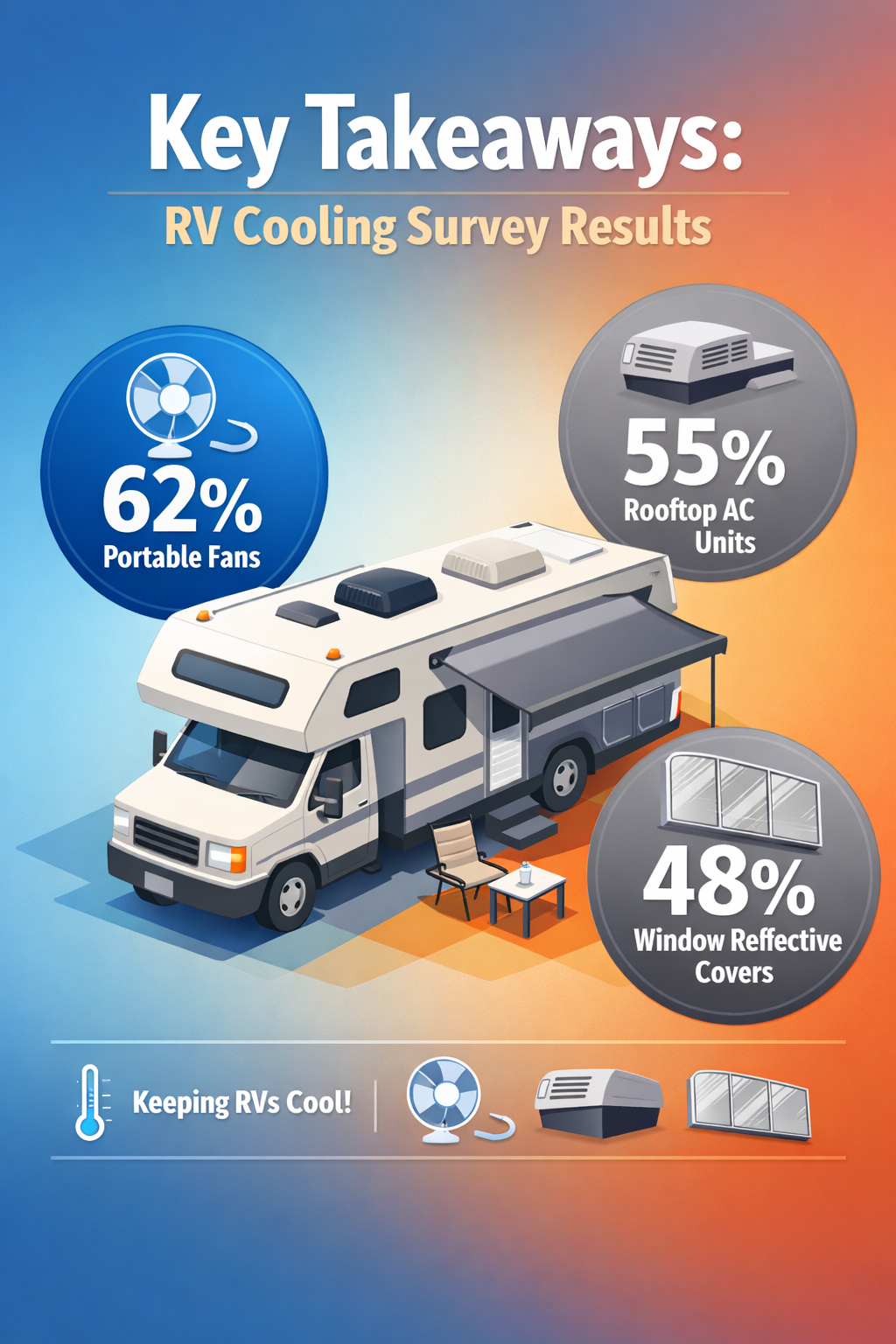
The numbers don’t lie—roof-mounted air conditioning units dominate the RV cooling landscape with an overwhelming 93% preference among survey respondents. This isn’t just a slight preference; it’s a landslide victory that tells us something important about what actually works in real-world RVing conditions.
Why do roof-mounted AC units reign supreme? Here are the key reasons:
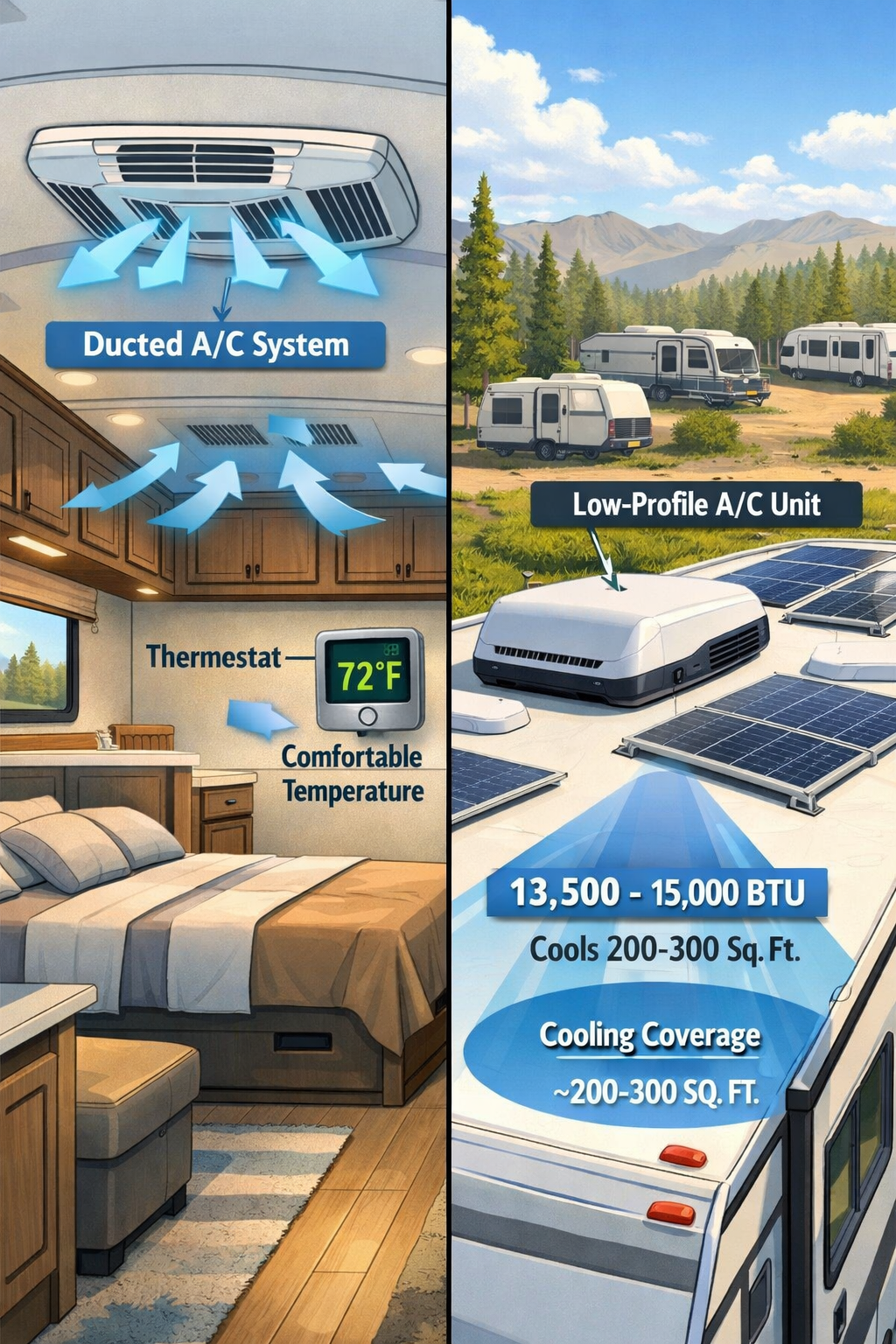
- Powerful cooling capacity: Most roof units range from 13,500 to 15,000 BTUs, enough to cool even larger RVs
- Out-of-the-way installation: Mounting on the roof saves precious interior and storage space
- Proven reliability: Decades of engineering refinement have made these units dependable
- Widespread availability: Parts and service are available at most RV centers
- Dual-zone options: Many RVers install multiple units for better temperature control
“After trying fans and portable units during our first summer on the road, we invested in a quality roof-mounted AC. It was a game-changer for our comfort and sleep quality.” — Survey Respondent
Shade and Ventilation: The 7% Who Go Natural
While only 7% of respondents listed shade and ventilation as their preferred method, this doesn’t mean these strategies aren’t valuable. Many RVers use these techniques in combination with air conditioning to reduce energy consumption and extend battery life.
The shade and ventilation approach includes:
- Strategic parking under trees or covered areas
- Reflective window covers and sunshades
- Roof vent fans like MaxxAir or Fantastic Fan models
- Awning deployment to create shaded outdoor living spaces
- Cross-ventilation techniques using multiple windows and vents
The Surprising 0%: Portable AC and Fans Only
Perhaps the most telling result is that zero respondents selected portable AC units or fans-only as their preferred cooling method. This doesn’t mean RVers don’t use these tools—they absolutely do—but they clearly don’t consider them adequate as primary cooling solutions.
Why portable AC units fell flat:
- Limited cooling capacity (typically 5,000-8,000 BTUs)
- Take up valuable floor space
- Require window venting that compromises insulation
- Often noisy and less efficient than roof units
- Drain precious battery power quickly
Why fans alone aren’t enough:
- They circulate air but don’t actually lower temperature
- Ineffective when ambient temperature exceeds 85°F
- Provide minimal relief in high humidity conditions
- Can’t compete with modern comfort expectations
Understanding RV Cooling Technology
The RV industry has experienced significant technological advancement in cooling systems, driven by changing consumer demands and environmental considerations. As more RVers embrace off-grid camping, the demand for energy-efficient cooling solutions has skyrocketed[1].
The Evolution of RV Air Conditioning
Modern roof-mounted AC units bear little resemblance to their predecessors from even a decade ago. Today’s units feature:
Energy Efficiency Improvements:
- Variable-speed compressors that adjust cooling output
- Better insulation and sealed ductwork
- Energy-saving modes that cycle intelligently
- Soft-start technology that reduces power surge demands
Smart Technology Integration:
- Wi-Fi connectivity for remote temperature control
- Mobile app integration for monitoring and adjustment
- Programmable thermostats with learning capabilities
- Energy consumption tracking and reporting
Physical Design Advances:
- Lower profile units that reduce wind resistance
- Quieter operation with improved sound dampening
- Lighter weight materials that don’t stress roof structures
- Improved weatherproofing and UV resistance
Solar-Compatible Cooling Solutions
The growing adoption of solar-compatible refrigeration units for sustainable off-grid experiences[2] extends beyond just refrigerators. Many RVers are now pairing solar panel arrays with their cooling systems to achieve true off-grid comfort.
Key considerations for solar-powered cooling:
| Component | Typical Requirement | Notes |
|---|---|---|
| Solar Panels | 800-1,200 watts | Depends on AC size and usage |
| Battery Bank | 400-800 amp hours | Lithium batteries preferred |
| Inverter | 2,000-3,000 watts | Pure sine wave required |
| Charge Controller | 40-60 amps MPAA | Maximizes solar efficiency |
DC-Powered Cooling Innovation
Innovation in 12V and 24V DC-powered refrigerators essential for battery-operated systems when not connected to shore power[1] has inspired similar advances in air conditioning technology. While traditional RV AC units run on 120V AC power, newer DC-powered options are emerging:
- 12V rooftop air conditioners that run directly from batteries
- Variable-speed DC compressors that use 30-50% less power
- Hybrid systems that switch between AC and DC power sources
- Battery management systems that protect against over-discharge
How Do RVers Keep Cool During the Summer? (Survey Reveals) Best Practices
Beyond the equipment itself, experienced RVers have developed a toolkit of strategies to maximize cooling efficiency and comfort. These practices help reduce energy consumption while maintaining pleasant interior temperatures.
Pre-Cooling Strategies 🌡️
Smart RVers start their cooling efforts before the temperature becomes unbearable:
- Morning preparation: Close windows and deploy reflective shades before the sun gets high
- Awning deployment: Extend awnings on the sun-facing side to shade windows and walls
- Vent fan operation: Run roof vent fans on exhaust mode to expel hot air that accumulates at the ceiling
- Strategic parking: Position the RV so the main living area faces away from afternoon sun
Maximizing AC Efficiency 💨
Getting the most from your roof-mounted air conditioning requires attention to detail:
Maintenance matters:
- Clean or replace AC filters monthly during heavy use
- Keep the roof unit clear of debris and leaves
- Check and clean condenser coils annually
- Ensure all duct seals are intact and not leaking
Operational tips:
- Set thermostat to 75-78°F rather than extreme cold settings
- Use ceiling fans to circulate cooled air throughout the RV
- Close bedroom doors and vents in unused areas
- Run AC continuously on low rather than cycling on/off at extreme settings
Combining Multiple Cooling Methods
While 93% prefer roof-mounted AC, the most comfortable RVers use layered cooling strategies:
The comprehensive approach:
- Primary cooling: Roof-mounted AC unit(s)
- Supplemental circulation: Ceiling and portable fans
- Heat reduction: Reflective window covers and awnings
- Ventilation: Roof vent fans for air exchange
- Strategic timing: Opening windows during cool morning/evening hours
The Demographics Driving RV Cooling Demands
Understanding who uses RVs helps explain why certain cooling solutions dominate. Current RVers have a median age between 35 and 54, with typical annual usage of about 30 days[3]. This demographic profile reveals important insights:
Comfort Expectations Have Changed
Today’s RVers, particularly those in the 35-54 age range, grew up with air conditioning as a standard amenity. They’re not interested in “roughing it” when it comes to temperature control. This generation:
- Expects modern comfort even while camping
- Values sleep quality which requires cool nighttime temperatures
- Works remotely from their RVs and needs comfortable workspace conditions
- Travels with children who may be less tolerant of extreme heat
Extended Trip Durations Demand Reliability
With typical annual usage of about 30 days[3], many RVers take extended trips rather than quick weekend getaways. A week-long or month-long summer trip means reliable cooling isn’t a luxury—it’s a necessity.
Trip length impacts cooling needs:
- Weekend trips: Fans and ventilation might suffice
- Week-long vacations: AC becomes essential for comfort
- Month-long adventures: Efficient, reliable AC is non-negotiable
- Full-time living: Multiple AC units and backup systems are common
Energy Considerations and Off-Grid Cooling
The rising demand for energy-efficient cooling driven by off-grid camping needs[1] reflects a significant shift in how RVers approach their adventures. More people want the freedom to camp anywhere without sacrificing comfort.
Power Source Options for Running AC
Understanding your power options helps determine which cooling solutions work for your camping style:
Shore Power (30/50 amp hookups):
- ✅ Unlimited AC runtime
- ✅ No battery concerns
- ✅ Can run multiple units simultaneously
- ❌ Limits camping location options
- ❌ Additional campground costs
Generator Power:
- ✅ AC capability anywhere
- ✅ Flexible runtime
- ❌ Noise concerns at some campgrounds
- ❌ Fuel costs and storage needs
- ❌ Maintenance requirements
Battery/Solar Power:
- ✅ Silent operation
- ✅ True off-grid capability
- ✅ Environmentally friendly
- ❌ Significant upfront investment
- ❌ Limited runtime without large battery bank
- ❌ Weather-dependent solar charging
Calculating Your Cooling Power Needs
Before investing in batteries and solar for off-grid AC operation, run the numbers:
Typical 15,000 BTU roof AC consumption:
- Startup surge: 2,800-3,000 watts
- Running power: 1,200-1,500 watts
- 8 hours of nighttime use: ~10,000-12,000 watt-hours
Required battery capacity (50% depth of discharge):
- Minimum: 400 amp hours at 12V (4,800 watt-hours usable)
- Recommended: 600-800 amp hours for comfortable margin
- Lithium batteries strongly preferred for weight and efficiency
Smart Technology and Remote Temperature Control
The broader RV refrigerator market is projected to grow by USD 2.69 billion at a CAGR of 9.15% by 2032[2], with growing adoption of smart-enabled refrigerators with remote temperature control via mobile apps[1][2]. This smart technology trend extends to RV cooling systems as well.
Connected Thermostats and Climate Control
Modern RVers increasingly demand the ability to monitor and control their RV’s temperature remotely:
Benefits of smart RV thermostats:
- 📱 Pre-cooling: Start AC before arriving at your RV
- 🔔 Alerts: Receive notifications if temperature exceeds set limits
- 📊 Energy monitoring: Track power consumption patterns
- ⏰ Scheduling: Program temperature changes based on your routine
- 🏠 Pet safety: Ensure comfortable temperatures for pets left in the RV
Integration with RV Management Systems
Advanced RVs now feature comprehensive management systems that integrate cooling with other functions:
- Whole-RV monitoring: Temperature, battery levels, tank status, and more
- Automated responses: AC adjusts based on battery levels or solar production
- Voice control: Integration with Alexa or Google Assistant
- Geofencing: Automatic temperature adjustments when you leave or approach
Regional Considerations for RV Cooling
Where you camp dramatically affects your cooling needs and strategies. RVers traveling across different climate zones need to adapt their approach:
Desert Southwest Camping ☀️
Challenges:
- Extreme daytime temperatures (100°F+)
- Low humidity (dry heat)
- Intense solar radiation
- Limited shade availability
Solutions:
- Dual roof AC units for larger RVs
- Maximum solar protection with reflective covers
- Early morning and evening outdoor time
- Siesta-style midday indoor rest periods
Humid Southeast Camping 💧
Challenges:
- High humidity makes temperatures feel hotter
- Afternoon thunderstorms and weather changes
- Mold and mildew concerns
- AC must work harder to dehumidify
Solutions:
- Dehumidifier operation alongside AC
- Excellent ventilation to prevent moisture buildup
- Anti-fungal treatments in AC systems
- Regular filter changes due to moisture
Mountain and High-Elevation Camping ⛰️
Challenges:
- Dramatic temperature swings (hot days, cool nights)
- Thinner air affects AC efficiency
- Variable weather conditions
- Limited power availability at remote sites
Solutions:
- Open windows for natural cooling at night
- AC use primarily during afternoon heat
- Layered bedding for temperature flexibility
- Portable fans for air circulation
Cost-Benefit Analysis of Cooling Options
Understanding the financial investment required for different cooling approaches helps RVers make informed decisions:
Initial Investment Comparison
| Cooling Solution | Initial Cost | Installation | Total Investment |
|---|---|---|---|
| Roof-mounted AC (single) | $800-$1,500 | $200-$500 | $1,000-$2,000 |
| Roof-mounted AC (dual) | $1,600-$3,000 | $400-$800 | $2,000-$3,800 |
| Portable AC unit | $300-$600 | DIY | $300-$600 |
| High-quality vent fans (2) | $400-$800 | $100-$300 | $500-$1,100 |
| Solar + battery for AC | $3,000-$8,000 | $500-$1,500 | $3,500-$9,500 |
Operating Cost Considerations
Campground hookup costs:
- Sites with 50-amp service: $40-$80/night
- Sites with 30-amp service: $30-$60/night
- Sites without hookups: $15-$35/night
Generator operation:
- Fuel consumption: 0.5-1 gallon/hour
- 8 hours of AC runtime: $15-$30 in fuel costs
- Generator maintenance: $100-$200 annually
Solar/battery system:
- Zero operating costs after installation
- Battery replacement every 5-10 years: $2,000-$4,000
- Minimal maintenance requirements
Maintenance Tips for Peak Cooling Performance
The 93% of RVers who rely on roof-mounted AC need to maintain their systems properly to ensure reliable performance when temperatures soar.
Seasonal Maintenance Checklist ✅
Spring preparation (before summer season):
- Remove winter covers from roof AC units
- Clean or replace all AC filters
- Inspect roof seals around AC unit for cracks
- Test AC operation and check for unusual noises
- Clean condenser coils and fins
- Verify thermostat accuracy with separate thermometer
- Check all duct connections for air leaks
Mid-summer maintenance:
- Clean filters monthly during heavy use
- Clear debris from roof AC unit
- Monitor power consumption for changes indicating issues
- Inspect condensate drainage
- Test emergency fan-only mode
Fall winterization:
- Final filter cleaning or replacement
- Cover roof AC units if storing in harsh climate
- Run system briefly to circulate refrigerant
- Document any issues for off-season repair
Troubleshooting Common AC Problems
AC runs but doesn’t cool effectively:
- Dirty filters restricting airflow
- Low refrigerant charge (requires professional service)
- Blocked condenser coils
- Undersized unit for RV size
- Poor insulation or air leaks
AC cycles on and off frequently:
- Thermostat location in direct sunlight or near heat source
- Oversized unit for space
- Electrical issues causing power fluctuations
- Dirty evaporator coil
AC won’t start:
- Tripped breaker or blown fuse
- Thermostat batteries dead (if battery-powered)
- Capacitor failure (common issue, easy professional fix)
- Compressor failure (expensive repair)
Future Trends in RV Cooling Technology
As the RV market continues its upward trend with expected shipments between 332,100 to 366,000 units in 2026[5], manufacturers are investing heavily in cooling innovation.
Emerging Technologies to Watch 🔮
Heat pump systems:
- Provide both cooling and heating from one unit
- More energy-efficient than separate systems
- Becoming more common in high-end RVs
- Better performance in moderate climates
Absorption cooling:
- Can run on propane, electricity, or both
- Silent operation with no compressor
- Ideal for off-grid applications
- Currently more common in RV refrigerators but expanding to AC
Advanced insulation materials:
- Spray foam insulation retrofits
- Reflective barrier technology
- Vacuum-insulated panels for extreme efficiency
- Reduces cooling load significantly
AI-powered climate management:
- Learning algorithms that optimize cooling schedules
- Predictive cooling based on weather forecasts
- Integration with solar production forecasting
- Automatic adjustment based on occupancy
Making the Right Cooling Choice for Your RV
While our survey clearly shows that How Do RVers Keep Cool During the Summer? (Survey Reveals) a strong preference for roof-mounted AC at 93%, your personal situation should guide your decision.
Questions to Ask Before Investing
About your camping style:
- Do you primarily camp with full hookups or off-grid?
- What’s your typical trip duration?
- Which climate zones do you visit most often?
- Do you camp year-round or seasonally?
About your RV:
- What’s your current electrical capacity (30 or 50 amp)?
- How much roof space is available for AC units?
- What’s your RV’s insulation quality?
- Do you have or plan to add solar panels?
About your budget:
- What’s your initial investment limit?
- Are you willing to pay for full-hookup sites?
- Would you consider financing a solar/battery system?
- How much are you willing to spend on generator fuel?
Recommended Cooling Setups by RV Type
Small travel trailers (under 25 feet):
- Single 13,500 BTU roof AC
- One or two roof vent fans
- Portable fans for circulation
- Reflective window covers
Mid-size travel trailers and fifth wheels (25-35 feet):
- Single 15,000 BTU roof AC (or dual 13,500 BTU units)
- Multiple roof vent fans
- Ceiling fans in main living areas
- Awnings for shade
Large fifth wheels and Class A motorhomes (35+ feet):
- Dual 15,000 BTU roof AC units (front and rear)
- Multiple roof vent fans throughout
- Residential-style ceiling fans
- Dual-zone thermostats for independent control
- Consider solar/battery system for off-grid capability
Class B and C motorhomes:
- Single roof AC (13,500-15,000 BTU)
- Roof vent fan with rain sensor
- Dash AC integration for cooling while driving
- Compact portable fans
Conclusion: Staying Cool on Your Summer Adventures
The survey results are crystal clear: 93% of RVers trust roof-mounted air conditioning to keep them comfortable during summer travels, and for good reason. These proven systems deliver reliable, powerful cooling that makes RVing enjoyable even in extreme heat. While shade, ventilation, and portable solutions play supporting roles, they simply can’t match the performance of a quality roof-mounted AC unit.
As the RV industry continues to grow with expected shipments trending upward in 2026[5], manufacturers are responding with increasingly efficient, smart, and solar-compatible cooling solutions. The future of RV cooling looks bright—or perhaps we should say, refreshingly cool! ❄️
Your Next Steps to Summer Comfort
Ready to optimize your RV’s cooling performance? Here’s your action plan:
- Assess your current setup: Evaluate whether your existing cooling system meets your needs
- Calculate your power requirements: Determine if your electrical system can support upgrades
- Schedule maintenance: Get your AC serviced before summer heat arrives
- Consider upgrades: Research smart thermostats, solar panels, or additional AC units
- Implement best practices: Start using the efficiency tips shared in this article
- Join RV communities: Learn from other RVers’ experiences with cooling solutions
- Plan your routes: Choose campgrounds with appropriate hookups for your cooling needs
Remember, staying cool isn’t just about comfort—it’s about safety, sleep quality, and enjoying your RV adventures to the fullest. Whether you’re a weekend warrior or a full-time RVer, investing in proper cooling solutions will transform your summer camping experience.
The open road awaits, and now you know exactly how to stay cool while exploring it! 🚐☀️
References
[1] Multi Door Rv Refrigerator 1872193 – https://www.datainsightsmarket.com/reports/multi-door-rv-refrigerator-1872193
[2] Rv Refrigerator – https://www.360iresearch.com/library/intelligence/rv-refrigerator
[3] Rv Roundup Hot Picks For 2026 – https://magazine.frva.com/2026/01/01/rv-roundup-hot-picks-for-2026/
[5] Rv Market Expected Trend Upward 2026 – https://www.rvia.org/news-insights/rv-market-expected-trend-upward-2026