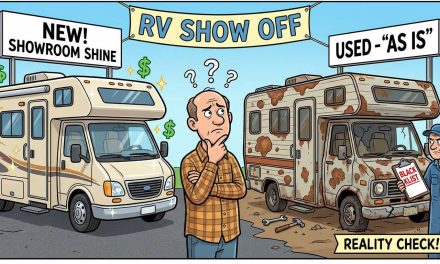

You bought your dream RV just two years ago, and now it’s worth less than half of what you paid for it. This isn’t normal depreciation—this is a full-blown market collapse that’s hitting RV owners across America. According to the 2025 NADA guide, 2022 travel trailers are now valued at a jaw-dropping 40-60% below their original price. That’s not below the dealer markup—that’s below the manufacturer’s suggested retail price!
The COVID-19 RV boom promised adventure and freedom, but it delivered something else entirely: mass-produced rolling homes with built-in expiration dates. Major manufacturers like Thor Industries and Forest River flooded the market with RVs they couldn’t build fast enough, sacrificing quality for quantity. The result? Your investment turned into a financial sinkhole faster than you can say “road trip.”
But here’s the good news: understanding why this happened can help you avoid making the same mistake twice. In this article, we’ll break down the 10 main reasons your RV lost so much value, and we’ll show you which RVs are actually still worth buying. Let’s dive in!
Would you like to save this article?
1. Delamination: The Silent Value Killer
What Is Delamination?
Delamination is when the outer fiberglass skin of your RV separates from the wooden wall underneath. It starts as a small bubble or ripple on the sidewall that you might not even notice during a quick walk-around. But underneath that innocent-looking bubble, water has already started destroying your RV from the inside out.
The problem happens because manufacturers switched to thinner fiberglass and cheaper water-based adhesives that fail in heat. The wooden substrate (usually Luan plywood) absorbs moisture like a sponge. Production workers are paid by the piece, not by the hour, so they rush through the bonding process without letting adhesives cure properly.
How Fast Does It Happen?
According to independent RV technicians, delamination can appear as early as 18 to 36 months after purchase. Once dealers see visible bubbles on your RV, they’ll quietly refuse your trade-in—even if you had it “professionally repaired.” Translation: Your RV becomes radioactive to informed buyers.
The Bottom Line
| Problem | Timeline | Repair Cost | Impact on Value |
|---|---|---|---|
| Delamination | 18-36 months | $3,000-$8,000+ | Catastrophic |
Here’s the thing: You probably spent hours researching floor plans and comparing kitchen layouts, but nobody warned you that your RV’s walls were basically held together with glorified Elmer’s glue. It’s like buying a house where the drywall is attached with chewing gum—sure, it looks fine during the tour, but wait until the first rainy season hits!
2. Frame Flex: When Your RV’s Skeleton Fails
What Is Frame Flex?
Your RV’s frame is supposed to be its structural foundation—the bones that hold everything together. Instead, it’s often the weakest link in the entire vehicle. Frame flex happens when an underbuilt chassis can’t handle the weight and twisting forces of highway travel.
You’ll notice doors that won’t close properly, cabinets separating from walls, and slide-outs that bind and stick. This isn’t a maintenance issue—it’s a fundamental design failure. Most RV frames come from Lippert Components, a monopoly supplier that builds frames to minimum weight specifications because volume contracts matter more than quality.
The Warning Signs
- Cracked welds at stress points
- Doors misaligned with their frames
- Slide-outs that won’t extend or retract smoothly
- Gaps appearing between walls and ceilings
Why Manufacturers Won’t Fix It
Instead of issuing full frame replacements (which would be the right thing to do), manufacturers issue “reinforcement kits”—basically band-aids welded onto a skeleton that was inadequate from day one. These kits don’t solve the underlying problem; they just delay the inevitable failure.
Imagine this: You’re cruising down the highway at 65 mph, and your RV frame is flexing and twisting like a bridge during an earthquake. Every mile you drive, your “home on wheels” is slowly tearing itself apart. You bought a house, and they put it on a coat hanger!
3. Roof and Sealant Failure: Slow-Motion Total Loss
The Predictable Disaster
Roof membrane separation and sealant breakdown are the most predictable disasters in the RV industry. They happen because speed trumps precision on every production line. Manufacturers use cheap lap sealant applied by workers who have seconds—not minutes—to complete each section.
There’s no cure time. The RV rolls off the assembly line with wet sealant that hasn’t even bonded yet. The roof membrane is installed without proper edge sealing around air conditioning units, front caps, and slide toppers.
The Warranty Scam
Fast forward 18 months, and you’ve got separation everywhere. When you file a warranty claim, dealers refuse it by citing “maintenance neglect.” They’ll say you didn’t reseal on schedule, even though the factory seal never worked in the first place!
Meanwhile, water enters invisibly through hairline cracks, rots the ceiling substrate, and destroys resale value without you even knowing there’s a problem until an inspector finds mold during a trade-in appraisal.
The Cost of Roof Failure
| Repair Type | Average Cost | Likelihood of Warranty Coverage |
|---|---|---|
| Roof reseal | $500-$1,500 | Low |
| Roof membrane replacement | $2,000-$5,000 | Very Low |
| Water damage repair (interior) | $5,000-$15,000+ | Almost None |
Pro tip: A leaking roof doesn’t announce itself with sirens and flashing lights. It just erases value month by month until your RV is worth less than your loan balance. You’d think a $50,000 RV would come with a roof that actually keeps water out, but apparently, that’s asking too much!
4. Slide-Out Rot: The Hidden Decay
Why Slide-Outs Sold RVs (And Destroyed Them)
Slide-outs are those expandable sections that make your RV feel more spacious inside. They sold millions of RVs because they create interior square footage that photographs beautifully and closes sales. They also create structural weak points that fail faster than any other component.
The failure mode is simple: Slide floors are built with Oriented Strand Board (OSB)—basically compressed wood chips—that absorbs moisture through exposed edges. The vinyl membrane on top is too thin, and the seals around the perimeter are so cheap they’re practically decorative.
How Water Destroys Slide-Outs
Water gets in during:
- Rain (from inadequate seals)
- Washing (water seeps through gaps)
- Storage (condensation and humidity)
The OSB swells, compresses, and rots from the inside out. RV technicians report slide floor rebuilds exceeding $10,000—that’s more than the slide-out adds to the resale value of the entire unit!
The Inspection Problem
Buyers doing pre-purchase inspections miss soft spots because they’re walking on carpet or laminate that hasn’t collapsed yet. Six months later, the floor gives way under furniture weight, and suddenly you’re facing a five-figure repair bill.
Think about it: The feature that convinced you to buy the RV becomes the reason nobody will buy it used. Slides are square footage financed with future regret. It’s like adding a swimming pool to your backyard—great for showing off, terrible for resale value, and even worse when it starts leaking into your basement!
5. Electrical and Tank Failures: The Liability Risk
The Hidden Dangers
Loose wiring, tank strap failures, grounding issues that cause appliances to short out randomly—these aren’t edge cases. They’re standard operating procedure in an industry that hires undertrained labor, rewards production speed, and hides every system where buyers will never look during a walkthrough.
The Safety Disasters
The NHTSA (National Highway Traffic Safety Administration) recall database is full of bulletins involving:
- Wiring chafing against metal edges (fire hazard)
- Freshwater tanks detaching on highways (crash hazard)
- Black water spills on interstates (public health hazard)
- Electrical fires caused by connections that were never properly crimped
What This Means for Resale Value
Once an RV develops a reputation for safety issues, resale value drops off a cliff. Insurance companies start asking difficult questions. Financing gets harder. Private buyers walk away the moment they see a recall notice in the vehicle history.
| Safety Issue | Frequency | Impact on Resale |
|---|---|---|
| Electrical fires | Common | Severe |
| Tank failures | Moderate | Severe |
| Wiring problems | Very Common | Moderate to Severe |
Reality check: You can fix cosmetics with a buffer and some decals. You can’t outrun a reputation for catching fire or dumping sewage on I-40. Someone in the YouTube comments said, “Mine looked fine until the underbelly fell apart on the highway.” That’s not an anomaly—that’s how these units fail when accountants run the show instead of engineers!
6. Corporate Oversupply: Why Prices Collapsed
The COVID Production Frenzy
Market saturation is the reason your RV lost value faster than you could make payments. Thor Industries and Forest River doubled production output during COVID without any exit strategy. They assumed demand would stay elevated forever.
Spoiler alert: It didn’t.
The Market Implosion
By 2023, dealers were stuffed with inventory they couldn’t move. Thousands of new units sat unsold on dealer lots while used prices cratered by 30-50% in a single model year. Here’s why: Nobody wants to buy a 2-year-old RV when a new one costs the same after fire-sale incentives!
How This Destroys Your Trade-In Value
When new RV prices fall, used prices don’t just decline—they implode. Your trade-in value gets benchmarked against a brand-new unit being sold at a loss just to clear lot space.
The Numbers
| Year | RV Production | Market Demand | Result |
|---|---|---|---|
| 2020 | High (COVID boom) | Very High | Prices stable |
| 2021 | Very High | High | Prices inflated |
| 2022 | Extremely High | Declining | Inventory piling up |
| 2023-2024 | High | Low | Price collapse |
Here’s the kicker: They printed RVs like stimulus checks, and now the market is paying the price in collapsing resale values. You didn’t lose money because you picked the wrong brand. You lost money because the entire industry built twice as many units as the market could absorb. It’s like showing up to a housing bubble with a 30-year mortgage—sure, it seemed like a good idea at the time!
7. Warranty Illusion: The Countdown Timer
How Warranties Hide Quality Problems
Warranty coverage masks build quality until it doesn’t. Manufacturers structure warranty terms around the assumption that most catastrophic failures will occur after coverage expires. It’s planned obsolescence hidden inside legal language.
The Timing Scam
A one-year bumper-to-bumper warranty sounds reasonable until you realize that:
- Delamination typically appears in year 2 or 3
- Frame flex becomes obvious in year 2 or 3
- Roof leaks start showing up in year 2 or 3
Convenient, isn’t it?
Denied Claims
Owners report denied claims for water damage cited as “maintenance-related”—even when factory sealant failed. The warranty wasn’t designed to protect you. It was designed to protect the manufacturer from liability during the brief window when failures would trigger recalls.
Impact on Resale Value
Once the warranty ends, the market assumes the problems begin. Buyers calculate risk differently when there’s no coverage. They discount the price to account for imminent repairs.
Translation: The warranty wasn’t protection. It was a countdown timer. And when it hits zero, your RV’s value evaporates like water in the desert. You thought that warranty was a safety net, but it was really just a “good luck, you’re on your own” timer!
8. Badge Engineering: Everything Is the Same RV
The Industry’s Dirtiest Secret
Different brand names, same factory, same failures, different decals. Badge engineering is when manufacturers produce multiple “competing” brands that are actually identical underneath the marketing.
A Keystone, Dutchmen, and Heartland might have different logos, but they share:
- Identical floor plans
- Identical frames from Lippert
- Identical construction methods
- Identical failure points
VIN Decoding Reveals the Truth
These “competing” brands roll off the same production lines in the same facilities. When a recall gets issued, it hits multiple brands simultaneously because they’re built with the same defective components.
Why This Destroys Value
When buyers figure this out, brand loyalty dies. And when brand loyalty dies, resale value collapses because there’s no differentiation in a saturated market.
| Brand | Owner | Frame Supplier | Reality |
|---|---|---|---|
| Keystone | Thor Industries | Lippert | Same as others |
| Dutchmen | Thor Industries | Lippert | Same as others |
| Heartland | Thor Industries | Lippert | Same as others |
| Forest River | Berkshire Hathaway | Lippert | Same as others |
The truth hurts: You paid a premium for a brand name that meant nothing. Different stickers, same rot. It’s like buying three “different” pairs of sunglasses at the gas station—they all came from the same factory in China, no matter what the label says!
9. Pre-2019 Units Hold Value (Here’s Why)
The Quality Cutoff
There’s a clear dividing line in the RV market: RVs built before 2019 versus RVs built during and after the COVID production frenzy. Pre-2019 units were built when manufacturers still had reputations to protect and quality standards to maintain.
What Changed in 2020
When COVID hit and RV demand exploded, manufacturers:
- Rushed production to meet quotas
- Cut corners on materials
- Hired inexperienced workers
- Reduced quality control
- Focused on volume over longevity
Why Pre-2019 RVs Are Better
These older units feature:
- Thicker fiberglass skins (less delamination)
- Better adhesives (longer-lasting bonds)
- More experienced craftsmanship (fewer defects)
- Slower production pace (proper curing time)
Market Demand
Informed buyers are actively seeking out pre-2019 models because they know these units were built to last. This sustained demand keeps values higher compared to 2020-2023 models that are flooding the used market.
Smart move: If you’re in the market for a used RV, you’re better off buying a well-maintained 2018 model than a nearly-new 2022 model. It’s like buying a Toyota Corolla from 2010 versus a brand-new car from a startup that just went bankrupt—sometimes older is way better!
10. Molded Fiberglass Trailers Still Refuse to Die
The Exception to the Rule
While stick-and-tin RVs are falling apart left and right, molded fiberglass trailers continue to hold their value remarkably well. Brands like Casita, Scamp, and Escape use a completely different construction method that eliminates the main failure points.
Why Molded Fiberglass Works
| Feature | Traditional RV | Molded Fiberglass |
|---|---|---|
| Seams | Many (leak points) | None or minimal |
| Delamination risk | Very high | Almost zero |
| Water intrusion | Common | Rare |
| Resale value retention | Poor | Excellent |
These trailers have no seams where water can enter. The entire shell is formed as one piece, creating a waterproof capsule. No seams = no delamination = no value destruction.
The Corporate Hatred
Big RV manufacturers hate these trailers because they prove that building quality RVs is possible—it’s just not as profitable. Molded fiberglass units are produced by low-volume independent builders who don’t answer to Wall Street analysts and can’t afford to destroy their brand with garbage construction.
The Trade-Off
Molded fiberglass trailers are:
- Smaller (usually 13-21 feet)
- More expensive per square foot
- Harder to find (long wait lists)
- Limited layouts (less customization)
But they hold their value and last decades instead of years.
Bottom line: These little trailers are like the Nokia phones of the RV world—not the fanciest, not the biggest, but they actually work and they never die. Meanwhile, your $80,000 luxury RV with the slideouts and the outdoor kitchen is rotting from the inside out like a pumpkin in December!
What You Can Do About It
If You’re Buying
- Target pre-2019 models or molded fiberglass trailers
- Get a professional pre-purchase inspection (not from the dealer)
- Check for delamination by pressing on exterior walls
- Inspect the roof for any signs of separation or repairs
- Test all slide-outs multiple times and check floors for soft spots
- Research recall history using the VIN
- Budget for immediate repairs even on “good” used RVs
If You Already Own an RV
- Maintain your roof religiously (reseal every 6-12 months)
- Check for delamination regularly and address bubbles immediately
- Inspect slide-out seals before and after every trip
- Address electrical issues as soon as they appear
- Document all maintenance for resale value
- Consider selling before warranty expires (if that’s financially viable)
The Harsh Truth
The era of quality mass-produced RVs is over—not because it had to be, but because it was more profitable this way. That depreciation isn’t accidental. It’s systemic, baked into every decision made by corporations optimizing for quarterly earnings instead of long-term reliability.
Conclusion: Stop Financing Their Mistakes
Your RV didn’t lose 60% of its value by accident. It was engineered to fail from the moment it left the factory floor. Thin fiberglass that delaminates. Underbuilt frames that flex and crack. Roof seals that fail within months. Slide-outs with OSB floors that rot from water intrusion.
The COVID RV boom wasn’t a success story—it was a manufactured crisis that turned recreation vehicles into financial sinkholes for hundreds of thousands of families. Thor Industries and Forest River flooded the market with units they couldn’t build fast enough, and now the entire industry is drowning in oversupply and collapsing values.
But you don’t have to be a victim.
Shop for pre-2019 units. Consider molded fiberglass trailers. Get professional inspections. Understand that warranties are countdown timers, not protection plans. And most importantly, stop believing that new equals better in an industry that’s proven it can’t be trusted.
Don’t let them take your retirement savings and call it recreation. Stop financing their mistakes with your trade-in loss.
Want more no-nonsense RV advice? Subscribe to RV SHOW OFF for weekly insights that dealers don’t want you to know!
SOURCES
- Why Your RV Just Lost 60% Of Its Worth (And It’s Getting WORSE) – RV Ryan YouTube Channel
- NADA Guides – RV Values and Pricing
- NHTSA Recall Database – RV Safety Recalls
- Thor Industries Corporate Information
- Forest River RV Company Overview
- Lippert Components – RV Frame Manufacturing
- Casita Travel Trailers – Molded Fiberglass Construction
- Scamp Trailers – Fiberglass RV Manufacturer