You’ve climbed that aluminum ladder on the back of your RV dozens of times without a second thought. But what if we told you that every single time you step on those rungs, you’re trusting nothing more than a few plastic spacers and flimsy star washers to hold your entire body weight?
According to the American Ladder Institute, 500,000 people suffer ladder-related injuries every year, and RV ladders are among the most dangerous culprits.
These bare-minimum aluminum ladders that manufacturers slap onto the back of your rig aren’t just scary—they’re actively causing damage to your RV through roof leaks, wall damage, and structural issues. In this eye-opening article, you’ll discover exactly why that rear ladder is more liability than asset, how to spot the warning signs before disaster strikes, and the surprisingly simple repair that could save you thousands in water damage.
Buckle up, because what you’re about to learn might just change the way you look at your RV forever.
1. Your RV Ladder is Held Together by Plastic and Hope
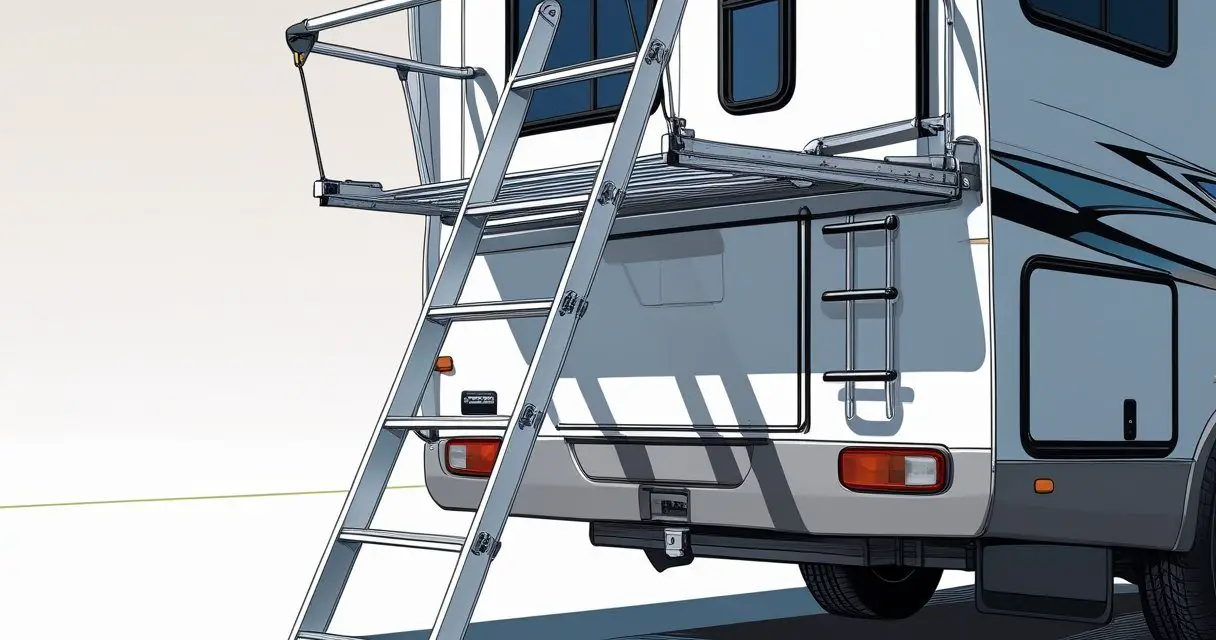
Here’s a reality check that’ll make your knees weak: those treads you’re standing on are literally held in place by screws going through thin-wall aluminum and plastic end caps. That’s it. No welding, no heavy-duty brackets, just a couple of Phillips head screws boring into hollow aluminum tubes.
The video reveals the disturbing anatomy of a typical RV ladder. When the expert disassembles one, you can see that each rung relies on plastic spacers that crack over time and star washers (small metal clips with tiny tabs) that are supposed to support 300 pounds. According to OSHA regulations, Type IA ladders should support 300 pounds, but that’s assuming they’re properly constructed—which most RV ladders barely are.
You’d think twice about climbing this thing if you saw what was holding it together. It’s like trusting your life to a glorified Erector Set. The plastic end caps? They crack. The star washers? They rust and break. And when they fail, you’re going straight down—or worse, pulling the entire ladder assembly through your RV’s roof.
| Component | Material | Common Problem | Danger Level |
|---|---|---|---|
| Ladder Rungs | Thin-wall aluminum | Bends under weight | High |
| Spacers | Plastic | Cracks and breaks | Very High |
| Star Washers | Spring steel | Rusts, loses grip | Critical |
| Mounting Screws | Steel | Pulls out, strips | Very High |
Supporting Facts:
- Most RV ladders use thin-wall aluminum that’s only 1-2mm thick
- Star washers are the only thing preventing your weight from collapsing the ladder
- Plastic spacers begin degrading after 2-3 years of UV exposure
- Factory RV ladders cost around $300-$400 to replace, yet use the cheapest materials
2. Every Time You Climb, You’re Creating a Roof Leak Waiting to Happen
Pop quiz: What happens when you bolt a heavy ladder to your RV’s roof and then put 200+ pounds of pressure on it repeatedly? You create stress points that crack your sealant and turn your roof into a water fountain.
The mounting points where your ladder connects to the roof are prime entry points for water. Each screw hole is a potential leak, and the constant flexing of the ladder as you climb breaks down even the best sealant over time. The video shows how water can run down the inside of the ladder tubes and straight into your roof decking, causing rot that you won’t even see until it’s too late.
According to RV Roof repair specialists, ladder mount leaks are among the top 5 causes of RV roof damage. And here’s the kicker: most RV owners don’t discover these leaks until they’ve caused thousands of dollars in structural damage.
Here’s what you probably didn’t think about: When that ladder gets hit backing up (and let’s be real, it happens to the best of us), it doesn’t just bend—it rips the mounting bolts right through your roof membrane. Now you’ve got four new holes for water to pour through, and your weekend trip just turned into a major insurance claim.
Supporting Facts:
- The average cost to repair roof water damage in an RV ranges from $1,200 to $3,500
- Ladder-related roof leaks can go undetected for months or years
- One survey found that 34% of RVs over 5 years old have water damage from external mounting points
- Self-leveling sealant needs to be reapplied around ladder mounts every 1-2 years
3. RV Manufacturers Know These Ladders Are Trash (But Keep Installing Them Anyway)
Want to know something infuriating? High-end luxury motorhomes don’t have rear ladders. Neither do the absolute cheapest, bare-bones travel trailers. So why does your mid-range RV have one? Because it’s a cheap feature that looks good on the sales lot but becomes your problem the moment you drive off.
As the video expert points out, RV manufacturers have been using these inadequate ladders for over 25 years. They know they’re problematic. They know stronger, better-built ladders exist (like those used on fire trucks and industrial vehicles). They just don’t want to spend the extra $50-$100 per unit to install them.
Think about it this way: The manufacturer is willing to risk a liability lawsuit rather than upgrade to a safer ladder. They’ve done the math, and apparently paying out occasional injury claims is cheaper than using quality components. How’s that for customer care?
Supporting Facts:
- Industrial-grade ladders with similar dimensions cost $400-$600 retail
- The Consumer Product Safety Commission reports 300 ladder-related deaths annually in the US
- RV manufacturers would need to increase unit costs by less than 0.5% to use better ladders
- Lance RV is noted as one of the few manufacturers offering models without rear ladders as a feature
4. The “300 lb Weight Capacity” Rating is Technically True (But Practically Useless)
Sure, your RV ladder says it can hold 300 pounds. And technically, under perfect laboratory conditions with even weight distribution and zero lateral movement, it probably can. For about 30 seconds. Once.
The reality? Every time you climb that ladder, you’re not gently distributing your weight evenly across all rungs. You’re creating dynamic loads—sudden impacts as you step, pull, and shift your weight. Those plastic spacers and tiny star washers? They’re experiencing forces 2-3 times your actual body weight with each movement.
The video demonstrates how these star washers work: they’re spring steel clips with small tabs that grip the inside of the aluminum tube. When you weigh 200 pounds and grab that ladder to pull yourself up, those tiny tabs experience 400-600 pounds of force. And they’re already weakened by rust and stress.
You could be under the weight limit and still end up on the ground. The ladder might hold 300 pounds of static weight sitting perfectly still, but climbing? That’s a whole different physics problem, and your RV ladder is failing the test.
| Activity | Static Weight | Dynamic Force | Stress on Components |
|---|---|---|---|
| Standing still | 200 lbs | 200 lbs | Moderate |
| Climbing up | 200 lbs | 400-500 lbs | High |
| Quick movements | 200 lbs | 600-800 lbs | Extreme |
| Pulling up with arms | 200 lbs | 500-700 lbs | Critical |
Supporting Facts:
- Dynamic loads can create forces 2-4 times greater than static weight
- Most RV ladders begin showing stress cracks after 50-100 uses
- The Bureau of Labor Statistics reported 161 workplace fatalities from ladders in 2020
- Studies show ladder accidents increase 40% when using extension-style ladders
5. The Fix is Ridiculously Simple (And Costs Less Than One Camping Trip)
Here’s the good news: you can fix your RV ladder for under $50 and prevent thousands in water damage. The repair involves replacing those failing star washers, tightening loose screws, and properly resealing the roof mounts. The entire job takes 2-3 hours if you take your time.
The video walks you through the complete repair process:
- Remove the ladder from the roof and sidewall
- Replace broken star washers (available on Amazon for $10 each)
- Tighten all rung mounting screws
- Reseal roof penetrations with proper self-leveling sealant
- Reinstall with new hardware
But here’s the even better solution: skip the factory ladder entirely and get a telescoping ladder for around $150. These portable ladders are stronger, more versatile, won’t damage your RV, and can be used anywhere. They fold down to 3 feet, weigh less than factory ladders, and many are rated for 330-375 pounds.
Your RV will thank you for removing that roof-destroying, accident-waiting-to-happen piece of aluminum. Plus, you’ll never have to worry about it getting ripped off in a narrow campground or parking garage. Win-win.
Supporting Facts:
- Star washer replacement kits cost $8-12 on Amazon
- Quality telescoping ladders range from $120-$200
- Professional ladder removal and repair costs $200-$400 at RV shops
- Dicor self-leveling sealant (the right stuff for roofs) costs $10-15 per tube
Comparison Table: Factory RV Ladder vs. Telescoping Ladder
| Feature | Factory RV Ladder | Telescoping Ladder |
|---|---|---|
| Price | $300-$400 | $120-$200 |
| Weight Capacity | 250-300 lbs | 330-375 lbs |
| Creates Roof Leaks | Yes | No |
| Gets Damaged Backing Up | Frequently | Never (not mounted) |
| Requires Maintenance | Every 1-2 years | Minimal |
| Versatility | Fixed location only | Use anywhere |
| Safety Rating | Questionable | Superior |
| Resale Value | Decreases if damaged | N/A |
Final Thoughts: Your Ladder Might Be the Most Dangerous Part of Your RV
You maintain your tires, you check your brakes, you service your engine. But when was the last time you actually inspected your RV ladder? Those seemingly innocent rungs on the back of your rig could be one broken star washer away from sending you to the emergency room or creating a catastrophic roof leak.
The experts in the video have repaired RVs for over 25 years and have seen countless ladder failures. Their advice is clear: inspect your ladder twice a year, retighten all fasteners, check for cracks in plastic components, and reseal the roof mounts regularly. Or better yet, remove it entirely and invest in a quality telescoping ladder.
Don’t wait until you’re lying on the ground with a broken ankle, or until you discover a soft, spongy spot in your ceiling from months of hidden water damage. Take 30 minutes this weekend to inspect your ladder. Your body—and your wallet—will thank you.
SOURCES
- AZ Expert – RV Ladders Made Simple or Simply a Bad Idea? (YouTube)
- American Ladder Institute – Ladder Accidents in the Home Are Preventable
- Bureau of Labor Statistics – Fatal Injuries from Ladders
- CDC NIOSH – Ladder Safety Statistics
- ANSI Blog – Make Ladder Safety a Priority
- iRV2 Forums – RV Rear Ladder Strength Capacity
- Reddit RVLiving – Roof Water Damage Repair Around Ladder
- iRV2 Forums – Damaged Roof Around Ladder Mount
- OSHA Regulations for Ladder Safety
- Integrity RV – Mesa, Arizona