
You’ve just pulled into a stunning campsite after hours on the road. The sun is setting, painting the sky in brilliant oranges and pinks. Your stomach rumbles, and you’re ready for dinner. But where will you eat? Inside your cozy RV at the dinette, or outside under the stars at your portable table? For many RV enthusiasts, this decision reflects a deeper question about lifestyle, comfort, and how they want to experience life on the road. RV Dining Space Preference isn’t just about where you eat—it’s about how you want to live your adventure.
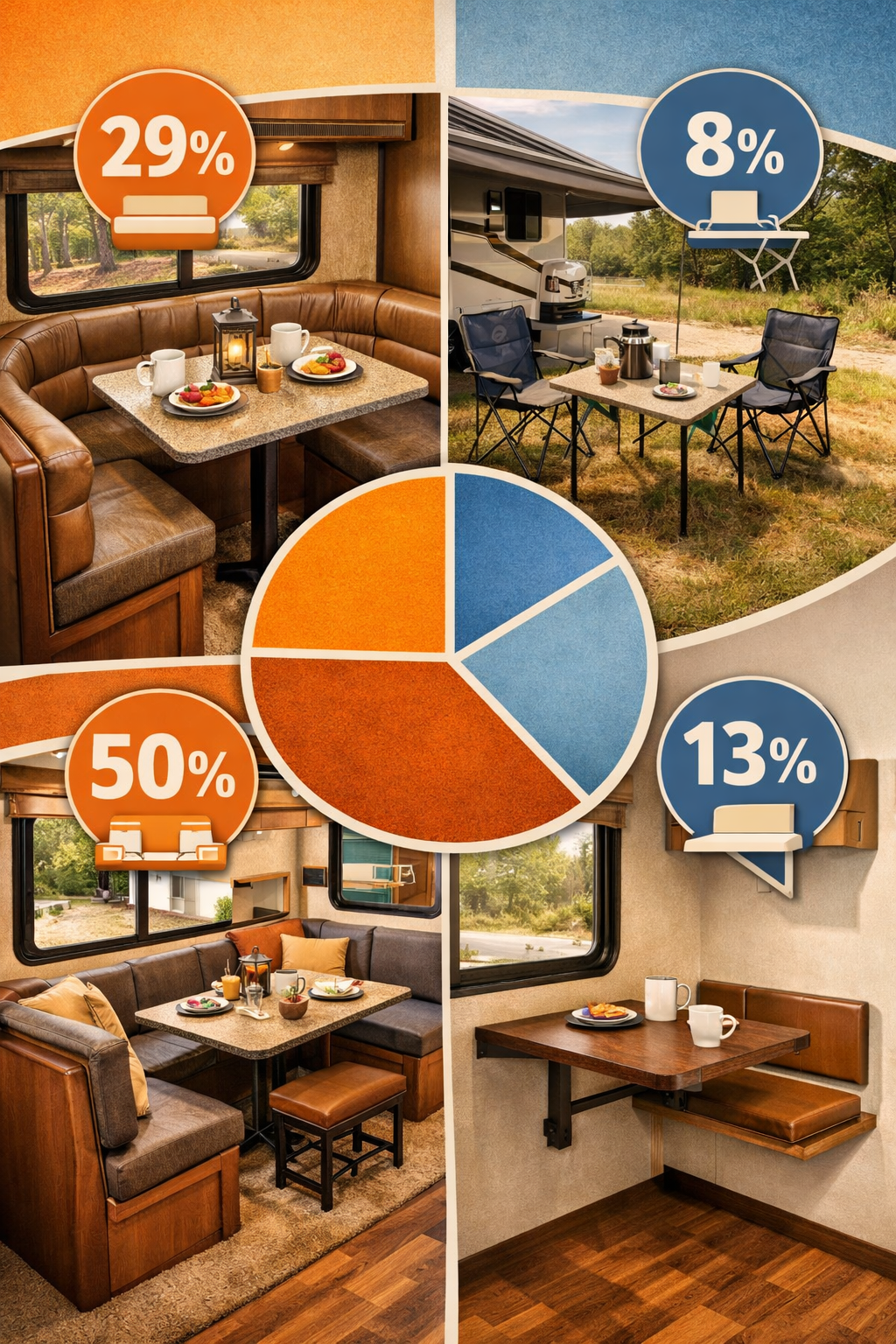
A recent poll of RV owners revealed fascinating insights into how people actually use their dining spaces. The results might surprise you: half of all respondents prefer a combination approach, while traditional indoor dinettes, outdoor setups, and minimal spaces each have their devoted followers. Understanding these preferences can help current and future RV owners make smarter decisions about their mobile homes.
Key Takeaways
- 50% of RVers prefer combination dining setups that offer both indoor and outdoor options, providing maximum flexibility for different weather conditions and moods
- Indoor dinettes remain popular (29%) for their convenience, comfort, and multi-functional use as workspaces and sleeping areas
- Outdoor dining enthusiasts (8%) and minimalists (13%) represent niche but passionate groups with specific lifestyle priorities
- RV Dining Space Preference directly impacts floor plan selection, storage capacity, and overall livability of your mobile home
- Your ideal dining setup depends on travel style, climate preferences, family size, and how you balance indoor comfort with outdoor adventure
Understanding RV Dining Space Preference: The Poll Results Explained
Would you like to save this article?
The numbers tell a compelling story about how modern RVers approach mealtime in their mobile homes. The RV Dining Space Preference poll reveals clear patterns that reflect broader trends in the RV community.
The Combination Approach Wins (50%)
Half of all respondents chose the combination option, making it the clear winner. This preference makes perfect sense when you consider the variable nature of RV travel. Some days bring perfect weather for outdoor dining under your awning, while other days call for the cozy comfort of an indoor booth.
The combination approach offers:
- ✅ Flexibility for any weather condition
- ✅ Options for different meal types (quick breakfast inside, leisurely dinner outside)
- ✅ Accommodation for varying group sizes
- ✅ Maximum use of available space
Sarah and Tom, full-time RVers from Colorado, exemplify this preference. “We love having our indoor dinette for morning coffee and work sessions,” Sarah explains. “But when we’re at a beautiful campsite, nothing beats setting up our outdoor table for sunset dinners. Having both options means we never feel limited.”
Indoor Dinette Loyalists (29%)
Nearly one-third of respondents prefer the traditional indoor dinette setup. These RVers value the reliability and comfort of a dedicated indoor dining space that doesn’t require setup or takedown.
Indoor dinette advantages include:
- 🏠 Climate-controlled comfort year-round
- 🏠 No setup or breakdown required
- 🏠 Multi-functional space (dining, working, sleeping)
- 🏠 Built-in storage underneath seats
- 🏠 Privacy from neighboring campers
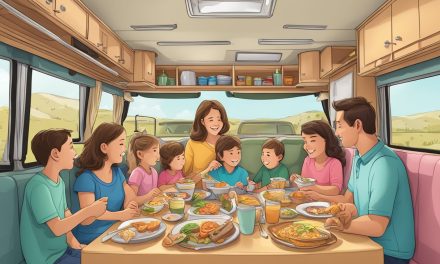
Many families with young children gravitate toward indoor dinettes. The contained space makes mealtime easier with kids, and the cushioned seating provides a safe, comfortable area for activities beyond eating.
Outdoor Enthusiasts (8%)
While representing the smallest group, the 8% who prefer outdoor tables are often the most passionate about their choice. These adventurers view meals as opportunities to fully immerse themselves in nature.
“We didn’t buy an RV to sit inside,” says Mike, a weekend warrior who travels throughout the Pacific Northwest. “Every meal is a chance to be outside, breathing fresh air and enjoying the views. We actually removed our indoor dinette to create more living space.”
Minimalist Approach (13%)
The 13% who prefer minimal dining space represent a growing trend toward downsizing and simplicity. These RVers often travel in smaller rigs like camper vans or truck campers where every square inch matters.
Minimalist dining typically involves:
- 📦 Fold-down or wall-mounted tables
- 📦 Lap trays or outdoor picnic blankets
- 📦 Using countertops or outdoor spaces
- 📦 Prioritizing other amenities over dining areas
Factors That Influence Your RV Dining Space Preference
Choosing the right dining setup isn’t random—several key factors shape what works best for each RVer’s unique situation.
Climate and Travel Destinations
Where you travel dramatically impacts dining preferences. Full-time RVers who follow warm weather can rely more heavily on outdoor dining. Those who camp year-round or venture into colder climates need robust indoor options.
| Climate Type | Recommended Setup | Why It Works |
|---|---|---|
| Warm Weather Only | Outdoor or Combination | Take advantage of pleasant temperatures |
| Four Season | Indoor or Combination | Need reliable indoor space for cold/rain |
| Desert Southwest | Combination | Hot days require AC, cool evenings perfect for outdoor |
| Pacific Northwest | Indoor Primary | Frequent rain makes outdoor dining challenging |
RV Size and Floor Plan
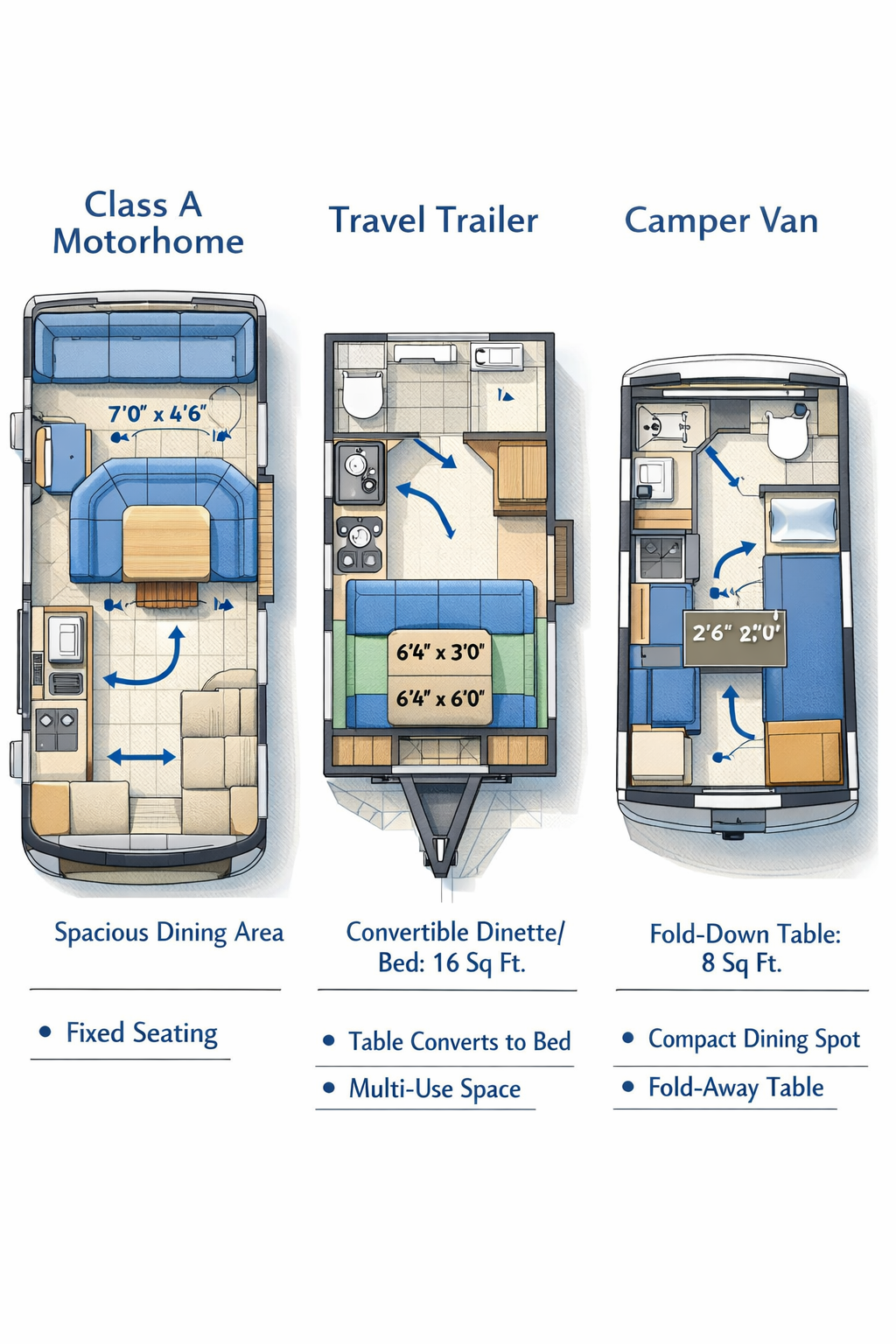
Your rig’s size naturally limits or expands dining options. A 40-foot Class A motorhome offers space for a full dinette plus outdoor setup, while a compact camper van requires creative solutions.
Class A Motorhomes typically feature spacious dinettes with booth seating or free-standing tables and chairs. Some luxury models include outdoor kitchens with integrated dining areas.
Travel Trailers and Fifth Wheels often incorporate convertible dinettes that transform into sleeping spaces, maximizing functionality in limited square footage.
Camper Vans and Truck Campers usually feature minimal dining—perhaps a small fold-down table or swivel seats that face a removable table.
Family Size and Travel Style
Solo travelers and couples have different needs than families with children. A couple might happily eat meals on their laps while watching sunset, but parents with three kids need a proper table for contained chaos.
Consider these scenarios:
- Solo/Couple: Maximum flexibility, can adapt to any dining style
- Family with Young Kids: Need stable, enclosed space for messy meals
- Multi-Generational Groups: Require larger dining capacity, often combination approach
- Pet Owners: May prefer indoor dining to keep pets contained
Budget Considerations
RV Dining Space Preference affects the overall cost of your rig and setup. Indoor dinettes come standard in most RVs, but quality outdoor furniture represents an additional investment.
Budget breakdown for dining setups:
- Indoor Dinette (Standard): Included in most RVs, $0-500 for upgrades
- Quality Outdoor Table Set: $200-800 for weather-resistant furniture
- Combination Setup: $300-1,200 for both indoor and outdoor options
- Minimalist Approach: $50-200 for compact, portable solutions
Maximizing Your RV Dining Space: Practical Tips for Every Preference
Regardless of which RV Dining Space Preference category you fall into, smart strategies can enhance your mealtime experience.
For Indoor Dinette Lovers
Make your indoor space work harder with these optimization techniques:
Storage Solutions: Use the space under dinette benches for kitchen items, games, or outdoor gear. Install organizers to maximize vertical space.
Comfort Upgrades: Replace thin factory cushions with memory foam toppers. Add throw pillows for lumbar support during long meals or work sessions.
Lighting Improvements: Install dimmable LED lights or add battery-powered accent lighting for ambiance. Good lighting transforms a basic dinette into an inviting space.
Multi-Function Design: Choose tables with extensions for hosting guests. Consider models that adjust in height for different uses—dining, working, or kids’ activities.
For Outdoor Dining Enthusiasts
Create an outdoor dining oasis that rivals any restaurant patio:
Furniture Selection: Invest in lightweight, weather-resistant furniture that’s easy to set up and store. Aluminum frames with quick-dry fabric work well.
Shade Solutions: Use your RV awning, add a separate canopy, or position your table under natural shade. Comfort in various weather conditions extends your outdoor dining season.
Lighting for Evening Meals: String solar-powered lights, use battery-operated lanterns, or invest in a portable LED light strip. Ambiance matters!
Bug Protection: Keep citronella candles, bug-repellent fans, or screened enclosures handy. Nothing ruins outdoor dining faster than mosquitoes.
Weather Protection: Have a quick-deploy plan for sudden weather changes. Waterproof storage bins near your outdoor setup allow rapid furniture protection.
For Combination Setup Users
Balance both spaces effectively to get maximum value from your investment:
Streamline Transitions: Keep outdoor furniture in an easy-access storage bay. Quick setup and breakdown encourages more frequent use.
Duplicate Essentials: Maintain separate sets of outdoor-appropriate dishes, utensils, and serving pieces. This eliminates the need to constantly move items between spaces.
Clear Decision Rules: Establish simple guidelines for when to use each space. For example: “Breakfast inside, dinner outside when above 65°F and not raining.”
Seasonal Rotation: During peak outdoor season, keep your outdoor setup ready to go. In winter, optimize your indoor space and store outdoor furniture properly.
For Minimalist Space Users
Maximize functionality in minimal square footage:
Fold-Down Solutions: Wall-mounted tables that fold completely flat when not in use preserve precious floor space.
Multi-Purpose Items: Use cutting boards that span your sink as temporary prep surfaces. Lap desks double as dining trays.
Outdoor Reliance: Invest in a quality, compact outdoor table that sets up in seconds. Many minimalists find they use outdoor space more than expected.
Creative Seating: Swivel cab seats (in vans) or storage ottomans that serve as both seating and dining spots.
The Psychology Behind RV Dining Space Preference

Understanding why different RVers prefer different dining setups reveals interesting insights about travel psychology and lifestyle priorities.
Indoor Preference: Comfort and Control
Those who favor indoor dinettes often value predictability and comfort. These RVers see their RV as a true home-away-from-home, where familiar routines provide grounding during travels.
“After a long day of hiking or driving, I want to relax in my comfortable booth with a hot meal and a movie. My RV is my sanctuary, and the dinette is the heart of that space.” – Janet, retired teacher and part-time RVer
Indoor preference correlates with:
- 🔹 Longer stays at each location (less frequent moving)
- 🔹 Appreciation for routine and structure
- 🔹 Focus on interior comfort and design
- 🔹 Work-from-road lifestyle (need dedicated workspace)
Outdoor Preference: Adventure and Connection
Outdoor dining enthusiasts often exhibit strong nature-connection values. They chose RV life specifically to spend more time outside, and their dining preference reflects this core motivation.
These RVers typically:
- 🌲 Prioritize destination over amenities
- 🌲 Engage in high levels of outdoor activities
- 🌲 Value social connection with neighboring campers
- 🌲 Embrace weather variability as part of adventure
Combination Preference: Flexibility and Optimization
The majority who prefer combination setups demonstrate adaptive thinking and optimization mindset. They want to maximize options and adapt to changing circumstances.
This preference suggests:
- ⚖️ Balanced approach to comfort and adventure
- ⚖️ Willingness to invest in multiple solutions
- ⚖️ Appreciation for variety in daily routines
- ⚖️ Practical problem-solving orientation
Minimalist Preference: Freedom and Simplicity
Those choosing minimal dining space often prioritize freedom from possessions and complexity. They’ve intentionally chosen smaller rigs and simpler systems.
Minimalist RVers typically value:
- ✨ Mobility and spontaneity (smaller rigs access more locations)
- ✨ Reduced maintenance and cleaning
- ✨ Lower costs (smaller rigs, less furniture)
- ✨ Focus on experiences over amenities
Future Trends in RV Dining Space Design
The RV industry continues evolving to meet changing consumer preferences. Understanding these trends helps buyers make forward-thinking decisions.
Convertible and Modular Furniture
Manufacturers increasingly offer flexible furniture systems that transform to serve multiple purposes. Dinettes that convert to beds are just the beginning—newer designs include tables that adjust in height, rotate, or fold into wall storage.
The Murphy bed-dinette combination has gained popularity in smaller trailers, allowing a full-size bed to fold up and reveal a dinette underneath. This innovation addresses the space constraints that force many buyers to choose between sleeping and dining areas.
Outdoor Living Spaces
Outdoor kitchens and dining areas have moved from luxury add-ons to expected features in many RV segments. Fifth wheels and toy haulers increasingly include:
- 🍳 Built-in grills or cooktops
- 🍳 Outdoor refrigerators
- 🍳 Integrated dining counters
- 🍳 Entertainment systems visible from outside
These features reflect the growing recognition that RV Dining Space Preference leans heavily toward combination approaches that emphasize outdoor living.
Smart Space Solutions
Technology and innovative design create dining solutions that didn’t exist five years ago:
Slide-out extensions specifically for dining areas maximize space when parked while maintaining compact travel dimensions.
Integrated storage beneath and around dining areas uses every cubic inch efficiently, addressing the perpetual RV storage challenge.
Lightweight materials allow larger tables and more comfortable seating without adding significant weight—crucial for towing capacity considerations.
Sustainability Focus
Eco-conscious RVers increasingly consider the environmental impact of their dining setups:
- ♻️ Furniture made from recycled or sustainable materials
- ♻️ Energy-efficient lighting for dining areas
- ♻️ Designs that minimize waste during manufacturing
- ♻️ Durable construction that reduces replacement frequency
Making Your RV Dining Space Preference Decision
For those currently shopping for an RV or considering modifications, several strategies help clarify the best dining setup.
Assessment Questions
Ask yourself these critical questions:
- How often will you use your RV? (Weekend warrior vs. full-timer affects priorities)
- What climates will you visit? (Year-round travel vs. fair-weather camping)
- How many people typically travel with you? (Solo, couple, family, or groups)
- What’s your typical daily routine? (Early riser who eats outside vs. night owl who prefers indoor)
- How important is workspace? (Remote workers need dedicated surfaces)
- What’s your budget for furniture and accessories? (Combination setups cost more initially)
Test Before You Invest
Experience different setups before committing:
Rent different RV types for weekend trips. A Class C with a dinette feels completely different from a camper van with minimal dining space.
Visit RV shows and spend time sitting in various dining areas. What looks good in photos might feel cramped in person, or vice versa.
Talk to current owners about their dining preferences. RV communities online and at campgrounds offer valuable real-world insights.
Consider your current home dining habits. If you rarely eat at your home dining table, you might not need elaborate RV dining either.
Modification Possibilities
Remember that RV interiors can be modified:
Many RVers remove or reconfigure factory dinettes to better suit their needs. This might mean:
- Replacing a dinette with a sofa or recliners
- Installing a smaller table to create more floor space
- Adding a fold-down table where none existed
- Upgrading to higher-quality outdoor furniture
Before buying, research modification potential for specific models. Some RV layouts adapt easily, while others have structural limitations.
Real Stories: How RVers Use Their Dining Spaces
Understanding RV Dining Space Preference becomes clearer through real experiences from the RV community.
The Full-Time Family: Combination Approach
The Martinez family—parents and two school-age children—travels full-time in a 32-foot travel trailer. Their combination approach proves essential for their lifestyle.
“Our indoor dinette is command central,” explains Maria Martinez. “The kids do schoolwork there every morning, we eat breakfast as a family, and my husband uses it as his remote work office in the afternoon. But when we’re at a great campsite, we set up our outdoor table for dinner. It gives the kids space to be louder, and we can enjoy the scenery we traveled so far to see.”
The family invested in a quality outdoor table set with cushioned chairs and a large umbrella. “It was $600 we didn’t initially budget for,” Maria admits, “but it’s been worth every penny. The kids complain less about being ‘stuck in the RV’ when we can eat outside regularly.”
The Weekend Warriors: Indoor Focus
Bob and Linda use their small Class C motorhome for weekend trips throughout the summer. They strongly prefer their indoor dinette and rarely use outdoor furniture.
“We camp to relax, not to set up and tear down furniture,” Bob explains. “Our dinette is comfortable, has great views through the windows, and we can eat in air-conditioned comfort. When we’re done eating, we convert it to a bed for our grandson when he joins us.”
Their approach reflects a common pattern among weekend RVers who prioritize convenience over outdoor immersion. “We take walks and enjoy nature during the day,” Linda adds. “But mealtime is about comfort and family conversation, which we prefer to do inside.”
The Solo Van-Lifer: Minimalist Philosophy
Jessica travels solo in a converted Sprinter van, embracing the minimalist dining approach. Her “dining area” consists of a small fold-down table and a swivel passenger seat.
“I initially worried about not having a proper dinette,” Jessica shares, “but I quickly realized I didn’t need one. I eat breakfast standing at my counter, lunch is usually at a picnic table wherever I’m exploring, and dinner is often at my outdoor camp chair with a lap tray. The space I saved by skipping a dinette gave me room for a larger bed and more storage—priorities that matter more to my lifestyle.”
Jessica’s experience highlights how RV Dining Space Preference connects to overall lifestyle design. Her minimal approach works because she’s rarely inside her van during waking hours.
The Retired Couple: Outdoor Enthusiasts
After retiring, Dave and Susan sold their house and moved into a fifth wheel with an extensive outdoor kitchen. They represent the 8% who prefer outdoor dining almost exclusively.
“We gutted the indoor dinette and installed a comfortable sofa instead,” Dave explains. “We eat every meal outside unless it’s literally pouring rain. Our outdoor kitchen has a griddle, refrigerator, and a beautiful dining counter with bar stools. We’ve hosted sunset dinners for neighboring campers at nearly every stop.”
Their setup required significant investment—approximately $3,000 for the outdoor kitchen components and furniture—but aligns perfectly with their vision of RV life. “We didn’t retire to sit inside,” Susan emphasizes. “Every meal is an event, a celebration of this lifestyle we worked so hard to achieve.”
Conclusion: Finding Your Perfect RV Dining Space Preference
The poll results revealing that 50% of RVers prefer combination dining setups shouldn’t surprise anyone familiar with the RV lifestyle. The beauty of RV travel lies in its flexibility—the ability to adapt to changing weather, moods, and circumstances. Having both indoor and outdoor dining options provides the ultimate flexibility.
However, the 29% who prefer indoor dinettes, 8% who favor outdoor tables, and 13% who embrace minimal dining spaces remind us that there’s no one-size-fits-all solution. Your ideal RV Dining Space Preference depends on your unique combination of travel style, family size, budget, climate preferences, and personal values.
The most important takeaway? Be honest about how you actually live, not how you imagine you’ll live. Many first-time RV buyers over-invest in features they rarely use or under-invest in aspects that become daily frustrations. Talk to experienced RVers, test different setups through rentals, and give yourself permission to modify your space as you learn what works for your lifestyle.
Your Next Steps
Ready to optimize your RV dining experience? Here’s your action plan:
Assess your current setup honestly. Track for one week how often you use indoor vs. outdoor dining spaces and note any frustrations.
Identify one improvement you can make immediately—whether that’s adding outdoor furniture, upgrading indoor cushions, or installing better lighting.
Join RV communities online and ask about dining setups. Facebook groups, RV forums, and Instagram communities offer endless real-world advice.
Budget for your ideal setup. If you want combination dining but currently lack outdoor furniture, start saving for quality pieces that will last.
Test modifications before making permanent changes. Use temporary solutions to experiment with different configurations.
Share your experience. Your RV Dining Space Preference journey can help others making similar decisions.
Whether you’re team indoor dinette, outdoor enthusiast, combination lover, or minimalist, the right dining setup transforms your RV from a vehicle into a true home on wheels. The perfect space is the one that supports your unique vision of adventure, comfort, and connection—both with nature and with the people who matter most. 🚐✨
References
[1] RV Industry Association. (2026). “RV Owner Demographic Study 2026.” RVIA.org.
[2] Kampgrounds of America. (2026). “North American Camping Report: Trends and Insights.” KOA.com.