Imagine rolling down a sun-drenched highway, your home on wheels humming along, with zero mortgage and total freedom — and then April rolls around and you have no idea what to do about your taxes. 😬 Sound familiar? You are not alone. Thousands of RV lovers every year find themselves confused about tax rules, missing out on big savings, or even paying more than they should. The good news? Smart tax strategies for RVers can put real money back in your pocket — money you can spend on fuel, campgrounds, and adventures. This guide breaks it all down in plain, simple language so every RVer can feel confident at tax time.
Would you like to save this article?
Key Takeaways 🗝️
- Your domicile (home state) matters most. Picking the right state can save you thousands in taxes every year.
- Full-time RVers have unique tax rules that are very different from part-time RVers or homeowners.
- Many RV expenses can be deducted — including mortgage interest on your RV, campground fees, and home office costs.
- Workampers and remote workers must track income carefully to avoid surprise tax bills.
- Planning ahead in 2026 is the single best move you can make to lower your tax bill legally and safely. [1]
Why Tax Strategies For RVers Are Different From Everyone Else
Most people have a house. They pay property taxes. They file taxes in one state. Simple.
RVers? Not so simple.
When your home has wheels, the rules change. You might drive through 20 states in a year. You might earn money from three different sources. You might not have a “permanent address” at all. These things make tax time tricky — but also full of opportunity.
💡 Pull Quote: “The RV lifestyle is one of the most unique financial situations in America. With the right knowledge, it can also be one of the most tax-efficient.”
Here is why RVer taxes are special:
- No fixed address means domicile rules are very important
- Multiple income streams (workamping, remote work, rental income) create complex filing needs
- Vehicle and living expenses can overlap, creating potential deductions
- State tax laws vary wildly, and choosing the wrong state costs money
Understanding these differences is the first step to building powerful tax strategies for RVers that actually work.
Section 1: Domicile — The Most Important Tax Decision You Will Make
What Is Domicile and Why Does It Matter?
“Domicile” is just a fancy word for your permanent legal home. Even if you live in your RV full-time, the government still wants to know: where do you officially live?
Your domicile state is where you:
- File your state income taxes
- Register your vehicle
- Get your driver’s license
- Vote in elections
- Receive mail
Choosing the wrong domicile can cost you thousands of dollars every year. Choosing the right one? That is one of the best tax strategies for RVers available.
The Three Most Popular Domicile States for RVers
Many full-time RVers choose one of three states because they have no state income tax and are very RV-friendly:
| State | State Income Tax | Vehicle Registration | Mail Service Available |
|---|---|---|---|
| South Dakota | None ✅ | Low fees ✅ | Yes ✅ |
| Texas | None ✅ | Moderate fees | Yes ✅ |
| Florida | None ✅ | Moderate fees | Yes ✅ |
South Dakota is the top pick for many full-time RVers. Why? It has no state income tax, low vehicle registration fees, and it is easy to establish residency even without a physical address. Many mail forwarding services are based there.
Texas is popular too, especially for RVers who already have ties to the state. No state income tax is a huge win.
Florida offers no state income tax and is easy to establish residency. It is also warm, which many RVers love! 🌞
How to Establish Domicile as an RVer
You cannot just say “I live in South Dakota now.” You need to prove it. Here is what most states require:
- Get a physical address — use a mail forwarding service or a friend/family member’s address
- Get a driver’s license in that state
- Register your RV in that state
- Register to vote in that state
- Open a bank account with that address
- Spend some time in the state each year (even a few days helps)
⚠️ Important: Some states are aggressive about claiming you as a resident. If you spend too many days in a high-tax state, they may try to tax you. Keep a travel log!
Avoiding “Accidental Residency”
This is a sneaky problem. Some states say: “If you spend more than X days here, you owe us taxes.” California, New York, and a few others are known for this.
Pro tip: Keep a detailed travel journal or use a GPS app to track where you spend each night. This protects you if a state ever challenges your domicile. [3]
Section 2: RV Tax Deductions — What You Can (and Cannot) Write Off
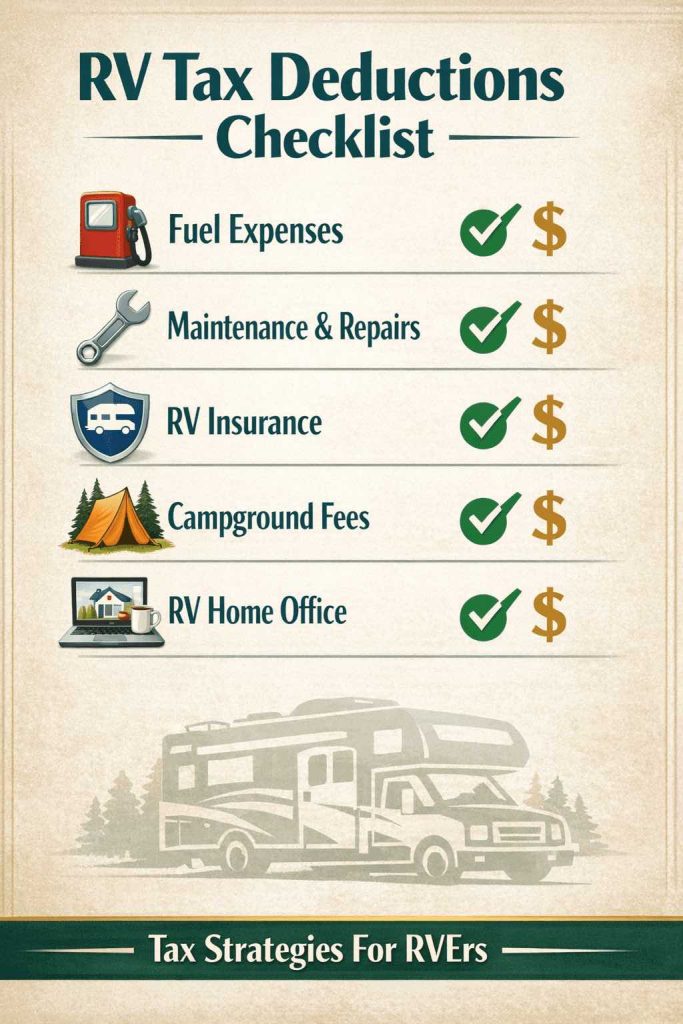
This is where things get exciting! There are more deductions available to RVers than most people realize. Here is a full breakdown of tax strategies for RVers focused on deductions.
Is Your RV a “Home”? The First Big Question
The IRS says a home is any place that has:
- ✅ Sleeping space
- ✅ Cooking facilities
- ✅ A toilet
Most RVs qualify! This means your RV can be treated as a primary residence or second home for tax purposes. That opens up some great deductions.
Deduction #1: Mortgage Interest Deduction
If you financed your RV with a loan, you may be able to deduct the interest you pay on that loan — just like a home mortgage.
Rules to know:
- The RV must qualify as a home (sleeping, cooking, toilet — check!)
- You can deduct interest on your primary residence AND one second home
- The loan must be secured by the RV itself
This can be a very large deduction, especially in the early years of a loan when interest payments are highest. [6]
Deduction #2: Home Office Deduction
Do you work from your RV? Many remote workers and self-employed RVers can deduct a home office.
To qualify, the space must be:
- Used regularly and exclusively for work
- Your principal place of business
In an RV, this is tricky because the space is small. But if you have a dedicated desk area or workspace, you may qualify. The deduction is based on the percentage of your RV used for work.
Example: If your RV is 300 square feet and your workspace is 30 square feet, you may deduct 10% of eligible RV expenses.
Deduction #3: Business Use of Your RV
If you use your RV for business travel, some expenses become deductible:
- 🚗 Fuel costs (business miles only)
- 🔧 Maintenance and repairs (business portion)
- 🛡️ Insurance (business portion)
- 🏕️ Campground fees (when traveling for business)
Important: You must keep detailed records. A mileage log is essential. The IRS loves documentation!
Deduction #4: Sales Tax Deduction
When you buy an RV, you often pay a lot of sales tax. In some cases, you can deduct that sales tax on your federal return.
The IRS allows you to deduct either state income taxes or state and local sales taxes (whichever is bigger). For RVers in no-income-tax states, the sales tax deduction can be very valuable.
Deduction #5: Campground Fees and Site Costs
If you use your RV for business, campground fees where you stay while doing business may be deductible.
For full-time RVers who also work from the road, this overlap can create meaningful deductions. Again — keep those receipts! 🧾
What You CANNOT Deduct
Let’s be honest about limits too:
| Expense | Deductible? | Notes |
|---|---|---|
| Personal fuel | ❌ No | Business fuel only |
| Personal campground fees | ❌ No | Business-related only |
| Food and groceries | ❌ No | Personal expense |
| Personal clothing | ❌ No | Not work-specific |
| RV loan interest (personal use only) | ✅ Yes | As home mortgage interest |
| RV depreciation (business use) | ✅ Yes | If used for business |
💡 Pull Quote: “The line between personal and business expenses is the most important line in an RVer’s tax life. Cross it carefully — and always with receipts.”
Section 3: Full-Time vs. Part-Time RVers — How Your Tax Situation Changes
Not all RVers are the same. Someone who lives in their RV 365 days a year has very different tax needs than someone who takes a few weekend trips. Here is how to think about it.
Part-Time RVers: Simpler Rules
If you have a traditional home AND an RV, your situation is more straightforward:
- Your house is your primary residence
- Your RV may qualify as a second home (for the mortgage interest deduction)
- You file taxes in the state where your house is
- Business use of the RV still applies if relevant
For part-time RVers, the biggest tax win is usually the second home mortgage interest deduction if they have an RV loan.
Full-Time RVers: More Complex, More Opportunity
Full-timers have more complexity — but also more opportunity. Here is what makes it different:
1. No traditional home means domicile is everything
As covered in Section 1, choosing the right domicile state is critical. [3]
2. The RV IS your home
This means the mortgage interest deduction applies to your RV loan as your primary residence — a potentially bigger deduction.
3. All living expenses are RV expenses
This creates more opportunities to identify business-related portions of expenses.
4. Multiple state tax filing may be required
If you earn income in multiple states, you may need to file returns in each one. This is called multi-state filing and it can get complicated fast.
Multi-State Tax Filing: What You Need to Know
Here is a simplified breakdown:
- Earned income is generally taxed in the state where you earn it
- Investment income is generally taxed in your domicile state
- Remote work income — rules vary! Some states tax it if you work from within their borders
Example: If you workamp in Arizona for three months and earn $5,000, Arizona may want a piece of that income — even if your domicile is South Dakota.
Solution: Keep records of where you worked and earned each dollar. A good tax professional who specializes in RV taxes is worth every penny here. [2]
The 183-Day Rule
Many states use the 183-day rule: if you spend more than 183 days in a state, they may consider you a resident and tax your income.
This is why travel logs matter so much. Here is a simple system:
- 📱 Use a GPS app or travel journal daily
- 📸 Take photos with location stamps at campsites
- 🗂️ Save campground receipts (they show dates and locations)
- 📅 Keep a simple spreadsheet: Date | State | Nights Stayed
Section 4: Workamping and Remote Work Tax Strategies
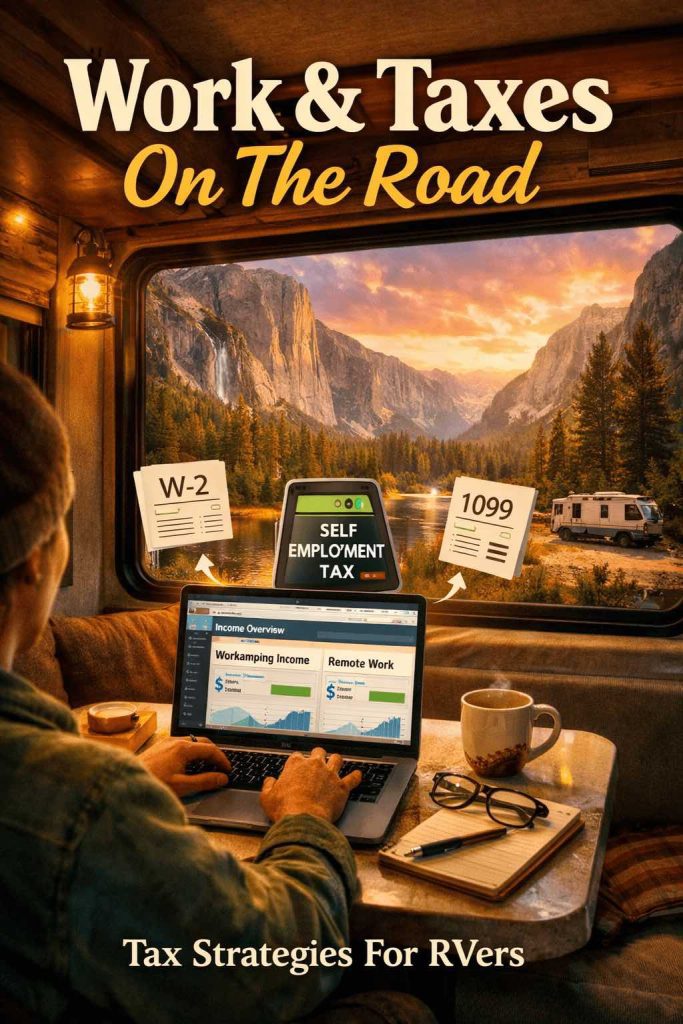
The rise of remote work and workamping has created a whole new layer of tax strategies for RVers. Whether you host at a campground, freelance online, or work a full-time remote job, here is what you need to know.
What Is Workamping?
Workamping is when RVers work at campgrounds, resorts, or other locations in exchange for a free campsite (and sometimes pay). It is a popular way to reduce living costs on the road.
Tax treatment of workamping:
- Free site as compensation: If you receive a free campsite as payment for work, the IRS may consider this taxable income at the fair market value of the site
- Cash wages: Fully taxable as regular income
- Benefits and perks: May or may not be taxable depending on how they are structured
⚠️ Heads up: Many workampers receive a 1099 form (not a W-2), meaning they are treated as independent contractors. This means you are responsible for self-employment tax (15.3% on top of income tax).
Self-Employment Tax for Workampers
If you are self-employed or receive 1099 income, you pay:
- 12.4% for Social Security (on income up to the annual limit)
- 2.9% for Medicare
- Total: 15.3% self-employment tax
The good news: half of self-employment tax is deductible on your federal return. This is a real money saver.
Quarterly Estimated Taxes
If you are self-employed or have income without withholding, you must pay estimated taxes quarterly to avoid penalties.
2026 estimated tax due dates:
- April 15
- June 16
- September 15
- January 15 (of the following year)
Missing these deadlines can result in penalties. Set calendar reminders! [1]
Remote Workers: State Tax Traps
Remote workers who move around in their RV face a tricky problem. Some states have what is called a “convenience of the employer” rule. This means even if you physically work in another state, your employer’s home state may still tax your income.
States known for aggressive remote worker taxation include:
- New York
- New Jersey
- Pennsylvania
- Arkansas
Best practice: Talk to a tax professional before spending extended time working from these states. [2]
Business Deductions for Self-Employed RVers
If you are self-employed, a whole new world of deductions opens up:
| Deduction | What It Covers |
|---|---|
| Home office | Portion of RV used for work |
| Internet | Hotspot, satellite internet (work portion) |
| Phone | Business portion of cell phone bill |
| Equipment | Laptop, camera, tools for work |
| Health insurance | Self-employed health insurance premiums |
| Retirement contributions | SEP-IRA, Solo 401(k) |
| Business travel | Mileage, campground fees for business trips |
| Professional services | Tax prep, accounting fees |
Retirement Savings: A Hidden Tax Strategy
This one is huge and often overlooked. If you are self-employed, you can open a SEP-IRA or Solo 401(k) and contribute a significant portion of your income — reducing your taxable income dramatically.
2026 contribution limits (approximate):
- SEP-IRA: Up to 25% of net self-employment income (max ~$70,000)
- Solo 401(k): Up to $23,500 employee contribution + 25% employer contribution
Every dollar you put in a retirement account is a dollar you do not pay taxes on today. This is one of the most powerful tax strategies for RVers who are self-employed. [3] [4]
Section 5: 2026 Tax Planning — Smart Moves for RVers This Year
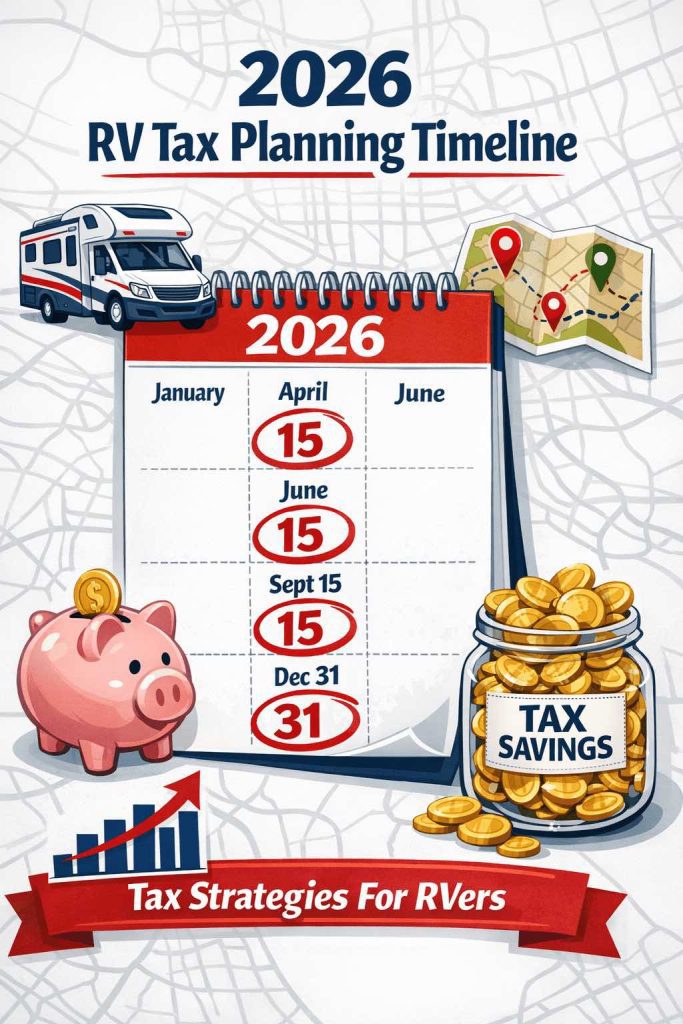
Tax planning is not just something you do in April. The best tax strategies for RVers happen all year long. Here are the smartest moves to make in 2026.
Move #1: Get Your Domicile Right (If You Have Not Already)
If you are a full-time RVer without a clear domicile, 2026 is the year to fix that. Pick a tax-friendly state, establish residency properly, and document everything. [3]
The money you save in state income taxes alone can be enormous. A person earning $80,000 a year who moves domicile from California (up to 13.3% state income tax) to South Dakota (0%) saves up to $10,640 per year. That is a lot of campground fees! 🏕️
Move #2: Track Every Expense Starting Now
Do not wait until December to start organizing receipts. Use a simple system starting today:
- 📱 Expense tracking app (like Expensify or Wave)
- 📁 Digital folder for scanned receipts
- 📊 Spreadsheet with categories: fuel, maintenance, insurance, campground, internet, etc.
- 🗂️ Separate business and personal from the start
Good records make tax time easy and protect you in an audit. [1]
Move #3: Consider Bunching Deductions
The standard deduction in 2026 is quite high (around $15,000 for single filers, $30,000 for married filing jointly). This means many RVers will not itemize.
But here is a smart trick: “Bunching” means grouping deductible expenses into one year so they exceed the standard deduction.
Example: Instead of paying two years of RV-related deductible expenses evenly, pay both in one year. That year you itemize and save. The next year you take the standard deduction.
This strategy works well for people near the threshold. [4]
Move #4: Max Out Tax-Advantaged Accounts
Before year-end, make sure you have maxed out:
- IRA contributions (traditional or Roth) — up to $7,000 in 2026 ($8,000 if age 50+)
- SEP-IRA or Solo 401(k) if self-employed
- HSA (Health Savings Account) if you have a high-deductible health plan — triple tax advantage!
An HSA is especially great for RVers. Contributions are tax-deductible, growth is tax-free, and withdrawals for medical expenses are tax-free. Since healthcare on the road can be unpredictable, an HSA is a smart safety net. [4] [5]
Move #5: Review Your Withholding or Estimated Payments
If you have a remote job with an employer, check your W-4 withholding. If you are self-employed, review your quarterly estimated payments.
Underpaying can result in penalties. Overpaying means you gave the government a free loan. Aim for “just right.” [1]
Move #6: Consider a Tax Professional Who Specializes in RVers
This cannot be stressed enough. RV taxes are complex. A general tax preparer may not know about:
- Domicile optimization
- Multi-state filing for RVers
- Workamping tax treatment
- RV-as-home deductions
Look for a CPA or enrolled agent who specifically works with full-time RVers or digital nomads. The cost of their fee is usually much less than the taxes they save you — and their fee is deductible! [2]
Move #7: Use Tax Software Designed for Complex Returns
If you prefer to DIY, use robust tax software. Look for software that handles:
- Self-employment income
- Multi-state filing
- Home office deduction
- Vehicle deductions
Many platforms offer step-by-step guidance that makes complex returns manageable. [6]
Move #8: Keep a Detailed Travel Log
As mentioned earlier, a travel log protects you from aggressive state tax claims AND helps you calculate business mileage deductions.
What to log:
- Date
- Starting location
- Ending location
- Miles driven
- Purpose (personal or business)
- Business purpose if applicable
A simple phone note or app works great. Do it daily — it takes 30 seconds.
Section 6: Common Tax Mistakes RVers Make (And How to Avoid Them)
Even smart RVers make tax mistakes. Here are the most common ones — and how to avoid them.
Mistake #1: Not Establishing a Clear Domicile
Floating between states without a clear domicile is a recipe for trouble. Multiple states may try to claim you. Pick one and commit.
Mistake #2: Mixing Personal and Business Expenses
If you use your RV for both personal and business, you MUST keep them separate. Mixed records lead to lost deductions and potential audit problems.
Fix: Open a separate bank account and credit card for business expenses.
Mistake #3: Forgetting to Pay Estimated Taxes
Self-employed RVers who skip quarterly estimated taxes face penalties at year-end. This surprises many new full-timers.
Fix: Set a reminder every quarter. Calculate your estimated tax and pay it on time. [1]
Mistake #4: Claiming 100% Business Use When It Is Not True
The IRS is suspicious of 100% business use claims for vehicles. If you live in your RV, it is clearly also personal. Be honest about the split.
Fix: Calculate the actual percentage of business use and claim only that.
Mistake #5: Ignoring State Tax Filing Requirements
Many RVers only think about federal taxes. But states can be aggressive. Earning income in a state often requires filing there.
Fix: Track where you earn income, not just where you live.
Mistake #6: Not Keeping Records Long Enough
The IRS can audit returns up to 3 years after filing (6 years if they suspect significant underreporting). Keep all tax records for at least 7 years to be safe.
Fix: Use cloud storage (Google Drive, Dropbox) for digital receipts. They last forever and take up no physical space. 🌐
Section 7: Special Situations — Unique Tax Scenarios for RVers
Renting Out Your RV
Some RVers rent their RV when they are not using it (through platforms like RVshare or Outdoorsy). This creates rental income — which is taxable.
Good news: Rental income comes with deductions:
- Depreciation of the RV
- Maintenance and repairs
- Insurance (rental portion)
- Platform fees
- Cleaning costs
The 14-day rule: If you rent your RV for 14 days or fewer per year, the rental income is tax-free! This is a little-known gem. 💎
Buying vs. Leasing an RV for Business
If you use an RV primarily for business (like a mobile office or work vehicle), buying may offer better tax benefits through depreciation deductions. Section 179 of the tax code allows businesses to deduct the full cost of certain assets in the year of purchase rather than depreciating over time. [6]
This is an advanced strategy — definitely talk to a tax professional before going this route.
RVers Who Also Own a Stick-and-Brick Home
Some RVers keep a traditional home and use the RV seasonally. In this case:
- The house is the primary residence
- The RV may be a second home (mortgage interest deductible)
- You file taxes in the state where your house is
- The RV deductions are limited to second-home rules
This is actually a simpler situation than full-time RVing, tax-wise.
Social Security and RV Living
Retired RVers receiving Social Security need to know: up to 85% of Social Security benefits can be taxable depending on your total income. Choosing a no-income-tax domicile state helps here, as most of those states also do not tax Social Security.
Quick Reference: Tax Strategies For RVers Cheat Sheet
Here is a one-stop summary of the best tax strategies for RVers in 2026:
| Strategy | Potential Savings | Difficulty |
|---|---|---|
| Choose no-income-tax domicile | Very High 💰💰💰 | Medium |
| RV mortgage interest deduction | High 💰💰 | Easy |
| Home office deduction | Medium 💰 | Medium |
| Business mileage deduction | Medium 💰 | Easy (with log) |
| Self-employment retirement contributions | Very High 💰💰💰 | Medium |
| HSA contributions | High 💰💰 | Easy |
| 14-day rental rule | High 💰💰 | Easy |
| Bunching deductions | Medium 💰 | Medium |
| Quarterly estimated taxes (avoid penalties) | Saves penalties | Easy |
| Hire RV-specialist tax pro | High 💰💰 | Easy |
Conclusion: Hit the Road With Confidence — Your Tax Action Plan
The open road is calling — and now you have the knowledge to answer it without dreading tax season. 🚐💨
Tax strategies for RVers are not just about saving money (though that is a great perk!). They are about understanding your unique situation, staying legal and compliant, and making smart decisions that support the lifestyle you love.
Here is your action plan for 2026:
✅ Your RVer Tax Action Checklist
- Establish your domicile in a tax-friendly state if you have not already
- Start tracking expenses today — fuel, maintenance, campground fees, internet, phone
- Keep a daily travel log — dates, locations, miles, purpose
- Set quarterly estimated tax reminders if you are self-employed
- Open a SEP-IRA or Solo 401(k) if you have self-employment income
- Review your RV loan — is the interest deductible as a home mortgage?
- Consider the 14-day rental rule if you rent your RV occasionally
- Find a tax professional who specializes in RVers or digital nomads
- Use tax software that handles multi-state and self-employment returns
- Save all records digitally for at least 7 years
💡 Final Pull Quote: “The best time to start planning your RV taxes was last year. The second best time is right now. Every mile you drive is a financial decision — make it a smart one.”
The RV life is about freedom, adventure, and living on your own terms. With the right tax strategies for RVers, you can keep more of your hard-earned money — and spend it on what really matters: the next great adventure. 🗺️🏕️🌄
References
[1] 2026 Tax Season Checklist Avoid April Stress – https://avior.com/insights/2026-tax-season-checklist-avoid-april-stress/
[2] 9 Tax Moves To Kick Off 2026 – https://www.jmco.com/articles/tax/9-tax-moves-to-kick-off-2026/
[3] Top 10 Tax Planning Strategies For 2026 – https://www.bdo.com/insights/tax/top-10-tax-planning-strategies-for-2026
[4] Tax Moves – https://www.fidelity.com/learning-center/personal-finance/tax-moves
[5] 5 Year End Tax Planning Actions To Take Before 2026 – https://privatebank.jpmorgan.com/nam/en/insights/markets-and-investing/ideas-and-insights/5-year-end-tax-planning-actions-to-take-before-2026
[6] Guide Filing Taxes 2024 Tax Law Changes 61904 – https://blog.turbotax.intuit.com/tax-planning-2/guide-filing-taxes-2024-tax-law-changes-61904/
[7] Watch – https://www.youtube.com/watch?v=ew2CJyQf6dk