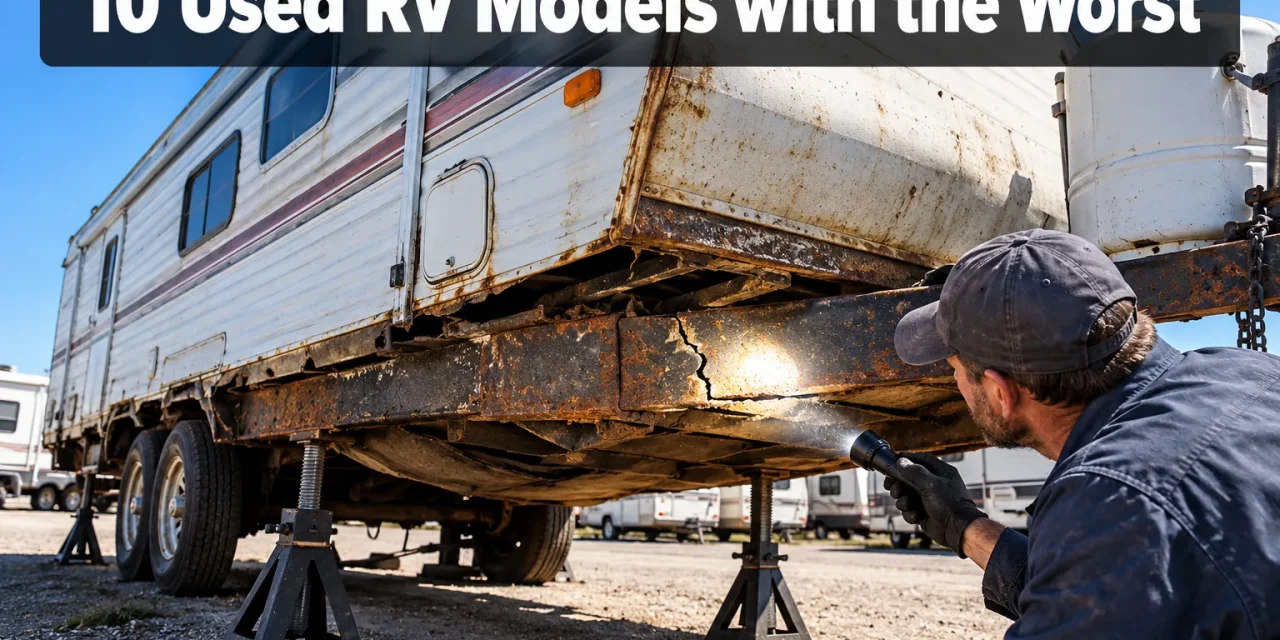
A $60,000 fifth wheel can turn into a $15,000 frame repair bill in under three years. That is not a rare horror story. It is a pattern. Owner forums, repair shops, and independent investigations keep pointing at the same group of used RVs, year after year. This guide breaks down the 10 used RV models with the worst structural issues, based on documented owner complaints, recall records, and repeated findings from RV review sources. If a frame-flex problem or a water-soaked floor is hiding under the paint of your next buy, you deserve to know before you sign anything.
Structural problems are different from a leaky faucet or a broken awning. A bad frame or a rotten floor can cost thousands of dollars and put your family at risk on the highway. This article walks through the brands and models that show up again and again when structural failures get discussed, why it happens, and how to protect yourself.
Key Takeaways
- Frame flex and frame cracking are the most serious and most expensive structural issues found in used RVs today.
- Grand Design, Heartland, Fleetwood, Gulf Stream, Forest River, Thor, Coachmen, Jayco, and Vanleigh models appear repeatedly in structural complaint data [1][7][10].
- Water intrusion is the hidden root cause behind most “sudden” structural failures, it rots framing long before anyone sees a problem.
- Structural repairs on fifth wheels and motorhomes often run $3,000 to $20,000+, depending on how far the damage has spread.
- A thorough pre-purchase inspection can catch most of these problems before you hand over a down payment.
Why Structural Damage Is the Most Dangerous RV Problem You Can Buy
Cosmetic issues are annoying. A cracked decal or a stained countertop will not hurt anyone. Structural issues are a different story. They affect the actual skeleton of the RV, the frame, the floor joists, the roof trusses, and the walls that hold everything together.
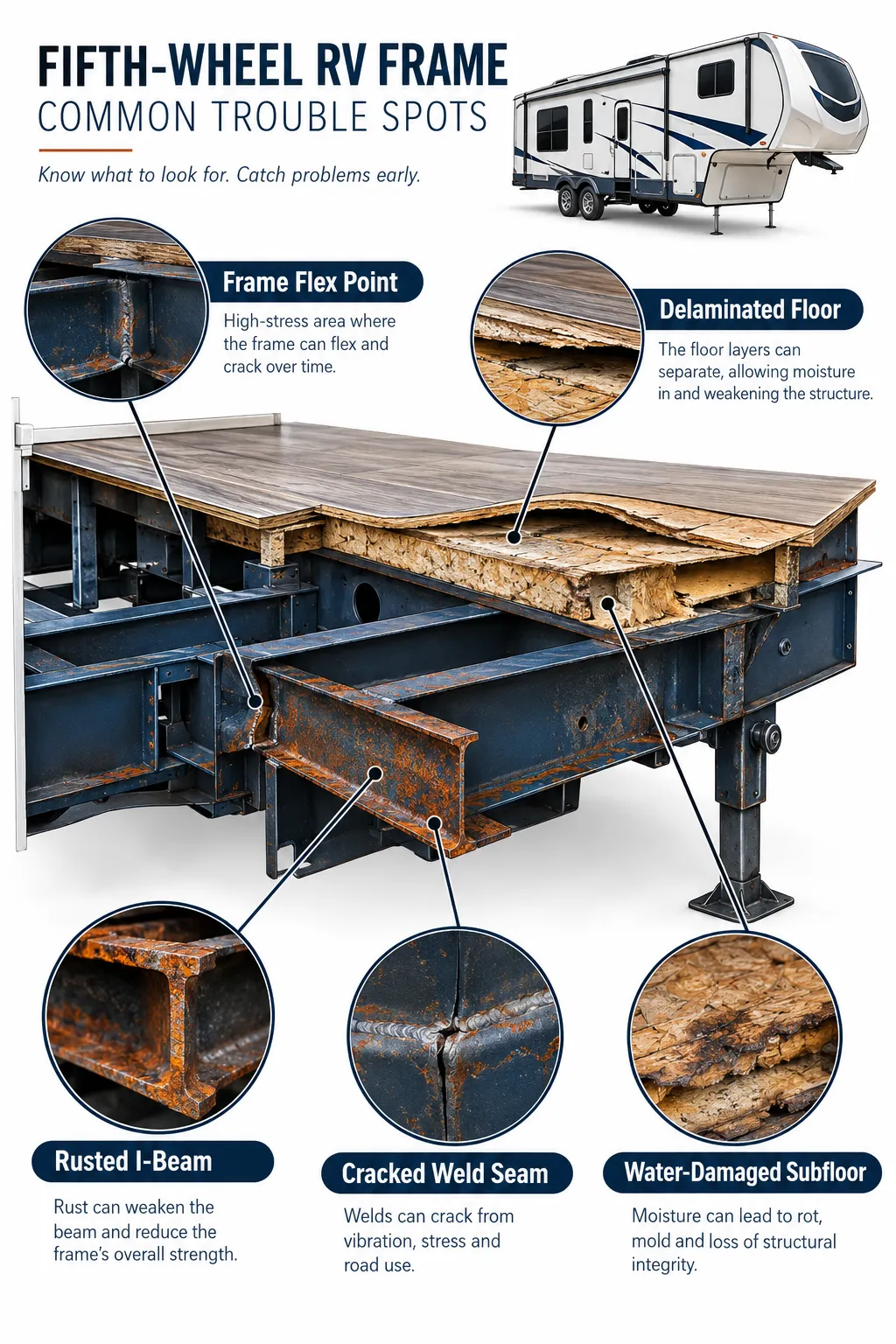
When a frame flexes too much on the highway, it stresses every seam in the RV. Cabinets crack. Slide-outs stop lining up. Windows leak. Eventually, the frame itself can bend, crack, or in the worst documented cases, fail outright [4][6]. That is not a maintenance item you fix with caulk. It is a safety issue.
Most structural failures start small and quiet. Water sneaks in around a roof seam or a window gasket. It soaks into wood framing nobody can see. Months or years later, the floor feels soft, or the frame starts to sag, and the owner is shocked. The truth is the damage had been building the whole time [5][9].
That is why this list matters so much for anyone shopping the used market. Knowing which brands and models show up most often in structural complaints gives buyers a real head start.
10 Used RV Models with the Worst Structural Issues
Below is the breakdown of the 10 used RV models with the worst structural issues, based on patterns found across owner reports, recall data, and independent RV reviews. These are not one-off complaints. They are repeated findings tied to specific build practices.
1. Grand Design Momentum & Solitude Fifth Wheels
Grand Design built a strong reputation early on, but newer Momentum and Solitude fifth wheels have become the center of an active frame-flex investigation. Owners report excessive frame movement on the highway, which leads to cracked walls, misaligned slide-outs, and stress cracks around the frame rails [4][8]. Toy hauler versions, like the Momentum, carry extra weight in the garage area, which seems to make the flexing worse over time.
Typical repair range: $4,000,$12,000 for frame reinforcement and related body repairs.
2. Heartland Fifth Wheels
Heartland fifth wheels, including several popular toy hauler and luxury trims, have documented cases of highway frame flex, and in some of the worst reports, full frame collapse [3][6]. This is one of the more serious entries on this list because the failure mode is not gradual. Some owners describe sudden sagging or buckling after towing on rough roads.
Typical repair range: $6,000,$20,000, since frame collapse often damages the floor and walls too.
3. Fleetwood Bounder & Discovery
These Class A motorhomes use an aluminum skeleton frame, which sounds lightweight and modern, but has shown real frame-integrity problems over time [2][9]. Aluminum fatigue, corrosion at weld joints, and flexing around the chassis-to-body connection points are common complaints. Because these are motorized RVs, a structural issue here can affect how the coach handles on the road.
Typical repair range: $5,000,$15,000 for skeleton and frame repair work.
4. Gulf Stream Conquest & Vintage Cruiser
Gulf Stream’s Conquest and Vintage Cruiser lines have a long history of chronic leak-driven structural damage [7][10]. Roof seams and window seals fail early, letting water soak into wall and floor framing. By the time an owner notices soft spots in the floor, the rot has usually spread much further than it looks.
Typical repair range: $3,000,$10,000 for floor and wall section replacement.
5. Forest River Travel Trailers & Fifth Wheels
Forest River produces a huge number of RVs under many brand names, and survey-based evidence shows a pattern of rapid structural degradation across several of its travel trailer and fifth wheel lines [1][7]. Thinner wall construction and inconsistent sealing at the factory level are frequently cited causes. Because Forest River owns so many sub-brands, buyers do not always realize they are buying into the same structural risk under a different label.
Typical repair range: $2,500,$9,000 depending on how far water damage has spread.
6. Thor Motor Coach & Subsidiaries
Thor Motor Coach, along with several of its subsidiary brands, shows up often in defect-frequency complaints, and some owners have pursued legal-rights claims over unresolved structural problems [1][5][10]. Reported issues include frame and chassis flex, slide-out room separation, and floor softening tied to incomplete factory sealing.
Typical repair range: $4,000,$14,000, with higher costs for motorized units needing chassis work.
7. Coachmen Catalina Travel Trailers
Coachmen Catalina travel trailers have been tied to recalls and slide-related structural risks [1][7]. When a slide-out room is not properly supported, it puts uneven stress on the surrounding frame and flooring every time it extends or retracts. Over hundreds of cycles, that stress adds up into cracked seams and sagging floors near the slide opening.
Typical repair range: $2,000,$8,000 for slide mechanism and surrounding structure repair.
8. Jayco Used Units
Jayco has a solid reputation overall, but older used units show a recurring pattern of water damage, roofing problems, and framing issues once they pass the five- to seven-year mark [1][7][10]. Roof membrane aging combined with minor seal failures lets water travel into the roof trusses and wall framing before anyone notices a leak from inside.
Typical repair range: $3,000,$9,000 for roof and framing repair.
9. Vanleigh Vilano & Beacon (Post-2020)
Vanleigh built a strong early reputation for quality, but post-2020 Vilano and Beacon fifth wheels have shown a noticeable decline in build quality and structural integrity [1][7]. Reports include frame flex, uneven floor settling, and slide-out alignment problems appearing earlier than expected for a premium-priced brand.
Typical repair range: $4,000,$13,000, reflecting the higher-end materials used in these units.
10. Budget-Tier Travel Trailers From Repeat “Worst Brand” Lists
Beyond single models, several budget-tier travel trailers keep reappearing across independent “worst RV brand” rankings for structural concerns [1][7][10]. These entry-level trailers often use thinner wall studs, fewer sealing points, and lighter-duty frames to hit a lower price point. The result is a trailer that looks fine on a dealer lot but develops structural softness within just a few seasons of regular use.
Typical repair range: $1,500,$7,000, though the lower repair cost often reflects a smaller, less durable structure to begin with.
“A soft floor you can feel through your socks is never just a flooring problem. It is almost always a structural problem wearing a rug.”
Common Structural Failure Modes Across These Used RVs
Even though these models come from different manufacturers, the structural problems tend to follow the same few patterns:
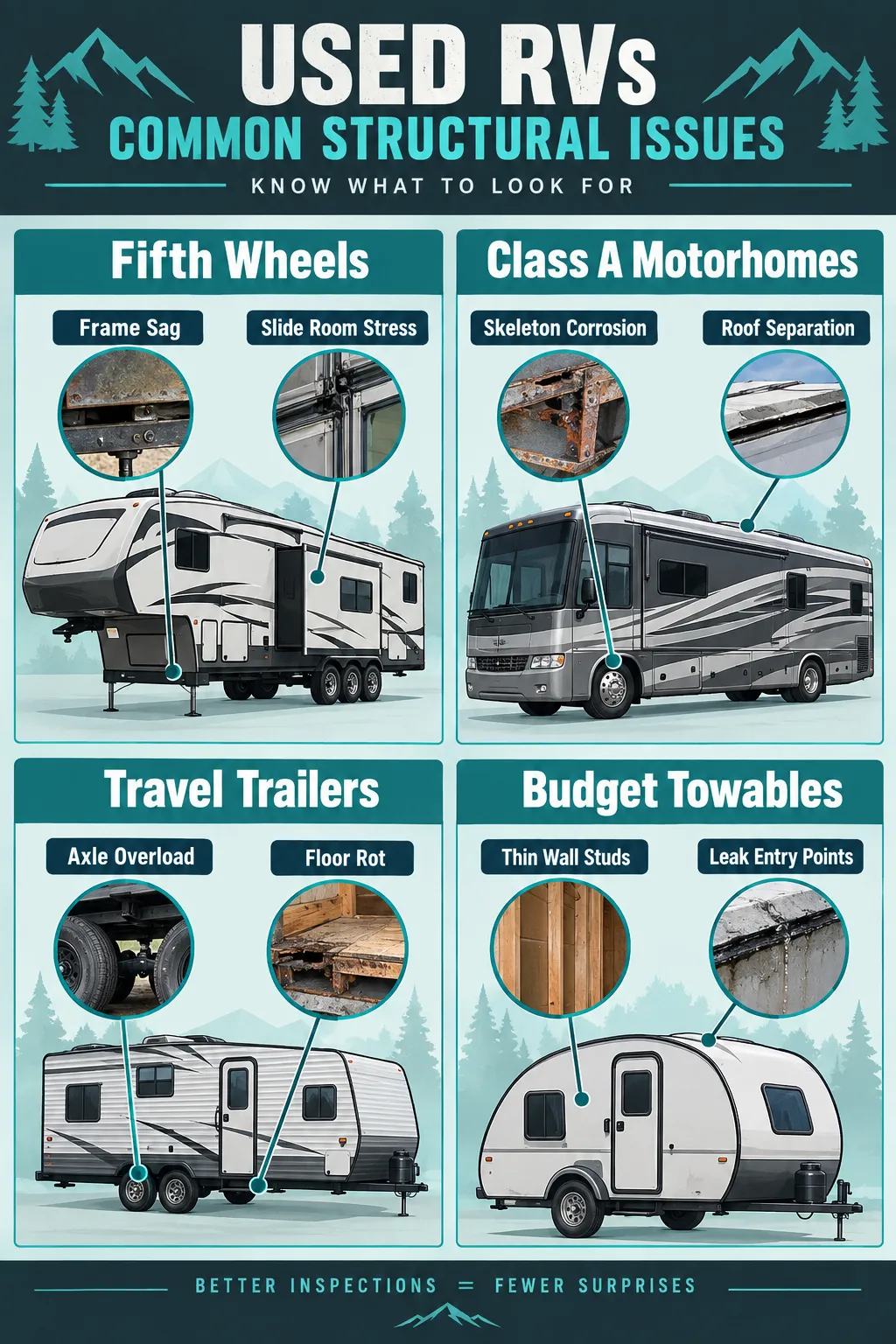
- Frame flex on the highway, the chassis bends more than it should under normal towing or driving conditions [3][4][6].
- Water intrusion through roof and window seals, the number one hidden cause of rotten framing [5][9].
- Slide-out stress, repeated extending and retracting puts uneven pressure on the surrounding structure [1][7].
- Thin or inconsistent wall framing, common in budget and mid-range models built to hit a lower price [1][10].
- Corrosion at weld joints and metal skeletons, especially in aluminum-frame motorhomes [2][9].
- Floor joist rot, often invisible until the floor feels soft or spongy underfoot.
Notice how most of these problems start as something small. A tiny seal failure or a slightly undersized frame rail does not look dangerous on day one. Given enough time, weather, and road miles, it becomes a major structural issue.
What Structural Repairs Really Cost
Structural repair costs vary a lot depending on how early the problem is caught. Here is a simple breakdown based on the patterns found across these models:
| Repair Type | Typical Cost Range | Notes |
|---|---|---|
| Frame reinforcement | $4,000,$15,000 | Higher for fifth wheels and toy haulers |
| Floor replacement (partial) | $2,000,$6,000 | Cost rises fast if rot has spread under walls |
| Roof structure repair | $3,000,$9,000 | Often paired with full roof replacement |
| Slide-out realignment/repair | $1,500,$8,000 | Depends on frame damage around the opening |
| Full frame collapse repair | $10,000,$20,000+ | Sometimes not worth it financially |
In many of the worst cases, the repair bill approaches, or even passes, the resale value of the RV itself. That is the real danger with structural issues. They are not just expensive. They can make an otherwise good-looking RV not worth fixing at all.
How to Spot These Problems Before You Buy
No one wants to buy their way into one of the 10 used RV models with the worst structural issues without knowing it. Here is a simple checklist to use at any showing:
- Walk the floor slowly in socks. Feel for soft spots, especially near the bathroom, slide-outs, and entry door.
- Check the roof from a ladder. Look for soft spots, bubbling, or separated seams.
- Look under the RV at the frame rails. Check for rust, bends, or welded patch repairs that were not done by a factory.
- Open and close every slide-out. Listen for grinding, and watch for gaps that do not close evenly.
- Ask for maintenance and repair records. A seller who cannot produce any history on a 5+ year old RV is a red flag.
- Get a professional RV inspection before closing the deal, especially on fifth wheels and motorhomes from the models listed above.
- Check recall history using the VIN before you buy, since several Coachmen and Thor models have had recall notices tied to structural components [1][7].
Frequently Asked Questions
Are all RVs from these brands bad?
No. These brands build thousands of RVs, and many owners never experience structural problems. These models simply show up most often in structural complaint data and independent rankings [1][7][10].
Can structural damage always be repaired?
Often yes, but not always affordably. Minor floor rot or a single cracked weld can usually be fixed. Full frame collapse or widespread wall rot sometimes costs more to repair than the RV is worth.
Is a cheaper used RV always riskier?
Not always, but budget-tier trailers tend to use lighter materials to hit a lower price, which can mean less structural margin for error over time [1][10].
What is the single best way to protect myself as a buyer?
A professional pre-purchase inspection. It is the one step that catches hidden water damage and frame problems before they become your problem.
Conclusion
Structural issues are the most expensive and most dangerous problems a used RV can hide. The 10 used RV models with the worst structural issues covered here, from Grand Design and Heartland fifth wheels to Thor, Coachmen, Jayco, and budget-tier travel trailers, all share a few common threads: water intrusion, frame flex, and thinner-than-ideal construction.
None of this means these brands should be crossed off completely. It means buyers need to slow down, inspect carefully, and ask hard questions before buying used. Walk the floors. Check the roof. Pull the maintenance records. Get a real inspection from someone who knows what frame flex and floor rot actually look like.
A little extra homework now can save thousands of dollars, and a lot of stress, down the road.
References
[1] Worst Rv Brands – https://rvbrands.org/worst-rv-brands/
[2] Watch – https://www.youtube.com/watch?v=ICM7XjwLb2M
[3] Watch – https://www.youtube.com/watch?v=Cx4LcMd59kE
[4] Watch – https://www.youtube.com/watch?v=BVqeJ1bRr1Q
[5] Watch – https://www.youtube.com/watch?v=oeB8I5JA1Pk
[6] Watch – https://www.youtube.com/watch?v=SKMXSY4PFMg
[7] Rv Brands To Avoid – https://www.cheapism.com/rv-brands-to-avoid/
[8] Watch – https://www.youtube.com/watch?v=iMrSSlvJkno
[9] Watch – https://www.youtube.com/watch?v=aW6D_tK9xAQ
[10] Worst Rv Brands To Avoid – https://www.rvtalk.net/worst-rv-brands-to-avoid/