Picture this: you’re cruising down the highway in your RV, wind in your hair, favorite playlist on — and then it hits you. Did you retract the slide-outs? 😬 That sinking feeling is something every RV lover has experienced at least once, and it’s exactly why knowing the 14 worst things to forget before leaving the campground can save your trip, your rig, and your sanity. Whether you’re a weekend warrior or a full-time road warrior, a solid pre-departure routine is the difference between a smooth getaway and a costly, stressful disaster.
Key Takeaways
- 🔑 Always use a physical or digital checklist — memory alone is not reliable when you’re excited to hit the road.
- 🔑 Mechanical and structural oversights (like forgetting to retract slides or unhook shore power) can cause serious damage to your RV.
- 🔑 Leaving personal items or waste behind is not just inconvenient — it can result in fines and damage your reputation at campgrounds.
- 🔑 A quick walk-around inspection before every departure catches most mistakes before they become expensive problems.
- 🔑 The 14 worst things to forget before leaving the campground fall into clear categories: systems, safety, site cleanup, and personal gear.
Why RV Campers Keep Making the Same Departure Mistakes
Even experienced RVers slip up. The excitement of a new destination, a tired morning after a late campfire night, or simply the chaos of packing up kids and pets — all of these create the perfect storm for forgetting something critical.
“A two-minute walk-around before departure can prevent a two-thousand-dollar repair bill.”
The good news? Every single one of the 14 worst things to forget before leaving the campground is 100% preventable with the right habits. Let’s break them down one by one.
Would you like to save this article?
The 14 Worst Things to Forget Before Leaving the Campground
1. 🔌 Disconnecting Shore Power
Leaving your electrical hookup connected is one of the most common — and most damaging — mistakes RVers make. Driving away with the power cord still plugged in can rip the cord from the pedestal, damage your RV’s electrical inlet, and even create a fire hazard at the campsite.
What to do: Always unplug, coil, and stow your shore power cord before moving the vehicle. Double-check that the inlet cover is securely closed.
2. 🚰 Leaving the Water Hose Connected
Similar to the power cord, a fresh water hose left connected will be yanked off and potentially damage your RV’s water inlet or the campground’s water spigot. It’s an easy thing to miss, especially if the hose runs behind a tire or under the rig.
Pro tip: Use a brightly colored hose so it’s easy to spot during your walk-around.
3. 📦 Forgetting to Retract the Slide-Outs
This is arguably the most expensive item on the list. Driving with slide-outs extended can cause catastrophic damage — to your RV, to other vehicles, to guardrails, and to anything else in the path of those extended walls.
Checklist item: Before starting the engine, visually confirm every slide is fully retracted and the indicator lights (if equipped) show green.
| Slide-Out Type | Common Forget Risk | Potential Damage |
|---|---|---|
| Living room slide | High | Wall, awning, structural |
| Bedroom slide | Medium | Siding, frame |
| Kitchen slide | Medium | Cabinetry, plumbing |
4. 🪜 Leaving Stabilizer Jacks Down
Stabilizer jacks are not designed to bear the weight of a moving vehicle — and they’re absolutely not designed to drag along the road at 60 mph. Forgetting to retract them can bend or break the jacks, damage the frame, and create dangerous road debris.
Quick check: After retracting, give each jack a visual confirmation and listen for the motor to stop completely.
5. 🏕️ Not Fully Extinguishing the Campfire
This one isn’t just about your RV — it’s a safety and legal issue. An unextinguished campfire left at a campsite is one of the leading causes of wildfire ignition in campgrounds. In many states, leaving a fire unattended or improperly extinguished carries significant fines.
The rule: Drown the fire with water, stir the ashes, and drown again. If it’s still warm to the touch, it’s not out.
“If it’s too hot to touch, it’s too hot to leave.” — National Forest Service guidance
6. 🪣 Forgetting to Dump and Disconnect the Sewer Hose
Leaving your sewer hose connected — or worse, leaving it on the ground at the dump station — is a messy, smelly, and potentially rule-violating mistake. Many campgrounds will charge fees or ban repeat offenders for improper waste disposal.
Departure order matters:
- Dump black tank first
- Flush with gray water
- Rinse hose thoroughly
- Disconnect, cap, and stow
- Close all tank valves
7. 💧 Leaving the Water Pressure Regulator Behind
Water pressure regulators are small, easy to forget, and surprisingly expensive to replace. They’re often left screwed onto the campground spigot after disconnecting the hose. The same goes for water filters — these inline accessories are frequently abandoned at sites.
Habit fix: When you coil your water hose, make it a rule to always check the spigot end for attached accessories before walking away.
8. ⚡ Not Disconnecting the TV Antenna or Satellite Dish
Rooftop satellite dishes and crank-up TV antennas that aren’t properly stowed before departure can be sheared off by low-hanging branches, bridge clearances, or even strong wind. This is a surprisingly common and completely avoidable repair.
Before you drive: Lower the TV antenna crank fully. If using a portable satellite dish, confirm it’s packed and secured inside or in a storage bay.
9. 🛖 Leaving Camp Chairs, Rugs, and Outdoor Gear Behind
It sounds obvious, but outdoor gear gets left behind at campsites constantly. Camp chairs tucked behind trees, outdoor rugs under the awning, doormats, welcome signs, solar lights, and kids’ toys are all prime candidates for being forgotten.
The walk-around rule: Do a complete 360-degree walk of your entire campsite — not just around the RV, but the full site perimeter — before departure.
Common forgotten outdoor items:
- 🪑 Folding camp chairs
- 🏕️ Outdoor rug or mat
- 💡 Solar stake lights
- 🔧 Leveling blocks and wheel chocks
- 🪣 Trash bags and recycling bins
- 🎮 Kids’ outdoor toys
10. 🔒 Forgetting Wheel Chocks and Leveling Blocks
Leveling blocks and wheel chocks are typically placed under and around tires to stabilize the RV at the site. They’re low to the ground, often the same color as gravel or dirt, and very easy to drive right over — or simply forget.
Smart storage tip: Store chocks and leveling blocks in a dedicated, brightly colored bag or bin so you always know exactly where they go and can easily see if the bag is missing.
11. 🔑 Leaving the Campground Key or Entry Card
Many private campgrounds and RV parks issue key fobs, gate cards, or wristbands for entry and amenity access. Driving off with these not only means a trip back or a replacement fee — some parks charge $25–$75 per unreturned card.
Habit: Place the campground key on your dashboard or in a designated “return” spot in your RV the moment you check in, so it’s visible and ready to hand back at checkout.
12. 🪟 Unsecured Roof Vents and Open Windows
Open roof vents and windows left ajar during travel are an invitation for rain, road debris, and insects. A sudden rainstorm while driving can soak interior furnishings, damage electronics, and create mold problems that take weeks to fix.
Pre-departure scan: Walk through the interior and close every window latch and roof vent cover. Check that vent fans are in the off position.
13. 🧯 Not Checking Propane Tank Valves
Propane leaks are a serious safety hazard on the road. Many RVers leave propane tanks open while driving, which is against safety regulations in many jurisdictions and creates risk in the event of an accident or pressure change.
Best practice: Turn off all propane appliances, then close the main propane tank valve(s) before departure. Some RVers use a propane tank cover with a lock to make this a non-negotiable habit.
| Propane Safety Step | Why It Matters |
|---|---|
| Turn off all appliances | Prevents gas buildup |
| Close main tank valve | Stops flow in case of leak |
| Check for hose damage | Prevents slow leaks while traveling |
| Confirm detector is working | Early warning system |
14. 🗑️ Leaving Trash or Personal Items at the Site
Leaving trash, food scraps, or personal belongings at a campsite is the fastest way to get banned from a campground and earn a bad reputation in the RV community. Beyond etiquette, food waste attracts wildlife — including bears in many popular camping areas — creating dangerous situations for the next campers.
Leave No Trace reminder: Pack out everything you packed in. Do a final sweep of fire pits, picnic tables, under the awning, and around hookup pedestals.
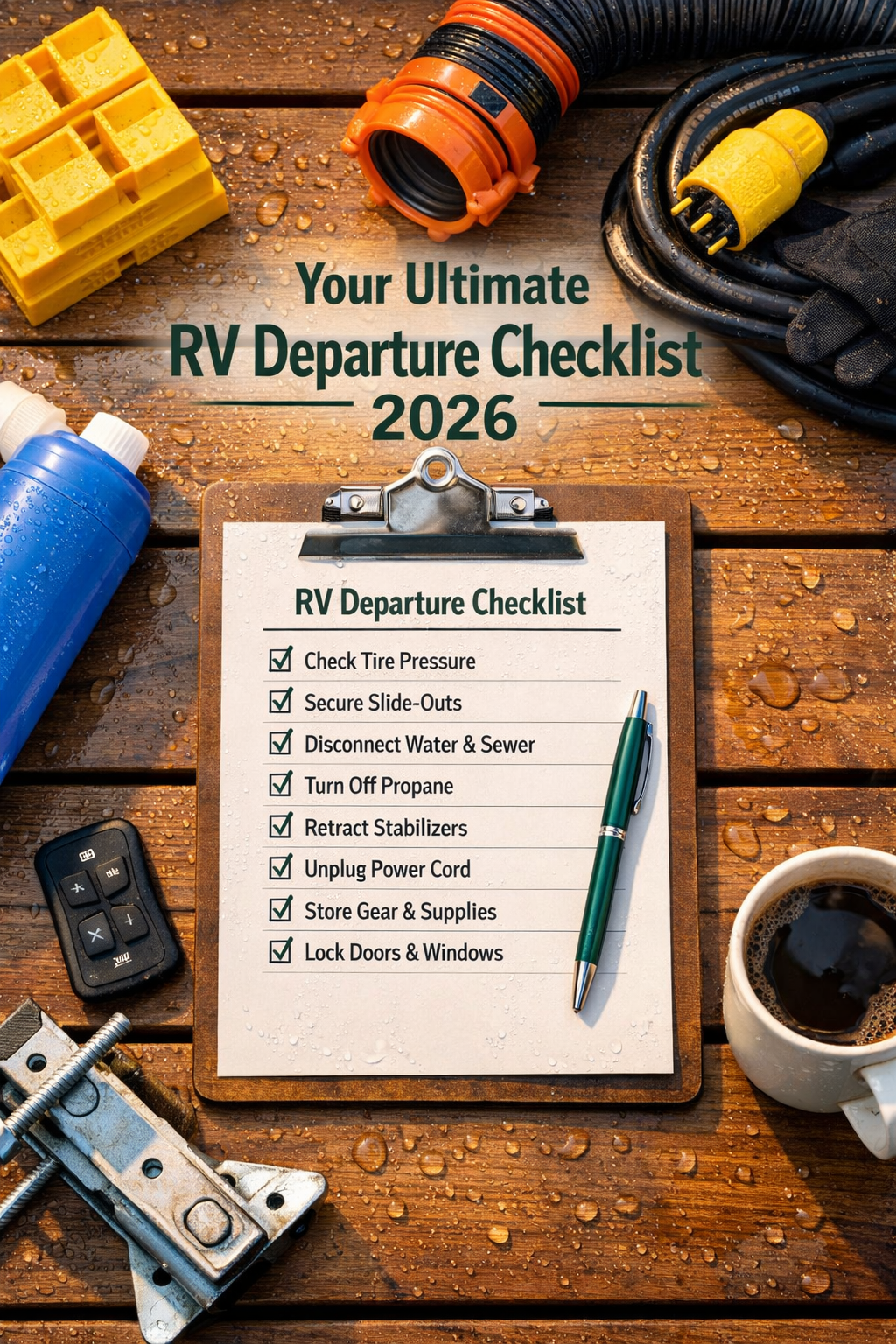
Your Quick-Reference RV Departure Checklist
Use this table as a fast visual reference every time you pack up camp. Print it out, laminate it, and stick it near your door!
| # | Item to Check | ✅ Done? |
|---|---|---|
| 1 | Shore power disconnected and stowed | ☐ |
| 2 | Fresh water hose disconnected and stowed | ☐ |
| 3 | All slide-outs fully retracted | ☐ |
| 4 | Stabilizer jacks fully raised | ☐ |
| 5 | Campfire fully extinguished | ☐ |
| 6 | Sewer hose dumped, rinsed, and stowed | ☐ |
| 7 | Water pressure regulator and filter retrieved | ☐ |
| 8 | TV antenna lowered / satellite dish stowed | ☐ |
| 9 | All outdoor gear collected | ☐ |
| 10 | Wheel chocks and leveling blocks collected | ☐ |
| 11 | Campground key/card returned | ☐ |
| 12 | All windows and roof vents closed | ☐ |
| 13 | Propane tank valve closed | ☐ |
| 14 | Site cleared of all trash and personal items | ☐ |
How to Build a Foolproof Pre-Departure Routine
Knowing the 14 worst things to forget before leaving the campground is only half the battle. Building a routine that makes checking these items automatic is the real goal.
The 3-Step Departure System
Step 1: Inside-Out Check (10 minutes)
Start inside the RV. Close all windows and vents, stow loose items, turn off propane appliances, retract slide-outs, and confirm all interior systems are secure.
Step 2: Full Site Walk-Around (5 minutes)
Exit the RV and walk the entire campsite perimeter. Collect all outdoor gear, check hookup pedestals, extinguish fire, and do a visual scan of the ground for forgotten items.
Step 3: Final Systems Check (2 minutes)
Do a final walk around the RV itself. Confirm jacks are up, slides are in, all connections are disconnected, storage bays are latched, and the tow vehicle (if applicable) is properly connected.
“The best RV departure routine is the one you actually do every single time — not just when you remember.”
Digital vs. Paper Checklists
Both work great. Here’s a quick comparison:
| Type | Pros | Cons |
|---|---|---|
| Paper (laminated) | Always available, no battery needed | Can get wet or lost |
| Digital app | Customizable, shareable, syncs with partner | Needs phone/tablet |
| Whiteboard on door | Visible, reusable | Limited space |
Many experienced RVers use a combination — a laminated card for the campsite walk-around and a digital checklist app for the full interior systems check.
Bonus Tips: What Experienced RVers Do Differently
The RV community has developed some clever habits over the years to prevent the most common departure mistakes:
- 🔴 Use a red “departure tag” on the steering wheel that must be physically removed after completing the checklist — you literally cannot drive away without it.
- 📸 Take a photo of your campsite from a distance before leaving so you have visual proof the site is clear.
- 👫 Use the buddy system — have a passenger do the walk-around while the driver does the interior check simultaneously.
- ⏰ Build in 30 extra minutes on departure morning so you’re never rushing through the checklist.
- 📱 Use a dedicated RV checklist app that lets you create custom checklists for different campsite types (full hookup, dry camping, etc.).
Conclusion: Never Leave a Campground Without This Routine
The 14 worst things to forget before leaving the campground aren’t just minor inconveniences — they range from costly mechanical damage and safety hazards to environmental harm and campground bans. The great news is that every single one of them is preventable with a consistent, systematic departure routine.
Here are your actionable next steps:
- Print and laminate the quick-reference checklist table above and keep it in your RV door pocket.
- Download a checklist app and customize it for your specific RV setup and hookup types.
- Practice the 3-Step Departure System on your very next camping trip until it becomes second nature.
- Share this guide with your camping crew so everyone knows the routine — including the kids!
- Do a post-departure review for the first few trips: once you’re on the road, mentally run through the list to reinforce the habit.
The best part of RV life is the freedom of the open road. Don’t let a forgotten sewer hose or an extended slide-out steal that joy. With the right habits in place, every departure can be smooth, confident, and stress-free. 🚐💨