Only 37% of RV trips that run into serious delays on the road could have been prevented with simple night-before preparation. That number is striking — and completely avoidable. The difference between a smooth, joyful departure and a stressful morning of scrambling almost always comes down to what happens the evening before. The 19 things smart RVers do the night before travel day are not complicated. They are simple, fast habits that save hours of headache later.
Whether someone is a weekend warrior or a full-time road warrior, this guide covers every smart move to make before the wheels roll. These are the night before travel day tips that experienced RVers swear by — and new RVers wish they had known sooner.
Key Takeaways
- ✅ A solid pre-trip RV checklist done the night before prevents most common travel-day problems.
- 🔧 Mechanical checks, fluid levels, and tire pressure should always happen before sleep — not at sunrise.
- 📋 Paperwork, documents, and route plans need to be ready and organized the night before.
- 🥪 Packing food, snacks, and comfort items ahead of time saves money and reduces stress on the road.
- 🔒 Home security, pet care, and notifying loved ones are easy to forget but critically important.
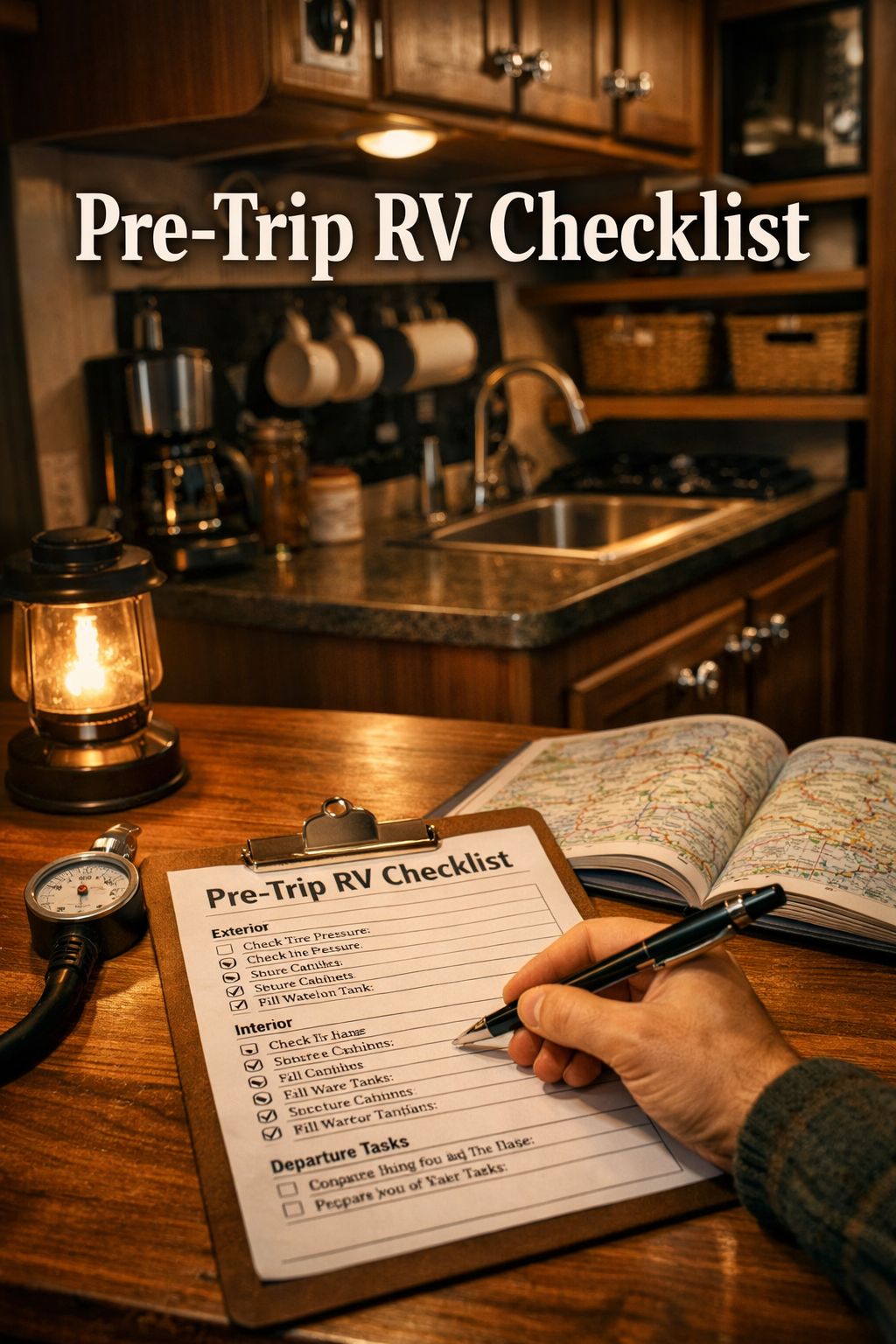
The Complete Guide: 19 Things Smart RVers Do the Night Before Travel Day
Getting ready the night before is the single most powerful habit any RVer can build. Each item below is a proven step that reduces stress, saves time, and keeps everyone safer on the road.
1. 🛞 Check Tire Pressure on Every Wheel
Tire problems are one of the top causes of RV breakdowns. Smart RVers check every single tire the night before — not just a quick glance, but an actual pressure reading with a quality gauge [10]. This includes the spare tire.
Why it matters: Tires lose pressure overnight, especially in cold weather. A tire that looks fine can be dangerously low. Driving on underinflated tires increases blowout risk and lowers fuel efficiency.
What to do:
- Use a digital tire pressure gauge for accuracy.
- Check the RV owner’s manual for the correct PSI for each tire position.
- Inflate or deflate as needed.
- Do not forget the toad vehicle (the car being towed) if applicable.
Checking tires the night before means there is still time to visit a service station or call for help if a problem is found. Finding a flat at 6 AM on departure day is a nightmare. Finding it at 8 PM the night before is just a quick fix [4].
💡 Pro Tip: Keep a tire pressure log in a small notebook stored in the RV. Track readings over time to spot slow leaks early.
2. 🔋 Inspect the Battery Systems
RV battery systems are complex. There is usually a chassis battery (for starting the engine) and one or more house batteries (for powering lights, appliances, and slides). Both need attention before travel day [5].
Check these things:
- Battery charge level on all batteries
- Corrosion on battery terminals (clean with baking soda and water if needed)
- Battery water levels on non-sealed batteries
- That the battery disconnect switch is in the correct position
A dead chassis battery means the RV will not start. A dead house battery means no lights, no water pump, and no slide-outs working correctly. Neither situation is fun at 7 AM when everyone is ready to roll.
Smart RVers also make sure the generator (if equipped) has enough fuel and starts properly the night before. Running a quick 5-minute generator test is a great habit to build into the pre-trip RV routine.
3. 💧 Check All Fluid Levels
Just like any vehicle, an RV needs proper fluid levels to run safely. This is one of the most skipped steps — and one of the most important [10].
Fluids to check:
| Fluid | Location | What to Look For |
|---|---|---|
| Engine oil | Under the hood | Between min/max marks |
| Coolant | Overflow reservoir | Correct level, no discoloration |
| Brake fluid | Under the hood | Between min/max marks |
| Power steering fluid | Under the hood | Correct level |
| Windshield washer fluid | Under the hood | Full |
| Generator oil | Generator compartment | Between min/max marks |
Low oil or coolant can cause serious engine damage on a long trip. Catching a low fluid level the night before means there is time to top it off at a nearby auto parts store — which is almost certainly open in the evening.
4. 🗺️ Plan and Download the Route
Smart RVers never rely on a single navigation source. The night before is the perfect time to plan the full route, download offline maps, and identify key stops [2].
Route planning checklist:
- Enter the destination into the RV-specific GPS app (like RV Life or Garmin RV)
- Download offline maps in case of no cell service
- Note low bridges, weight restrictions, and propane restrictions (tunnels!)
- Identify fuel stops that can accommodate RV length
- Mark rest areas and dump stations along the route
- Have a paper map as a backup — technology fails [2]
Knowing the route the night before also helps with departure time planning. If there is a tricky merge or a known traffic bottleneck, leaving 30 minutes earlier can make a huge difference.
5. 📄 Gather and Organize All Documents
Nothing slows down a trip like searching for the registration or insurance card at a weigh station. Smart RVers gather every important document the night before and put them in one easy-to-reach spot [2].
Documents to have ready:
- RV registration
- Vehicle insurance cards (RV and toad)
- Driver’s license
- Campground reservation confirmations
- Roadside assistance membership card (like Good Sam) [10]
- Passport or ID if crossing borders
- Pet vaccination records if traveling with animals
- Rental agreement if renting the RV [2]
A small accordion folder or a dedicated document pouch works perfectly. Keep it in the cab where the driver can access it quickly.
6. 🔒 Secure the Home Before Leaving
Leaving home for a week or more requires some important security steps. Smart RVers handle this the night before so nothing is forgotten in the morning rush [2].
Home security steps:
- Set the alarm system
- Lock all doors and windows
- Put interior lights on timers
- Stop mail and newspaper delivery (or ask a neighbor)
- Arrange for someone to check the house
- Unplug non-essential electronics
- Turn the water heater to vacation mode
- Adjust the thermostat to an energy-saving setting
Doing this the night before means there is time to call a neighbor or set up mail hold if it was forgotten. Rushing through these steps on the morning of departure leads to mistakes.
7. 🐾 Confirm Pet Care Arrangements
Pets traveling with the family need their own preparation. Pets staying home need solid care arrangements [2].
For pets coming along:
- Pack food, water bowls, leash, and waste bags
- Bring vaccination records and vet contact info
- Confirm the campground is pet-friendly
- Set up a safe travel space in the RV
For pets staying home:
- Confirm the pet sitter or boarding reservation
- Leave detailed feeding and care instructions
- Provide emergency vet contact information
- Make sure the pet has enough food and supplies
Forgetting to confirm pet care the night before can mean a last-minute scramble — or worse, bringing a pet to a campground that does not allow them.
8. 📞 Notify Trusted Family and Friends
This is a safety step that many RVers skip — and should not. Letting trusted people know the full travel itinerary is smart and responsible [2].
Share with 1-2 trusted contacts:
- Departure date and expected return date
- Full route with major stops
- Campground names and reservation numbers
- Emergency contact numbers
Important: Do NOT post this information on social media. Sharing travel plans publicly lets strangers know a home will be empty [2].
This step takes five minutes and provides enormous peace of mind. If something goes wrong on the road, someone at home knows exactly where to start looking.
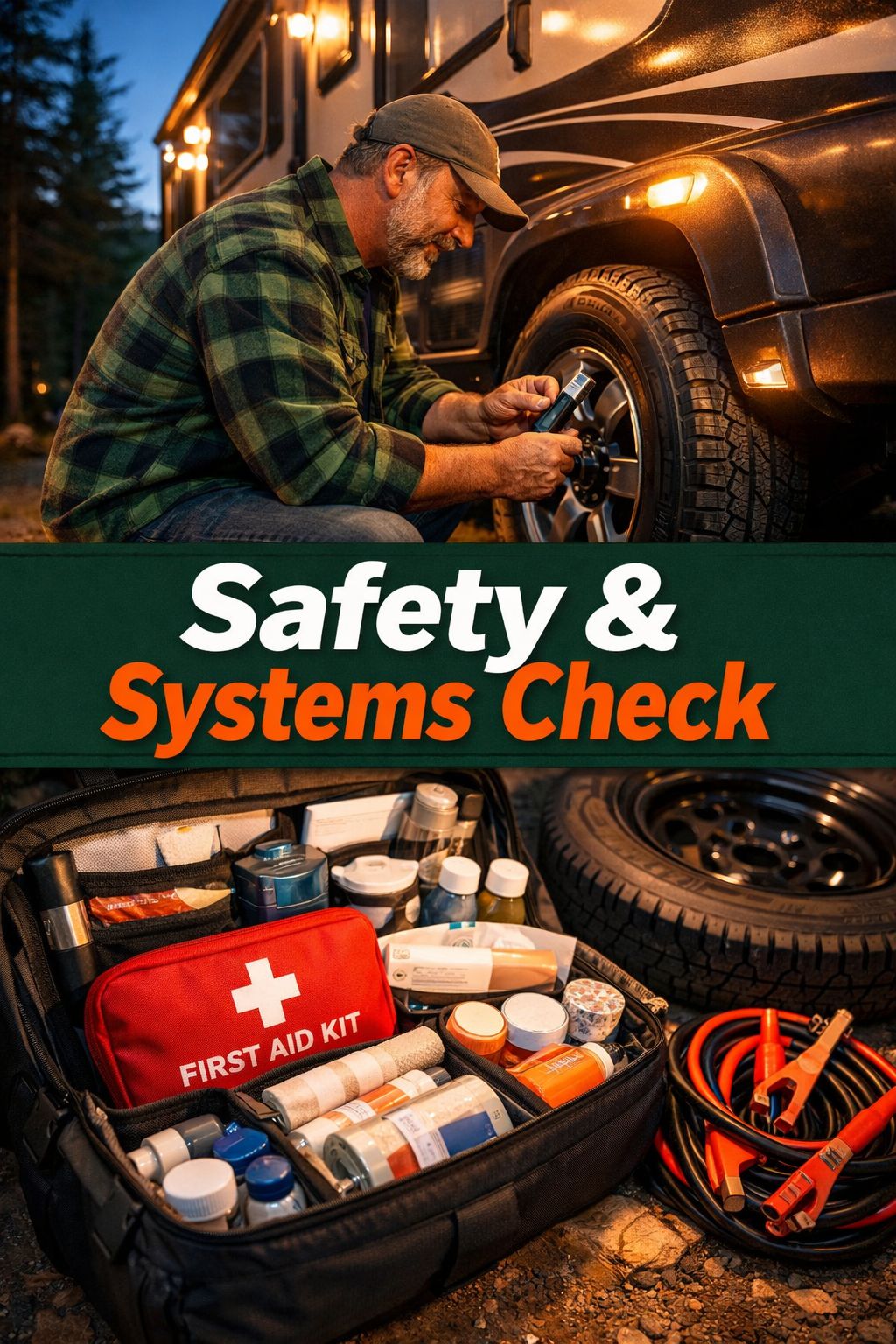
9. 🧰 Inspect the Emergency and Safety Kit
Every RV should carry a solid emergency kit. The night before is the perfect time to check that everything is stocked and in good condition [4].
Emergency kit essentials:
- Spare tire (properly inflated!)
- Jumper cables or a jump starter pack [4]
- Reflective triangles or road flares
- Tow strap
- Basic tool kit (screwdrivers, pliers, wrenches)
- Duct tape and zip ties
- Work gloves
- Flashlight with fresh batteries
- Fire extinguisher (check the gauge)
Checking these items the night before means there is time to replace a dead flashlight battery or grab a missing item from the hardware store. An emergency kit that is incomplete is not really an emergency kit at all.
10. 🩺 Restock the First Aid Kit
A comprehensive first aid kit is non-negotiable for any RV trip [6]. The night before is the time to open it up and make sure nothing is expired or missing.
First aid kit must-haves:
- Bandages in multiple sizes
- Antiseptic wipes and cream
- Gauze pads and medical tape
- Tweezers and scissors
- Pain relievers (ibuprofen, acetaminophen)
- Antihistamines for allergic reactions
- Prescription medications (enough for the full trip plus extra)
- Thermometer
- Cold/hot packs
- Any personal medical supplies
🚨 Important: Check expiration dates on medications and replace anything that is expired. An expired medication may not work when it is needed most.
11. 🍎 Pack Food, Snacks, and Drinks
One of the smartest money-saving moves any RVer can make is packing food and snacks before the trip [3]. Buying snacks at gas stations and convenience stores on the road costs two to three times more than buying them at a grocery store.
Smart food prep the night before:
- Stock the RV fridge with easy meals and fresh produce
- Pack a cooler with drinks and grab-and-go snacks
- Prepare some ready-to-eat meals for the first day of travel
- Pack snacks that do not need refrigeration (nuts, granola bars, dried fruit)
- Fill a reusable water bottle for each traveler
Snack ideas for the road:
- Trail mix
- String cheese
- Apple slices with peanut butter packets
- Crackers and hummus
- Popcorn
Having food ready also means fewer stops, which translates to arriving at the campground earlier and with more energy [3].
12. ☕ Set Up the Coffee Station
This one sounds small but it is a big deal for morning morale. Smart RVers set up the coffee station the night before so the first cup of the day is effortless [4].
Night-before coffee prep:
- Fill the water reservoir in the coffee maker
- Set up the coffee grounds or pods
- Set out mugs
- If using a pour-over or French press, have everything within reach
A solid coffee setup in the RV means no stopping at a drive-through in the morning. That saves time, money, and gets the trip started on the right foot [4].
13. 🔌 Disconnect Shore Power Properly
When leaving a campsite or storage facility that has shore power hookups, disconnecting properly the night before (or as part of the departure checklist) prevents damage to the RV’s electrical system.
Proper shore power disconnect steps:
- Turn off all high-draw appliances first (air conditioner, microwave)
- Switch the RV’s main breaker to OFF
- Unplug the shore power cord from the pedestal first
- Then unplug from the RV
- Coil and store the cord in its designated compartment
- Check that the cord is fully secured before driving
Forgetting to disconnect shore power and driving away is a surprisingly common mistake. It can damage the cord, the pedestal, and even the RV’s electrical inlet.
14. 🚿 Fill Fresh Water Tank (If Needed)
Knowing the water situation before departure is essential. Smart RVers check the fresh water tank level the night before and fill it if needed.
Water system night-before checklist:
- Check fresh water tank level
- Fill if the trip requires boondocking (no hookups)
- Add a water sanitizing tablet if the tank has been sitting
- Check that all water connections are tight
- Confirm the water pump works
- Empty the gray and black tanks if they are getting full
Arriving at a dry campsite with an empty fresh water tank is a stressful situation. A full tank the night before means the first morning coffee and shower are no problem at all.
15. 🪟 Retract Awnings and Slides (If Stored Out)
If the RV has been parked with slides extended or awnings out, the night before is the time to retract everything — or at minimum, confirm the plan for morning retraction.
Slide and awning checklist:
- Retract all slide-outs if possible before departure morning
- Retract all awnings completely
- Check that awning arms are locked in travel position
- Inspect slide seals for any debris or damage
- Lubricate slide mechanisms if needed
Forgetting to retract a slide or awning before driving is one of the most expensive mistakes an RVer can make. Catching this the night before — when there is good light and no time pressure — prevents a very costly accident.
16. 🧹 Secure All Interior Items
Everything inside an RV becomes a projectile during travel if it is not properly secured. Smart RVers do a full interior walkthrough the night before to make sure everything is locked, latched, or stowed [5].
Interior securing checklist:
- Close and latch all cabinet doors
- Secure the refrigerator door with a travel latch
- Stow all loose items on counters and tables
- Secure the TV (if it is not mounted)
- Put away any decorative items
- Make sure the toilet lid is closed
- Secure any items in the shower or bathtub
- Check that the microwave door is latched
A single unsecured cast iron pan can cause serious damage — and injury — during a hard brake. This walkthrough takes about 10 minutes and prevents a lot of cleanup and potential danger.
17. 💡 Test All Exterior Lights
Driving an RV with a broken brake light or turn signal is both dangerous and illegal. The night before is the perfect time to do a full exterior light check.
Lights to check:
- Headlights (low and high beam)
- Tail lights
- Brake lights
- Turn signals (front and rear)
- Reverse lights
- Marker lights along the roof and sides
- Interior step lights
- Porch/entry light
For the brake lights and turn signals, it helps to have a second person stand behind the RV while the driver tests each one. If no helper is available, a reflective surface like a garage door or a video on a phone propped behind the RV can work.
18. 🗓️ Review the Campground Reservation Details
Arriving at a campground only to discover the reservation is for the wrong date — or the wrong campground — is a gut-punch. Smart RVers review all reservation details the night before [2].
Reservation review checklist:
- Confirm the campground name and address
- Double-check arrival and departure dates
- Note the check-in time (many campgrounds have a specific window)
- Review any rules (quiet hours, pet policies, fire restrictions)
- Note the site number if assigned
- Save the campground phone number in the phone
- Print or download a backup copy of the confirmation
If anything looks wrong, the night before is the right time to call or email the campground. Campground offices are often closed early in the morning, making a night-before review especially important.
19. 😴 Get a Good Night’s Sleep
This last item is the most overlooked — and arguably the most important. Driving a large, heavy vehicle while tired is genuinely dangerous. Smart RVers protect their sleep the night before travel day.
Tips for a better night’s sleep before a big trip:
- Finish all prep tasks early enough to wind down before bed
- Set a realistic departure time that does not require waking up at 4 AM
- Lay out clothes for the morning
- Set multiple alarms if needed
- Avoid screens for 30 minutes before sleep
- Keep the RV at a comfortable sleeping temperature
A well-rested driver is a safe driver. All the preparation in the world means nothing if the person behind the wheel is running on three hours of sleep. Building a solid night-before RV routine means there is no last-minute scrambling — and everyone gets to bed on time.
Quick Reference: The Night-Before RV Prep Checklist
Here is a fast summary of all 19 things smart RVers do the night before travel day:
| # | Task | Done? |
|---|---|---|
| 1 | Check tire pressure on every wheel | ☐ |
| 2 | Inspect battery systems | ☐ |
| 3 | Check all fluid levels | ☐ |
| 4 | Plan and download the route | ☐ |
| 5 | Gather and organize documents | ☐ |
| 6 | Secure the home | ☐ |
| 7 | Confirm pet care arrangements | ☐ |
| 8 | Notify trusted family and friends | ☐ |
| 9 | Inspect the emergency kit | ☐ |
| 10 | Restock the first aid kit | ☐ |
| 11 | Pack food, snacks, and drinks | ☐ |
| 12 | Set up the coffee station | ☐ |
| 13 | Disconnect shore power properly | ☐ |
| 14 | Fill fresh water tank | ☐ |
| 15 | Retract awnings and slides | ☐ |
| 16 | Secure all interior items | ☐ |
| 17 | Test all exterior lights | ☐ |
| 18 | Review campground reservation details | ☐ |
| 19 | Get a good night’s sleep | ☐ |
Conclusion: Make the Night Before Your Secret Weapon
The 19 things smart RVers do the night before travel day are not difficult. None of them require special skills or expensive tools. What they require is intention — the decision to spend 60 to 90 minutes the evening before making sure everything is ready.
RVers who build this habit report less stress, fewer breakdowns, earlier arrivals, and more enjoyment on the road. The night before is not just preparation — it is the foundation of a great trip.
Actionable next steps:
- Print or bookmark the quick reference checklist above and keep it in the RV.
- Walk through the list the night before the next trip, even if it feels like overkill.
- Customize the list by adding any RV-specific items that are unique to a particular rig.
- Share it with travel companions so everyone can help with the prep.
- Make it a habit — after two or three trips, this routine will feel natural and fast.
The road is waiting. Get ready the night before, and enjoy every mile. 🚐✨
References
[1] Merging Into Life Road Trip Starter Pack – https://magazine.northeast.aaa.com/daily/travel/road-trips/merging-into-life-road-trip-starter-pack/
[2] How To Plan A Road Trip – https://www.bhtp.com/planning/how-to-plan-a-road-trip/
[3] Road Trip – https://www.packhacker.com/guide/road-trip/
[4] Road Trip Checklist – https://www.rei.com/learn/expert-advice/road-trip-checklist.html
[5] Preparing Our RV For An Extended Road Trip – https://www.loveyourrv.com/preparing-our-rv-for-an-extended-road-trip/
[6] Long Distance Road Trip Tips Safety – https://afternoonteareads.com/long-distance-road-trip-tips-safety/
[7] Packing List For Road Trips – https://twooutliers.com/packing-list-for-road-trips/
[10] RV Spring And Summer Maintenance Checklist – https://roadside.goodsam.com/resources/rv-spring-and-summer-maintenance-checklist