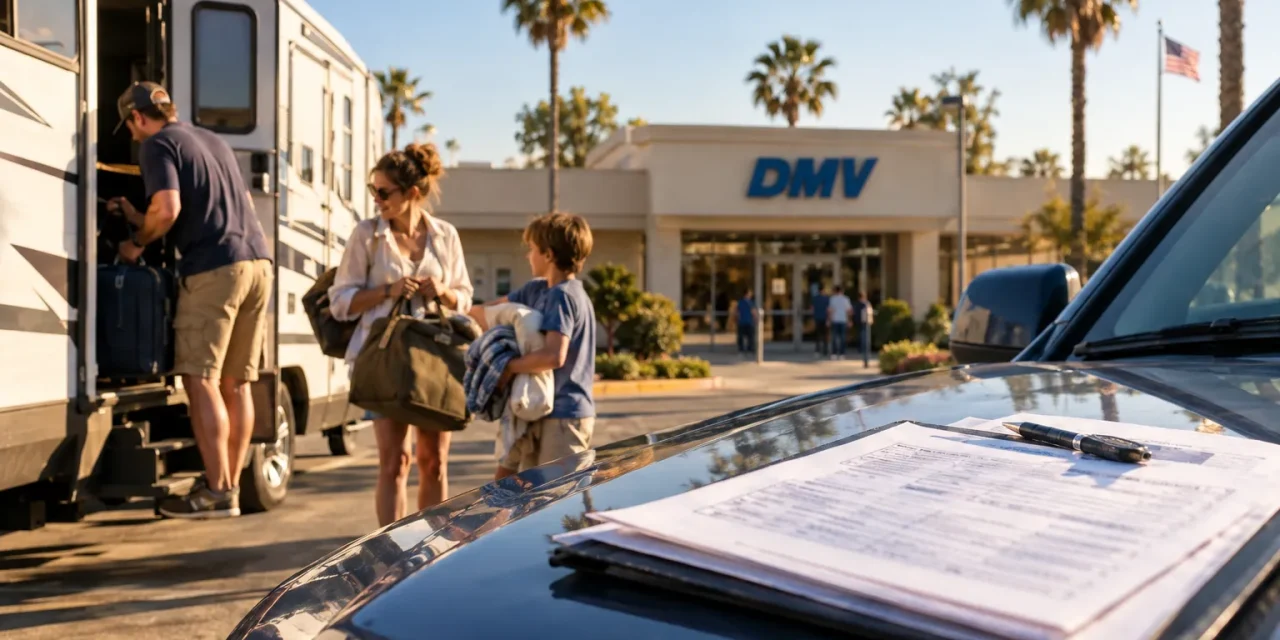
Nearly 11 million households in the U.S. own an RV, but most of them find out the hard way that registering a motorhome is nothing like registering a car. Some RV owners get turned away at the counter. Others tow a brand-new trailer home only to learn it was illegal the whole time. That is exactly why this guide breaks down 3 Things the DMV Won’t Tell You About Registering Your RV, the quiet rules, hidden fees, and new laws that clerks rarely explain unless you ask the exact right question.
RV registration looks simple on the surface. Fill out a form, pay a fee, get a sticker. But underneath that simple process are classification rules, use-based regulations, and brand-new ID and emissions laws that can stop your registration cold. Knowing these secrets before you walk into the DMV can save you time, money, and a very awkward conversation with a clerk.
Key Takeaways
- Classification is everything. Whether your rig is called a “motorhome,” “housecar,” or “travel trailer” changes your fees, your paperwork, and even your tax bracket. 🚐
- How you use your RV matters as much as what it is. Personal use and commercial or for-hire use are treated very differently by the DMV. [3]
- New ID and emissions rules are landing in 2026 and 2027. Texas is rolling out new identification requirements, and California’s Clean Truck Check now covers diesel RVs.
- Deadlines are shorter than you think. Many states give you only a few weeks to register a new RV, and towing without plates can be illegal almost immediately. [9]
- Big rigs may need a special license. RVs over 26,000 pounds can trigger licensing rules that many DMV clerks never mention up front. [4]
Secret #1: Your RV’s Classification Changes Everything the DMV Charges You
Here is the first thing that catches new owners off guard. The DMV does not just ask “is this an RV?” It asks what kind of RV it is, and that one answer decides your fees, your paperwork, and sometimes your tax rate. In California, for example, self-propelled RVs are officially called “housecars,” and that specific label comes with its own rules separate from a regular passenger car or a towable trailer [1].
This might sound like a small wording issue, but it is not. A motorhome (which has its own engine) is treated differently than a travel trailer (which has no engine and needs a tow vehicle). Some states even have a separate category for truck campers that slide into a pickup bed. Each category can carry different registration fees, different renewal schedules, and different title requirements [6].
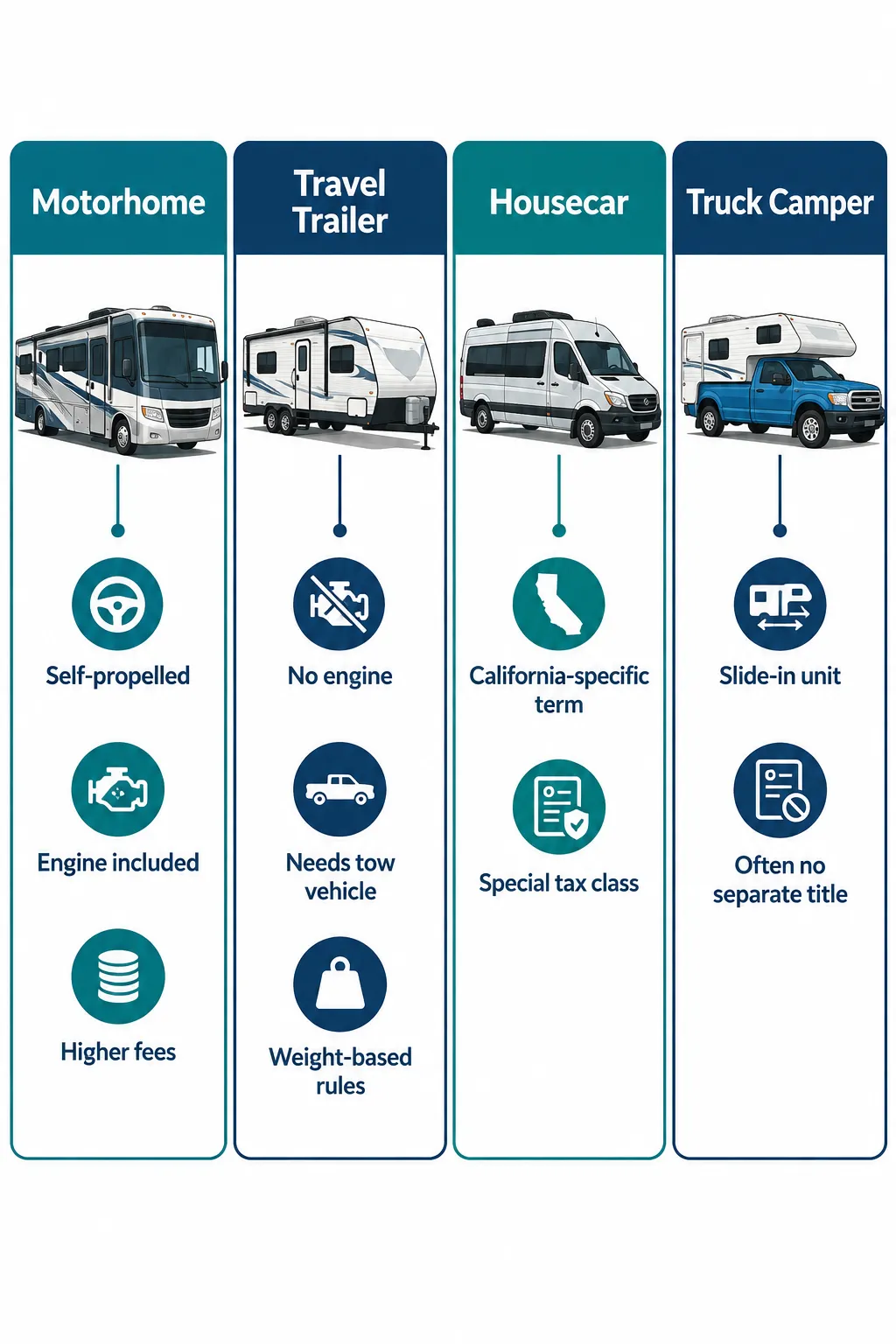
Why does this matter for your wallet? Because two RVs that look almost identical on the outside can be charged completely different fees simply because one is registered as a “motorhome” and the other as a “housecar” or “special mobile equipment.” Clerks process what is on the paperwork in front of them. If a dealer or previous owner classified your rig wrong, you could be stuck paying incorrect fees for years without realizing it [1].
Quick Classification Cheat Sheet
| RV Type | Has Its Own Engine? | Needs a Tow Vehicle? | Typical Registration Path |
|---|---|---|---|
| Motorhome / Housecar | Yes | No | Registered like a powered vehicle [1] |
| Travel Trailer | No | Yes | Titled and plated based on weight [2] |
| Truck Camper | No (slide-in) | Mounted, not towed | Often folded into truck’s registration |
| Commercial Motor Home | Yes | No | Extra permits if used for business [3] |
💡 Pull Quote: “The label on your paperwork can matter more than the size of your rig.” 🏷️
The fix is simple: before you ever sign a registration form, ask the clerk to confirm exactly which classification your RV falls under. Do not assume it is correct just because a dealer filled it in that way.
3 Things the DMV Won’t Tell You About Registering Your RV, Secret #2: How You Use It Matters More Than the RV Itself
This is the part almost nobody explains clearly, and it is one of the biggest 3 Things the DMV Won’t Tell You About Registering Your RV overall. The DMV does not just care about the vehicle. It cares about how you use it. A motorhome used strictly for weekend camping trips is treated very differently from the same motorhome used to shuttle paying passengers or haul freight for a business.
Once an RV crosses into commercial or “for-hire” territory, it can quietly slide into a much stricter regulatory lane. In some regions, a motorhome used commercially needs special permits, inspections, and even different plates than a personal-use rig [3]. Renting out your RV, using it as a mobile business, or letting it double as a work vehicle can all push it into this category.
Weight and Use Cutoffs Nobody Mentions
Trailers are where this gets extra tricky. Many states set a specific weight cutoff that decides whether a travel trailer even needs a title and plates in the first place. Below that weight, some states let small utility-style trailers skip full registration. Above it, you need a title, a plate, and sometimes a weigh station check [7].
Here is the twist: even a lightweight trailer can lose its exemption if you use it for hire, rent it to other people, or take it out of state regularly. Crossing state lines with an RV that was only lightly registered at home can create real headaches, because other states may not honor the same weight exemption [7][9].
Things that can quietly tighten your requirements:
- Renting your RV out through a peer-to-peer platform 💰
- Using your RV to haul goods for a side business
- Living in your RV full-time in some jurisdictions
- Crossing state lines frequently for extended trips
- Letting someone else operate it commercially
The Deadline Trap
Another quiet rule: most states do not give you long to register a newly purchased RV. Some states require registration within just a matter of days or weeks after purchase, and towing an unregistered trailer on public roads can be illegal almost immediately, even if you just bought it that morning [9]. Many new owners assume they have a generous grace period like they might with a car loan closing. That assumption can turn into a costly ticket on the very first drive home.
Simple rule of thumb: if you would not drive a car home without plates, do not tow a trailer home without them either.
Secret #3: New Rules the DMV Won’t Tell You About Registering Your RV Until You’re Denied
The third secret is the one changing the fastest, and it is arguably the most important part of understanding 3 Things the DMV Won’t Tell You About Registering Your RV in 2026 and beyond. States are actively tightening identification and emissions requirements, and RV owners are often the last to hear about it.
Texas Is Rolling Out New ID Requirements
Starting in March 2026, and expanding further by January 2027, Texas is putting new identification requirements into place that will affect vehicle registration and renewals statewide, including RVs. This means Texas RV owners should expect to bring more thorough identity documents to renewal appointments than they may have needed in past years. Waiting until the last minute to renew could mean a wasted trip if the correct ID is not in hand.
California’s Clean Truck Check Now Touches RVs
California has also expanded its Clean Truck Check program to cover diesel-powered RVs and heavier pickups used to tow them. This program tracks emissions compliance, and if a diesel RV falls out of compliance, the state can place a hold directly on the DMV registration, blocking renewal until the issue is fixed. Many owners of older diesel motorhomes have no idea this rule now applies to them until their registration renewal gets rejected.
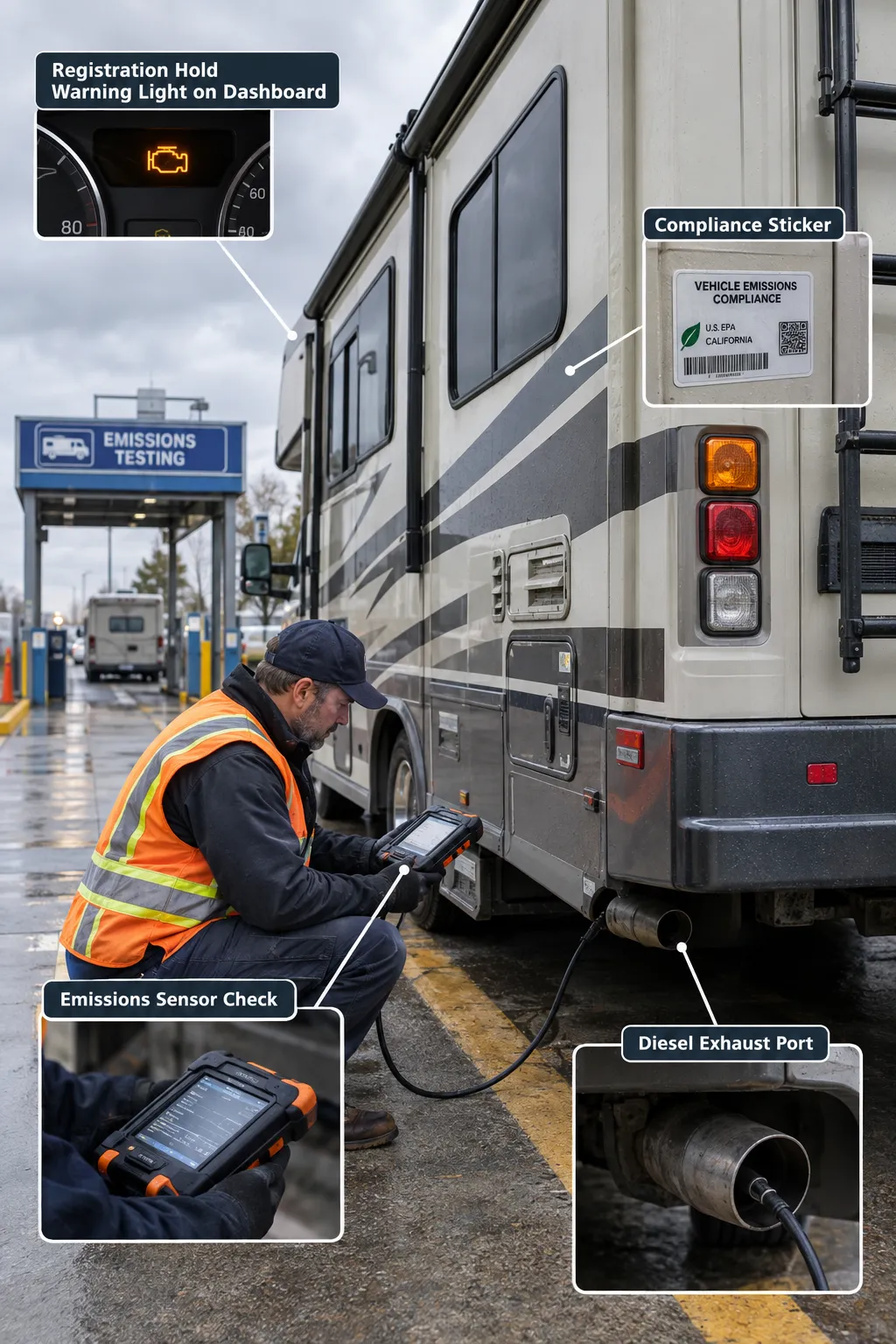
This is a good moment to slow down and check your own paperwork. If a diesel RV or heavy diesel tow vehicle has not been tested recently, it is worth checking compliance status before renewal season arrives, not after a registration gets stuck in limbo.
The License Requirement Clerks Rarely Bring Up
Most RVs can legally be driven with a standard driver’s license. That part is true and it is why many buyers assume licensing is a non-issue. But once a rig crosses roughly 26,000 pounds in gross vehicle weight, some states require a special license class, and DMV clerks do not always volunteer that information unless directly asked [4]. Owners of very large Class A motorhomes, especially ones towing a car behind them, should double-check total combined weight before assuming a regular license covers everything.
Registering Out of State: Montana, California, and the Document Pile
Some RV owners look at registering in a different state, such as Montana, hoping for simpler paperwork or different fee structures. What often surprises people is just how much documentation this actually requires, proof of ownership, proof of insurance, sometimes a formal business entity setup, and specific residency or LLC documents depending on the state’s rules [5][8]. Registering in California carries its own document checklist too, often including smog or emissions paperwork depending on the RV’s fuel type and weight class [1][8].
Documents commonly needed for RV registration:
- Proof of ownership (bill of sale or manufacturer’s certificate)
- Valid photo identification
- Proof of insurance
- Weight or classification documentation
- Emissions or smog certification, if applicable
- Odometer disclosure, for certain vehicle types
Skipping even one item on this list is one of the most common reasons DMV visits turn into a second trip.
What This Means Going Forward
The pattern is clear: California and Texas are tightening the rules first, and other states are likely to follow with their own version of stricter ID checks or emissions tracking for larger vehicles. RV owners who stay a step ahead by checking classification, use rules, and new state requirements every year will avoid the surprise denials that are becoming more common.
Quick Reference Table for 3 Things the DMV Won’t Tell You About Registering Your RV
| Hidden Issue | Why It Sneaks Up on Owners | Simple Fix |
|---|---|---|
| Wrong classification | Dealer paperwork may mislabel your RV type [1][6] | Ask the clerk to confirm the category before signing |
| Commercial use creep | Renting or hauling for pay changes your regulatory class [3] | Check local rules before renting your RV out |
| Weight cutoffs | Some trailers skip plates until weight or use changes [7] | Weigh your trailer and confirm your state’s cutoff |
| Short deadlines | Some states require registration within days of purchase [9] | Register before the first long tow home |
| New ID and emissions rules | Texas ID rules and California Clean Truck Check are expanding | Renew early and check compliance status ahead of time |
Step-by-Step: How to Register Your RV Without Getting Blindsided
Following a clear checklist takes the mystery out of the process. Here is a simple order of operations for anyone about to register an RV.
- Confirm the classification first. Ask directly: is this a motorhome, housecar, travel trailer, or truck camper? [1][6]
- Check the weight. Some trailers need titles and plates only above a certain weight, and crossing state lines can change that rule [7].
- Decide how the RV will actually be used. Personal camping trips are treated differently than commercial or rental use [3].
- Gather every document in advance. Bring ownership proof, ID, insurance, and emissions paperwork if it applies [5][8].
- Check the deadline clock. Some states expect registration within days of purchase, not months [9].
- Verify license requirements for big rigs. If the RV plus tow vehicle tops 26,000 pounds, ask about special license classes [4].
- Check emissions or ID compliance for 2026-2027 rules. This matters most for diesel RVs in California and any RV owner renewing in Texas.
- Keep a copy of everything. A folder with every document makes future renewals dramatically faster.
Following this order helps avoid the single biggest mistake RV owners make: assuming registration works exactly like registering a car.
Frequently Asked Questions
Does every RV need a title and license plate?
Not always. Many states only require a full title and plate once a trailer crosses a certain weight limit. Lighter utility-style trailers may be exempt in some states, though that can change if the trailer is used commercially or taken across state lines [7].
Can a regular driver’s license operate any RV?
In most cases, yes. But rigs over roughly 26,000 pounds combined weight can require a special license class in some states, a detail that is not always explained clearly at the counter [4].
Is registering an RV in Montana or another state actually simpler?
It can offer different fee structures, but it usually comes with its own detailed document list, including ownership proof, insurance, and sometimes formal entity paperwork [5].
Will California’s Clean Truck Check affect gas-powered RVs too?
The program is focused on diesel-powered RVs and heavy diesel tow vehicles. Gasoline RVs are generally outside this specific requirement, but owners should always confirm current rules for their exact vehicle.
What happens if an RV is used for both personal trips and paid rentals?
Mixed use can push a vehicle toward commercial classification rules, which often means different permits, inspections, or plates depending on the state [3].
Conclusion
Registering an RV is rarely as simple as the paperwork makes it look. The real story lives in the details: what your RV is officially classified as, how you actually use it, and which new state rules are quietly rolling out in 2026 and 2027. Understanding these 3 Things the DMV Won’t Tell You About Registering Your RV puts owners in control instead of leaving them surprised at the counter.
The best next step is simple. Before the next registration or renewal, confirm the RV’s classification, check its weight and use category, and look up any new ID or emissions rules in the home state. A short phone call to the local DMV, or a careful read of the state’s RV registration page, can prevent a wasted trip and unexpected fees. A little homework now means many more stress-free miles on the road later. 🚐✨
References
[1] Recreational Vehicles – https://www.dmv.ca.gov/portal/handbook/vehicle-industry-registration-procedures-manual-2/new-vehicles-sold-by-california-dealers/recreational-vehicles/
[2] Camper Trailer Rv – https://dmv.sc.gov/vehicle-owners/types-of-vehicles/camper-trailer-rv
[3] Commercial Motor Home – https://saaq.gouv.qc.ca/en/vehicle-registration/registering-vehicle/commercial-or-special-use-vehicle/commercial-motor-home
[4] Other Types Of Vehicles – https://www.dmv.org/other-types-of-vehicles.php
[5] What Is Needed To Register An Rv – https://1dollarmontana.com/what-is-needed-to-register-an-rv/
[6] Mobile Home – https://wisconsindot.gov/Pages/dmv/vehicles/title-plates/mobile-home.aspx
[7] Do Trailers Need License Plates A State By State Guide 2025 – https://www.aatrailer.com/do-trailers-need-license-plates-a-state-by-state-guide-2025/
[8] How To Register And Insure Camper Rv California – https://mtregistrationservices.com/blog/how-to-register-and-insure-camper-rv-california
[9] Registering Travel Trailers – https://dol.wa.gov/vehicles-and-boats/vehicles/vehicle-registration/register-other-vehicles-and-other-services/registering-travel-trailers
[10] What Law Says – https://saaq.gouv.qc.ca/en/road-safety/modes-transportation/motor-home/what-law-says