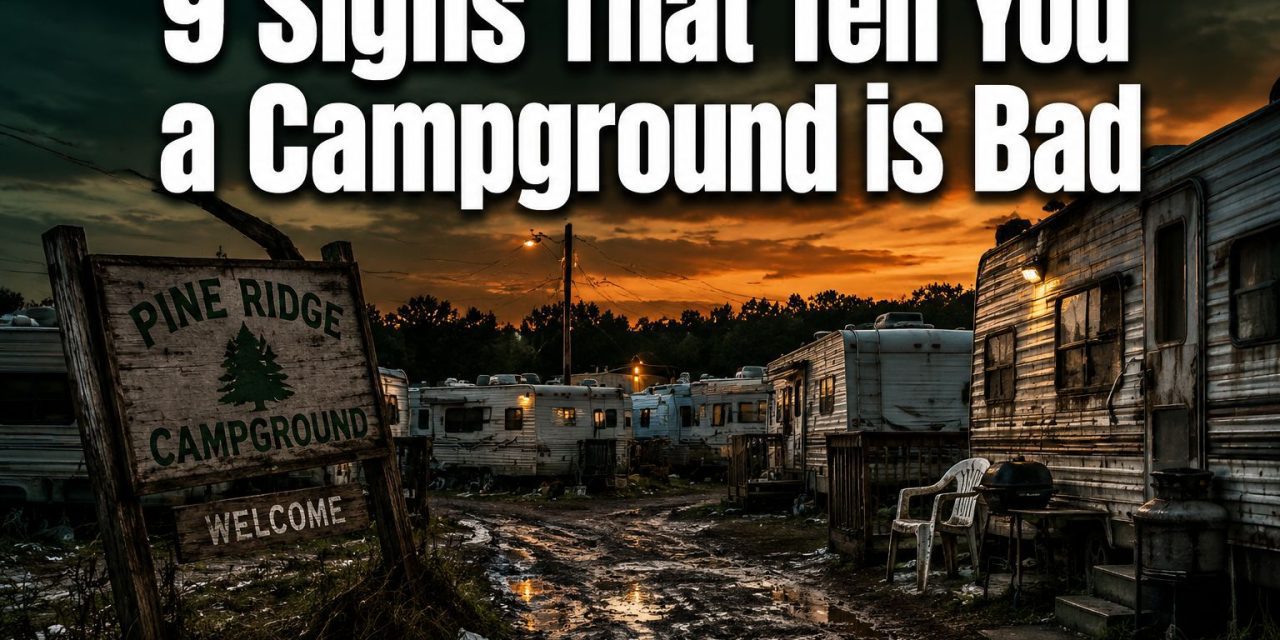
Nearly 40% of campers say they have shown up to a campground that looked nothing like the photos online [1]. For RV lovers, a bad campground is not just disappointing — it can ruin an entire trip. Knowing the 9 signs that tell you a campground is bad before you pull your rig into a tight, noisy, poorly lit site can save you a lot of stress, money, and frustration. This guide breaks down every red flag you need to watch for, whether you are researching online or pulling through the entrance gate for the first time.
Key Takeaways 🏕️
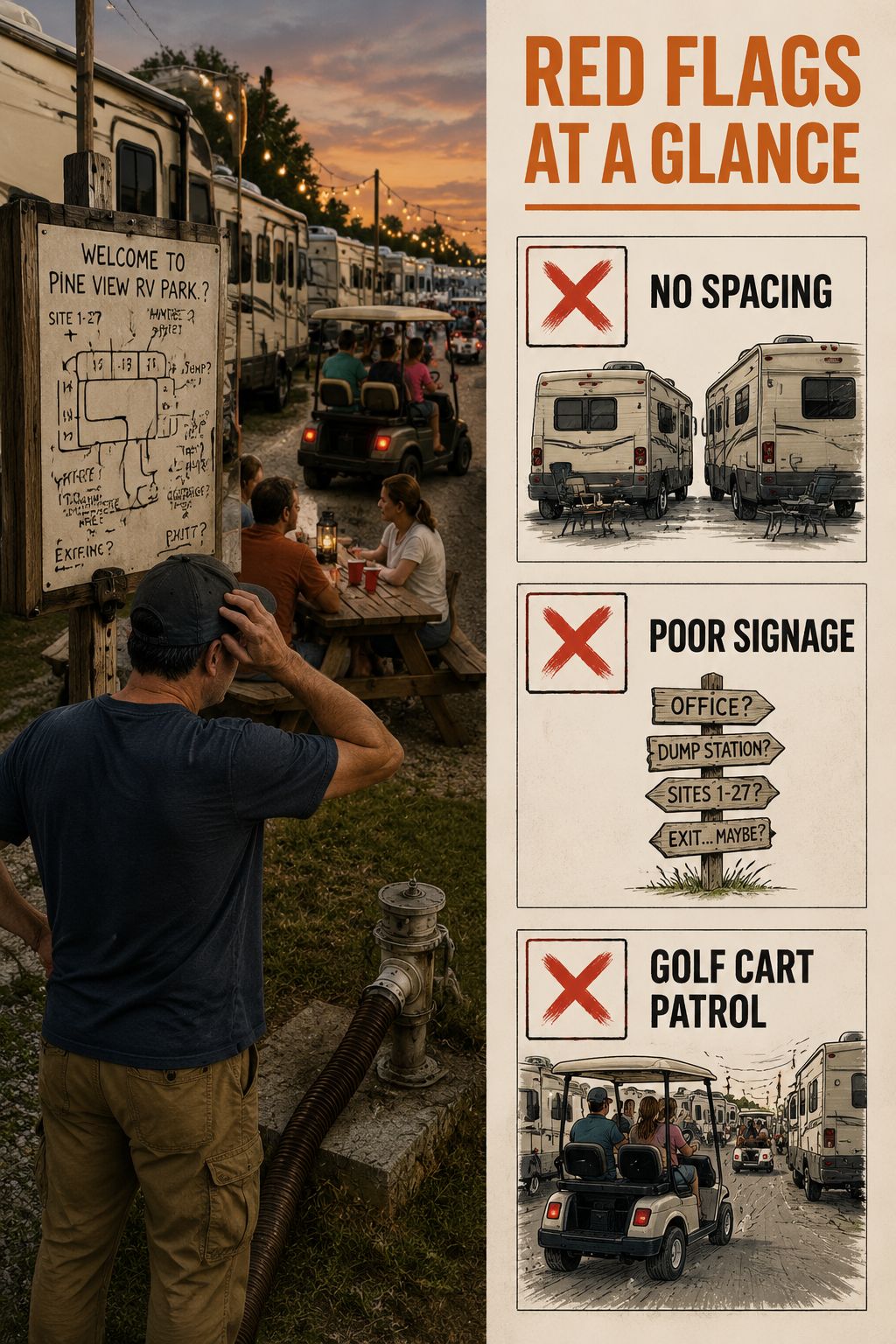
- Bad signage is one of the fastest red flags to spot — both online and at the gate.
- Overcrowded sites with no privacy are a major quality warning.
- Golf cart patrols and a “spectator culture” signal poor campground management.
- Nighttime conditions — bright floodlights and loud generators — reveal design failures.
- Always check user-submitted Google photos instead of relying on official campground websites.
Why Spotting a Bad Campground Matters for RV Lovers
RVing is all about freedom. You want to park somewhere beautiful, breathe fresh air, and actually relax. But not every campground delivers on that promise. Some are overcrowded. Some are noisy. Some look great in photos but feel like a parking lot when you arrive.
The good news? Most bad campgrounds show their warning signs early — if you know what to look for. The 9 signs that tell you a campground is bad are not hard to spot once you know them. Some show up during your online research. Others hit you the moment you turn into the entrance.
💡 Pull Quote: “A bad campground does not hide. It just hopes you are not paying attention.”
Let’s walk through every red flag, one by one.
The 9 Signs That Tell You a Campground is Bad
Sign #1: Confusing or Useless Maps and Signage 🗺️
Good campgrounds guide you clearly from the entrance to your site. Bad ones leave you guessing.
Watch for signs that say things like:
- “Turn left where the old playground used to be”
- “Site 14 is near the big oak tree” (which big oak tree?)
- Hand-drawn maps that look like they were made in a hurry
These kinds of directions rely on landmarks that may no longer exist or that only longtime staff would recognize [1]. For a first-time visitor pulling a 35-foot fifth wheel, that is a recipe for disaster.
What good signage looks like:
| Good Signage ✅ | Bad Signage ❌ |
|---|---|
| Numbered site markers on posts | “Turn where the barn used to be” |
| Clear directional arrows | Faded, unreadable signs |
| Map at the entrance with legend | No map at all |
| Permanent, weather-proof markers | Hand-written cardboard signs |
Beyond navigation, safety signage matters too. Every quality campground should have clear “No Swimming,” “No Climbing,” “Campfire Area,” and emergency rule signs posted where guests can easily see them [2]. If those are missing, that is a serious red flag about how much the management cares about your safety.
Pro tip: Before you book, ask the campground to email you their site map. If they do not have a digital version, that tells you something right away.
Sign #2: Sites That Are Way Too Cramped 🚐
Space matters. A lot.
One of the clearest signs of a bad campground is when your picnic table is practically touching your neighbor’s sewer connection [1]. No privacy. No breathing room. Just a parking lot with trees painted on the brochure.
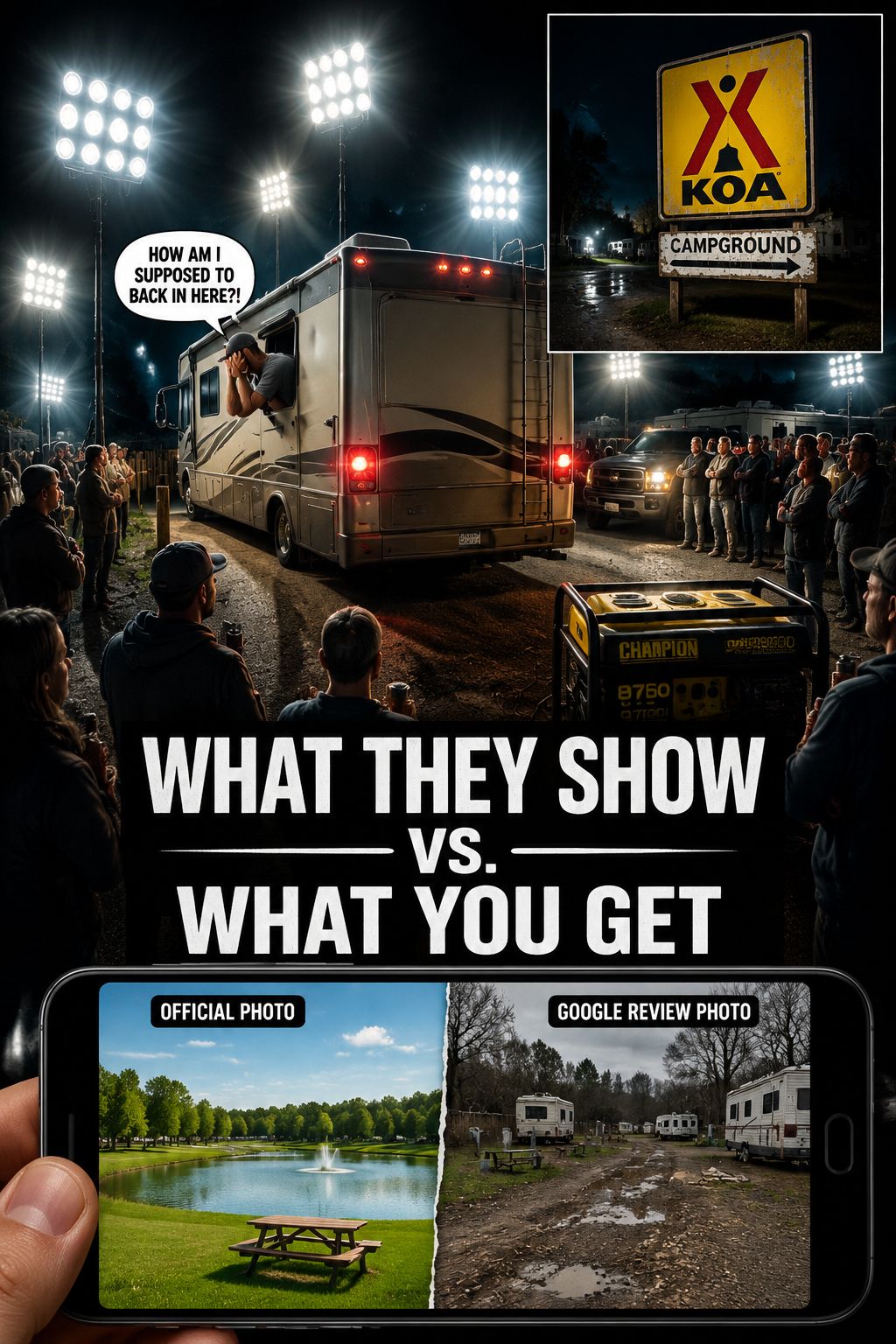
This problem is especially sneaky because official campground photos almost never show how tight the sites really are. Marketing photos are taken with wide-angle lenses and carefully chosen angles that make tiny sites look spacious.
Here is what to look for:
- 🔴 Sites where slideouts would touch or nearly touch the neighboring RV
- 🔴 No grass or natural buffer between sites
- 🔴 Picnic tables that are shared between two sites
- 🔴 Photos on the website that show only one RV with wide open space around it
The fix: Always check user-submitted photos on Google Maps for the campground. Real campers take real photos. You will see the actual spacing, the real condition of the sites, and what it actually looks like when it is full [3]. The difference between the official website photo and a Google review photo can be shocking.
💡 Pull Quote: “If the picnic table is ‘socially involved’ with your neighbor’s sewer connection, you are too close.” — [1]
Sign #3: Golf Cart Patrols That Never Stop 🛺
Here is one that sneaks up on you after you arrive.
Some campgrounds have staff or management who drive golf carts through the grounds constantly. And by constantly, that means slow, repetitive loops — the same cart, the same route, over and over again.
A little golf cart activity is normal. Staff need to check on things. But when the same cart passes your site four times in one hour, that is not management. That is surveillance [1].
This kind of environment signals a few things:
- Management does not trust its guests to follow the rules on their own.
- The campground may have had problems with rule-breaking in the past.
- The overall atmosphere will feel more like a monitored parking lot than a relaxing retreat.
The result? You end up knowing more about the golf cart driver’s daily schedule than you know about your actual neighbors [1]. That is not the camping experience most RV lovers are looking for.
Ask yourself: Is the cart checking on things, or is it circling? There is a big difference.
Sign #4: The “Unofficial Audience” During Your Back-In 👀
Every RV driver knows the stress of backing into a tight site. It takes focus. It takes patience. It sometimes takes a few tries.
At a good campground, neighbors might offer a friendly hand signal or a kind word. At a bad campground, something different happens.
The moment you start your back-in, an audience appears. People pull up lawn chairs. They watch. They whisper. They do not offer help. They just… observe and judge [1].
This “spectator culture” is a real sign of a low-quality campground community. It means:
- The campground does not foster a helpful, welcoming atmosphere
- Guests feel more competitive than neighborly
- You are going to feel self-conscious every time you do anything outside your rig
A great campground community is one where a stranger walks over and says, “Hey, want me to spot you?” — not one where they grab popcorn.
Sign #5: Stadium Lighting and Generator Chaos at Night 💡🔊
Daytime visits can fool you. Nighttime tells the truth.
Two of the biggest nighttime red flags at a bad campground are:
1. Floodlights that blast on all at once Some campgrounds install security or facility lights that are way too bright for a relaxing outdoor environment. When these lights all switch on at dusk at full intensity, it feels less like a campground and more like a sports arena [1]. Your “stargazing” trip becomes a washout.
2. Generators running without coordination Generator noise is a fact of RV life. But well-managed campgrounds have quiet hours and generator policies that are actually enforced. At bad campgrounds, generators run at all hours with no coordination and no enforcement [1]. You will hear them all night long.
What to check before you book:
- Does the campground list specific quiet hours on their website?
- Are there generator-free zones or designated generator hours?
- What do recent reviews say about nighttime noise?
🌙 Quick Tip: Search the campground name + “noisy” or “lights” on Google Reviews. If multiple people mention it, believe them.
Sign #6: Missing or Inadequate Safety Signs ⚠️
This one is easy to overlook, but it is important.
A well-run campground takes safety seriously. That means posting clear, visible signs that tell guests what they can and cannot do — especially around water, fire, and children’s areas.
Signs every good campground should have [2]:
- 🚫 No Swimming (at non-designated water areas)
- 🚫 No Climbing (on structures, rocks, or equipment)
- 🔥 Designated Campfire Area markers
- 🏊 Pool rules and depth markers
- 🚨 Emergency contact information posted visibly
When these signs are missing, it is not just an inconvenience. It is a sign that management is not paying attention to guest safety [2]. And if they are not paying attention to safety signs, what else are they ignoring?
This is especially important for families with kids. A campground without proper safety signage is one where accidents are more likely to happen — and where the staff may not be prepared to respond.
Bonus red flag: If the campground’s rules are only communicated verbally at check-in and not posted anywhere, that is a problem too [3].
Sign #7: Facilities That Look Like They Are Falling Apart 🏚️
Walk into the bathhouse. Look at the laundry room. Check the dump station.
The condition of these shared facilities tells you everything about how a campground is managed [3]. If the bathrooms have broken fixtures, mold on the walls, or doors that do not lock properly, that is not just unpleasant — it is a sign that maintenance is not a priority.
Visual red flags to look for:
| Area | Warning Signs |
|---|---|
| Bathrooms | Broken locks, mold, no soap or paper towels |
| Laundry | Machines out of order, dirty floors, no change machine |
| Dump station | Broken hoses, no water rinse, strong odor with no cleanup |
| Common areas | Broken furniture, overflowing trash cans, dead landscaping |
| Pool (if listed) | Cloudy water, broken gates, no safety equipment |
A campground that lets its facilities fall apart is one that is either underfunded, understaffed, or simply does not care about the guest experience [3]. None of those options are good for you.
💡 Pull Quote: “The bathhouse is the campground’s report card. Read it carefully.”
What to do: If you can, visit the campground’s Google listing and look at user photos of the facilities specifically. Real guests love to photograph bad bathrooms.
Sign #8: Rules That Do Not Make Sense (Or Are Not Enforced) 📋
Rules at a campground exist for a reason. They keep things safe, fair, and enjoyable for everyone. But there is a sweet spot — and bad campgrounds usually miss it in one of two ways.
Too few rules: When a campground has almost no rules, guests fill the gap with their own behavior. That often means late-night noise, unleashed dogs, fires that get too big, and general chaos [3]. A campground with no rules is a campground that has given up.
Too many rules: On the other end, some campgrounds have rules that feel controlling, petty, or just plain weird. Rules about what color your outdoor mat can be. Rules about when you can sit outside. Rules that seem designed to make guests feel unwelcome [3].
Inconsistently enforced rules: This might be the worst version. Rules exist on paper, but staff only enforce them when they feel like it — or only for certain guests. This creates resentment and a feeling of unfairness that poisons the whole community atmosphere.
The “vibe check” test: Read the campground’s rule sheet before you book. Ask yourself:
- Do these rules make sense for safety and community?
- Do they feel respectful or controlling?
- Are there reviews that mention rules being ignored?
If the rules do not pass the vibe check, trust your gut [3].
Sign #9: Former Franchise Campgrounds Clinging to Old Branding 🟡
This one is specific but important — especially for RV travelers who rely on brand recognition to judge quality.
You have probably seen it: a campground that looks like a KOA — yellow signs, KOA-style cabin layouts, the familiar color scheme — but is not actually a KOA anymore [3]. It left the franchise system at some point, but it kept the visual identity.
Why does this matter?
Franchise campgrounds like KOA operate under specific quality standards. When a campground exits the franchise, it no longer has to meet those standards. Sometimes the quality drops significantly after the separation. But because the old branding is still visible, guests assume they are getting the same experience they would at a real KOA.
What to watch for:
- Yellow signs that say something like “Kampground” instead of “KOA”
- KOA-style cabins and layout but no KOA logo on the website
- A campground that shows up in old KOA directories but not on the current KOA website
- Reviews that say “this used to be a KOA and it has really gone downhill”
Quick check: Go to koa.com and search for the campground by location. If it does not appear, but the campground looks like a KOA, that is your answer [3].
How to Research a Campground Before You Book
Now that you know all 9 signs that tell you a campground is bad, here is a simple research checklist to use before every booking.
Your Pre-Booking Research Checklist ✅
Online Research (Do This First):
- Search the campground name on Google Maps and click “Photos” — then filter for user-submitted photos only [3]
- Read the most recent reviews (last 3-6 months) — not just the star rating
- Look for the words “noisy,” “crowded,” “dirty,” “lights,” or “rude” in reviews [5]
- Check if the campground is listed on koa.com if it looks like a former KOA [3]
- Ask the campground to send you their site map and rules sheet before booking
- Look at the campground’s website photos vs. Google user photos — compare honestly
Red Flag Words in Reviews to Watch For [5]:
| Review Language | What It Really Means |
|---|---|
| “Cozy sites” | Extremely tight spacing |
| “Lively atmosphere” | Expect noise all night |
| “Rustic facilities” | Bathrooms need work |
| “Great for socializing” | Very little privacy |
| “Management is strict” | Lots of rules, possibly inconsistent enforcement |
When You Arrive (Check These Immediately):
- Is the entrance signage clear and professional?
- Does the map they gave you match reality?
- Do the facilities look maintained?
- Are safety signs posted in common areas?
- Does the spacing on your site match what you expected?
What Makes a Great Campground? (The Flip Side)
It helps to know what good looks like so you can spot the difference.
A quality campground will typically have:
✅ Clear, permanent signage that guides you from entrance to site without confusion [2] ✅ Generous site spacing with natural buffers between neighbors ✅ Friendly, helpful staff who check in without hovering ✅ Enforced quiet hours and generator policies that are actually followed ✅ Clean, well-maintained facilities that get regular attention ✅ Safety signs posted clearly in all relevant areas [2] ✅ Consistent rules that are fair and clearly communicated ✅ User photos on Google that match the official website photos
💡 Pull Quote: “A great campground feels like it was designed for the camper — not for the campground owner’s convenience.”
The Dyrts 2026 Camping Report found that campground quality and amenities are now the top factors RV campers consider when choosing where to stay — above price and location [6]. That means the market is paying attention. Good campgrounds are investing in quality. Bad ones are getting left behind.
Real Talk: What RV Travelers Are Saying in 2026
The RV community is more connected than ever. Forums, YouTube channels, and review platforms have made it easier to share experiences — good and bad [6].
Here is what experienced RV travelers consistently say about spotting bad campgrounds:
“Trust the photos more than the stars.” A campground can have a 4-star average but still have terrible sites. Look at the photos. Real photos from real guests do not lie [3].
“Call ahead and ask specific questions.” Ask: “How far apart are the sites?” Ask: “Do you have quiet hours and are they enforced?” Ask: “What is the condition of the bathrooms?” A good campground will answer confidently. A bad one will be vague [1].
“If something feels off when you pull in, it probably is.” Your gut is a good detector. Faded signs, a chaotic entrance, staff who seem disorganized — these things add up [1].
“Check the reviews from the last 30 days, not the last 3 years.” Campgrounds change. Management changes. A place that was great in 2022 might be terrible now. Always read the freshest reviews [5].
A Note on Campground Snobbery vs. Smart Standards
There is a difference between being a campground snob and having reasonable standards [4].
Being a campground snob means refusing to stay anywhere without a full-service spa, a resort pool, and a gourmet camp store. That is a personal preference — and there is nothing wrong with it if that is what you enjoy.
Having smart standards means knowing the basic quality markers that separate a well-run campground from a poorly managed one — and using those markers to protect your trip investment.
The 9 signs that tell you a campground is bad are not about being picky. They are about being informed. You work hard for your vacation time. You deserve to spend it somewhere that actually delivers on its promises [4].
💡 Pull Quote: “Knowing your standards is not snobbery. It is self-respect.”
Conclusion: Use These 9 Signs Every Time You Book
Bad campgrounds are not always obvious from the road. But they almost always leave clues — in their signage, their spacing, their online photos, their rules, and their nighttime atmosphere.
Here is a quick recap of the 9 signs that tell you a campground is bad:
- 🗺️ Confusing or outdated maps and signage
- 🚐 Sites that are too cramped with no privacy
- 🛺 Constant golf cart surveillance loops
- 👀 Spectator culture during your back-in
- 💡 Stadium floodlights and generator chaos at night
- ⚠️ Missing safety signs in common areas
- 🏚️ Dilapidated or poorly maintained facilities
- 📋 Rules that are too few, too many, or inconsistently enforced
- 🟡 Former franchise campgrounds clinging to old branding
Your Action Steps 🎯
- Before every booking: Run through the pre-booking checklist above. Spend 10 minutes on Google Maps looking at user photos.
- Read recent reviews: Focus on the last 30-60 days. Look for specific language about noise, spacing, and facilities.
- Call the campground: Ask direct questions. Good campgrounds give direct answers.
- Trust your arrival instincts: If the entrance feels off, do a slow drive-through before unhooking anything.
- Share your experience: Leave honest reviews after your stay. Help the next RV traveler make a smarter choice.
The RV community is strong because people share what they know. Use these 9 signs, share them with your fellow travelers, and never waste a weekend at a bad campground again. 🏕️
References
[1] Watch – https://www.youtube.com/watch?v=42lZiLs9yoU
[2] 5 Signs Every Campground Needs Asap – https://www.dornbossign.com/sign-blog/5-signs-every-campground-needs-asap/
[3] Watch – https://www.youtube.com/watch?v=cVMnHTLeqaE
[4] Campground Snob – https://www.mortonsonthemove.com/campground-snob/
[5] Spot Hidden Warnings Online Campground Reviews 1222 – https://www.rvtravel.com/spot-hidden-warnings-online-campground-reviews-1222/
[6] The Dyrts 2026 Camping Report Uncovers Camping Trends – https://rvbusiness.com/the-dyrts-2026-camping-report-uncovers-camping-trends/
[7] Understanding Key Symbols And Meanings Of Campground Signs For Rv Users – https://www.ronhooverrvs.com/blog/understanding-key-symbols-and-meanings-of-campground-signs-for-rv-users/