
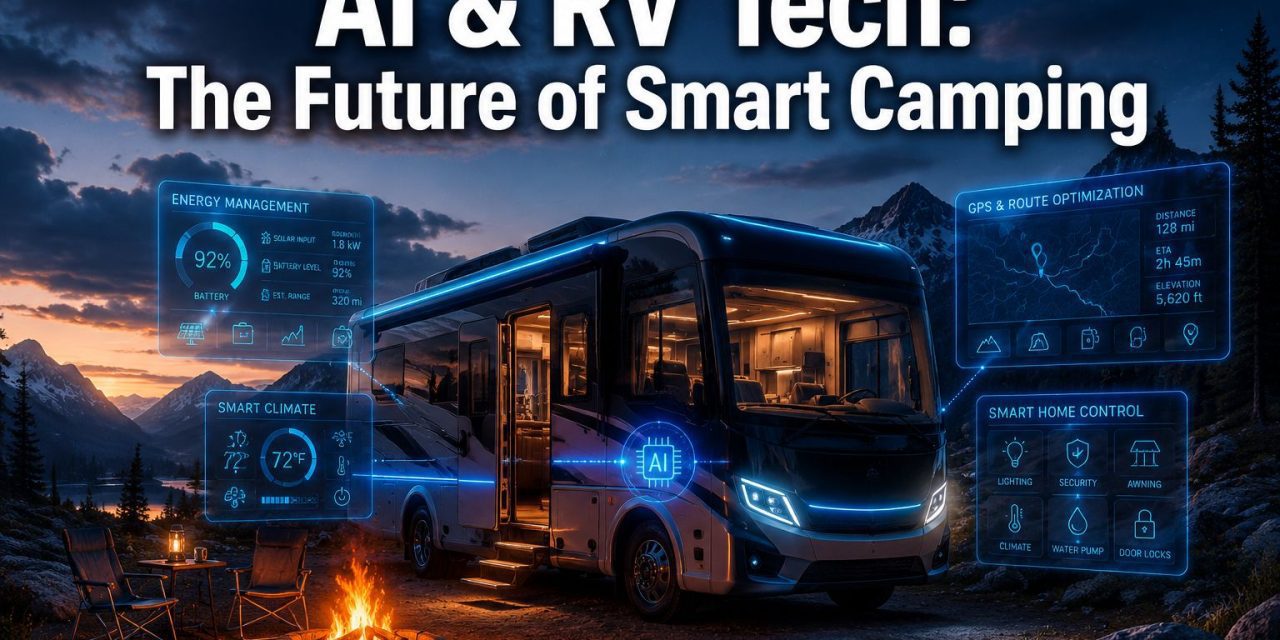
By 2026, more than 11 million American households own a recreational vehicle — and the rigs rolling off factory floors today look nothing like the ones from just five years ago. Artificial intelligence, electric powertrains, and app-controlled smart systems have turned the humble rec vehicle into something closer to a rolling tech lab. Whether someone is a weekend warrior or a full-time nomad, the camping experience is changing fast. This article breaks down exactly what is happening, what it means for RV lovers, and how to get ready for the smartest era of outdoor living ever seen.
Key Takeaways 📌
- AI-powered systems now manage energy, water, climate, and safety inside modern rec vehicles automatically.
- Electric RVs like Lightship’s AE.1 are already in production and expanding fast to meet demand.
- Shape-shifting trailers like AC Future’s AI-THt can expand from 150 sq ft to over 350 sq ft at the touch of a button.
- Starlink connectivity and mobile apps let campers control everything — from anywhere — even off-grid.
- Vehicle-to-Load (V2L) and Vehicle-to-Home (V2H) tech turns the modern RV into a portable power station for life on and off the road.
What Does a “Smart” Rec Vehicle Actually Mean?
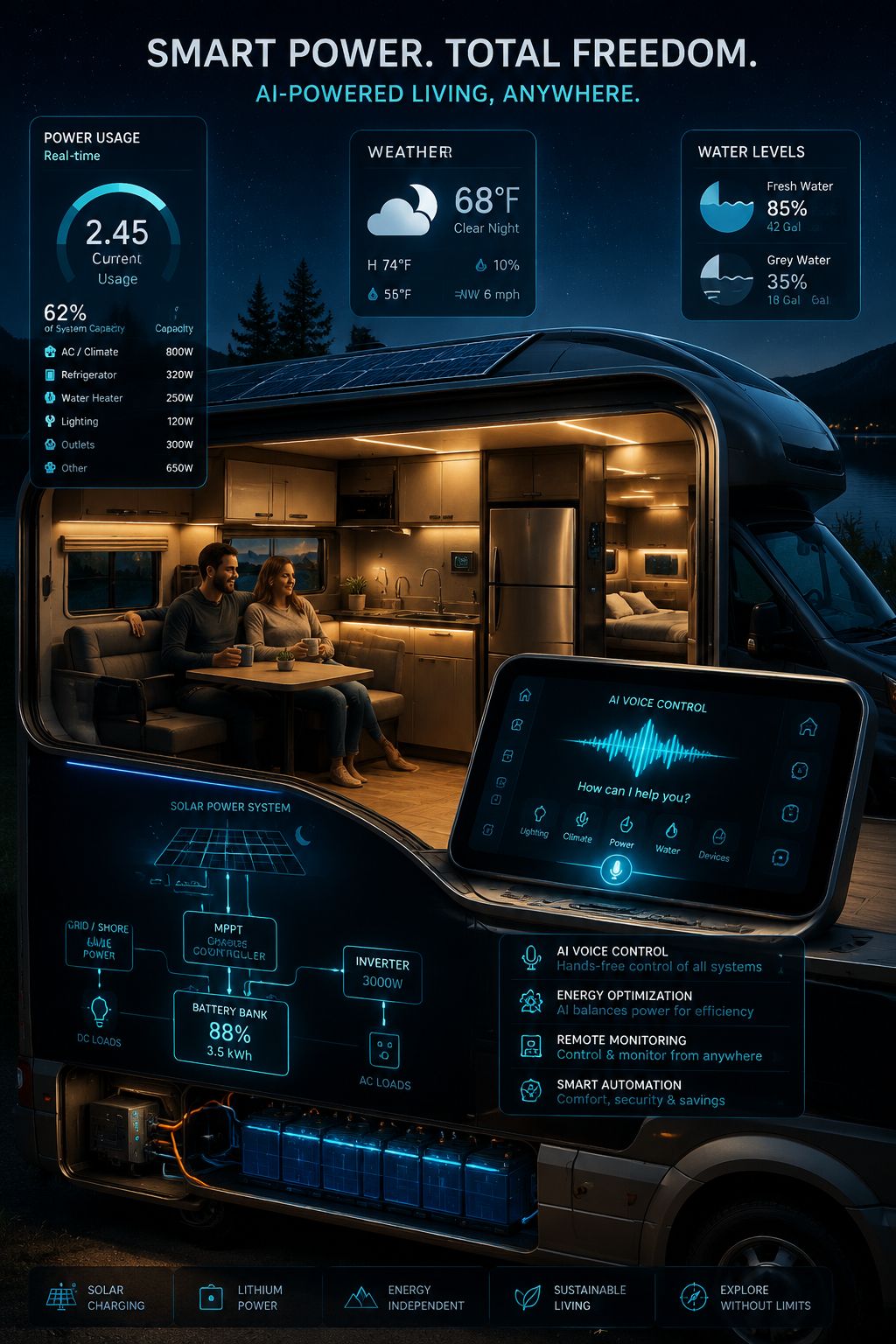
The word “smart” gets thrown around a lot. But when it comes to today’s rec vehicle, it means something very specific. A smart RV uses artificial intelligence to make decisions on its own — or with very little help from the driver or camper.
Think of it like a very helpful co-pilot. This co-pilot watches how much power the solar panels are making. It checks how much battery is left. It adjusts the temperature inside the coach. It warns about blind spots on the road. It even lets someone fix a problem remotely without being physically inside the vehicle. [1]
The Three Pillars of Smart RV Tech
| Pillar | What It Does | Example |
|---|---|---|
| 🔋 Energy AI | Manages solar, battery, and power use | Auto-directs solar power to battery packs |
| 🏠 Living AI | Controls climate, lighting, water | Voice-activated lights and AC |
| 🛣️ Driving AI | Assists navigation and safety | 360° cameras, blind spot radar |
These three pillars work together. The result is a camping trip that feels less like roughing it and more like staying in a very comfortable, very mobile smart home.
AI-Powered Energy Management: No More Power Worries 🔋
One of the biggest headaches for any rec vehicle owner is power. Running out of battery in the middle of nowhere is no fun. That is exactly why energy management AI is one of the most exciting upgrades in modern RVs.
How It Works
Today’s smart motorhomes use AI systems that automatically direct power from rooftop solar panels to battery packs. The system watches real-time usage patterns — like when the air conditioner kicks on or when someone starts cooking — and adjusts the flow of electricity to match. This stops energy waste. It also prevents system overloads that can damage expensive equipment. [1]
💡 Pull Quote: “The AI does not just store energy — it thinks about how to use it most efficiently, so campers never have to.”
The Numbers Behind the Power
AC Future’s AI-THt trailer is a great example of what is possible right now. This rec vehicle comes with:
- Up to 100 kWh of battery capacity — enough to run a small home for several days
- Up to 25 kW of rooftop solar power capture
- The trailer itself can act as a backup battery for household loads [2]
For comparison, a typical home uses about 30 kWh of electricity per day. That means this trailer can theoretically run a house for three days on battery alone — without any solar input at all.
Vehicle-to-Load and Vehicle-to-Home Technology
Lightship’s AE.1 electric rec vehicle takes energy sharing even further. It comes standard with Vehicle-to-Load (V2L) technology. This means the RV can share its stored energy to:
- ⚡ Charge another electric vehicle parked nearby
- 💻 Power devices like laptops, power tools, or medical equipment while parked
- 🏡 Eventually power a home through Vehicle-to-Home (V2H) capability, which is coming through a future software update [4]
This turns the modern rec vehicle into much more than a camper. It becomes a portable power station that can support life both on the road and back at home.
Voice Control and Smart Living Inside the Rec Vehicle 🏠
Stepping inside a 2026 smart motorhome feels different. The interior is not just comfortable — it is responsive. It listens. It adjusts. It learns.
Hands-Free Everything
Current-generation smart motorhomes feature AI-powered voice control for lighting and climate systems. That means a camper can say “turn the lights to 50%” or “make it cooler in here” and the system responds — no buttons, no apps, no fumbling around. [1]
This is especially useful when hands are full of groceries, when someone is cooking, or when it is dark outside and finding a light switch is tricky.
The Shape-Shifting Trailer That Wowed CES 2025
One of the most jaw-dropping examples of AI-powered living came from AC Future at the Consumer Electronics Show in January 2025. The company showed off the AI-Transformable Home (AI-THt) — a Pininfarina-designed trailer that was called a “fully functional AI-enabled, shape-shifting smart home on wheels.” [3]
Here is what makes it remarkable:
- It starts at a van-sized 150 square feet
- At the touch of a button, it expands to over 350 square feet
- Collapsible, modular, and folding interiors deploy automatically
- The whole process is controlled by AI — no manual setup needed [2]
🤯 Fun Fact: The AI-THt was designed by Pininfarina — the same Italian design firm famous for creating iconic Ferrari and Maserati bodies. This is not a toy. It is serious design meeting serious technology.
Automated Water and Power Management
Smart living inside a rec vehicle also means never worrying about running out of water or accidentally overloading the electrical system. AC Future’s AI features include:
- Automated water management — monitors tank levels and usage
- Active monitoring systems — watches all systems in real time
- Remote login serviceability — technicians can troubleshoot problems without physically being at the vehicle [2]
That last point is huge. Imagine being parked at a remote campsite and something goes wrong with the water pump. Instead of packing up and driving to a service center, a technician logs in remotely and fixes the software issue from hundreds of miles away.
AI-Assisted Driving: Safer Roads for Every Rec Vehicle Owner 🛣️
Driving a large rec vehicle has always been stressful. These rigs are big. Blind spots are real. Backing into a campsite can feel like parallel parking a school bus. AI is changing all of that.
What the Smart Dashboard Does
2026 smart motorhomes use fully digital dashboards packed with AI tools. Here is what they include: [1]
- Real-time terrain scanning — the AI reads the road ahead and adjusts driving recommendations
- 360° camera monitoring — see every angle of the vehicle at all times
- Blind spot radar — alerts the driver when something is in a dangerous zone
- AI-assisted driving systems — helps with lane keeping, speed management, and smoother braking
These tools do not replace the driver. They make the driver better. For someone who is new to driving a large rec vehicle, this technology is a game-changer.
Backing Up Just Got Easy
One of the most dreaded moments for any RV owner is backing into a campsite. AI-powered backup cameras with intelligent guidance overlays now show exactly where the vehicle will go based on steering input. The system draws predicted path lines on the screen, making it much easier to line up perfectly — even in tight spots.
Connectivity: Staying Online Anywhere With Your Rec Vehicle 📡
Being off-grid used to mean being off-line. Not anymore.
Starlink Changes Everything
Both AC Future and Lightship have integrated Starlink satellite internet into their rec vehicles. This means that even when parked deep in a national forest or on a remote desert plain, campers can have:
- Fast internet for streaming and video calls
- Remote access to vehicle systems
- Real-time weather and road condition updates
- Smart home device connectivity [2][4]
Starlink’s low-earth-orbit satellites provide speeds that can rival home broadband in many locations. For full-time RVers or remote workers, this is not a luxury — it is essential.
The Atlas App: Control Everything From a Phone
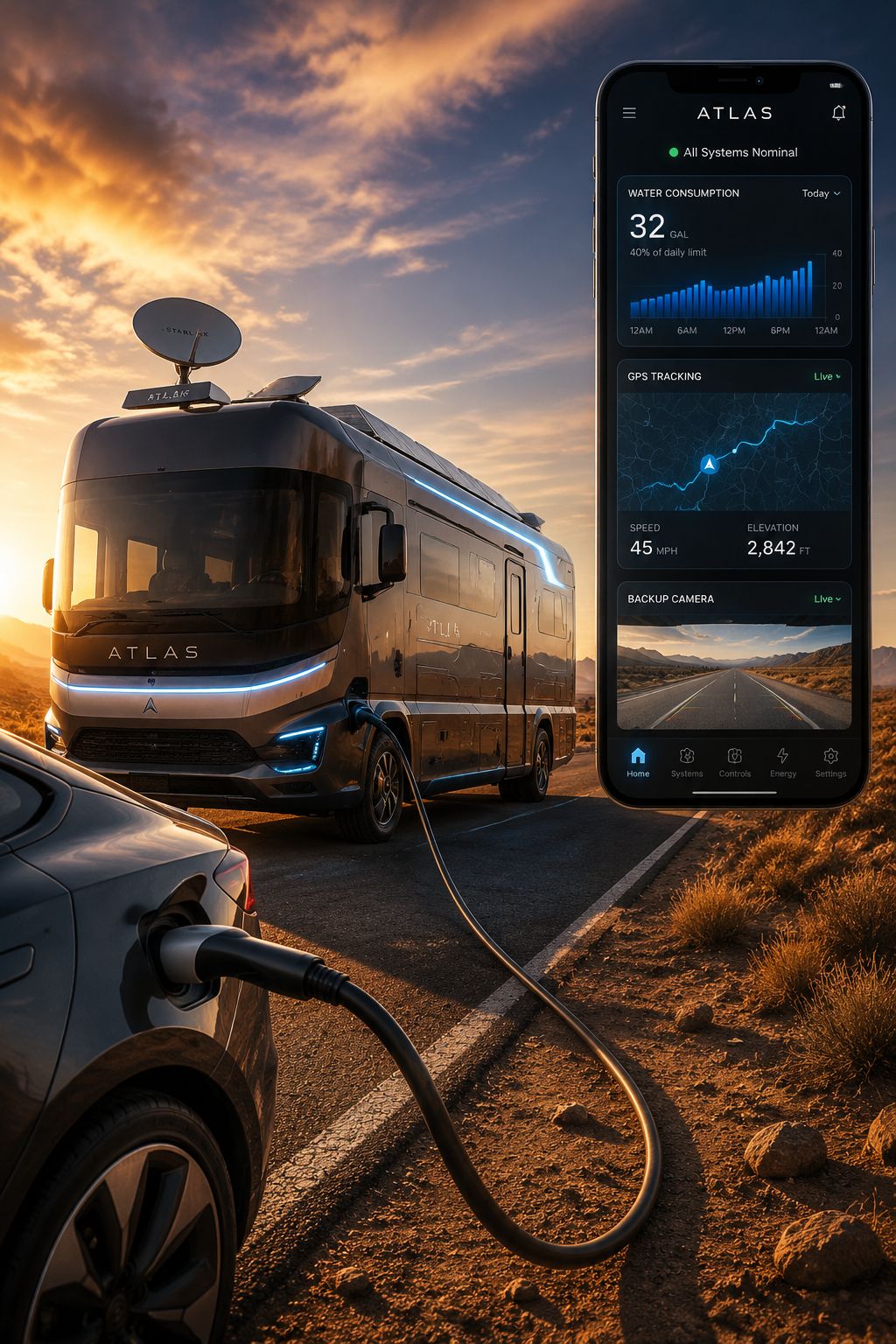
Lightship’s Atlas app brings all vehicle systems together in one place. Here is what it can do: [4]
| Feature | What It Does |
|---|---|
| 📊 Real-time tracking | Monitors water and power consumption live |
| 📷 Backup camera | Navigate and park from the phone screen |
| 🗺️ GPS integration | Connects with the vehicle’s onboard computer |
| 🔧 System control | Manage all RV systems from anywhere |
This kind of centralized control means a camper can check battery levels from a hiking trail, turn on the AC before returning to the rig, or monitor water usage while sitting by a campfire. The rec vehicle becomes an extension of the smartphone.
The Electric Rec Vehicle Revolution: Lightship Leads the Way ⚡
Electric vehicles have taken over the car market. Now they are coming for the RV market — and the pace is picking up fast.
Lightship’s AE.1: From Concept to Reality
Lightship is an all-electric U.S. RV startup that began manufacturing its first electric rec vehicle — the AE.1 — in August 2025. By April 2026, the company announced a major expansion of its Colorado-based manufacturing facility to meet surging demand. [4]
This is not a concept car. This is a real product being built right now, in America, for American campers.
What Makes the AE.1 Special
The AE.1 is not just electric. It is smart. Key features include:
- ✅ V2L technology standard — power devices and other EVs from the trailer
- ✅ V2H capability coming via software update — power the home from the RV
- ✅ Starlink connection port built in — stay connected anywhere
- ✅ Atlas app integration — full smartphone control
- ✅ Made in the USA — Colorado manufacturing facility [4]
The expansion of Lightship’s factory in 2026 signals that consumer demand for electric rec vehicles is real and growing. This is not a niche product anymore.
Why Electric Makes Sense for RVing
Some people wonder why an RV needs to be electric. Here are the key reasons:
- Lower fuel costs — electricity is cheaper than diesel or gasoline per mile
- Quieter operation — no generator noise at the campsite
- Cleaner air — no exhaust fumes near the campsite
- Energy independence — solar + battery means less reliance on hookups
- V2L/V2H capability — the RV becomes a power asset, not just a consumer
The AI-Transformable Home: A Rec Vehicle That Reshapes Itself 🏡
The AC Future AI-THt deserves its own deep dive. This is one of the most ambitious rec vehicle concepts ever built — and it actually works.
From Van to Villa
The AI-THt starts as a compact, towable trailer. It looks almost normal from the outside. But press a button, and the transformation begins:
- Walls slide outward
- Floors extend
- Ceilings rise
- Modular furniture deploys
- The entire living space more than doubles in size [2][6]
All of this happens automatically, controlled by the AI system. No manual cranking. No setup time. No instruction manual needed.
The Tech Specs That Matter
Here is a quick breakdown of what the AI-THt packs in:
| Feature | Specification |
|---|---|
| 🔋 Battery capacity | Up to 100 kWh |
| ☀️ Solar power | Up to 25 kW capture |
| 📐 Collapsed size | ~150 square feet |
| 📐 Expanded size | 350+ square feet |
| 🌐 Connectivity | Starlink-ready |
| 💧 Water system | AI-automated management |
| 🔧 Serviceability | Remote login capable |
Is It Practical?
Honest answer: it is still early days. The Autopian noted that while the design is stunning and the technology is impressive, some aspects “might be wildly impractical” for everyday use. [2] The price point, the towing requirements, and the complexity of the systems are real considerations.
But that is how all new technology starts. The first smartphones were expensive and limited. The first electric cars had tiny range. The AI-THt is a glimpse of where the rec vehicle is headed — not necessarily what every camper will buy next year.
What CES 2025 Told Us About the Future of Smart Camping 🎯
The Consumer Electronics Show in January 2025 was a turning point for the RV industry. For the first time, AI-integrated rec vehicles moved from concept renders to working prototypes. [3]
Why CES Matters for RV Lovers
CES is where the tech world shows its hand. When major players start showing RV technology at CES — alongside smartphones, TVs, and laptops — it signals that the RV industry has officially joined the tech revolution.
The AC Future showcase at CES 2025 was a statement: smart camping is not the future — it is now.
What to Expect at Future Shows
Based on the trajectory seen in 2025 and 2026, here is what RV lovers can expect to see at upcoming tech and RV shows:
- 🤖 More AI-driven autonomous parking and campsite leveling systems
- 🔋 Higher-capacity solid-state batteries for longer off-grid stays
- 🌐 Deeper Starlink integration with predictive weather routing
- 📱 More powerful mobile apps with AI trip planning built in
- 🏠 More expandable, modular living spaces with smart furniture
Comparing Today’s Smart Rec Vehicle Options 🔍
Not all smart RVs are created equal. Here is a quick comparison of the two leading AI-powered rec vehicles making waves in 2026:
| Feature | Lightship AE.1 | AC Future AI-THt |
|---|---|---|
| Type | Electric trailer | AI-transformable trailer |
| Power | Electric drivetrain | 100 kWh battery + 25 kW solar |
| Connectivity | Starlink port + Atlas app | Starlink-ready |
| Smart features | V2L, V2H (coming), app control | Voice control, auto-expand, remote service |
| Production status | In production (2025) | Prototype shown (CES 2025) |
| Made in | USA (Colorado) | Designed by Pininfarina |
| Best for | Electric vehicle owners | Tech-forward luxury campers |
Both options represent the cutting edge of what a modern rec vehicle can be. The right choice depends on priorities — whether that is energy independence, living space, or connectivity.
Challenges and Honest Considerations ⚠️
No technology is perfect. Here are some real things to think about before jumping into the smart RV world:
Price
Smart rec vehicles cost more upfront. The AI-THt and AE.1 are premium products aimed at early adopters. As production scales up and competition increases, prices will come down — but right now, these are significant investments.
Complexity
More technology means more things that can go wrong. A traditional RV has a propane system, a generator, and some basic wiring. A smart RV has AI systems, software updates, satellite connections, and automated mechanical systems. Maintenance and repairs require specialized knowledge.
Charging Infrastructure
Electric rec vehicles need places to charge. While the EV charging network is growing fast across the USA, it is not yet as widespread as gas stations. For remote camping, the onboard solar and battery system helps — but long road trips require planning.
Learning Curve
Voice controls, apps, and AI dashboards are intuitive for some people and overwhelming for others. New rec vehicle owners should expect a learning period before everything feels natural.
Tips for Getting Ready for the Smart Camping Era 🧭
Not everyone is ready to buy a new AI-powered rec vehicle right now. But there are steps any RV lover can take today to prepare for the smart camping future:
Start Small With Smart Upgrades
- Add a solar panel kit to an existing RV — many aftermarket options exist
- Install a smart battery monitor that connects to a smartphone app
- Get a Starlink subscription — it works with any RV setup
- Try a smart thermostat designed for RV use
- Download campground apps that use AI to find and book sites
Stay Informed
The smart RV world is moving fast. Following manufacturers like Lightship and AC Future, attending RV shows, and reading tech-forward RV publications will help any camper stay ahead of the curve.
Join the Community
Online RV communities are buzzing with discussion about smart technology. Forums, Facebook groups, and YouTube channels dedicated to electric and smart RVs are great places to learn from early adopters who have already made the leap.
The Bigger Picture: What Smart RVs Mean for Camping Culture 🌲
Beyond the gadgets and specs, there is a bigger story here. Smart rec vehicles are changing what it means to go camping.
More People Can Camp Comfortably
AI-assisted driving makes large vehicles less intimidating. Automated systems reduce the learning curve. Better connectivity means remote workers can camp without sacrificing productivity. All of this opens the RV lifestyle to more people than ever before.
Less Environmental Impact
Electric powertrains, efficient solar systems, and AI-managed energy use mean that smart RVs leave a smaller footprint. Quieter operation also means less noise pollution in natural areas — something every nature lover can appreciate.
A New Definition of “Off-Grid”
Off-grid used to mean truly disconnected — no power, no internet, no comfort. Today’s smart rec vehicle redefines off-grid as self-sufficient, not disconnected. Campers can be miles from the nearest power hookup and still have full electricity, fast internet, and a comfortable temperature-controlled home on wheels.
Conclusion: The Smart Rec Vehicle Era Has Arrived ✅
The numbers, the prototypes, and the factory expansions all point to the same conclusion: the smart camping revolution is not coming — it is here. In 2026, AI-powered rec vehicles are moving from concept to reality faster than almost anyone predicted.
From Lightship’s AE.1 rolling off the production line in Colorado to AC Future’s shape-shifting AI-THt wowing crowds at CES 2025, the rec vehicle of today is smarter, cleaner, and more connected than anything that came before it.
Actionable Next Steps for RV Lovers
Here is what to do right now:
- ✅ Research the Lightship AE.1 — visit the website, join the waitlist, understand the pricing
- ✅ Watch demos of the AC Future AI-THt — see the transformation in action on YouTube
- ✅ Start upgrading — add solar, a smart battery monitor, or Starlink to an existing rig
- ✅ Follow CES and RV Expo announcements — 2026 and 2027 will bring even more innovations
- ✅ Connect with the community — find other smart RV enthusiasts online and learn from their experiences
- ✅ Test drive or tour a smart motorhome — many dealers are now showcasing AI-equipped models
The open road has always called to adventurers. Now it is calling with a smarter, cleaner, more connected voice. The rec vehicle of the future is ready. The only question is: are you?
References
[1] Watch (2026 Smart Motorhome) – https://www.youtube.com/watch?v=EC1iTb6qhI0
[2] This New Pininfarina Designed Self Towing Ai Rv Looks Like The Future But Might Be Wildly Impractical – https://www.theautopian.com/this-new-pininfarina-designed-self-towing-ai-rv-looks-like-the-future-but-might-be-wildly-impractical/
[3] Watch (American RV Market – CES 2025) – https://www.youtube.com/watch?v=0d4hZOOBMek
[4] Lightship Expands Manufacturing Capacity For Its Game Changing Electric Rv – https://futurride.com/2026/04/14/lightship-expands-manufacturing-capacity-for-its-game-changing-electric-rv/
[5] CES 2026 RV Innovations – https://www.mortonsonthemove.com/ces-2026-rv-innovations/
[6] Pininfarina Smart Expandable Camping Trailer – https://newatlas.com/camping-trailers/pininfarina-smart-expandable-camping-trailer/