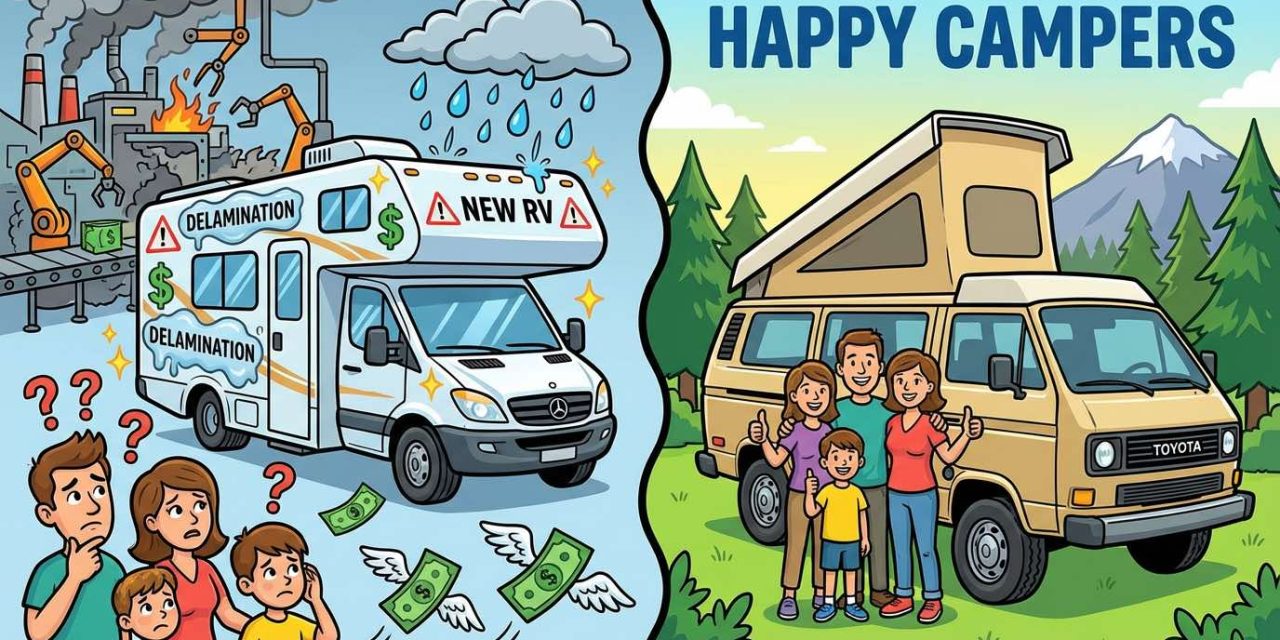
If you’ve been dreaming of hitting the open road in a shiny new RV, you might want to pump the brakes. A shocking investigation dropped last year exposed what mechanics and repair shops have been whispering about for years: the RV industry has a serious quality problem. Brand-new units are literally leaking on dealer lots before anyone even drives them off. One manufacturer has racked up more recalls than any car company in America, and you’re about to find out why.
The harsh truth? You might think you’re choosing between dozens of different RV brands, but that’s just clever marketing. The reality is far more disturbing, and your family’s vacation dream could turn into a financial nightmare if you don’t know what to look for. But don’t worry—there are still ways to outsmart the system and get an RV that’ll actually last.
Ready to discover the factory secrets that could save you tens of thousands of dollars? Let’s dive in.
Would you like to save this article?
1. The Monopoly Illusion: Two Companies Control 80% of All RVs
When you walk onto an RV dealership lot, you see names like Airstream, Jayco, Keystone, Heartland, and Tiffin lined up in shiny rows. You probably assume these are different companies competing to build the best product for your money, right? Wrong.
Here’s the truth that’ll make your jaw drop: Thor Industries and Forest River—just TWO massive corporations—control a staggering 80% of the entire RV market. They’ve spent the last two decades buying up every independent competitor they could find. When you buy a “Keystone” or a “Heartland,” you’re not buying from passionate craftsmen in Indiana. You’re buying from a subsidiary of Thor Industries, a publicly traded company obsessed with quarterly earnings reports.
| Major RV Brands | Actual Owner |
|---|---|
| Keystone, Heartland, Dutchmen, KZ | Thor Industries |
| Cherokee, Berkshire, Coachmen, Rockwood | Forest River (Berkshire Hathaway) |
| Airstream, Cruiser RV, DRV, Entegra | Thor Industries |
According to the Wall Street Journal’s damning 2025 investigation, Forest River issued more recalls than any U.S. automaker or RV manufacturer from 2015 to 2024—and many of these were due to preventable human errors, not design flaws.
Here’s the kicker: You might think you’re shopping around and comparing quality, but you’re basically choosing between different labels slapped on products built by the same companies using the same cost-cutting methods. Talk about the illusion of choice!
2. The “Piece-Rate Pay” Problem: Why Your New RV Is Built by Workers Racing Against the Clock
Ever wonder why brand-new RVs have so many bizarre defects? Screws puncturing through microwaves. Furnace flues that don’t line up with exhaust vents. Electrical wires stapled straight through their centers. These aren’t freak accidents—they’re the inevitable result of how RV workers get paid.
Unlike the automotive industry where workers earn hourly wages and can take their time ensuring quality, RV factory workers operate under a “piece-rate pay” system. Translation? They only get paid based on how many units they push out the door each day. Speed is literally the only thing that matters to their paycheck.
Think about what this means: If a worker stops the production line to fix a crooked cabinet or rewire something properly, they’re taking money out of their own pocket—and their coworkers’ pockets too. So guess what happens? They don’t stop. They rush through, cut corners, and move on to the next unit.
In fact, there was even a class action lawsuit filed in December 2020 against Forest River Manufacturing for unpaid overtime owed to these piece-rate production workers. The system is so flawed that workers weren’t even getting compensated fairly for the rushed work they were doing!
If you thought you were buying quality craftsmanship, you’re actually buying whatever can be slapped together in record time. And that $80,000 motorhome you’re eyeing? Yeah, it was probably assembled by someone who had exactly 4.3 minutes to install your entire electrical system.
3. The “Sandwich Wall” Disaster: Why Your $80,000 RV Is Designed to Rot
Here’s where things get really ugly. The most fatal engineering flaw in modern RVs is something called “laminated sandwich wall construction.” Sounds fancy, right? Well, it’s actually a cheap disaster waiting to happen.
To save weight and money, manufacturers stopped building frames out of sturdy aluminum. Instead, they started gluing fiberglass skins to a substrate—ideally a water-resistant composite material. But here’s the problem: to save even more money, they use cheap Luan plywood instead.
The construction looks like this:
- Fiberglass outer skin (glued)
- Luan plywood (glued)
- Styrofoam insulation core
- Interior paneling
This works perfectly fine… until water touches it. And since your RV is bouncing down highways at 70 mph, those roof seals will eventually crack. Water always finds a way in.
When moisture hits that cheap Luan plywood, the glue dissolves and the wood begins to rot from the inside out. You’ll start seeing bubbles forming on the exterior walls—a condition called “delamination.” According to RV Life, once delamination begins, it’s chemically impossible to repair because you can’t inject new glue into rotted wood.
At that point, your $80,000 asset becomes a worthless total loss. No dealership will accept it as a trade-in. Insurance won’t cover it because it’s considered a maintenance issue. You’re stuck with a rotting box on wheels.
You’d think a house on wheels would be built better than an actual house, but nope! These manufacturers would rather save $200 per unit on materials and let you deal with the consequences five years down the road. By then, your warranty is expired and you’re on your own.
4. The Warranty Scam: How Manufacturers Wear You Down on Purpose
So you discover a defect in your brand-new RV. No problem, right? It’s under warranty! Well, buckle up for some serious frustration because the RV warranty process is essentially a bureaucratic nightmare designed to make you give up.
Here’s how the scam works:
Step 1: You take your broken RV back to the dealership.
Step 2: The dealer can’t fix anything without approval from the manufacturer. They have to take photos, submit detailed claims, and wait for a corporate representative to approve the labor hours.
Step 3: The manufacturer often denies the claim entirely—or approves it but says the specific part you need is on “back order” for months.
Step 4: Your RV sits in a parking lot gathering dust for 3-6 months while you continue making monthly payments and insurance premiums on a vehicle you can’t use.
According to RV Auto Legal Team, California alone saw over 22,000 Lemon Law cases in 2023, with that number expected to surpass 25,000 in 2024. The Wall Street Journal investigation noted that these RVs are sitting broken on dealer lots instead of at campsites, creating a cycle of depreciation that destroys middle-class buyers’ wealth.
So while you’re dreaming of campfires and s’mores, your RV is becoming a money pit faster than you can say “road trip.” The manufacturers are banking on you getting so exhausted by the process that you’ll just give up and pay for repairs out of pocket. Smart, right? Well, smart for them, not for you.
5. Even the “Premium” Brands Aren’t Safe: What Happened to Airstream Quality?
You might be thinking, “Okay, but what about the premium brands? Surely Airstream is still good, right?” Hate to break it to you, but even the legendary Airstream brand got swallowed up by Thor Industries.
Airstream was once the gold standard of American RV quality—the brand that lasted for generations with minimal issues. But since Thor Industries acquired them, owners of newer Airstreams are reporting quality control problems like popping rivets and leaking windows that were virtually unheard of 20 years ago when the company was independent.
This is the classic private equity playbook:
- Buy a brand with an excellent reputation
- Strip out the quality to increase profit margins
- Coast on that reputation until customers catch on
- By the time the reputation is destroyed, you’ve already cashed out
| Brand | Pre-Acquisition Era | Acquired By | Year Acquired |
|---|---|---|---|
| Airstream | Known for lifetime quality | Thor Industries | 1980 (family control until 2000s) |
| Tiffin | Bob Tiffin personally answered phones | Thor Industries | 2020 |
| Jayco | Family-owned craftsmanship | Thor Industries | 2016 |
According to the video investigation, Bob Tiffin was famous for personally answering customer phone calls and authorizing repairs himself. That level of service? It disappeared the second Thor took over. Now you’re dealing with corporate bureaucracy and automated phone trees.
If you’re paying premium prices for an Airstream thinking you’re getting old-school quality, you’re basically paying extra for a shiny aluminum exterior wrapped around the same cheap sandwich walls as every other Thor subsidiary. The iconic silver bullet has become just another victim of corporate consolidation.
6. The Secret Smart Buyers Know: Buy Pre-Acquisition Era RVs
So if the entire market is rigged against you, should you give up on the RV dream? Absolutely not! You just need to stop shopping like a typical consumer and start thinking like an auditor.
Here’s the secret that savvy RV buyers have figured out: Look for units built BEFORE the private equity takeovers. These pre-acquisition era vehicles were made when the brands were still family-owned and cared about reputation more than quarterly profits.
What to look for:
✅ Tiffin models built before 2020 (pre-Thor acquisition): Bob Tiffin personally oversaw quality control and customer service. A 2018 Tiffin Allegro Bus is likely built better than a 2026 model.
✅ Factory-direct brands like Lazy Daze and Born Free: These small California companies refuse to expand beyond their capacity and refuse to sell through dealerships. They paint graphics on (instead of cheap stickers that peel in the sun) and build walls with aluminum skins that can actually be repaired.
✅ Older Jayco units from the family-owned era: Before Thor acquired them in 2016, Jayco had a reputation for solid construction.
The beauty of this strategy? These older units have already depreciated. You’re not taking the massive financial hit that comes with driving a new RV off the lot. Plus, you can get inspection records and see how the unit has held up over time—something impossible with a brand-new model.
You’d rather trust a 10-year-old RV built by people who actually cared than gamble on a 2026 model assembled by workers racing the clock for minimum wage. Sometimes “new” isn’t better—it’s just more expensive.
7. The Ultimate Insider Secret: Import a Japanese Toyota Camper for a Fraction of the Price
Ready for the best-kept secret in the overland community? There’s a legal loophole in the United States called the 25-Year Import Rule. This allows Americans to import any vehicle from Japan as long as it’s at least 25 years old.
Why would you want a 25-year-old camper van? Because Japanese vehicles—especially Toyotas—are built with commercial-grade reliability that makes American RVs look like Fisher-Price toys.
Here’s how the system works in Japan: Vehicles are subjected to a rigorous inspection program called “Shaken” which becomes extremely expensive as vehicles age. According to Reddit discussions, these inspections cost around $899 USD and get stricter after 10 years. Many Japanese owners sell their camper vans with only 30,000-40,000 miles on the odometer because it’s cheaper than paying for the inspection.
What you can import:
🚐 Toyota HiAce: The legendary workhorse van used by businesses across Japan
🚐 Toyota Camroad: Purpose-built motorhomes with commercial diesel engines
🚐 Mazda Bongo: Compact campers perfect for couples
The advantages are mind-blowing:
| Feature | New American RV | Imported Japanese Camper |
|---|---|---|
| Price | $80,000-$120,000 | $20,000-$30,000 |
| Engine Life | 150,000 miles typical | 500,000+ miles with 3.0L diesel |
| Wall Construction | Cheap Luan plywood | Real wood & quality composites |
| Depreciation | Loses $40,000 immediately | Already fully depreciated |
| Build Quality | Rushed piece-rate assembly | Japanese craftsmanship standards |
According to the video investigation, these Japanese diesel engines are designed for commercial delivery trucks and can run for 500,000 miles without major overhauls. The interior build quality uses real wood and high-quality composites instead of stapled particle board.
You can import one of these units for $20,000-$30,000—a fraction of the cost of a new American Class B van. And here’s the best part: A 25-year-old Toyota will likely still be worth the same amount 5 years from now, while that new $120,000 American van will be worth $80,000 the second you drive it off the lot.
If you’re going to drop serious cash on an RV, wouldn’t you rather have one that was built to actually last forever? The Japanese figured out decades ago how to build vehicles that don’t turn into rotting money pits. Maybe it’s time American RV buyers caught on.
Final Thoughts: Don’t Let Corporate Greed Destroy Your Retirement Dreams
The American RV industry is banking on you being distracted by LED lights, flat-screen TVs, and fancy slide-outs so you don’t notice the cheap Luan plywood rotting inside your walls. They’re counting on you to trust brand names that were bought out years ago and stripped of their quality.
But now you know the truth. The era of widespread quality in American RV manufacturing is over, and the big brands are hoping you won’t notice until it’s too late.
Your move? Stop falling for the shiny new models. Check the manufacturing dates. Research the ownership lineage. Consider pre-acquisition models or Japanese imports. And never, ever underestimate the value of a commercial-grade engine from the 1990s.
Your retirement savings deserve better than a product designed to fail. Don’t let Thor Industries and Forest River take you for a ride—unless it’s the kind of ride you actually want to take, in an RV that’ll last for decades instead of disintegrating in five years.
SOURCES
- Consumer Affairs – Forest River RV Recalls Raising Safety Concerns
- Wall Street Journal – Even Warren Buffett Hasn’t Fixed the RV Industry’s Serial Breakdowns
- RV Travel – Wall Street Journal Alleges Serious Quality Flaws in Forest River RVs
- RV Life – RV Delamination: How to Spot It
- RV Auto Legal Team – Lemon Law Cases Surge in California
- McCoffman Legal – Piece Rate Overtime Lawsuit Filed Against Forest River RV
- Valley Central – California’s Lemon Law Filings Surge
- Reddit – Importing a Van from Japan Discussion
- Motor Trend – Awesome JDM Camper Vans and Conversions
- YouTube – Why 80% of New RVs Are Garbage (The Factory Secret)