
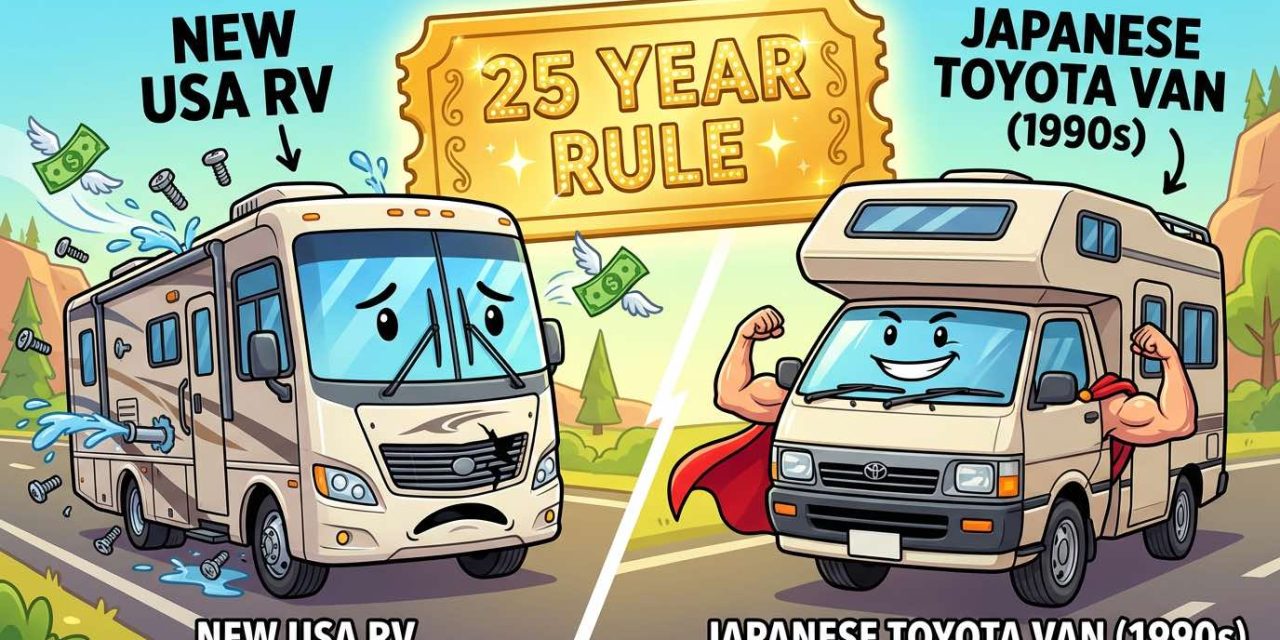
Are you tired of watching your brand-new RV fall apart while still making payments? There’s a growing movement of RV enthusiasts who’ve discovered a secret loophole that’s got American RV manufacturers sweating.
They’re importing 25-year-old Japanese camper vans that outlast, outperform, and outsmart anything rolling off assembly lines in Indiana today.
The American RV industry doesn’t want you to know about the “25-Year Import Rule.” This federal regulation allows you to legally import vehicles from Japan that were built when engineers—not accountants—called the shots. We’re talking about Toyota HiAces, Toyota Coasters, and Isuzu Elfs that were designed to survive the apocalypse, not just look pretty in a dealer’s showroom.
In this article, you’ll discover why savvy RVers are saying “no thanks” to $120,000 modern motorhomes. Instead, they’re spending $25,000 on Japanese imports that actually hold their value. Sound too good to be true? Keep reading, because the math might just blow your mind.
Before we dive in, check out this eye-opening video that exposes the truth about American RV quality versus Japanese engineering:
Would you like to save this article?
1. The Water Tank Disaster: When Your $100,000 RV is Held Together by Hope and Self-Tapping Screws
Here’s a nightmare scenario that actually happened: A proud owner drove his brand-new Forest River toy hauler off the lot, excited for his first camping trip. During one of his first outings, the freshwater tank literally fell out of the frame and onto the highway.
How did this catastrophe happen? The tank wasn’t bolted on with proper steel brackets like you’d expect. Instead, it was held in place with cheap self-tapping screws that couldn’t handle the weight of water. When he took it back for warranty repair, the manufacturer denied the claim, arguing the tank wasn’t “technically part of the frame.”
This isn’t an isolated incident—it’s the norm. According to industry reports, modern American RVs have some of the highest defect rates in the automotive world. Thor Industries and Forest River, two of the biggest manufacturers, prioritize assembly speed over quality control, leading to units held together with staples, glue, and prayers.
| American RV Reality | What You’re Actually Getting |
|---|---|
| $100,000+ price tag | Staples and self-tapping screws |
| “Luxury” materials | Particleboard and thin aluminum |
| Warranty coverage | Denied claims and loopholes |
| Build time | 1-2 days (rushed assembly) |
Reality Check
You’d think spending six figures on a recreational vehicle would get you at least the same build quality as a $30,000 sedan. But nope! You’re essentially buying a fancy tent on wheels that depreciates faster than you can say “lemon law.” Maybe those self-tapping screws are a metaphor for how the industry is screwing customers.
2. The 25-Year Loophole: Your Golden Ticket to Japanese Engineering Excellence
What if I told you there’s a legal way to bypass the entire American RV system? Enter the 25-Year Import Rule—a federal regulation that the RV industry desperately hopes you never learn about. Here’s how it works:
The EPA and Department of Transportation have an exemption: If a vehicle is at least 25 years old, it’s legally considered an antique. This means it’s exempt from modern safety standards and emission regulations, allowing you to import incredible Japanese camper vans that were never sold in the US.
Why does this loophole exist? Originally, it was designed to allow classic car collectors to import vintage vehicles. But smart RVers discovered it’s also the perfect way to get their hands on commercial-grade Japanese campers built during the golden age of Toyota and Isuzu engineering (the 1990s).
Here’s what you can legally import:
- Toyota HiAce camper vans with legendary diesel engines
- Toyota Coaster mini-buses converted into luxury motorhomes
- Isuzu Elf commercial trucks with camper bodies
The Fine Print
So basically, you can thank bureaucratic regulations for accidentally creating the best loophole in RV history. The same government rules meant to “protect” you from foreign vehicles are now your ticket to escaping overpriced American junk. It’s like finding out the “No Trespassing” sign actually has a secret door behind it.
3. No DEF, No DPF, No Problem: Why 1990s Diesel Engines Are Superior to 2026 Models
Modern diesel engines are strangled by regulations that sound good on paper but create nightmares for RV owners. If you’ve ever been stranded because a sensor threw your truck into “limp mode,” you know exactly what I’m talking about.
Here’s what’s killing modern diesels:
- DEF (Diesel Exhaust Fluid) systems that freeze in cold weather
- DPF (Diesel Particulate Filters) that clog and cost $3,000+ to replace
- Endless sensors that can shut down your engine over a $10 computer chip
Now let’s talk about the Toyota 1KZ-TE engine found in many imported Japanese campers. This 3.0L turbo diesel is a mechanical masterpiece:
| Modern American Diesel | Toyota 1KZ-TE (1990s) |
|---|---|
| DEF tank required | Zero DEF system |
| DPF filter clogs constantly | No DPF whatsoever |
| Electronics everywhere | Mechanical simplicity |
| 200,000 mile lifespan | 500,000+ mile proven durability |
| Frequent dealer visits | Runs forever with basic maintenance |
These engines were designed for Japanese commercial delivery routes, where reliability wasn’t optional—it was mandatory. According to automotive engineers, the Toyota L-series and KZ-series engines are considered some of the most bulletproof powerplants ever manufactured.
The Tech Trade-Off
While your neighbor is babysitting his 2026 Sprinter at the dealership waiting for a software update, your 1996 Toyota is happily chugging up a mountain pass without breaking a sweat. It’s the difference between a smartphone that needs constant updates and a hammer that just… hammers. Sure, the smartphone has more features, but which one actually works when you need it most?
4. The Parts Availability Myth: Why Getting Parts for a Japanese Import is EASIER Than American RVs
“But what about parts availability?” This is the #1 concern stopping Americans from making the switch—and it’s based on a complete myth. Let me destroy this misconception with cold, hard facts.
Here’s the truth about Japanese import parts:
The engines in these campers (Toyota L-series and KZ-series) are global engines. They weren’t just used in campers—they powered forklifts, generators, and commercial trucks all over the world for decades. This means:
- Oil filters, belts, and alternators are available at your local AutoZone or NAPA
- Major mechanical parts are still manufactured and stocked globally
- Body parts and accessories can be ordered from Japanese exporters and arrive in 3 days
Now let’s compare this to the American RV experience in 2026:
| Japanese Import Parts | American RV Parts |
|---|---|
| Oil filter at AutoZone: Same day | Slide-out motor: Call the dealer |
| Alternator at NAPA: In stock | Dealer calls manufacturer: Part on backorder |
| Headlight from Japan: 3 days shipping | Waiting for your part: 6+ months |
| Engine parts: Global availability | Proprietary parts: Dealer monopoly |
According to industry reports, American RV manufacturers use proprietary components that can only be ordered through dealers. This creates a monopoly where you’re at the mercy of supply chains, backorders, and price gouging.
The Waiting Game
Let’s be honest: Would you rather wait 3 days for a headlight from Tokyo or 6 months for a mystery part from Indiana that may or may not fix your problem? The “parts availability” argument is just the RV industry’s way of keeping you scared and stuck in their broken system. Meanwhile, Toyota owners are out there actually camping instead of sitting in service bays.
5. The Financial Math That Will Make You Cry: $40,000 Lost vs. $0 Depreciation
Let’s talk about the only numbers that really matter: your bank account. The financial reality of buying a new American RV versus a Japanese import is so stark, it should be criminal.
Here’s the brutal truth about new American RV depreciation:
| Year | New American Class B Van | 25-Year Japanese Import |
|---|---|---|
| Purchase Price | $120,000 | $25,000 (landed at port) |
| Value After 5 Years | $80,000 | $25,000 |
| Total Loss | -$40,000 | $0 |
You read that correctly. When you buy a new American RV for $120,000, you lose $40,000 in value over five years—and that’s if you’re lucky. Some models lose 50% of their value in just three years.
Meanwhile, Japanese imports are already fully depreciated. You’re buying a 25-year-old vehicle, so it’s already hit rock bottom in terms of depreciation. In many cases, these vehicles appreciate as they become rarer and more sought-after by enthusiasts.
The real kicker? You’re getting:
- ✅ Better engineering (commercial-grade components)
- ✅ Better reliability (mechanical simplicity)
- ✅ Better longevity (500,000+ mile engines)
- ✅ Better value retention (zero depreciation)
For ONE-FIFTH the price of a new American RV.
According to financial advisors specializing in RV purchases, new RVs are one of the worst investments you can make—right up there with timeshares and lottery tickets.
The Retirement Killer
So let me get this straight: You can either spend $120,000 on a brand-new RV that will be worth $80,000 before you’ve even figured out how the propane system works, OR you can spend $25,000 on a Japanese tank that will outlive you and still be worth $25,000. If you choose the first option, maybe you should also invest in some oceanfront property in Arizona while you’re at it.
Bonus: The Right-Hand Drive “Problem” That Isn’t Really a Problem
One last objection: “But the steering wheel is on the wrong side!” Let’s address this head-on (pun intended).
Yes, Japanese vehicles have right-hand drive configurations. The steering wheel is on the right side of the vehicle because Japan drives on the left side of the road. This freaks out a lot of Americans who’ve never experienced it.
Here’s what nobody tells you:
Right-hand drive actually has SAFETY BENEFITS for large vehicles:
- You’re positioned on the curb side of the road, giving you a perfect view of road edges
- You can see exactly how close your tires are to ditches or obstacles
- You’re less likely to drift into oncoming traffic because your perspective is aligned with the road edge
According to drivers who’ve made the switch, it takes about 2 hours to adjust to right-hand drive. After that, it becomes completely natural. The only real inconvenience? Drive-thru windows—but you’re buying an RV to explore nature, not eat fast food.
Priority Check
So the big question is: Would you rather deal with the “inconvenience” of reaching across the seat to pay a toll, or the “inconvenience” of your freshwater tank falling out on the highway at 65 mph? Tough choice, right? It’s almost like complaining about the color of your parachute when the alternative is free-falling without one.
Final Thoughts: Don’t Buy Their Junk
The American RV industry is counting on your fear. They want you scared of steering wheels, scared of parts availability, and scared of anything that isn’t sold at their dealerships. Why? Because if you’re not scared, you might realize that a 30-year-old Toyota is better than anything they’re building today.
The 25-Year Import Rule is your escape hatch from planned obsolescence, garbage build quality, and financial loss. You get commercial-grade engineering, bulletproof diesel engines, and you keep your retirement savings in the bank where it belongs.
Don’t let fear-mongering stop you from making the smart financial decision. Do your research, find a reputable importer, and get yourself a machine that actually works. Your future self (and your bank account) will thank you.
SOURCES
- How Smart Americans Are Beating the RV Scam (The 25-Year Loophole) – Industrial Decay YouTube Channel
- EPA 25-Year Import Rule – Environmental Protection Agency
- NHTSA Vehicle Importation Guidelines – National Highway Traffic Safety Administration
- RV Industry Association – Annual Depreciation Reports
- Thor Industries Official Website – Manufacturing Information
- Toyota 1KZ-TE Engine Specifications – Toyota Technical Information
- Japanese Vehicle Import Guide – US Customs and Border Protection


