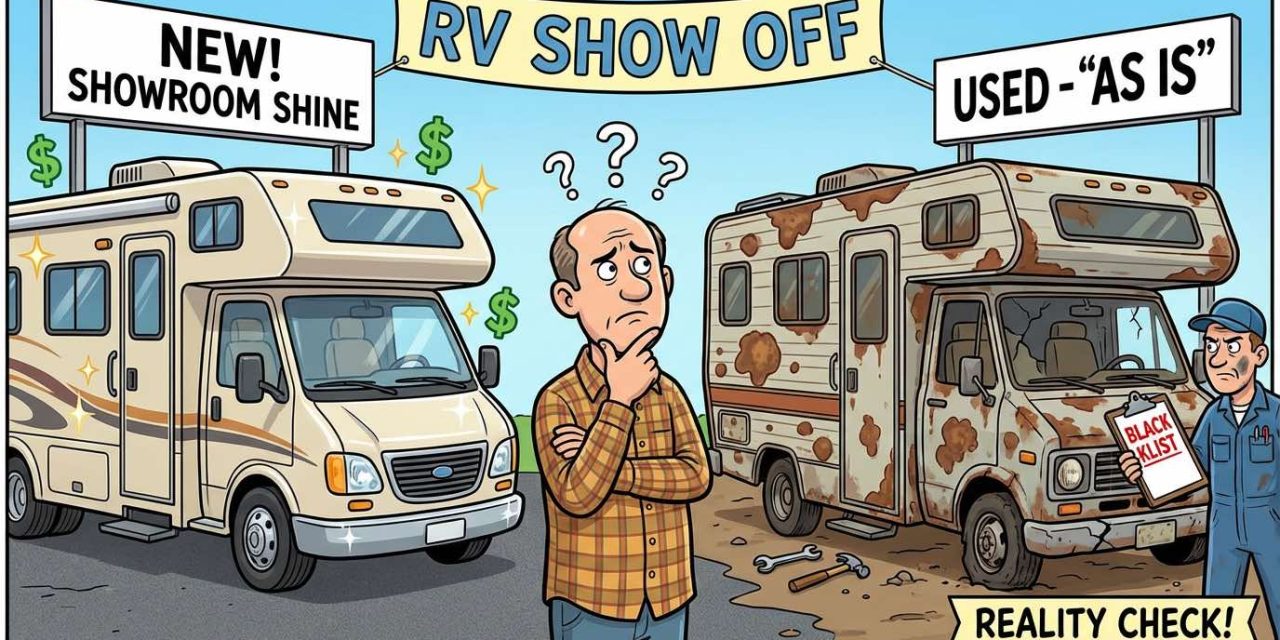
You’re standing on that shiny dealership lot, staring at rows of beautiful RVs. They all look amazing. But here’s what nobody’s telling you: most of them are built by the same two companies, and they’re cutting corners you can’t even see yet.
Walking into an RV dealership feels like you have endless choices. But you don’t. Two massive corporations—Thor Industries and Forest River—control over 80% of the entire market, and they’ve replaced quality craftsmanship with speed and cheap materials.
If you’re about to drop your hard-earned retirement savings on one of these rolling houses, you need to know which brands mechanics are quietly refusing to work on. We’re talking about frames snapping in half on highways, walls literally rotting from the inside out, and dealerships holding your RV hostage for six months.
In this investigation, we’re exposing the 7 specific RV brands that are destroying bank accounts in 2026. We’ll also give you the short list of the only 3 options you can trust. Let’s dive in before you sign that contract.
1. Keystone: When Your Walls Start Bubbling Like Soda
Keystone is a subsidiary of Thor Industries, and it suffers from the highest rate of a terminal condition called delamination. This isn’t just peeling paint—it’s a complete structural failure where your RV’s exterior walls literally separate from the frame.
Here’s how it happens: Keystone uses laminated construction. They glue a thin layer of fiberglass to cheap wood backing called Luan plywood. The problem? The glue is water-soluble.
The moment a seal on your roof cracks (and they will), water seeps inside the wall and dissolves that bond. The wood starts rotting from the inside, and you’ll see large bubbles forming on the side of your trailer. Once delamination starts, your RV becomes essentially worthless. No dealership will accept it as a trade-in.
The Numbers Don’t Lie
| Issue | Details |
|---|---|
| Repair Cost | $1,000 to $5,000+ depending on severity |
| Insurance Coverage | Usually NOT covered (considered maintenance issue) |
| Resale Impact | Essentially worthless once delaminated |
According to independent service centers, delamination repair can range from $300 for minor issues to over $5,000 for major structural damage. RV Repair Cost Index 2025
But wait—there’s more. Keystone owners also report water tanks falling out while driving down the highway. The freshwater tanks are held in place by thin metal straps attached with cheap self-tapping screws instead of structural bolts. When you fill that tank with water (adding hundreds of pounds), those screws simply shear off. Imagine your entire water supply crashing onto the asphalt at 65 mph.
Here’s the Kicker
You’d think buying an RV means you’re getting a carefully engineered vehicle. Nope. You’re getting a product assembled so fast that basic structural integrity becomes optional. The workers aren’t taking shortcuts because they’re lazy—they’re paid by the unit, not the hour. Speed wins, quality loses.
2. Heartland: The Frame Flex Nightmare That’ll Snap You in Half
Heartland Recreational Vehicles are plagued by something called “frame flex,” particularly in their fifth-wheel toy haulers. This is a catastrophic failure where the welds holding the front cap of your trailer to the sidewalls literally break under the stress of towing.
You can spot this problem by looking at the silicone seal where the side molding meets the front cap. If you see that seal splitting or separating, it means the metal structure underneath is moving independently of the walls. That’s not supposed to happen. Ever.
Why does this occur? Manufacturers have reduced the gauge of steel in the frame to save weight and cost, while simultaneously making trailers larger and heavier. It’s engineering suicide.
Frame Flex by the Numbers
- Repair Cost: Upwards of $10,000
- Repair Process: Requires stripping the entire front skin off and rewelding
- Safety Risk: Frames can snap completely on highways
- NHTSA Involvement: Multiple investigations opened
The National Highway Traffic Safety Administration (NHTSA) has opened investigations into frame failures across multiple RV manufacturers. NHTSA RV Recalls
The Reality Check
So you’re cruising down the interstate, excited about your camping trip, when suddenly you feel a weird vibration. That’s your $80,000 investment trying to fold in half. The front cap is literally separating from the rest of your trailer because someone decided thinner steel would boost profit margins.
3. Forest River: Where Construction Trash Becomes Interior Décor
Forest River (especially their Cherokee and Salem lines) achieves high production volume by pushing assembly line speeds to the breaking point. This is where we see the most evidence of piece-rate pay negligence.
Because workers are paid by the unit and not by the hour, they don’t have time to clean up their workspace. Owners frequently report finding construction trash like sawdust, empty glue bottles, and even half-eaten sandwiches sealed inside the walls and cabinetry.
We’re not making this up. Service technicians have found:
- Electrical wires stapled directly through the center of the insulation (fire hazard)
- Plumbing lines that were kinked because installers didn’t take time to route them properly
- Actual garbage sealed behind walls
- Missing screws and structural fasteners
Forest River: The Speed Edition
| Market Share | Production Focus | Quality Control |
|---|---|---|
| 33.8% of travel trailer market | Volume over quality | Piece-rate assembly |
| Thor holds 41% | Speed = Profit | Minimal inspection |
In 2022, Thor held about 41% of new travel trailer sales and Forest River held 33.8%, giving them a combined 75% market share. RV Industry Analysis
When you buy a Forest River Cherokee, you’re buying a product assembled as fast as humanly possible with zero regard for longevity. It’s not a home on wheels—it’s a ticking time bomb with wheels.
The Uncomfortable Truth
You’d probably take better care building a treehouse with your kids than the “professionals” who slapped your RV together. At least you’d remember to take out your lunch before nailing up the walls.
4. Jayco: The Fallen Hero That Sold Its Soul to Corporate America
This one hurts because Jayco used to be the gold standard of quality. For decades, it was an independent family-owned company that prided itself on Amish craftsmanship. Owners of older Jaycos from the 1990s or early 2000s will tell you they’re built like tanks.
But that era ended in 2016 when Jayco was acquired by Thor Industries for $576 million.
Since the acquisition, the unique culture of quality control has been eroded and replaced with corporate mandates for higher profit margins. Modern units rolling off the line today are just generic Thor trailers wearing a Jayco sticker. They suffer from the exact same issues as other Thor brands.
The Jayco Timeline
| Era | Quality Level | Ownership |
|---|---|---|
| Pre-2016 | Exceptional Amish craftsmanship | Independent family-owned |
| Post-2016 | Standard Thor quality | Thor Industries subsidiary |
| 2026 | Same issues as budget brands | Corporate profit focus |
Jayco was acquired by Thor Industries in July 2016 for $576 million, and many long-time owners report noticeable quality decline. Thor Announces Acquisition
That includes:
- Cheap staples instead of screws
- Plastic plumbing fittings that crack after one winter
- The same laminated construction issues as Keystone
Do not be fooled by the nostalgia of the brand name. The company that built your grandfather’s trailer doesn’t exist anymore. It’s just a Thor Industries sticker parade now.
What You Need to Know
You’re essentially paying a premium for the memory of quality, not actual quality. It’s like buying a Ferrari badge and finding a Yugo underneath. The name means nothing when the craftsmanship disappeared a decade ago.
5. Winnebago: Particle Board Masquerading as Luxury
Winnebago used to be synonymous with the open road. Their name became shorthand for “motorhome” itself. But their modern towable division has traded legendary reputation for cheap laminate cabinets that swell and peel.
Winnebago’s modern trailers use wrapped particle board for cabinetry. It looks like wood on the showroom floor, but it’s essentially compressed sawdust wrapped in paper laminate.
Here’s what happens: The environment inside an RV is harsh, with massive swings in temperature and humidity. When humidity rises, that particle board absorbs moisture like a sponge and begins to swell. The paper laminate peels off, and you’re left with cabinets that look like they’re disintegrating.
Why This Matters
| Material | Cost | Durability | Winnebago’s Choice |
|---|---|---|---|
| Solid wood | High | Excellent | ❌ No |
| Real plywood | Moderate | Very good | ❌ No |
| Particle board | Low | Poor | ✅ Yes |
This is a cost-saving measure, pure and simple. Building cabinets out of real plywood or solid wood costs significantly more. They’re banking on the unit looking good enough to sell on the dealer lot. By the time the cabinets start peeling, the warranty will have expired.
The Real Story
You’re paying luxury prices for IKEA furniture quality. Except IKEA actually stands behind their particle board. At least their stuff comes with an Allen wrench and reasonable expectations.
6. Camping World: The Dealership That’ll Hold Your RV Hostage
This isn’t a manufacturer—it’s a retailer you must avoid at all costs. You cannot talk about the RV industry’s decline without mentioning the dealership chain that dominates it.
Camping World’s business model depends on selling units at low prices, then making profit on the back end through high-interest financing and worthless extended warranties. When customers bring a vehicle in for repair, they routinely report it sitting on the lot for 3 to 6 months waiting for warranty approval.
The Camping World Experience
- ❌ Sell RV at attractive price
- ❌ Push high-interest financing
- ❌ Sell overpriced extended warranties
- ❌ Prioritize new sales over service
- ❌ Hold repaired units for months
Camping World prioritizes getting new units out the door over fixing the units they’ve already sold. We’ve seen horror stories of customers who missed an entire camping season because their vehicle sat in a Camping World lot waiting for a $50 part.
Their service department is notorious for:
- 3-6 month wait times for repairs
- Refusing warranty claims on technicalities
- Poor communication with customers
- Prioritizing profit over service
Bottom Line
You didn’t buy an RV to watch it collect dust in a service lot for half a year. But that’s exactly what you’re signing up for when you walk into Camping World. Your dream of weekend getaways turns into a nightmare of endless phone calls and zero progress.
7. Airstream: Paying Ferrari Prices for Toyota Quality
This is controversial because Airstream is an American icon. That iconic aluminum shell and vintage aesthetic have inspired generations of travelers. But that’s exactly why it belongs on this list.
Airstream charges luxury prices—often exceeding $150,000 for a travel trailer. For that price, you should be getting perfection. Instead, you’re getting the same quality control issues as a $20,000 trailer.
Since being acquired by Thor Industries, owners have reported:
- Leaking rivets
- Water-damaged subfloors
- Failing appliances right out of the factory
- Poor customer service
The Airstream Math
| What You Pay For | What You Actually Get |
|---|---|
| $150,000+ price tag | Same Thor quality control |
| Legendary reputation | Leaking rivets from factory |
| American craftsmanship | Generic appliances |
| Status symbol | Buyer’s remorse |
Since Thor’s ownership, Airstream quality control has declined significantly, with owners reporting leaking issues and water damage in brand-new units. Airstream Quality Issues
The aluminum shell is beautiful, but aluminum expands and contracts with heat. If the rivets aren’t installed perfectly, they will leak. And guess what? They’re not being installed perfectly anymore.
Buying a modern Airstream means you’re buying a status symbol, not a superior piece of engineering. You’re paying a premium for history and looks, but you’re not getting a proportionate increase in reliability.
The Hard Truth
You’re essentially paying six figures for the privilege of telling people you own an Airstream while dealing with the same problems as everyone else. It’s the Emperor’s New RV—everyone pretends it’s amazing because of the price tag, but you’re still getting wet when it rains.
Why These Brands Keep Failing (The Uncomfortable Truth)
All seven brands are victims of the private equity business model—a model that prioritizes volume over craftsmanship. They’ve engineered products to survive the warranty period and not a day longer.
The Corporate Consolidation Problem
| Corporation | Market Share | Strategy | Result |
|---|---|---|---|
| Thor Industries | ~43% | Volume & speed | Quality decline |
| Forest River | ~24% | Piece-rate labor | Rushed assembly |
| Combined Control | ~80% | Monopoly pricing | No competition pressure |
Thor Industries holds approximately 43.3% market share, while Forest River controls 24.4%, creating a near-monopoly. RVDA Market Share Report
When two companies control 80% of the market, they don’t have to compete on quality anymore. They compete on who can build fastest and cheapest while still getting you to sign.
The Safe List: 3 Options That Won’t Destroy Your Retirement
So if the entire modern market is a minefield, does that mean you should give up? Absolutely not. It means you need to change your strategy.
Option 1: Pre-2020 Tiffin Motor Homes
Before Tiffin was sold to Thor Industries in 2020, owner Bob Tiffin ran the company with an old-school philosophy. He was famous for personally answering the phone and authorizing repairs even for units technically out of warranty.
He believed his name was on the side of the bus, so he was responsible for it. Those older Tiffin Allegro buses and Phaeton models are built with:
- Heavier chassis rails
- Thicker fiberglass
- Real wood cabinetry
- Actual quality control
If you can find a well-maintained Tiffin from 2018 or 2019, you’re buying a machine that’s already taken its depreciation hit and is built better than a new one.
Option 2: Lazy Daze (Factory Direct Excellence)
Lazy Daze is a small company based in California that refuses to expand and refuses to sell through dealership networks. Because they don’t pay a middleman, they put that money back into materials.
Key differences:
- No laminated walls (they use replaceable aluminum skins)
- Aircraft-grade paint
- Individual panels can be replaced if damaged
- Low production = high quality
Lazy Daze production is low, and you often have to wait to get one. But that scarcity is a sign of quality, not inefficiency. They’re not trying to flood the market—they’re trying to build the perfect Class C motorhome.
Option 3: Commercial Platforms (Think Outside the Box)
For those willing to think creatively, ignore the consumer market entirely. Buy a commercial platform like:
- Retired ambulances (built to medical emergency standards)
- Japanese imports (Toyota Hiace, Isuzu Elf)
- Commercial truck chassis conversions
Why Commercial Beats Consumer
| Feature | Consumer RV | Commercial Platform |
|---|---|---|
| Build Standard | Cost-cutting | Lives depend on it |
| Electrical | Cheap components | Marine-grade wiring |
| Chassis | Light & flexible | Heavy-duty truck frame |
| Engine | Complex emissions | Simple diesel reliability |
| Longevity | Warranty period | Hundreds of thousands of miles |
Ambulances are built to a completely different standard because lives depend on them. They’re built with aluminum boxes that are crash-tested and wired with marine-grade electrical components.
You can buy a retired ambulance with a 7.3L diesel engine for a fraction of the price of a new Sprinter van. When you buy a commercial vehicle, you’re buying a tool. When you buy a consumer RV, you’re buying a toy.
Tools are designed to be used and abused. Toys are designed to look pretty on the shelf.
Final Thoughts: Stop Being a Testing Ground for Corporate Greed
The era of trusting a brand name just because your father bought one is over. You cannot trust the sticker on the side of the trailer. You have to inspect the frame, the walls, and the wiring yourself.
Your Action Plan
- Avoid the Blacklist 7: Keystone, Heartland, Forest River, Jayco, Winnebago, Camping World, modern Airstream
- Consider the Safe 3: Pre-2020 Tiffin, Lazy Daze, Commercial conversions
- Inspect everything: Don’t trust dealer PDIs
- Research ownership history: Look for pre-corporate acquisition models
- Think long-term: Buy used and proven over new and unproven
Stop letting massive corporations use your bank account as their testing ground. Stop rewarding them for cutting corners and stripping out quality.
If you stick to the safe list and avoid the seven brands we exposed today, you can still find a machine that will take you across the country and back without falling apart on the highway.
Your retirement dreams deserve better than bubble-wrapped particle board and leaking rivets.
SOURCES
- RVDA Market Share Report – Thor and Forest River market dominance statistics
- RV Manufacturing Industry Analysis 2025-2029 – Market share breakdown and industry trends
- RV Repair Cost Index 2025 – Delamination and repair cost statistics
- NHTSA RV Recalls January 2026 – National Highway Traffic Safety Administration recall data
- Thor Announces Jayco Acquisition – 2016 acquisition details
- Airstream Quality Control Issues – Owner-reported problems post-Thor ownership
- Industrial Decay YouTube Channel – Original investigative video source
- NHTSA Safety Issues Database – Official recall and complaint data
- RV Delamination Repair Guide – Technical information on delamination causes and costs
- North America RV Market Analysis 2026 – Industry market value and forecasts