

Many RV owners wonder about driving without a catalytic converter, especially after theft or mechanical failure. Yes, you can technically drive an RV without a catalytic converter, but doing so is illegal in most areas and can result in fines, failed inspections, and environmental damage.
The vehicle will run, but owners face serious legal and mechanical consequences.
Catalytic converters play an important role in reducing harmful emissions from RV engines. These devices convert dangerous gases like carbon monoxide and nitrogen oxides into safer compounds before they exit the exhaust system.
Without one, an RV releases toxic pollutants directly into the air. Understanding what happens when driving without this critical component helps RV owners make informed decisions.
The effects range from immediate issues like increased noise and check engine lights to long-term problems including engine damage and hefty legal penalties.
Key Takeaways
- Driving an RV without a catalytic converter is illegal in most places and results in fines and failed emissions tests
- The RV will run but produces harmful emissions, creates louder exhaust noise, and may trigger warning lights
- Missing catalytic converters cause environmental damage and can lead to engine performance problems over time
What Is a Catalytic Converter and Its Role in an RV?
A catalytic converter is a device that transforms harmful exhaust gases from an RV’s engine into safer emissions before they exit through the tailpipe. The component contains precious metals that trigger chemical reactions to reduce pollutants by up to 90%.
How a Catalytic Converter Works
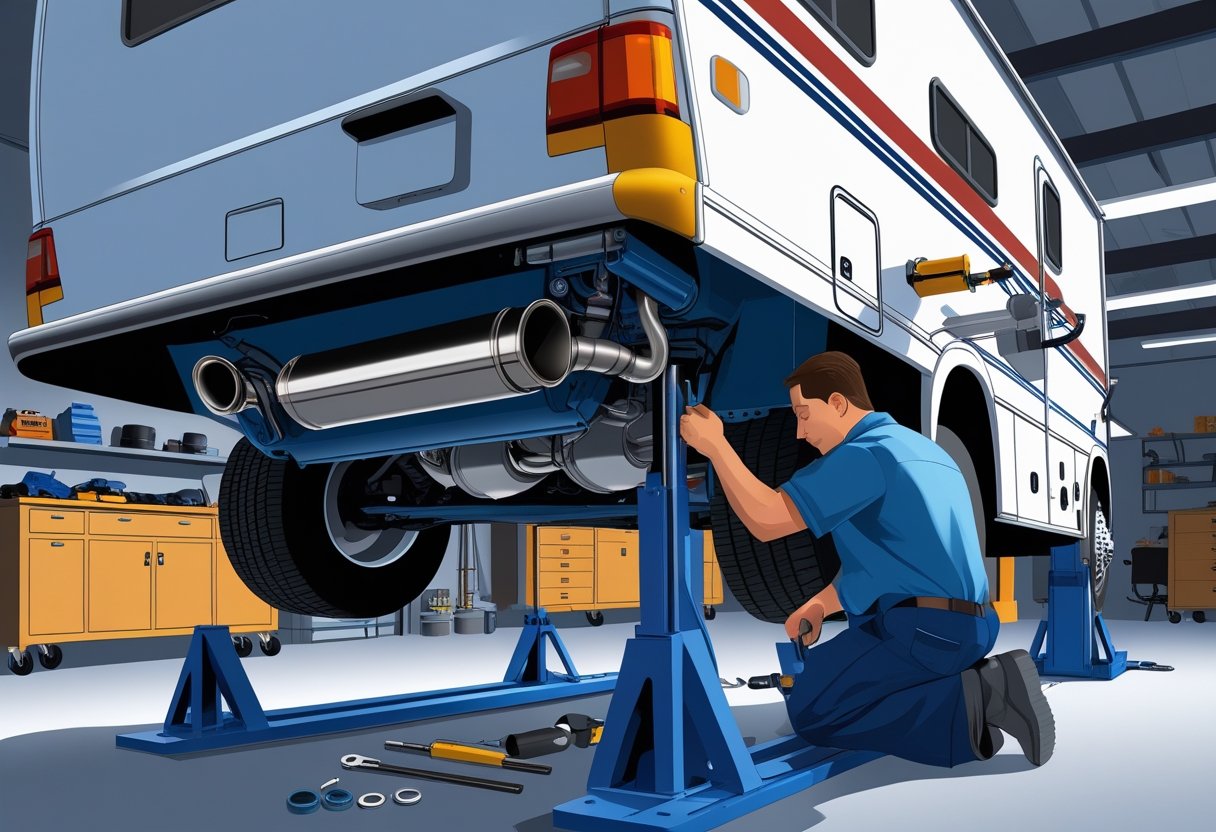
The catalytic converter sits in the exhaust system between the engine and the muffler. When hot exhaust gases flow through the device, they pass over a ceramic honeycomb structure coated with catalyst materials.
This process converts three main pollutants. Carbon monoxide becomes carbon dioxide.
Hydrocarbons from unburned fuel turn into carbon dioxide and water. Nitrogen oxides break down into nitrogen and oxygen.
The converter needs to reach high temperatures to work properly. Most catalytic converters operate best between 400°F and 800°F.
Short trips or letting an RV sit for long periods can cause problems because the cat never gets hot enough to burn off deposits. The device only works when exhaust gases contact the catalyst surface.
If the honeycomb structure gets clogged or damaged, gases can’t flow through properly and the converter fails.
Common Materials and Precious Metals Used
The ceramic honeycomb inside a catalytic converter is coated with three key precious metals:
- Platinum (Pt) – Helps oxidize carbon monoxide and hydrocarbons
- Palladium (Pd) – Works with platinum to speed up oxidation reactions
- Rhodium (Rh) – Reduces nitrogen oxides into harmless nitrogen gas
These metals make catalytic converters valuable targets for theft. A single converter can contain several grams of these materials worth hundreds of dollars.
The outer shell is made from stainless steel to withstand heat, corrosion, and road debris. Modern converters also include an oxygen sensor that monitors exhaust gases.
This sensor helps the engine computer adjust the fuel mixture for better efficiency and lower emissions.
Types of Catalytic Converters in RVs
RVs use different types of catalytic converters based on their fuel type. Gasoline-powered motorhomes typically have three-way catalytic converters that handle all three major pollutants at once.
Diesel RVs require diesel oxidation catalysts. These work differently because diesel engines produce less carbon monoxide but more particulate matter.
Many diesel motorhomes also have a diesel particulate filter in addition to the cat. Larger Class A motorhomes may have two or more catalytic converters due to their bigger engines.
Class B and C motorhomes usually have one converter similar to what trucks use. The size and complexity depend on engine size and emission requirements.
Can You Legally Drive an RV Without a Catalytic Converter?
Driving an RV without a catalytic converter is illegal on public roads in all 50 states. Federal law requires catalytic converters on all vehicles to control air pollution, and removing or tampering with this emissions device violates both federal and state regulations.
Federal and State Regulations
The Clean Air Act requires all vehicles manufactured after 1975 to have catalytic converters installed. This federal law applies to RVs just as it does to cars and trucks.
The Environmental Protection Agency enforces these rules across the country. Removing a catalytic converter from an RV breaks federal law.
Tampering with emissions equipment can result in fines up to $2,500 per violation under federal regulations. Each state also has its own laws that make it illegal to operate a vehicle without a working catalytic converter on public roads.
RV owners can only legally drive without a catalytic converter on private property. Race tracks and off-road areas fall under this exception.
The moment an RV enters a public road, highway, or street, it must have a functioning catalytic converter.
Emissions Testing and Compliance
Most states require regular emissions testing for RVs. The testing checks whether the vehicle meets air quality standards.
An RV without a catalytic converter will immediately fail emissions testing. States with strict emissions programs include California, New York, Texas, and Illinois.
These states conduct thorough inspections that detect missing or modified catalytic converters. The testing equipment measures the pollutants coming from the exhaust system.
A failed emissions test prevents RV registration renewal. Owners cannot legally operate their RV until they install a new catalytic converter and pass the required testing.
The cost of a replacement catalytic converter for an RV ranges from $1,000 to $3,000 depending on the model.
Penalties for Non-Compliance
Law enforcement can issue tickets for driving without a catalytic converter. Officers can identify the violation through visual inspection or excessive exhaust noise.
The fines vary by state but typically range from $100 to $500 for the first offense. Repeat violations lead to higher fines and potential vehicle impoundment.
Some states classify catalytic converter removal as a misdemeanor offense. This creates a criminal record that affects insurance rates and employment opportunities.
The resale value of an RV drops significantly without a catalytic converter. Buyers avoid vehicles with emissions violations because they cannot register or insure them.
Dealerships and private buyers will either refuse the sale or demand steep discounts to cover replacement costs.
Immediate Effects of Driving an RV Without a Catalytic Converter
When an RV operates without a catalytic converter, drivers will notice several immediate changes to how the vehicle sounds, smells, and performs. The vehicle’s computer system will also detect the missing component and respond accordingly.
Increase in Exhaust Noise and Smell
The exhaust becomes much louder once the catalytic converter is removed. The internal structure of the converter normally dampens sound, so its absence creates a harsh, rasping noise similar to a straight pipe exhaust.
This increased volume can violate local noise ordinances and attract unwanted attention from law enforcement. A strong, unpleasant odor comes from the tailpipe without the converter in place.
The device normally breaks down harmful emissions like unburned hydrocarbons and nitrogen oxides into safer substances. Without this process, raw pollutants exit directly from the exhaust.
The smell is distinct and easily recognized as untreated exhaust gases.
Potential Health and Safety Hazards
Carbon monoxide levels increase significantly when an RV runs without its catalytic converter. This colorless, odorless gas is deadly in enclosed spaces.
The open exhaust system creates a higher risk of carbon monoxide entering the living area of the RV, especially when the vehicle is idling or parked with the engine running. Occupants face exposure to other toxic gases that would normally be converted into less dangerous compounds.
These harmful emissions include nitrogen oxides and volatile organic compounds. Extended exposure can cause headaches, dizziness, and respiratory problems.
The risk is especially high in RVs because passengers often occupy the vehicle while it’s running.
Check Engine Light and Error Codes
The check engine light will illuminate almost immediately after the catalytic converter is removed. Modern RVs use oxygen sensors before and after the converter to monitor its efficiency.
When both sensors read nearly identical values, the engine computer knows something is wrong. The system typically generates error codes P0420 or P0430, which specifically indicate catalytic converter efficiency problems.
Once these codes appear, the engine may enter a protective mode that reduces performance. Fuel economy usually drops, and the RV may experience reduced power until the issue is fixed.
The vehicle will fail emissions testing with these active error codes.
Mechanical and Performance Consequences
Removing or driving without a catalytic converter creates immediate problems with engine sensors, exhaust flow, and fuel delivery systems. Modern RV engines depend on precise feedback from oxygen sensors to adjust air-fuel mixtures, and losing the converter disrupts this entire monitoring chain.
Impact on Engine Performance
The engine control unit uses data from oxygen sensors to keep the air-fuel mixture at optimal levels. When the catalytic converter is missing, the downstream oxygen sensor sends abnormal readings that confuse the computer.
This triggers the check engine light and often stores trouble codes like P0420. The engine may run rough at idle because the computer tries to compensate for readings it doesn’t understand.
Some RV owners notice hesitation during acceleration or a lack of power when climbing hills. The problem gets worse over time as the engine control unit switches to default “limp mode” settings that reduce performance to prevent damage.
Influence on Fuel Efficiency
Fuel economy drops when oxygen sensors can’t provide accurate data to the engine computer. The system often defaults to a rich fuel mixture, which means it pumps more gasoline or diesel than needed into the cylinders.
This wastes fuel and increases operating costs on long trips. Drivers typically see a 10-20% reduction in miles per gallon after the catalytic converter is removed or stolen.
The pre-cat O2 sensor still functions, but without the rear sensor’s feedback, the engine can’t fine-tune combustion properly. Over thousands of miles, the extra fuel consumption costs far more than replacing the converter.
Effects on Oxygen Sensors
The downstream oxygen sensor is designed to read exhaust gases after they pass through the catalytic converter. Without the converter in place, this sensor detects raw, unprocessed exhaust that falls outside its expected range.
The sensor sends continuous fault signals to the engine computer. Over time, exposure to higher concentrations of unburned hydrocarbons and carbon monoxide can damage both the pre-cat O2 sensor and downstream sensor.
These sensors have a limited lifespan anyway, but the harsh conditions accelerate wear. Replacing failed oxygen sensors adds to repair costs while the root problem remains unfixed.
Risks to Exhaust Components
The catalytic converter helps manage exhaust temperature and backpressure throughout the system. Removing it changes how heat flows through the exhaust pipe and flex pipe connections.
Higher temperatures can damage gaskets, crack welds, and cause the muffler to fail prematurely. Turbocharged RV engines face additional stress because the turbocharger relies on specific exhaust flow characteristics.
Altered backpressure can cause the turbo to spin incorrectly, leading to bearing damage or complete turbo failure. Exhaust valves in the engine head also experience more heat stress without the converter’s temperature-moderating effect, which can lead to valve seat erosion and compression loss.
Environmental Impact and Emissions Concerns
Removing or driving without a catalytic converter in an RV releases significantly higher levels of toxic gases into the atmosphere. These uncontrolled emissions directly harm air quality and contribute to environmental problems that affect both human health and ecosystems.
Increase in Harmful Emissions
A catalytic converter reduces harmful exhaust gases by up to 90% through chemical reactions. Without this device, an RV releases these pollutants directly into the air at their original concentrations.
The converter uses a ceramic structure coated with platinum, palladium, and rhodium to trigger reactions that transform dangerous gases into less harmful substances. When an RV operates without a catalytic converter, the engine produces the same amount of toxic gases, but none of them get converted.
This means every mile driven releases substantially more pollutants than a properly equipped vehicle. The difference becomes particularly noticeable during acceleration and high-load driving conditions when engines produce more exhaust.
Contribution to Air Pollution and Poor Air Quality
Vehicles without catalytic converters release emissions that degrade air quality in surrounding areas. These pollutants mix with sunlight and other atmospheric compounds to create smog, which reduces visibility and creates respiratory hazards.
Urban areas and popular RV destinations suffer the most impact when multiple vehicles operate without proper emission controls. Communities near highways and camping areas experience higher concentrations of pollutants when RVs drive without catalytic converters.
This contributes to ground-level ozone formation and particulate matter buildup.
Specific Pollutants Released
Carbon monoxide is a colorless, odorless gas that prevents oxygen from reaching body tissues. Without a catalytic converter, an RV releases three to four times more carbon monoxide into the air.
Nitrogen oxides form when nitrogen and oxygen combine at high engine temperatures. These compounds cause acid rain and respiratory problems.
A missing converter allows nitrogen oxide levels to remain 10 times higher than normal.
Hydrocarbons are unburned fuel particles that escape through the exhaust. They react with nitrogen oxides in sunlight to create smog.
Uncontrolled hydrocarbon emissions from an RV can be five times higher without the converter.
The catalytic converter also affects carbon dioxide output indirectly by improving fuel efficiency through better combustion management.
Repair, Replacement, and Temporary Solutions
Would you like to save this article?
RV owners facing catalytic converter issues have several paths forward, from choosing between aftermarket and OEM parts to exploring temporary fixes. Cost factors and insurance coverage play major roles in deciding which solution works best.
Options for Aftermarket and OEM Catalytic Converters
OEM catalytic converters are made by the original equipment manufacturer and guarantee proper fitment for specific RV models. These parts cost more but eliminate compatibility problems.
One RV owner reported that an insurance company recommended a cheaper aftermarket cat that didn’t fit their Ford E450, forcing them to install the OEM version instead.
Aftermarket catalytic converters offer lower prices and work well when sized correctly for the exhaust system. These parts typically cost 50-70% less than OEM options.
The quality varies between manufacturers, which affects both performance and lifespan.
Some RV owners choose to install flanges on both ends of the catalytic converter and exhaust pipes. This modification allows the converter to be removed and stored in a locked garage when the RV sits in storage.
The installation takes 10-15 minutes with basic tools.
Role of Muffler Shops and Temporary Pipe Installations
Muffler shops can order correct catalytic converters and handle the installation process. These shops have experience matching parts to specific RV chassis models.
They also install the necessary flanges and connections for secure mounting.
A straight pipe replacement removes the catalytic converter entirely from the exhaust system. This option costs less initially but creates legal problems in most states.
The exhaust becomes extremely loud without the converter, which can result in noise violation fines.
Some muffler shops weld temporary repairs to keep an RV operational until the owner can afford a full replacement. These fixes involve patching cut sections or installing short pipe segments.
The temporary solution allows the vehicle to be driven but doesn’t address emission requirements or noise levels.
Cost Considerations and Insurance Impacts
Catalytic converter replacement for an RV typically costs $2,800 per incident when using professional installation. This price includes both parts and labor.
Insurance policies often cover theft with deductibles ranging from $200-500.
Driving without a catalytic converter increases fuel consumption due to disrupted exhaust flow. The vehicle loses back pressure needed for efficient engine operation.
The resale value of an RV drops if the catalytic converter has been removed or replaced with a straight pipe. Buyers avoid vehicles with emission system modifications due to registration difficulties.
Insurance companies may also request estimates from multiple shops before approving claims, which can delay the repair process.