
Planning an RV adventure is exciting. Many people wonder if their current driver’s license will allow them to hit the road.
The answer depends on the type of RV and where it will be driven.
Most RVs can be driven with a standard Class C license as long as the vehicle weighs 26,000 pounds or less. This covers many Class B and Class C motorhomes, plus most travel trailers when combined with the towing vehicle.
The Class C license is what most people already have in their wallet for driving regular cars and light trucks. However, larger RVs that exceed the weight limit may require a different license class.
Each state has its own rules, and some add extra requirements based on vehicle length or special features like air brakes. Understanding these requirements before purchasing or renting an RV helps avoid legal issues and ensures a safe trip.
Key Takeaways
- A Class C license allows drivers to operate most RVs under 26,000 pounds in weight
- Larger RVs exceeding 26,000 pounds typically require a non-commercial Class A or Class B license
- State requirements vary, so checking with the local DMV ensures compliance with specific regulations
What Is a Class C License?
A Class C license refers to the standard driver’s license that most Americans carry in their wallets. This license type allows drivers to operate regular passenger vehicles and smaller trucks for personal use without needing commercial certification.
Definition and Purpose
A Class C license is a non-commercial license that permits drivers to operate standard passenger vehicles. Most states issue this as the default driver’s license for everyday driving needs.
The license allows operation of vehicles weighing up to 26,000 pounds with two axles. This license type serves personal transportation needs rather than commercial purposes.
Drivers can transport themselves, family members, and personal belongings. The license covers basic vehicle operation without requiring the extensive training needed for a CDL.
States use the Class C designation to distinguish standard licenses from commercial ones. The licensing process includes a written test, vision screening, and driving test.
Drivers must be at least 16-18 years old depending on state requirements.
Comparison With Other License Classes
A Class C license differs significantly from commercial driver’s licenses. A CDL Class A allows operation of combination vehicles over 26,000 pounds with trailers exceeding 10,000 pounds.
A CDL Class B permits single vehicles over 26,000 pounds.
Key License Distinctions:
- Class C License: Standard non-commercial license for vehicles under 26,000 lbs
- CDL Class A: Commercial vehicles with combined weight over 26,000 lbs
- CDL Class B: Single commercial vehicles over 26,000 lbs
- CDL Class C: Commercial vehicles transporting 16+ passengers
Some states also offer non-commercial special licenses for larger recreational vehicles. These fall between standard Class C licenses and full commercial licenses.
They allow operation of heavier personal vehicles without commercial certification requirements.
Common Vehicles Covered
A Class C license covers most everyday vehicles Americans drive. This includes sedans, SUVs, pickup trucks, and minivans.
Small cargo vans and panel trucks under the weight limit also qualify. The license permits towing trailers under 10,000 pounds in most states.
This covers small camping trailers, boat trailers, and utility trailers. Drivers can also operate small moving trucks rented for personal use.
Most Class B and Class C RVs fall within Class C license limits. Class B RVs typically weigh 6,000-8,000 pounds.
Class C RVs usually weigh 10,000-12,000 pounds. Both stay well under the 26,000-pound threshold for standard licenses.
Types of RVs and License Requirements
Different RV types have varying weight limits that affect what license a driver needs. Most smaller RVs work with a standard Class C license, while larger models may require additional credentials depending on their weight and the state where they’re driven.
Class A RVs
Class A RVs are the largest motorhomes available. These vehicles often look like buses and typically range from 26 feet to 45 feet in length.
Many Class A motorhomes have a Gross Vehicle Weight Rating (GVWR) that exceeds 26,000 pounds. Some models weigh 30,000 pounds or more.
When a Class A RV exceeds the 26,000-pound threshold, a standard Class C license is not sufficient in most states. Drivers need a non-commercial Class A or Class B license for these heavier models.
However, some smaller Class A motorhomes have a GVWR as low as 12,500 pounds. These lighter models can be driven with a regular Class C license.
The specific requirements depend on the individual state’s laws. Drivers should check their RV’s exact GVWR before determining what license they need.
Class B RVs and Campervans
Class B RVs and campervans are the smallest motorized recreational vehicles. These vehicles are built on van chassis and typically range from 17 to 23 feet in length.
Most Class B RVs have a GVWR well below 26,000 pounds. The typical weight falls between 6,000 and 9,000 pounds.
This means a standard Class C driver’s license is sufficient to operate these vehicles in all states. Campervans offer an easy entry point for new RV owners.
They require no special licensing beyond what most people already have. These compact motorhomes can be parked in regular parking spaces and driven like standard vans.
Class C RVs
Class C RVs are mid-sized motorhomes built on truck or van chassis. They feature a distinctive cab-over section above the driver’s area that usually contains sleeping space.
The average Class C motorhome weighs between 10,000 and 12,000 pounds GVWR. This weight range falls comfortably within Class C license limits.
Most drivers can operate these RVs without obtaining any additional licensing. Class C motorhomes offer a balance between size and drivability.
They provide more living space than Class B models but remain easier to handle than Class A units. The standard license requirement makes them popular choices for families and first-time RV buyers.
Travel Trailers and Towables
Travel trailers and fifth-wheel trailers are not motorized. These RVs must be towed behind a truck or SUV.
The license requirements depend on the combined weight of both the towing vehicle and the trailer. A Class C license permits towing when the Gross Combination Weight Rating (GCWR) stays at 26,000 pounds or less.
The towed unit itself must weigh 10,000 pounds or less. Many small to mid-sized travel trailers meet these requirements.
Larger fifth-wheel trailers often exceed these weight limits. When the combined weight goes over 26,000 pounds, drivers need a non-commercial Class A license in most states.
The towing vehicle’s capacity and the loaded trailer weight both factor into this calculation.
Can You Drive an RV With a Class C License?
Most drivers can operate an RV with a standard Class C license as long as the vehicle weighs under 26,000 pounds. Weight restrictions and vehicle dimensions determine whether additional licensing is needed, and requirements vary by state.
Typical Weight Limits and GVWR
A standard Class C driver’s license covers vehicles with a Gross Vehicle Weight Rating (GVWR) up to 26,000 pounds in most states. The GVWR represents the maximum weight a vehicle can safely carry, including passengers, cargo, and fuel.
Class B RVs typically weigh between 6,000 and 8,000 pounds. Class C motorhomes usually fall in the 10,000 to 12,000 pound range.
These vehicles stay well under the 26,000-pound threshold. Class A RVs present more variation.
Their weight ranges from 13,000 to 30,000 pounds. Models under 26,000 pounds can be driven with a regular license.
Heavier models trigger special licensing requirements in many states. Drivers who tow trailers need to consider combined weight.
Some states require upgrades when the combined weight of the towing vehicle and trailer exceeds 26,000 pounds. Others set a 10,000-pound limit specifically for the towed vehicle.
Vehicle Size and Length Considerations
Weight restrictions form the primary licensing criteria, but some states add length requirements. California requires a Class B license for RVs over 40 feet, even if they weigh less than 26,000 pounds.
Wisconsin mandates a CDL for any RV exceeding 45 feet in length. This requirement applies regardless of the vehicle’s weight.
Most states focus solely on GVWR and do not impose length restrictions. Drivers should verify their state’s specific rules before purchasing or renting a longer RV.
States That Require a Special License
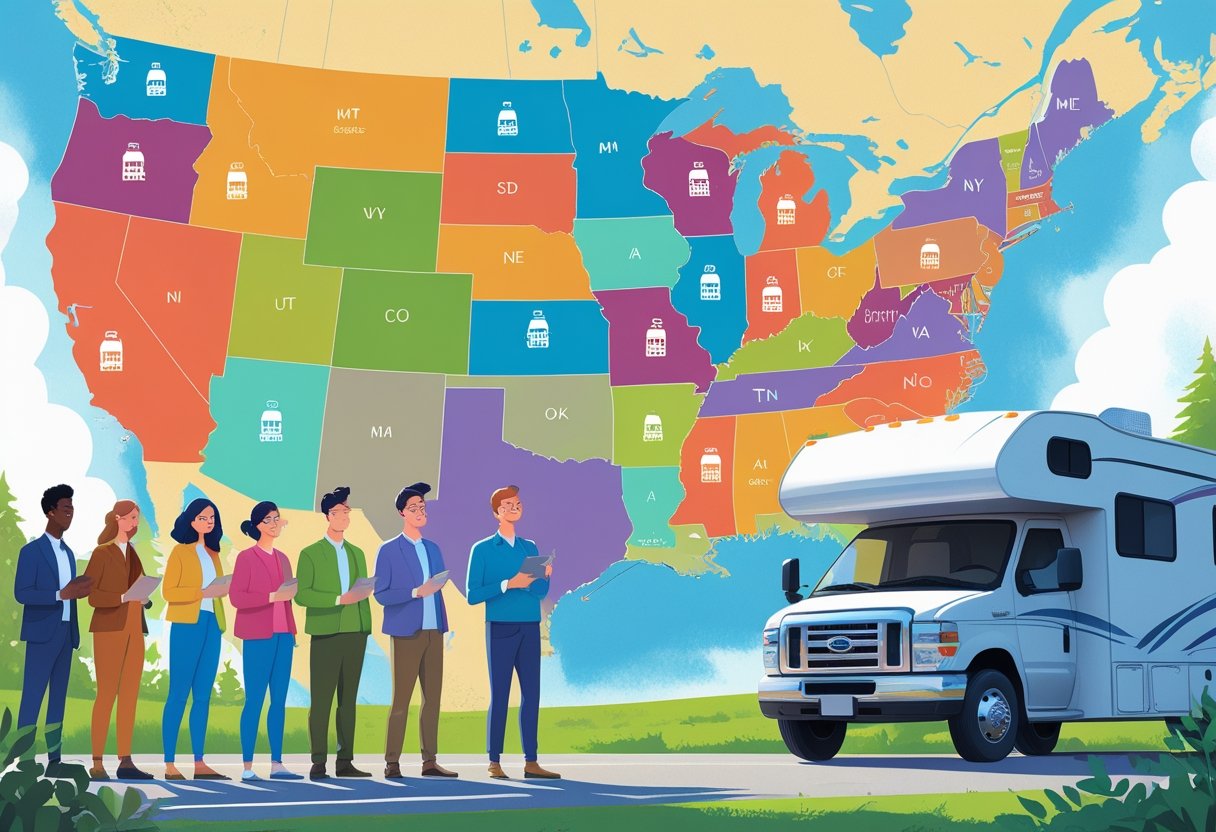
Seven states require commercial driver’s licenses for RVs over 26,000 pounds: Arkansas, Connecticut, Hawaii, Kansas, New Mexico, Washington D.C., and Wisconsin. These states treat large RVs the same as commercial vehicles.
Ten states mandate non-commercial special licenses for heavier RVs:
- California: Class B license for vehicles over 26,000 pounds or 40 feet
- Maryland: Class B license over 26,000 pounds
- Nevada: Class B for single vehicles over 26,000 pounds; “J” endorsement for trailers over 10,000 pounds
- New York: “R” endorsement for vehicles over 26,000 pounds
- North Carolina: Class B for single vehicles over 26,000 pounds
- Pennsylvania: Class B for single vehicles over 26,000 pounds
- South Carolina: Class E license for single vehicles over 26,000 pounds
- Texas: Class B for single vehicles over 26,000 pounds
- Wyoming: Class B for vehicles over 26,000 pounds towing under 10,000 pounds
- Michigan: “R” endorsement for specific towing configurations
The remaining 33 states allow drivers to operate RVs of any weight with a standard driver’s license. These states exempt recreational vehicles from commercial licensing requirements.
State-Specific Rules for RV Licensing
Would you like to save this article?
RV licensing requirements change based on where a driver lives. Most states allow drivers to operate smaller RVs with a standard Class C license, but some states require special licenses for larger vehicles that exceed certain weight limits.
States With No Special License Needed
The majority of U.S. states allow drivers to operate RVs with a standard Class C driver’s license as long as the vehicle stays under 26,000 pounds GVWR. This includes most Class B and Class C motorhomes, along with many travel trailers and fifth wheels.
States like Florida, Texas, and Arizona follow the 26,000-pound rule without additional requirements. These states also permit towing as long as the combined weight stays under 26,000 pounds and the towed unit weighs less than 10,000 pounds.
Most states in this category do not require any endorsements for personal RV use. Drivers can travel freely without taking extra tests or obtaining a special license.
This applies to recreational use only, not commercial purposes.
States Requiring Non-Commercial Special Licenses
Some states require a non-commercial Class A or Class B license for RVs that exceed 26,000 pounds. These licenses differ from a CDL because they are specifically for personal use, not business purposes.
California requires a non-commercial Class B license for single RVs over 26,000 pounds GVWR. The state also requires a non-commercial Class A license for combination vehicles that exceed this weight threshold.
Other states with similar requirements include:
- Montana – Non-commercial Class A for combinations over 26,000 pounds
- New York – Non-commercial Class B for vehicles over 26,000 pounds
- Hawaii – Non-commercial Class B for larger motorhomes
Drivers must check their state’s DMV website to confirm current driver’s license requirements. Each state has different testing and documentation processes for these non-commercial licenses.
States Requiring a Commercial Driver’s License (CDL)
Very few states require a commercial driver’s license for personal RV use. A CDL is typically only mandatory when an RV is operated for business purposes, such as transporting passengers for hire or delivering goods.
Alaska previously required a CDL for certain large RVs, though regulations have changed over time. Most states now distinguish between commercial and recreational use, allowing personal RV travel without a CDL regardless of size.
However, if an RV has air brakes, some states may require a specific air brake endorsement. This applies even for non-commercial licenses in certain jurisdictions.
Obtaining and Upgrading Your License for RVs
Most RV drivers can start with a standard Class C license. Some situations require additional endorsements or an upgraded license class.
The specific requirements depend on the RV’s weight, whether it has air brakes, and individual state laws.
How to Check State Requirements
The state Department of Motor Vehicles (DMV) or Department of Public Safety (DPS) website provides the most accurate information about RV license requirements. Drivers should search for terms like “RV driver’s license requirements” or “non-commercial Class A license” on their state’s DMV site.
Weight limits are the primary factor in most states. The 26,000-pound GVWR threshold determines whether a standard license suffices or if an upgrade is needed.
Some states also impose length restrictions that affect licensing requirements. Each state maintains different rules for recreational vehicles.
Drivers planning to travel across state lines should check requirements for each state they plan to visit. Contact information and licensing guides are available on official state DMV websites.
License Endorsements for RVs
An air brake endorsement may be required in certain states if the RV is equipped with air brakes. This endorsement applies regardless of the vehicle’s weight in some jurisdictions.
The endorsement requires passing a written test about air brake systems. A CDL is not necessary for personal RV use in any state.
Commercial licenses only become mandatory when operating an RV for business purposes, such as transporting passengers for hire or delivering goods. Some states offer specific endorsements for towing large trailers.
These endorsements apply when the combination weight exceeds standard limits but doesn’t require a full commercial license.
Process for Upgrading Your License
Drivers who need a non-commercial Class A or Class B license must apply through their state DMV. The application typically requires proof of identity, residency documents, and the current driver’s license.
Most states require a written knowledge test covering vehicle operation and safety for larger vehicles. Some states also mandate a skills test in the actual RV or a similar vehicle.
The skills test evaluates basic maneuvers like turns, backing, and parking. The fee for upgrading a license varies by state but typically ranges from $20 to $100.
Processing times differ, with some states issuing upgraded licenses immediately and others taking several weeks. Drivers should apply well before planned travel dates to avoid delays.
Additional Considerations for Driving an RV
Beyond licensing requirements, RV drivers need proper insurance coverage. They must also understand rental agreements if not using their own vehicle.
Drivers should follow basic safety practices to protect themselves and others on the road.
Insurance Requirements
RV insurance differs from standard auto insurance in several important ways. Most states require liability coverage at minimum, but RV policies need higher limits due to the vehicle’s size and potential damage.
Personal auto insurance does not typically cover RVs over a certain size. Class C motorhomes usually need their own dedicated policy.
Full-time RVers need specialized coverage that includes personal belongings and liability protection similar to homeowner’s insurance. Insurance costs vary based on the RV’s value, type, and how often it gets used.
Additional coverage options include collision, comprehensive, vacation liability, and roadside assistance. Many insurers offer discounts for safety courses or anti-theft devices.
Travel trailers towed by a regular vehicle may be covered under an existing auto policy’s extension. Owners should verify this before camping trips.
RV Rental and Driving
When you rent an RV, the rental company typically provides insurance options at checkout. Renters should review what their personal auto insurance and credit cards already cover to avoid paying for duplicate protection.
Rental agreements usually require drivers to be at least 25 years old with a clean driving record. Some companies allow younger drivers with an additional fee.
The renter must have a valid Class C license for vehicles under 26,000 pounds. Most rental companies provide a vehicle orientation before departure.
This walkthrough covers operating systems like slide-outs, generators, water tanks, and electrical hookups. Renters should ask questions about anything unclear during this session.
Mileage limits and generator hour restrictions often apply to RV rentals. Exceeding these limits results in additional fees.
Key Safety Tips for New RV Drivers
Driving an RV requires different skills than operating a standard car. The vehicle’s height means checking clearances at gas stations, drive-throughs, and underpasses becomes necessary before proceeding.
Practice turning, backing up, and parking in an empty lot before hitting highways. RVs need wider turns and more space to maneuver.
Side mirrors require frequent checking since there is no rear-view option. Allow extra distance for braking and merging.
An RV weighs significantly more than a car and takes longer to stop. Avoid sudden lane changes or sharp turns.
Essential safety practices include:
- Check tire pressure and condition before each trip
- Secure all items inside cabinets and storage areas
- Distribute weight evenly throughout the vehicle
- Drive slower than normal traffic, especially in wind or rain
- Know the RV’s exact height, length, and weight
New drivers should start with short trips close to home. This builds confidence and reveals any issues with the vehicle setup before longer camping adventures.