
Walking onto an RV dealership lot with a sticker price staring back at you can feel intimidating. That big number on the windshield might seem final — but it absolutely is not.
So, can you negotiate RV prices? The short answer is a resounding yes. In fact, failing to negotiate is one of the most expensive mistakes a buyer can make in 2026. Whether shopping for a brand-new Class A motorhome or a gently used travel trailer, the price listed is almost always just a starting point. With the right knowledge, timing, and strategy, buyers can save thousands — sometimes tens of thousands — of dollars on their next recreational vehicle purchase.
The RV market in 2026 has shifted significantly from the pandemic-era frenzy when dealers held all the cards and buyers paid over MSRP just to secure a unit. Today, supply is running slightly high, used RV values are stabilizing, and buyers have more leverage than they have had in years [1][3]. This guide breaks down exactly how to negotiate effectively, when to buy, what to watch out for, and how to walk away with the best possible deal.
Key Takeaways 📋
- Yes, you can negotiate RV prices — and in 2026, buyers have more leverage than at any point since before the pandemic thanks to higher inventory levels and stabilizing values [1][3].
- Timing matters enormously: Late fall and winter offer the strongest negotiating power, while summer is the worst time to try to haggle [1].
- Always request an itemized price sheet before signing anything — hidden fees like destination charges, doc fees, and dealer prep can add thousands to the final cost [2].
- Secure outside financing first to strengthen your position and avoid dealer financing traps that inflate the true cost of ownership [2].
- New RVs depreciate rapidly, sometimes leaving owners owing more than the RV is worth within the first year, which makes negotiating the purchase price even more critical [2].
Why Can You Negotiate RV Prices in 2026?
Would you like to save this article?
Understanding why negotiation is possible — and even expected — in the RV industry requires a look at how this market works compared to other major purchases.
RVs Are Not Like Buying Groceries
Unlike everyday consumer goods with fixed retail prices, recreational vehicles operate on a dealer markup model. Manufacturers set a Manufacturer’s Suggested Retail Price (MSRP), but dealerships purchase units at wholesale cost and then add their own margin. That margin is where negotiation lives. Depending on the unit, the markup can range from 20% to 40% or more above the dealer’s invoice cost.
The 2026 Market Favors Buyers
Several factors make 2026 a particularly strong year for negotiation:
| Market Factor | Impact on Negotiation |
|---|---|
| Inventory levels | Supply is running slightly high, giving buyers more choices and more leverage [3] |
| Stabilizing used values | After years of pandemic-era chaos, pricing is more predictable [3] |
| Projected shipments | 2026 RV shipments are projected at 349,300 units (median forecast), a 2.8% increase over 2025 [4] |
| Elevated sticker prices | Manufacturers have maintained higher prices from the pandemic boom, creating room for negotiation [2] |
| Market characterization | The RV Industry Association describes the market as “stable, resilient, and preparing for renewed growth” [4] |
This combination of higher supply, stabilizing values, and inflated sticker prices creates a perfect environment for buyers who are willing to negotiate.
💡 “RV prices remain elevated through early 2026, with both new and used units still carrying inflated values that don’t match actual worth.” [2]
This means there is often a significant gap between what a dealer asks and what a unit is truly worth — and that gap represents potential savings for informed buyers.
When Can You Negotiate RV Prices Most Effectively? 🗓️
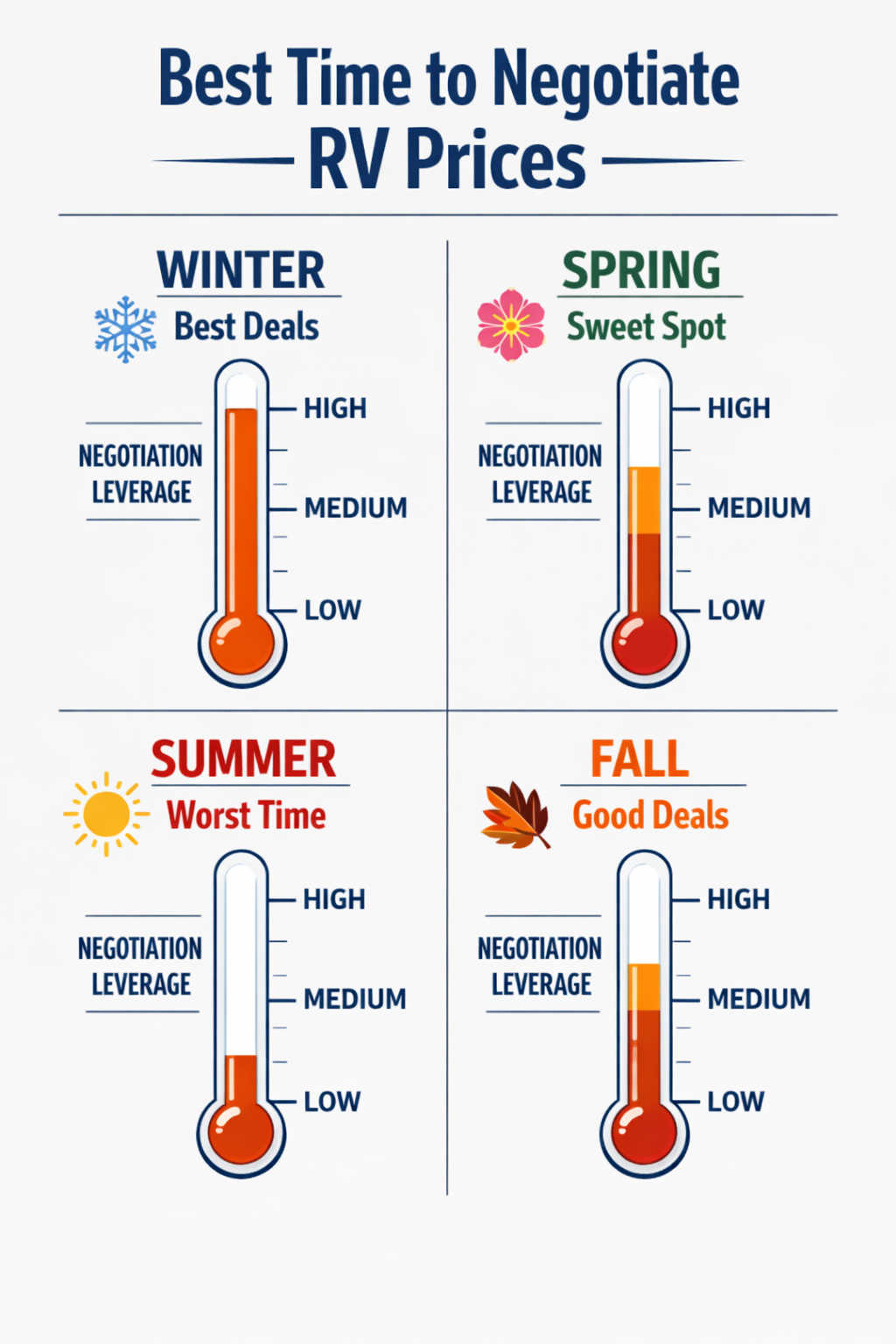
Timing is arguably the single most powerful tool in an RV buyer’s negotiation toolkit. The time of year dramatically affects how flexible a dealer is willing to be.
Late Fall and Winter: The Golden Window ❄️
Late fall and winter offer the best deals on RVs [1]. During these months:
- Demand drops significantly as fewer people are thinking about camping
- Dealers are motivated to clear out current-year inventory before new models arrive
- End-of-year sales targets create pressure on dealership managers
- Financing promotions may be more aggressive
This is when negotiating power is at its absolute strongest. Dealers would rather sell a unit at a lower margin than carry it through winter, paying for floor plan financing (the interest they pay on unsold inventory).
Spring: The Sweet Spot 🌸
Spring presents an interesting negotiation sweet spot, particularly right after RV show season and before peak summer demand kicks in [3]. During this window:
- Dealers have taken in trade-ins from show season and need to move used inventory
- Cash is tied up in trade-in units, creating motivation to sell
- New model excitement can make leftover units easier to negotiate on
- Buyers still have reasonable selection before summer shoppers thin out inventory
Summer: The Worst Time to Negotiate ☀️
Summer is the worst time to negotiate RV prices [1]. The reasons are straightforward:
- Everyone wants to camp, so demand is at its peak
- Dealers know buyers are emotionally driven by upcoming vacations
- There is less motivation to discount when units are selling at or near asking price
- Selection may be more limited on popular models
Negotiation power drops significantly during summer months. If possible, avoid making a major RV purchase between June and August.
Seasonal Negotiation Power Summary
| Season | Negotiation Power | Why |
|---|---|---|
| Winter ❄️ | ⭐⭐⭐⭐⭐ Strongest | Low demand, year-end clearance pressure |
| Late Fall 🍂 | ⭐⭐⭐⭐⭐ Strongest | Inventory clearing, reduced traffic |
| Spring 🌸 | ⭐⭐⭐⭐ Strong | Post-show season, pre-summer window |
| Summer ☀️ | ⭐⭐ Weakest | Peak demand, high buyer competition |
How to Negotiate RV Prices: Step-by-Step Strategy
Knowing that negotiation is possible is one thing. Executing it effectively is another. Here is a proven, step-by-step approach to getting the best deal.
Step 1: Do Your Research Before Visiting a Dealership 📊
Knowledge is the foundation of every successful negotiation. Before setting foot on a lot:
- Research fair market values using tools like NADA Guides, RV Trader, and comparable listings in the area
- Understand the specific model — its features, common issues, and how long it has been on the lot
- Check for signs the list price is too high, such as extended days on market, price reductions already made, or pricing significantly above comparable units [6]
- Know the difference between MSRP, invoice price, and street price
Step 2: Secure Outside Financing First 🏦
One of the most powerful moves a buyer can make is to obtain outside financing offers before stepping foot in a dealership [2]. This accomplishes several things:
- It establishes a baseline interest rate that the dealer must beat
- It removes the dealer’s ability to manipulate financing terms to recover margin lost on the sale price
- It signals to the dealer that the buyer is serious and informed
- It protects against financing traps where favorable-looking monthly payments mask unfavorable loan terms
⚠️ Pro Tip: Dealers sometimes offer an attractive sale price but make up the difference through inflated financing terms. Having an outside offer in hand neutralizes this tactic entirely [2].
Step 3: Request an Itemized Price Sheet 📝
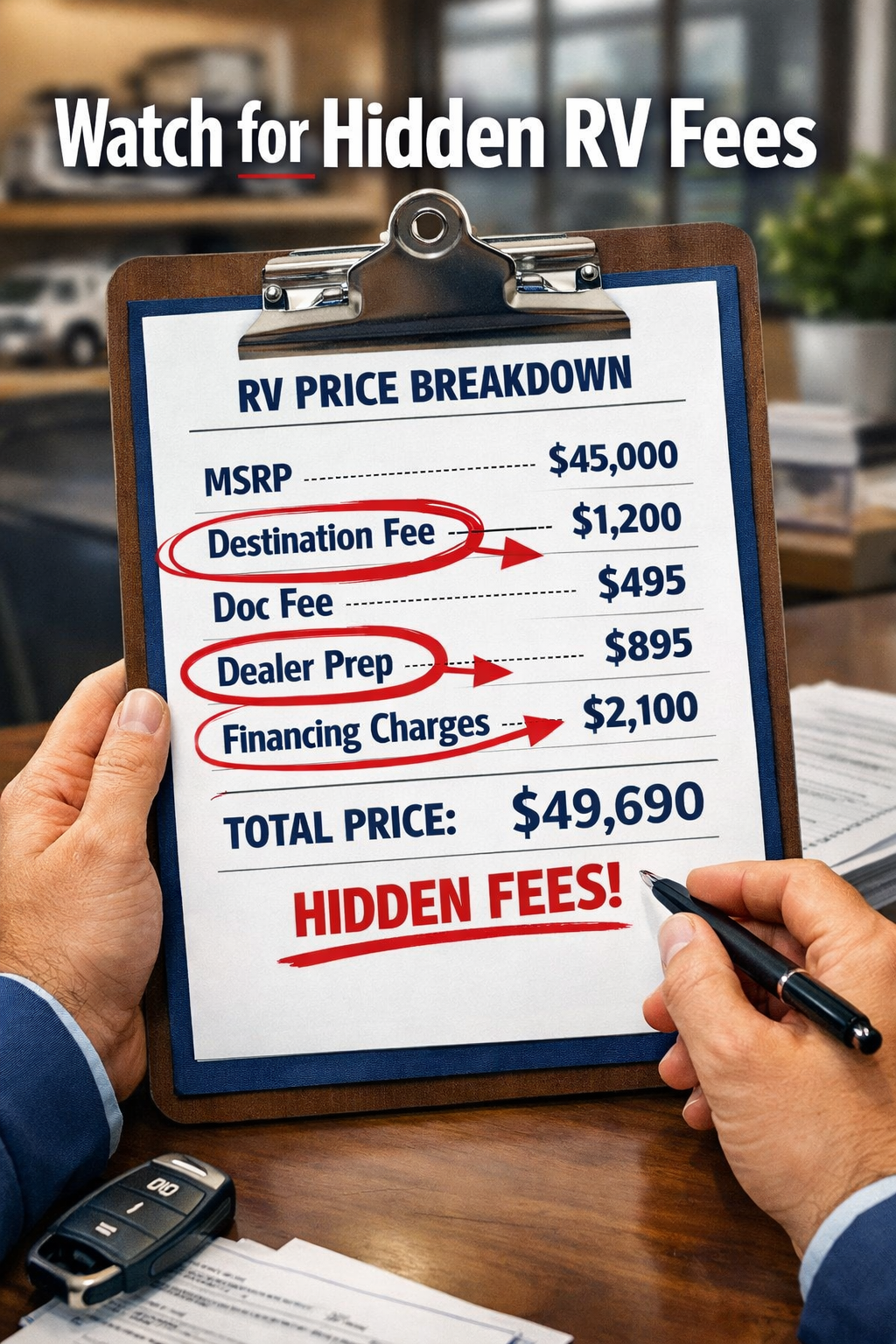
This step is non-negotiable. Before signing anything or even getting deep into discussions, request a complete itemized price sheet that breaks down every single charge [2]. This should include:
- Base price of the unit
- Destination/freight fees
- Dealer preparation fees
- Documentation (doc) fees
- Any added accessories or packages
- Tax, title, and registration
- Extended warranty costs (if included)
- Any other line items
Hidden fees are increasingly common in 2026, with dealers using deceptive “sale” pricing with bright discount stickers that mask higher final prices once fees are added [2]. An itemized sheet exposes these tactics and gives specific line items to negotiate.
Step 4: Negotiate the Total Out-the-Door Price
Never negotiate based on monthly payments. Always focus on the total out-the-door price. Here is why:
- Monthly payment negotiations allow dealers to extend loan terms, hiding the true cost
- A lower monthly payment can actually mean paying significantly more over the life of the loan
- Focusing on total price keeps the negotiation transparent and honest
Step 5: Be Willing to Walk Away 🚶
The most powerful word in any negotiation is “no.” Dealers know that once a buyer is emotionally attached to a specific unit, leverage shifts to the seller. Being genuinely willing to walk away — and demonstrating it — often produces the best results.
Effective walking-away tactics include:
- Thanking the salesperson for their time and heading toward the door
- Mentioning that another dealership has a comparable unit at a lower price
- Saying the numbers do not work and leaving a business card for follow-up
- Waiting 24-48 hours before responding to a counteroffer
Can You Negotiate RV Prices on Both New and Used Units?
Absolutely — but the dynamics differ slightly between new and used RVs.
Negotiating New RV Prices
New RVs typically have the largest markup, which means there is often the most room for negotiation. However, buyers should be aware of a critical issue in 2026:
Rapid depreciation is a major concern. New RVs sold in 2026 depreciate significantly, with buyers potentially owing more than their RV is worth within the first year [2]. This makes negotiating the lowest possible purchase price even more important — every dollar saved upfront helps offset the inevitable depreciation hit.
Key strategies for new RV negotiation:
- Target leftover model years — dealers are especially motivated to move these units [1]
- Ask for the invoice price as a starting point rather than working down from MSRP
- Negotiate dealer-added accessories separately from the base unit price
- Request complimentary services like free first-year maintenance, winterization, or a walk-through orientation
Negotiating Used RV Prices
Used RVs offer a different negotiation landscape. With used RV values stabilizing after years of pandemic-era volatility, pricing is becoming more predictable and providing clearer negotiating ground [3].
Advantages of negotiating on used units:
- Someone else has already absorbed the steepest depreciation
- Condition issues provide concrete negotiating points (worn tires, aging appliances, cosmetic damage)
- Market comparables are easier to find and present to dealers
- Private-party sales offer even more negotiation flexibility than dealership purchases
New vs. Used Negotiation Comparison
| Factor | New RV | Used RV |
|---|---|---|
| Typical markup | 20-40%+ | 15-30% |
| Depreciation risk | Very high (first year) [2] | Lower (already depreciated) |
| Condition leverage | Minimal | Significant |
| Pricing transparency | MSRP is published | More variable |
| Negotiation room | Often substantial | Moderate to substantial |
Common Dealer Tactics to Watch For in 2026 🚨
Being aware of common dealer strategies helps buyers stay in control of the negotiation process.
The “Sale” Price Illusion
Dealers increasingly use bright discount stickers and sale pricing that appear generous but mask higher final prices once fees are added [2]. A unit advertised at “$10,000 off MSRP” might end up costing nearly the same once destination fees, dealer prep, documentation fees, and other charges are tacked on.
Defense: Always compare the final out-the-door price, not the advertised discount.
The Payment Shuffle
When a buyer focuses on monthly payments, dealers can manipulate loan terms (extending the length, adjusting the interest rate, or adding products) to hit a target payment while maximizing profit.
Defense: Negotiate total price first, financing terms second.
The Trade-In Trap
Dealers may offer an inflated trade-in value to make the deal seem attractive, then recover that money by holding firm on the new unit’s price or adding fees.
Defense: Know the true market value of the trade-in and negotiate each element of the deal independently.
Pressure and Urgency Tactics
Phrases like “this deal is only good today” or “we have another buyer looking at this unit” are designed to short-circuit rational decision-making.
Defense: Legitimate deals do not expire overnight. Take time to think, compare, and decide without pressure.
Practical Negotiation Checklist ✅
Use this checklist before and during the RV buying process:
- Researched fair market value for the specific make, model, and year
- Secured at least one outside financing pre-approval
- Identified the best seasonal timing for purchase
- Prepared to request an itemized price breakdown [2]
- Set a firm maximum budget (total out-the-door, not monthly payment)
- Identified comparable units at competing dealerships
- Prepared to walk away if the deal does not meet expectations
- Reviewed common dealer tactics and how to counter them
- Checked for signs the list price is too high [6]
- Planned a post-negotiation inspection (ideally by an independent RV inspector)
Conclusion: Take Control of the RV Buying Process 🎯
So, can you negotiate RV prices? Without question. In 2026, the market conditions — higher inventory, stabilizing used values, and inflated sticker prices — give buyers more negotiating power than they have had in years. But leverage alone is not enough. Success requires preparation, timing, and discipline.
Here are the actionable next steps to take right now:
- Start researching the specific RV type, make, and model that fits your needs and budget. Use NADA Guides, RV Trader, and dealership listings to understand fair market pricing.
- Get pre-approved for financing from a bank or credit union before visiting any dealership. This single step dramatically strengthens your negotiating position [2].
- Plan your timing — if possible, target late fall, winter, or early spring for the best deals [1][3]. Avoid summer purchases unless absolutely necessary.
- Always request an itemized price sheet and negotiate the total out-the-door price, not monthly payments [2].
- Be prepared to walk away. The best deal often comes after the buyer has left the lot and the dealer calls back with a better offer.
The RV lifestyle is about freedom, adventure, and making memories. Starting that journey with a smart, well-negotiated purchase ensures more money stays in your pocket for the road ahead. Happy negotiating — and happy camping! 🏕️
References
[1] Watch – https://www.youtube.com/watch?v=rEqav-fvE_0
[2] Watch – https://www.youtube.com/watch?v=2Q9CdeP9KXI
[3] Rv Industry Trends 2026 What Show Season New Tech And Market Shifts Mean For Buyers – https://www.bishs.com/blog/rv-industry-trends-2026-what-show-season-new-tech-and-market-shifts-mean-for-buyers/
[4] Rv Market Expected Trend Upward 2026 – https://www.rvia.org/news-insights/rv-market-expected-trend-upward-2026
[5] 2026 Residual Value Outlook Regional Shifts And Trends – https://autovista24.autovistagroup.com/news/2026-residual-value-outlook-regional-shifts-and-trends/
[6] 6 Tell Tale Signs Your Rv List Price Is Too High – https://www.rvtrader.com/blog/2026/01/16/6-tell-tale-signs-your-rv-list-price-is-too-high/