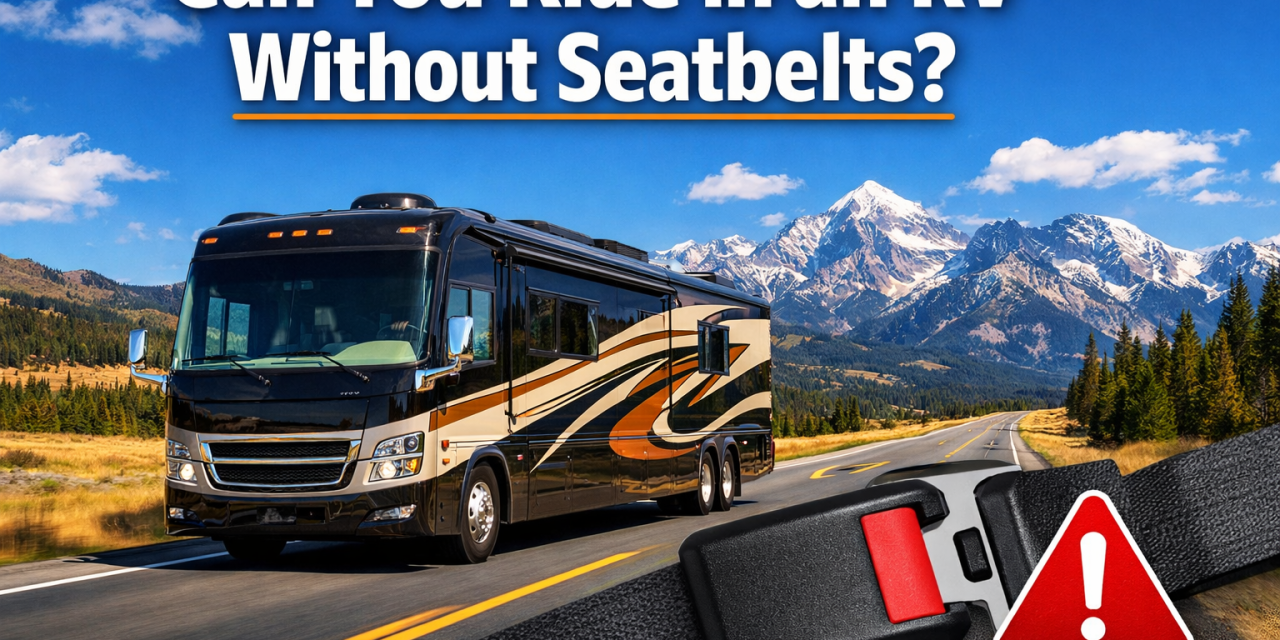
Your family is cruising down a sun-soaked highway in your Class A motorhome, kids playing cards at the dinette table, grandma relaxing on the couch. Sounds like the perfect road trip — but is it legal? More importantly, is it safe? The question “Can you ride in an RV without seatbelts?” is one of the most searched topics among RV lovers, and the answer is more complicated than a simple yes or no. Let’s break it all down. 🚐
Key Takeaways
- Every state requires front-seat passengers in RVs to wear seatbelts (with very limited exceptions).
- Rear-seat rules vary widely by state — some require all passengers to buckle up, others only require children to do so.
- Rear cabin seats in many Class A, B, and C RVs are not required by federal standards to have seatbelts installed. [5]
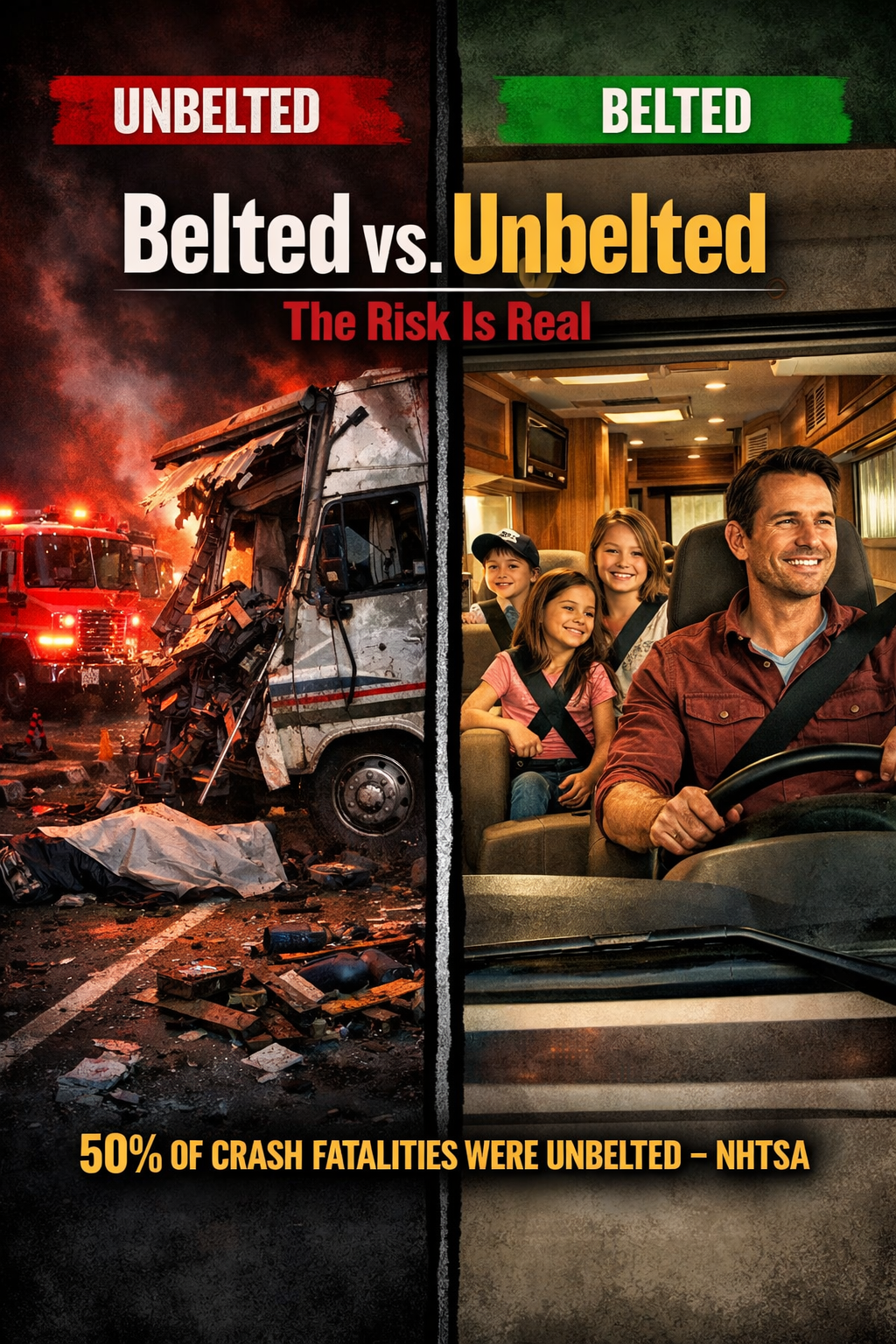
- Roughly 50% of all passenger vehicle occupants who died in crashes in 2022 were unbelted, according to NHTSA data. [1]
- New federal seatbelt warning rules take effect in 2026 and 2027, raising the bar for vehicle safety across the board. [1]
Can You Ride in an RV Without Seatbelts? Understanding the Law
Would you like to save this article?
The short answer: it depends on where you are and where you’re sitting. RV seatbelt laws in the United States are a patchwork of state regulations, and the rules differ significantly between the front cab and the rear living area.
Front Seats: No Wiggle Room
When it comes to the driver’s seat and front passenger seat, the rules are clear. Every U.S. state requires front-seat occupants in RVs to wear seatbelts, with one narrow exception — New Hampshire only mandates seatbelt use for those under 18 in the front seat. [2] [3]
So if you’re driving or riding shotgun, buckle up. No exceptions.
Rear Seats and the Living Area: A Gray Zone
Here’s where things get interesting. The rear cabin of a Class A, B, or C motorhome — think the couch, the dinette, the bunk beds — often operates in a legal gray zone.
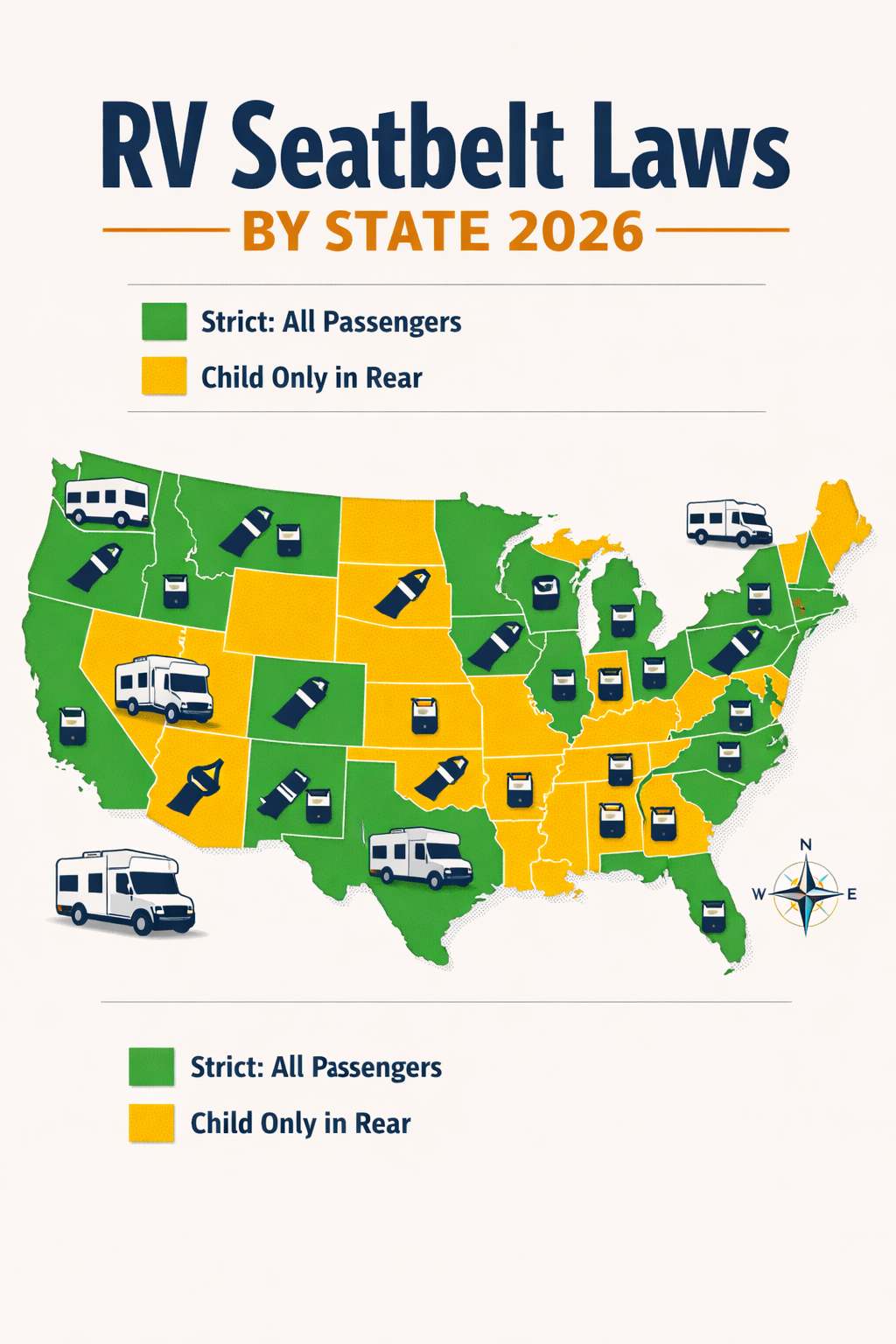
States with strict all-passenger seatbelt requirements (including rear seats in RVs):
| State | Requirement |
|---|---|
| Alaska | All passengers must be belted |
| California | All passengers must be belted |
| Delaware | All passengers must be belted |
| Kentucky | All passengers must be belted |
| Montana | All passengers must be belted |
| Nevada | All passengers must be belted |
| South Carolina | All passengers must be belted |
| Utah | All passengers must be belted |
[3] [4]
Texas takes enforcement especially seriously — officers can pull over drivers and issue tickets if any passenger is found unbelted. [6]
In states not on this list, rear-seat adults may technically be allowed to ride without a seatbelt — but that doesn’t mean it’s a good idea. More on that shortly.
💡 Pull Quote: “Just because it’s legal doesn’t mean it’s safe. In a crash at highway speed, an unbelted passenger becomes a dangerous projectile inside the RV cabin.”
The Federal Standards Gap
Here’s a surprising fact many RVers don’t know: rear cabin seats in Class A, C, and C+ motorhomes are not required to meet federal seatbelt standards. [5] This means some RV manufacturers simply don’t install proper three-point seatbelts in the living area — and they’re not legally required to.
This federal gap is one reason why the question “Can you ride in an RV without seatbelts?” doesn’t have a one-size-fits-all answer.
Who Must Wear a Seatbelt in an RV? Rules for Children and Adults
Children in RVs: Non-Negotiable Safety
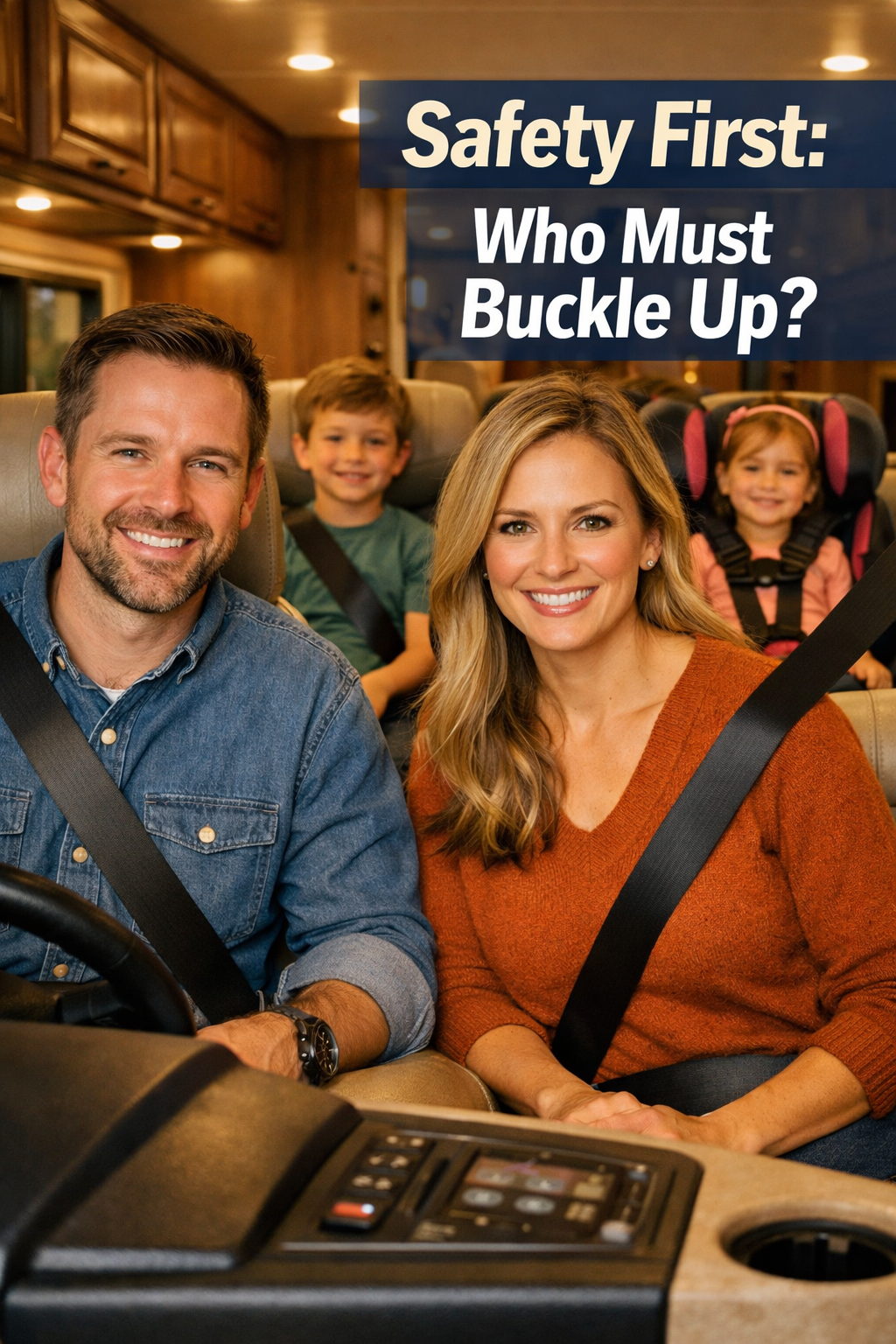
When it comes to kids, the rules are stricter — and for good reason. Children must be secured in properly installed child seats or booster seats that are attached to forward-facing vehicle seats equipped with a three-point belt system (lap belt plus shoulder strap). [6]
⚠️ Important: A child sitting at a dinette table or on a couch in the rear cabin is not properly restrained, even if the state technically allows adults to ride there unbelted. For children, always use a dedicated, forward-facing seat with a full harness system.
Adults in the Rear Cabin
For adults riding in the back of an RV:
- Check your specific state’s law before assuming it’s okay to ride unbelted.
- Even where it’s legal, riding without a seatbelt in the rear cabin is extremely risky.
- If your RV has rear seats with installed seatbelts, use them every time.
Older RVs: Possible Exemptions
Some older RV models — particularly those manufactured before 1968 — may qualify for exemptions in certain states like New Hampshire. [3] However, this is a narrow exception and should not be used as a loophole for modern vehicles.
Can You Ride in an RV Without Seatbelts? The Safety Case Against It
Even when the law allows it, the safety data tells a powerful story. 📊
The Numbers Don’t Lie
- ~50% of all passenger vehicle occupants who died in crashes in 2022 were unbelted. [1]
- Front seatbelt usage in the U.S. sits at 91.6%, but rear seatbelt use drops to just 81.7% — a significant gap. [1]
- New NHTSA rules projected to save approximately 50 lives per year and prevent 500+ injuries annually once fully implemented. [1]
New Federal Rules Are Raising the Bar in 2026
The National Highway Traffic Safety Administration (NHTSA) has finalized new rules that are changing the seatbelt landscape:
- September 1, 2026: New vehicles must meet enhanced front seat seatbelt warning system requirements. [1]
- September 1, 2027: New vehicles must include rear seat seatbelt warning systems. [1]
While these rules primarily target passenger cars and lighter vehicles (up to 10,000 lbs), they signal a clear direction: regulators are pushing hard for universal seatbelt compliance, including in rear seats.
Physics Doesn’t Care About Loopholes
In a crash at 60 mph, an unbelted 150-pound person exerts roughly 9,000 pounds of force on impact. Inside an RV cabin, that person becomes a projectile — endangering themselves and everyone else on board. No dinette table, couch cushion, or overhead bunk offers meaningful crash protection.
Practical Safety Tips for RVers 🛡️
- Always sit in a designated seat with a functioning seatbelt when the RV is moving.
- Never ride in the bathroom, bedroom, or kitchen area while the vehicle is in motion.
- Inspect seatbelts before every trip — check for fraying, stuck buckles, or retractor issues.
- Install aftermarket seatbelts if your RV’s rear cabin lacks them (consult a certified installer).
- Brief all passengers — especially kids — on seatbelt rules before hitting the road.
Conclusion: Buckle Up, Every Seat, Every Time 🚐✅
So, can you ride in an RV without seatbelts? Technically, in some states and in some rear cabin situations, the law may not require it. But the safety evidence is overwhelming — riding unbelted in any moving vehicle dramatically increases the risk of serious injury or death.
Here’s what to do right now:
- Look up your state’s specific RV seatbelt laws before your next trip (especially if you’re crossing state lines).
- Ensure every seat in your RV has a working seatbelt — if not, consider upgrades.
- Buckle up every child in a properly installed, forward-facing car seat or booster.
- Make seatbelts non-negotiable for all passengers, regardless of where they’re sitting.
- Stay informed about the new 2026–2027 NHTSA seatbelt warning requirements as they roll out.
The open road is one of life’s greatest adventures. Protect the people you love so you can enjoy every mile of it. 🌄
References
[1] Nhtsa Finalizes Seat Belt Reminder Rule Increase Seat Belt Use Improve Occupant – https://www.nhtsa.gov/press-releases/nhtsa-finalizes-seat-belt-reminder-rule-increase-seat-belt-use-improve-occupant
[2] Rv Seat Belt Laws – https://www.lazydays.com/rv-lifestyle/rv-seat-belt-laws
[3] Things Need Know Rv Safety Laws – https://rvshare.com/blog/things-need-know-rv-safety-laws/
[4] Rv Seat Belt Laws In Every Us State Canada – https://www.cruiseamerica.com/trip-inspiration/rv-seat-belt-laws-in-every-us-state-canada
[5] procarseatsafety – https://www.procarseatsafety.com/rv.html
[6] Seat Belt Safety In Rvs – https://rvsafety.com/rveducation/driving/seat-belt-safety-in-rvs