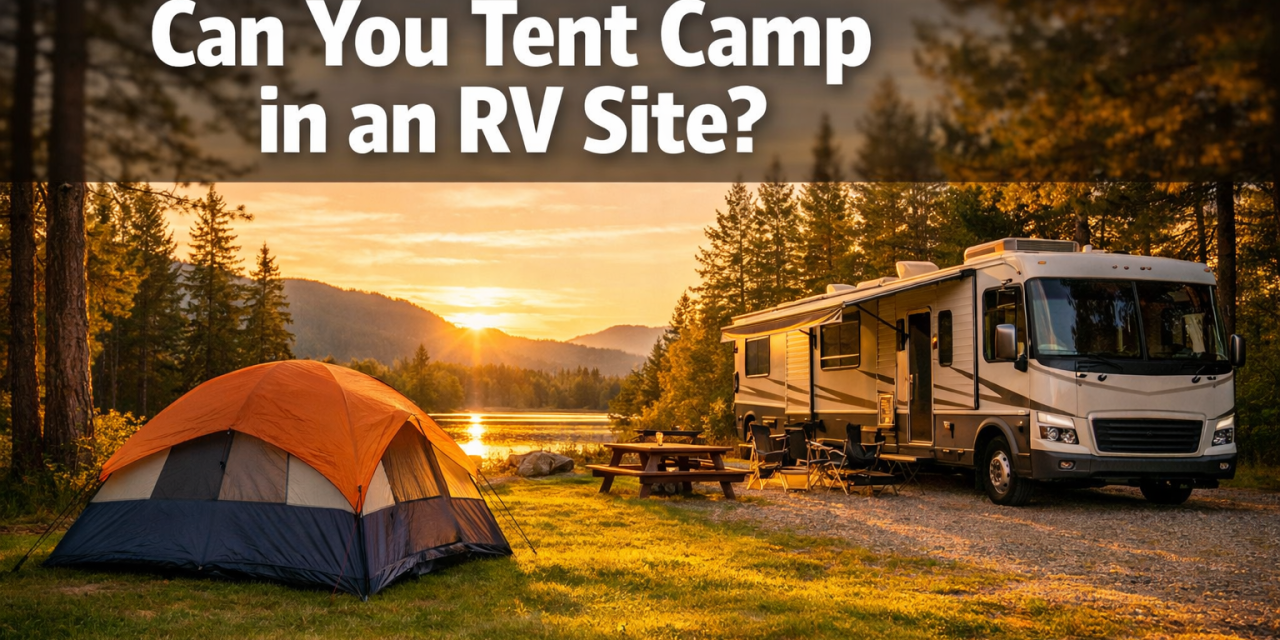
Picture this: your camping crew rolls up to a beautiful campground, but the only available spots are labeled “RV sites.” Your rig is back home, and all you have is a tent. Sound familiar? The question — can you tent camp in an RV site — comes up more often than most people realize, and the answer is more nuanced than a simple yes or no.
Whether you’re a seasoned RV owner who occasionally pitches a tent, or a tent camper eyeing an open RV pad, understanding the rules around mixed-use camping can save you from a frustrating check-in experience. This guide breaks down everything you need to know.
Key Takeaways
- 🏕️ Not all RV sites allow tents — policies vary widely by campground, state park, and private operator.
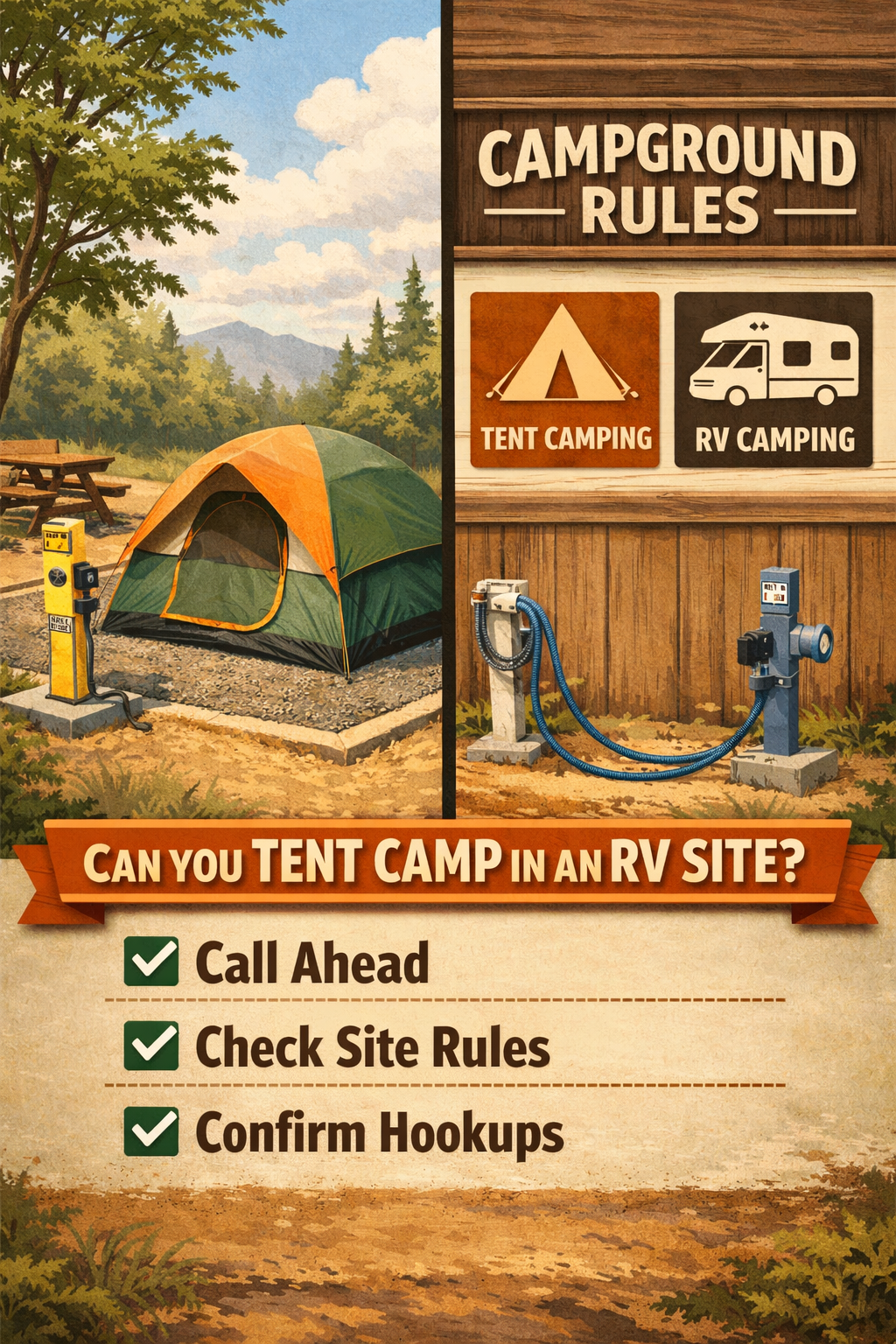
- 📋 Always call ahead to confirm whether tent camping is permitted on an RV site before booking.
- ⚡ RV hookups (electric, water, sewer) are generally not designed for tent campers, but the pad space itself may be usable.
- 🌿 California’s AB 518 is a leading example of legislation that formally allows mixed accommodation types — tents, RVs, and yurts — within the same campground framework. [2][3]
- 💡 Fees, rules, and amenities differ — tent campers on RV sites may pay RV site rates without access to all hookup benefits.
Would you like to save this article?
Can You Tent Camp in an RV Site? Understanding the Basics
The short answer: sometimes, yes — but it depends entirely on the campground’s policies.
Most campgrounds divide their sites into categories: tent-only sites, RV sites (with hookups), and sometimes “mixed” or “primitive” sites. RV sites are typically designed with:
- A gravel or paved pad large enough to accommodate a vehicle
- Electrical pedestals (30-amp or 50-amp service)
- Water hookup connections
- Sometimes sewer or dump station access
None of these features are harmful to a tent camper — but they’re also not particularly useful. The real question is whether the campground allows you to use that space without an RV.
Why Campgrounds Restrict Tent Camping on RV Sites
Campground operators have legitimate reasons for separating tent and RV sites:
| Reason | Explanation |
|---|---|
| Revenue optimization | RV sites command higher fees; tent campers may not pay the full rate |
| Safety concerns | Electrical pedestals near tent stakes can be a hazard |
| Noise and density | RV areas may have different quiet-hour enforcement |
| Reservation systems | Sites are categorized for booking accuracy |
💬 “The pad is big enough for three tents — but that doesn’t mean you’re allowed to pitch them there.” — A common reality at many campgrounds.
When Tent Camping on an RV Site IS Allowed
Many private campgrounds and some state parks do permit tent camping on RV sites, especially when:
- The campground is not fully booked and wants to fill empty pads
- The site is listed as a “combo” or “flex” site
- You’re traveling with an RV group and want a tent for extra sleeping space alongside your rig
- The campground explicitly markets mixed-use accommodations
Pro tip: Always ask directly. Call the campground office or check the fine print on booking platforms like Hipcamp, Campspot, or ReserveAmerica before assuming a site is open to tents.
How New Camping Laws Are Reshaping the Answer to “Can You Tent Camp in an RV Site?”
Legislation is beginning to formalize what many campgrounds have handled informally for years. California’s Assembly Bill 518 (AB 518) is one of the most significant recent examples of a law that explicitly permits mixed accommodation types within the same camping area. [2]
California’s AB 518: A Model for Mixed-Use Camping
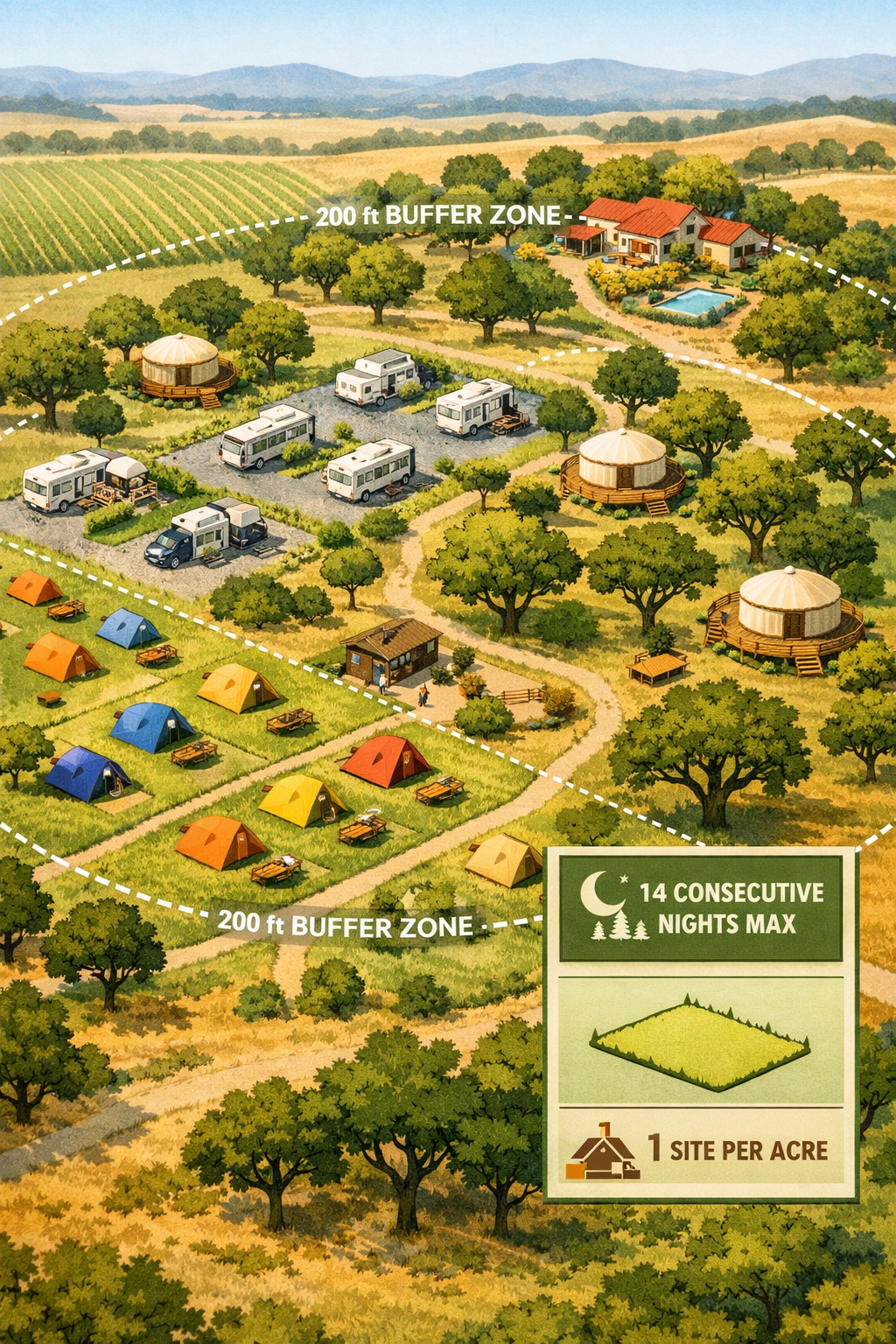
Under AB 518, farms and ranches in California can host small-scale camping operations that blend different types of temporary sleeping accommodations. Key provisions include:
- Up to nine total temporary sleeping accommodations are permitted, with no more than four designated specifically for RVs — meaning the remaining sites can be used for tents, yurts, or other shelters. [2]
- Density rules apply equally to all accommodation types: no more than one site per acre on parcels of at least two acres. [3]
- Occupancy limits are identical for tent and RV campers: a maximum of 14 consecutive nights and 28 nights total per calendar year. [3]
- Operational standards are shared: all campers must observe quiet hours from 10 p.m. to 6 a.m., sites must maintain a 200-foot buffer from off-site residences, and all accommodations must meet fire, health, and safety codes. [3]
This legislation matters because it signals a broader trend: regulators are increasingly treating tents and RVs as compatible co-users of the same camping space, rather than requiring strict separation.
What This Means for RV Lovers in 2026
For the RV community, this shift opens up exciting possibilities:
- Bring the whole crew — family members who prefer tent camping can join an RV trip without needing a separate tent-only site
- Farm and ranch camping is expanding across California, offering unique outdoor experiences on private land [3]
- More flexible booking as campground operators adapt to mixed-use frameworks
🌟 The line between “RV campground” and “tent campground” is blurring — and that’s good news for everyone who loves the outdoors.
Practical Tips for Tent Camping on an RV Site
If you’ve confirmed that tent camping is allowed on an RV site, here’s how to make the most of it:
✅ Before You Arrive
- Get written confirmation — email or screenshot the campground’s policy
- Ask about fees — will you pay the full RV site rate, or a discounted tent rate?
- Check for shade and surface — gravel pads can be uncomfortable under a tent; ask if grass areas are available
- Confirm hookup access — some campgrounds allow tent campers to use the electrical pedestal with an adapter
⛺ At the Campsite
- Avoid pitching directly on gravel if possible — use a ground cloth or footprint
- Keep clear of electrical pedestals — maintain safe distance from hookup hardware
- Respect the site boundaries — RV pads are sized for one vehicle, not multiple tents sprawling into neighboring sites
- Follow all posted quiet hours — RV areas often have stricter enforcement than tent loops
🚫 Common Mistakes to Avoid
- Assuming a large pad means unlimited tent space
- Bringing extra guests beyond the site’s occupancy limit
- Using RV hookups without permission or proper adapters
- Ignoring fire restrictions that apply equally to all site types
State Parks and National Campgrounds: Know the Rules
Rules vary significantly across different campground types:
State Parks: Many state parks have strict site classifications. California State Parks, for example, maintain specific rules about what vehicle types and accommodation styles are permitted on each site type. [8] Always check the individual park’s reservation page.
National Forest and BLM Sites: These tend to be more flexible, especially at dispersed camping areas, but designated campgrounds still have site-specific rules.
Private Campgrounds (KOA, Jellystone, etc.): Policies vary by location. Many KOA campgrounds offer “Kampsite” options that accommodate both tents and small RVs, making them a reliable choice for mixed groups.
Farm and Ranch Camping (California AB 518 sites): As of 2026, these newer venues are among the most flexible, explicitly designed to welcome both tent and RV campers under the same regulatory framework. [2][3]
Conclusion: The Smart Camper’s Approach
So, can you tent camp in an RV site? In 2026, the answer is increasingly “yes” — but only when you’ve done your homework first.
Here are your actionable next steps:
- 📞 Call the campground directly before booking — don’t assume.
- 🔍 Search for “flex” or “combo” sites on booking platforms that explicitly allow both tents and RVs.
- 🌾 Explore farm and ranch camping in California and similar mixed-use venues opening up under new legislation.
- 📋 Read the fine print on any reservation — site rules are usually listed under “site details” or “campground policies.”
- 🤝 Advocate for flexibility — if your favorite campground doesn’t allow tent camping on RV sites, let them know there’s demand for it.
The outdoor community is evolving, and smart campers — whether they prefer a tent or a Class A motorhome — benefit most when they stay informed, flexible, and respectful of the rules that make shared camping spaces work for everyone.
References
[1] California Campers Hailing New Law Expanding Camping Ranches Farms – https://www.explore.com/2018913/california-campers-hailing-new-law-expanding-camping-ranches-farms/
[2] California 2025 Ab518 Amended – https://legiscan.com/CA/text/AB518/id/3217272/California-2025-AB518-Amended.html
[3] California Law Opens Farms And Ranches To Small Scale Camping – https://moderncampground.com/usa/california/california-law-opens-farms-and-ranches-to-small-scale-camping/
[4] An Answer To Californias Camping Crunch – https://www.savetheredwoods.org/blog/an-answer-to-californias-camping-crunch/
[5] New Rv Regulations – https://rvshare.com/blog/new-rv-regulations/
[6] Farms Ranches Rural Outdoor Adventures California New Camping Law – https://www.planetware.com/2088283/farms-ranches-rural-outdoor-adventures-california-new-camping-law/
[7] California Rv Length Laws For State Parks 2026 – https://www.blackseries.net/blog/california-rv-length-laws-for-state-parks-2026.html
[8] parks.ca.gov – https://www.parks.ca.gov/?page_id=1029