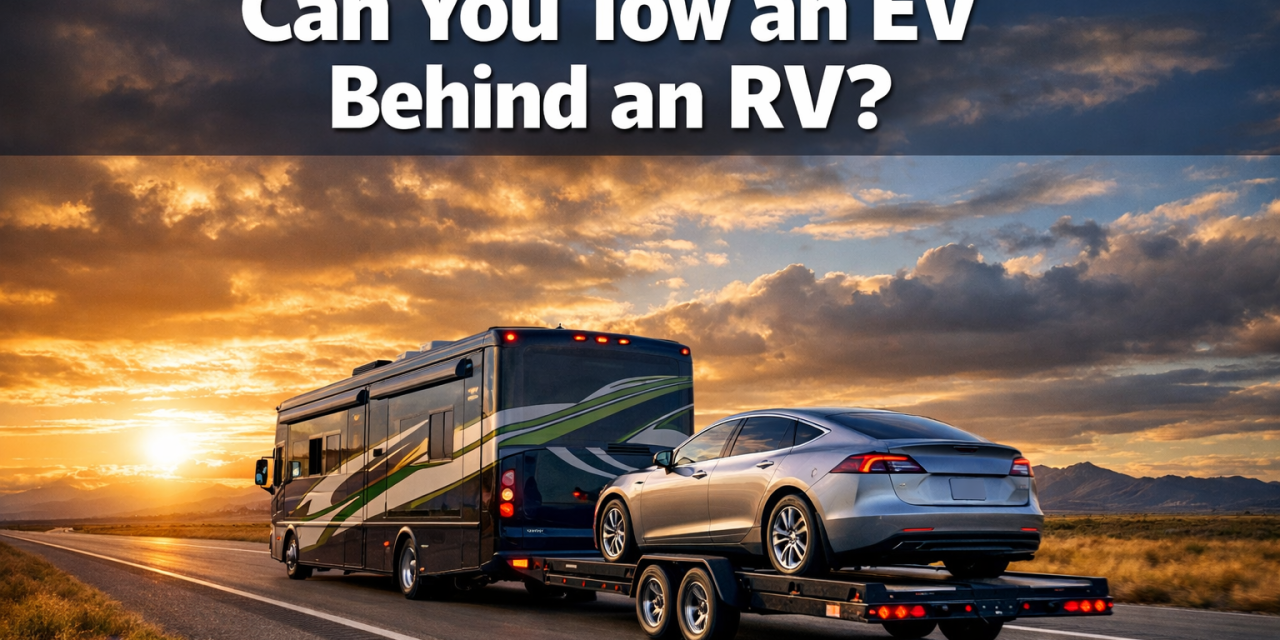
Imagine pulling into a stunning national park campsite in your Class A motorhome — only to realize your electric vehicle is stuck back home because you weren’t sure if you could bring it along. The question of can you tow an EV behind an RV is one of the most searched topics among the RV community right now, and for good reason. As EVs become more common in American driveways, millions of RV enthusiasts are wrestling with this exact dilemma. The short answer is: it’s complicated — and getting it wrong can cost you thousands in repairs.
Key Takeaways
- 🚫 Flat-towing an EV is almost universally prohibited by manufacturers due to drivetrain damage risks.
- ✅ Flatbed towing is the safest and most recommended method for transporting an EV behind an RV.
- ⚡ Spinning EV drive wheels generate voltage that can overheat electronics and stress the battery pack.
- 🔧 Automakers like Stellantis and Ford are developing solutions that may allow flat-towing EVs in the future.
- 📋 Always consult your EV owner’s manual for approved tie-down points and towing specifications before hitting the road.
Why Can You Tow an EV Behind an RV? The Technical Reality
Would you like to save this article?
This is where most RV owners get surprised. Traditional gas-powered cars can often be flat-towed (four wheels on the road) because they have a true mechanical neutral that disconnects the wheels from the engine. Most EVs do not have this feature.
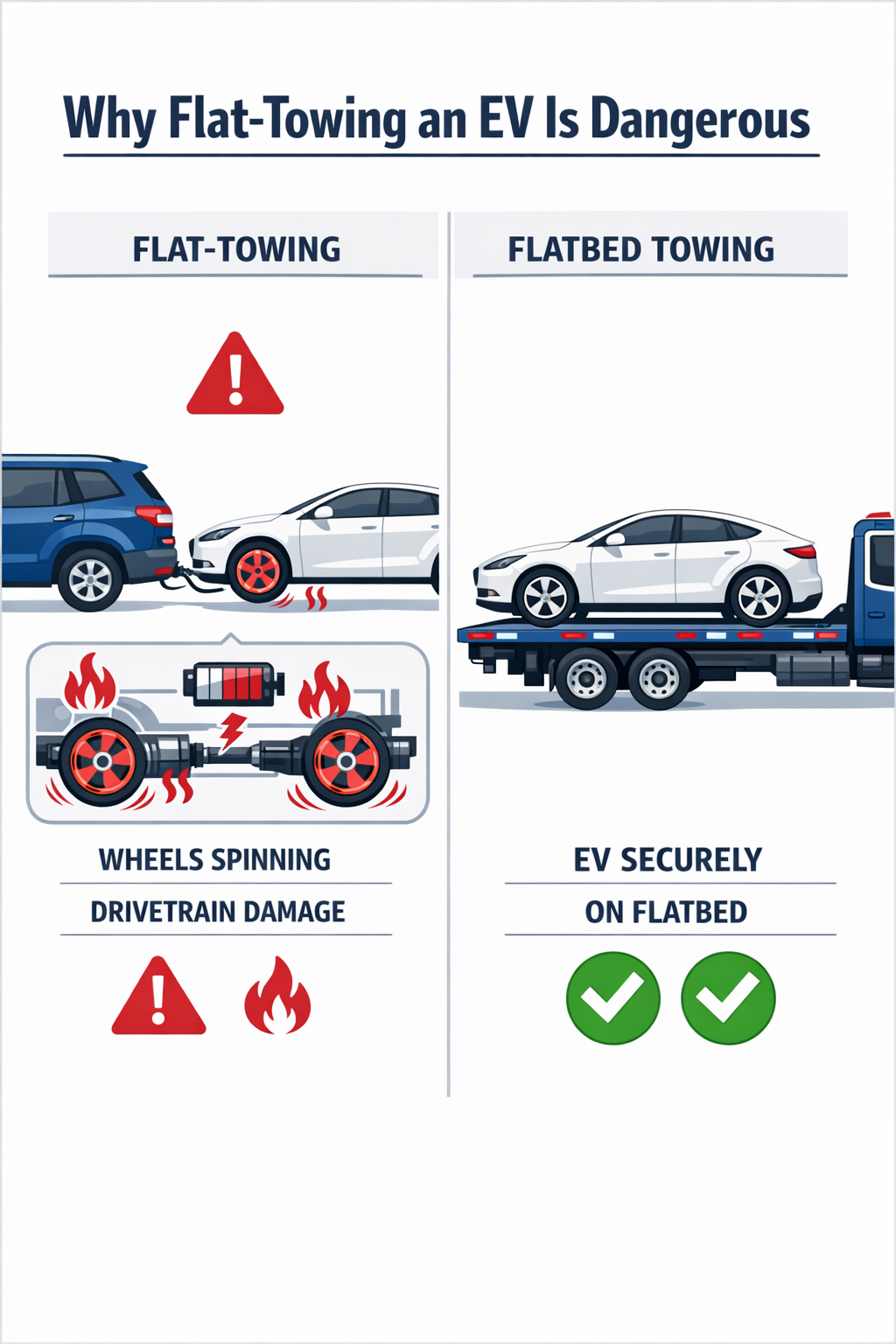
When an EV’s drive wheels spin during flat-towing, they act like generators — creating voltage in the electric motor. This voltage buildup can overheat sensitive electronics, stress the battery pack, and cause serious internal damage that may not show up immediately [1]. By the time you arrive at your destination, the damage is already done.
The Flat-Towing Problem Explained
Here’s a simple breakdown of what happens when you try to flat-tow an EV:
| What Happens | Gas Vehicle | Electric Vehicle |
|---|---|---|
| Wheels spin freely in neutral | ✅ Yes | ❌ Rarely |
| Drivetrain disconnected | ✅ Yes | ❌ Usually no |
| Motor generates voltage | ❌ No | ⚠️ Yes — dangerous |
| Risk of drivetrain damage | Low | Very High |
| Manufacturer approval | Common | Almost never |
“Spinning drive wheels create voltage in the motor that can overheat electronics and stress the battery — even at low speeds.” [1]
Which EVs Are the Most Restricted?
Tesla models (all variants) and dual-motor AWD EVs — including the Rivian R1T, Rivian R1S, and Ioniq 5 AWD — carry the strictest restrictions. These vehicles permit only flatbed towing or heavy-duty wheel dollies for very short, walking-speed repositioning in parking lots [1].
Front-wheel-drive (FWD) EVs like the Nissan Leaf have slightly more flexibility. Some FWD models may allow the front wheels to be lifted with rear wheels resting on dollies for limited distances — but even then, flatbed towing remains the recommended approach [1].
Safety Hazards Beyond the Drivetrain
Towing an EV incorrectly isn’t just a mechanical risk — it’s a safety risk too:
- 🟠 Orange-colored cables and covers mark high-voltage components. Never touch them or attempt to self-rig a damaged EV [1].
- 📍 Incorrect tie-down points can crush battery casings, coolant lines, or wiring. Always follow the manufacturer’s specifications, marked in the owner’s manual with triangle or jack-point symbols [1].
- 🚨 After a crash, always inform first responders the vehicle is electric. Require flatbed towing to a secure yard and do not attempt to disconnect the 12-volt battery unless properly trained [1].
Can You Tow an EV Behind an RV Safely? Your Best Options in 2026
So what can RV lovers actually do? The good news is there are practical solutions available right now — and exciting developments on the horizon.
Option 1: Flatbed Trailer (Best Choice ✅)
A flatbed trailer with all four wheels completely off the ground is the gold standard for transporting an EV behind an RV [1]. This eliminates any risk of drivetrain damage because the wheels never touch the road.
Pros:
- Approved by virtually every EV manufacturer
- No risk of motor voltage buildup
- Works for all EV types including AWD models
Cons:
- Adds significant weight and length to your RV setup
- Requires a motorhome with adequate towing capacity
- Higher cost than a tow bar setup
Option 2: Wheel Dolly (Limited Use ⚠️)
A wheel dolly lifts only the drive wheels off the ground. For FWD EVs, this can work for very short distances, but it is not recommended for highway travel [1].
Option 3: Drive a Second Vehicle Separately
Many full-time RVers simply have a travel partner drive the EV separately. This eliminates all towing risk and keeps both vehicles’ warranties intact.
The Energy Cost of Towing
Here’s something many RVers overlook: towing anything dramatically increases fuel or energy consumption. Independent testing confirmed that towing at highway speed increases energy consumption by 30 to 50% above the unladen baseline [4]. If your motorhome is diesel-powered, budget accordingly for longer trips.
The Future: Can You Tow an EV Behind an RV With Manufacturer Approval?
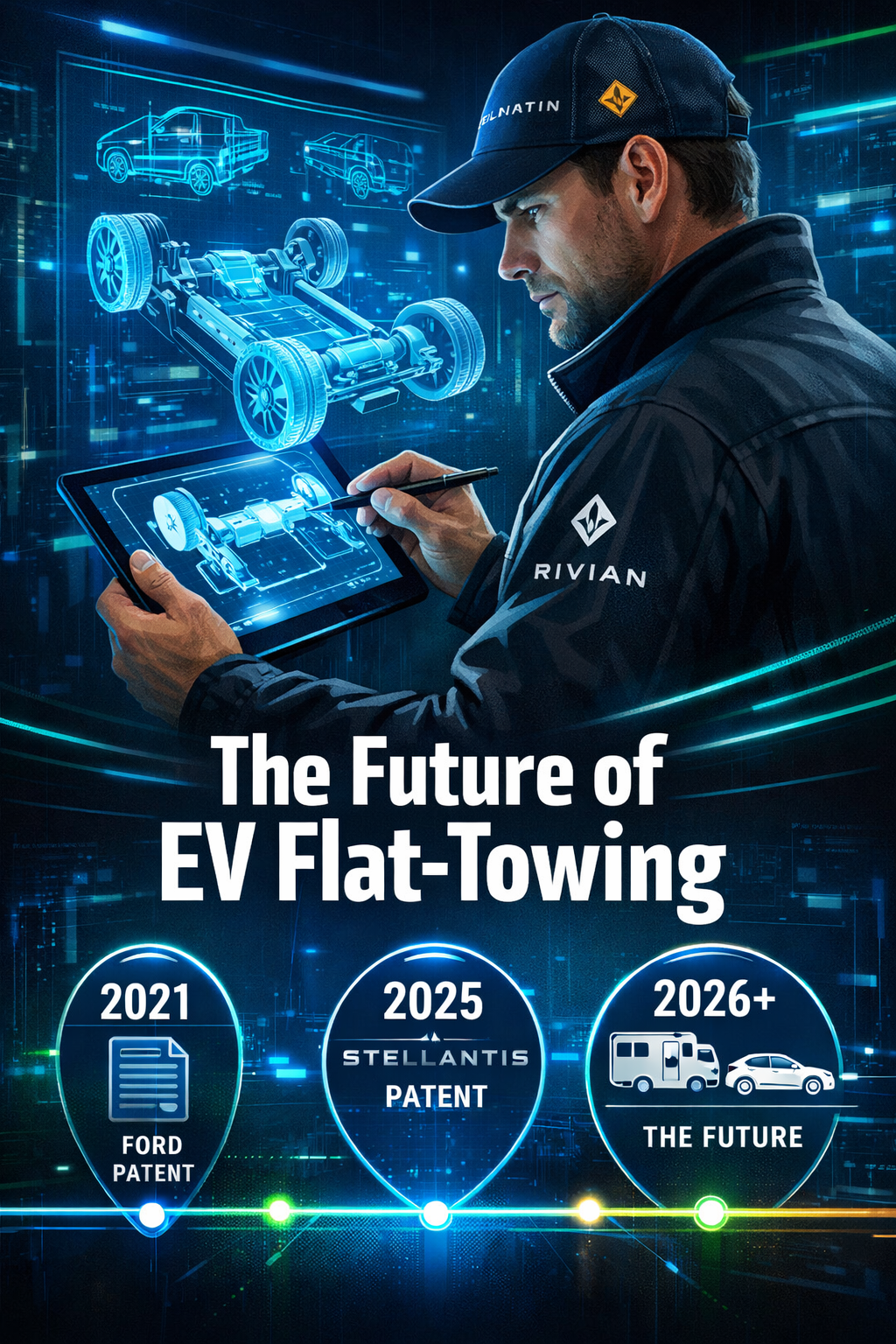
The RV community has been vocal about wanting a solution, and automakers are listening. Several promising developments are underway that could change the answer to “can you tow an EV behind an RV” dramatically in the coming years.
Stellantis Patent: High-Voltage Field Weakening
In January 2025, Stellantis published a patent proposing a high-voltage field weakening system. The technology would reduce motor torque and allow wheels to spin more freely while being isolated from the battery pack — essentially creating a safe “towing mode” for EVs [3]. If this reaches production, it could open flat-towing to a whole new generation of electric vehicles.
Ford’s Charging-While-Towed Concept
An earlier Ford patent application explored an even more creative idea: selectively charging an EV while it is being towed [3]. In this scenario, the EV’s motor could act as a generator to help boost the tow vehicle up hills — turning a limitation into an advantage. While still a patent concept, it signals that the industry sees EV towability as a priority.
What About 2026 Regulations?
New 2026 regulations focus primarily on emissions compliance labels for heavy-duty diesel motorhomes and stricter emission standards for large RVs [2]. As of 2026, no federal or state regulations specifically address or approve EV flat-towing — so always rely on your manufacturer’s owner’s manual as the final authority.
Quick Reference: EV Towing Rules by Vehicle Type
| EV Type | Flat-Tow Allowed? | Dolly Allowed? | Flatbed Required? |
|---|---|---|---|
| Tesla (all models) | ❌ No | ❌ No | ✅ Yes |
| Rivian R1T/R1S (AWD) | ❌ No | ❌ No | ✅ Yes |
| Ioniq 5 AWD | ❌ No | ❌ No | ✅ Yes |
| Nissan Leaf (FWD) | ❌ No | ⚠️ Limited | ✅ Recommended |
| Most FWD EVs | ❌ No | ⚠️ Check manual | ✅ Recommended |
Conclusion
The question of can you tow an EV behind an RV doesn’t have a simple “yes” — at least not yet. In 2026, the safest and most manufacturer-approved method remains flatbed towing with all four wheels off the ground. Flat-towing an EV risks serious drivetrain damage, voided warranties, and real safety hazards from high-voltage components.
Here are your actionable next steps:
- ✅ Check your EV’s owner’s manual for the exact towing specifications and approved tie-down points before any trip.
- ✅ Invest in a quality flatbed trailer rated for your EV’s weight if you plan to travel frequently.
- ✅ Follow patent developments from Stellantis and Ford — manufacturer-approved flat-towing may be available sooner than expected.
- ✅ Budget for increased fuel costs — towing adds 30–50% to energy consumption at highway speeds.
- ✅ Never touch orange-colored components on a damaged or crashed EV — always call trained professionals.
The RV lifestyle and the EV revolution are on a collision course — and the industry is working hard to make them compatible. Stay informed, tow safely, and enjoy the open road. 🚐⚡
References
[1] How To Tow Electric Car Safely – https://recharged.com/articles/how-to-tow-electric-car-safely
[2] New RV Regulations – https://rvshare.com/blog/new-rv-regulations/
[3] Stellantis And Rivian Working On Flat Towing For EVs – https://www.greencarreports.com/news/1145859_stellantis-and-rivian-working-on-flat-towing-for-evs
[4] Watch (Towing An RV Energy Consumption Testing) – https://www.youtube.com/watch?v=r9AqEzdt5nA