
Over 11 million households in the U.S. now own an RV — and one of the most common questions new and experienced owners ask before hitting the road is: can you use RV fridge while driving? The short answer is yes, but the how and which type matter enormously for safety, food preservation, and legal compliance.
This guide breaks down everything RV lovers need to know about running a refrigerator on the road, from propane risks to 12V compressor advantages.
Key Takeaways 📌
- Yes, you can use an RV fridge while driving — but the method depends on your fridge type.
- 12V compressor fridges are the safest and most convenient option for travel days.
- Propane fridges work while driving but carry safety and legal risks in tunnels and certain states.
- Pre-cooling your fridge before departure is one of the most effective food-safety strategies.
- Always check local regulations regarding propane use while driving through tunnels or specific regions.
Would you like to save this article?
Understanding Your RV Fridge Type Before You Drive
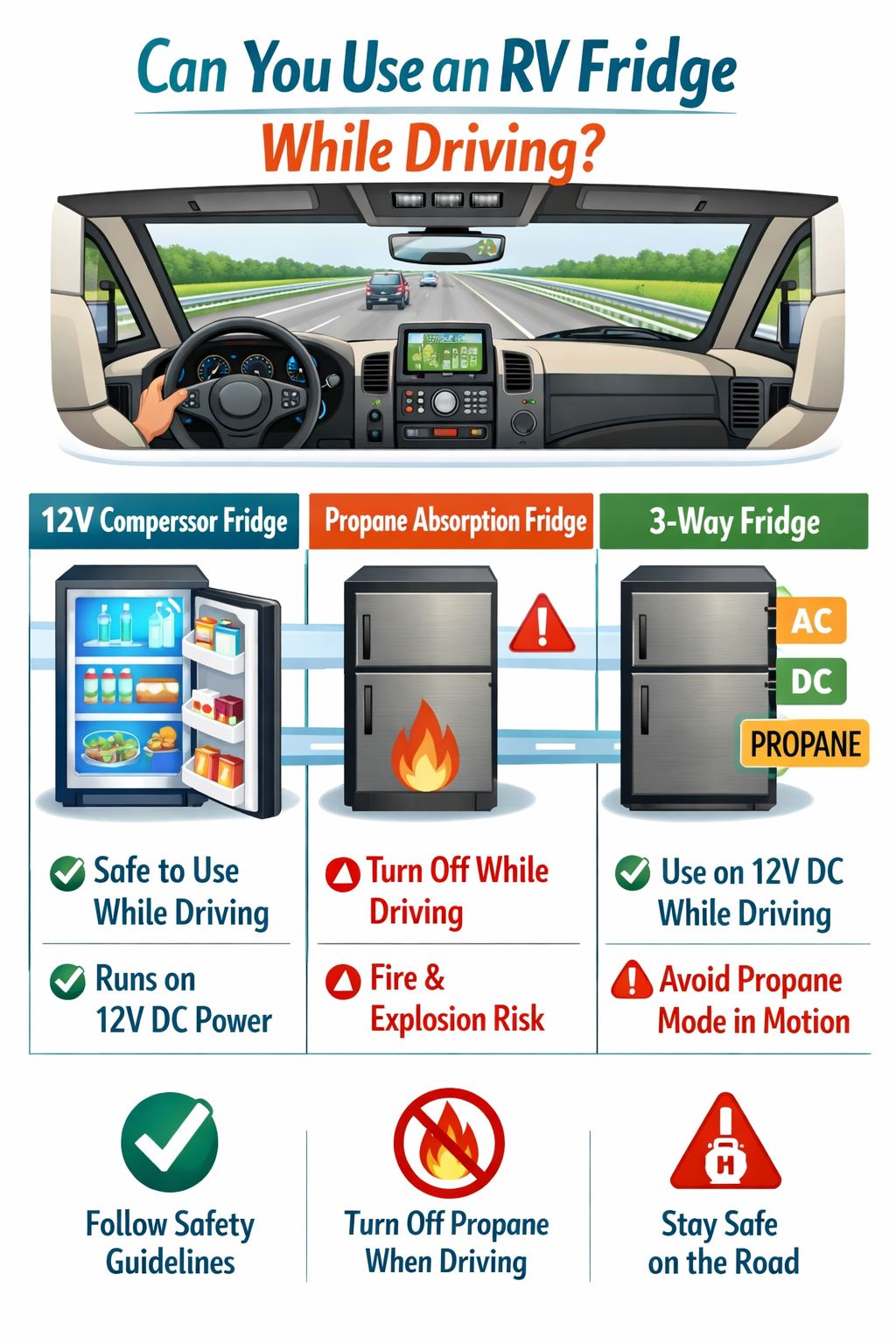
Before answering “can you use RV fridge while driving?” definitively, it helps to understand what type of refrigerator is installed in your rig. Each type operates differently on the road.
The Three Main RV Refrigerator Types
| Fridge Type | Power Source(s) | Safe While Driving? | Best Use Case |
|---|---|---|---|
| 12V Compressor | 12V DC battery/solar | ✅ Yes — ideal | Full-time RVers, long trips |
| Absorption (3-Way) | Propane, 120V AC, 12V DC | ⚠️ With caution | Weekend campers |
| Residential (120V) | Shore power / inverter | ✅ Yes (with inverter) | Large Class A motorhomes |
12V Compressor Refrigerators
These are the gold standard for driving days. They work exactly like a home refrigerator — using a compressor powered by your RV’s 12V battery system or solar setup. No open flames, no leveling requirements, no fuss.
💡 Pull Quote: “A 12V compressor fridge can run continuously from your battery bank or solar array, making it the safest and most efficient option for travel days.”
Advantages while driving:
- Works on any terrain — no leveling needed
- No open flame hazard
- Consistent cooling performance
- Compatible with solar and lithium battery systems
Absorption (3-Way) Refrigerators
These are the most common fridges found in older and mid-range RVs. They can run on propane gas, 120V AC shore power, or 12V DC. While driving, the 12V DC mode is available, but it provides only minimal cooling — often just enough to maintain temperature, not actively cool warm items.
The propane option while driving is where things get complicated (more on this below).
Residential Refrigerators
Some larger Class A motorhomes come equipped with standard household refrigerators. These require 120V AC power, which means running them while driving requires a power inverter connected to your battery bank or a generator. They cool efficiently but draw significant power.
Can You Use RV Fridge While Driving on Propane? ⚠️
This is the most debated question in the RV community — and for good reason. Technically, yes, most absorption fridges will run on propane while the vehicle is in motion. But there are real safety and legal concerns to weigh.
Safety Risks of Running Propane While Driving
🔥 Open flame hazard: Propane fridges use a small burner flame. If that flame is extinguished by wind or road vibration, unburned propane can accumulate — creating a fire or explosion risk, especially when refueling.
Key risks include:
- Flame extinguishment from road vibration or wind
- Propane leak near fuel sources at gas stations
- Increased fire risk in an accident scenario
- Potential issues passing through tunnels
Tunnel Regulations and State Laws
Many tunnels across the U.S. and Canada prohibit vehicles with active propane systems. Notable examples include:
- Baltimore Harbor Tunnel (Maryland)
- Eisenhower Tunnel (Colorado)
- Various tunnels in New York and New Jersey
⚠️ Important: Always check tunnel regulations before your route. Fines and being turned away at the entrance are real consequences.
Some RVers use a propane solenoid shutoff valve — an automatic device that cuts propane flow when the ignition is on. This is a popular safety upgrade that satisfies many tunnel requirements.
The 12V Mode Compromise for Absorption Fridges
When driving with an absorption fridge, switching to 12V DC mode is the safer choice. The trade-off: 12V mode on absorption fridges is designed for temperature maintenance, not rapid cooling. This is why pre-cooling your fridge the night before departure is so critical.
Best practice checklist for absorption fridge owners:
- Pre-cool fridge to target temperature 8–12 hours before departure
- Switch to 12V DC mode before driving
- Keep fridge well-stocked (thermal mass helps maintain temp)
- Avoid opening the fridge frequently while driving
- Switch back to propane or shore power once parked
Practical Tips for Running Your RV Fridge on the Road
Whether the question is “can you use RV fridge while driving?” or “how do you do it well?” — these strategies apply to every setup.
Pre-Cooling Is Non-Negotiable 🧊
The single most effective thing any RV owner can do is pre-cool the refrigerator at least 8–12 hours before departure. A fridge that starts cold stays cold far longer than one trying to cool down while bouncing down the highway.
Pack Smart for Travel Days
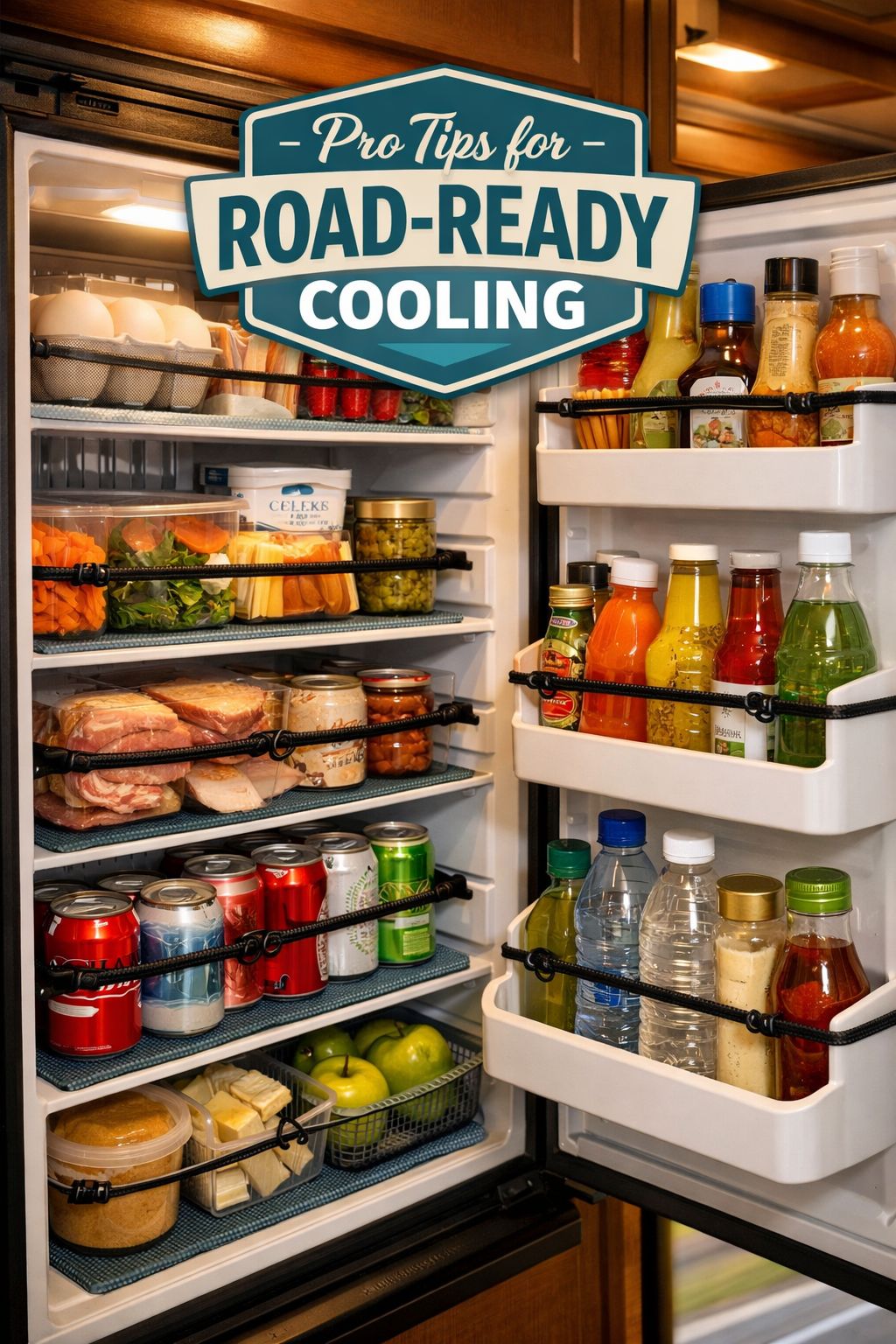
- Use thermal mass: Pack the fridge full. More items = more cold retention.
- Use ice packs or frozen water bottles to supplement cooling.
- Organize with bungee cords or non-slip mats to prevent items from shifting.
- Avoid warm items: Never put room-temperature food directly into the travel fridge.
Monitor Temperature Remotely 📱
In 2026, several affordable Bluetooth and WiFi fridge thermometers allow RVers to monitor interior fridge temperature from the cab. Brands like Govee and SensorPush offer reliable options under $30. This eliminates the need to open the fridge to check — preserving cold air.
Battery and Solar Considerations
For 12V compressor fridge users, power management is key:
| Setup | Estimated Fridge Runtime |
|---|---|
| 100Ah AGM battery (single) | ~8–12 hours |
| 200Ah lithium battery | ~24–36 hours |
| 200W solar + 100Ah lithium | Indefinite (sunny conditions) |
| Running generator | Unlimited |
💡 Pro Tip: Upgrading to a lithium battery bank is one of the most impactful investments for full-time RVers who rely on 12V appliances.
Generator Use While Driving
Running a built-in generator while driving is a popular option for residential fridge owners. Most Class A motorhomes with onboard generators can power a residential fridge continuously. Portable generators should never be run inside or in enclosed spaces.
Frequently Asked Questions
Q: Does an RV fridge need to be level while driving?
Absorption fridges require leveling when stationary for proper operation. While driving, the constant motion typically prevents the coolant from pooling — but extended off-level parking (more than 30 minutes) can damage the unit. 12V compressor fridges have no leveling requirement.
Q: How long can an RV fridge hold temperature without power?
A well-insulated, fully stocked fridge can hold safe temperatures (below 40°F / 4°C) for 4–6 hours without power. Adding frozen items extends this significantly.
Q: Is it safe to leave the RV fridge running overnight at a campsite?
Yes — on shore power, 12V, or properly vented propane, overnight operation is standard and safe.
Conclusion: Keep It Cool and Keep It Safe 🚐
The answer to “can you use RV fridge while driving?” is a confident yes — with the right setup and precautions. 12V compressor fridges offer the simplest, safest experience for travel days. Absorption fridge owners should default to 12V DC mode while driving and pre-cool thoroughly before departure. Those using propane on the road should invest in a solenoid shutoff valve and always research tunnel regulations along their route.
Actionable next steps:
- Identify your fridge type and its available power modes.
- Pre-cool your fridge the night before every trip.
- Audit your battery system — upgrade to lithium if running a 12V compressor fridge.
- Install a fridge thermometer for real-time monitoring from the cab.
- Map your route for tunnel restrictions if running propane.
A well-managed RV refrigerator means fresh food, happy passengers, and one less thing to worry about on the open road. 🛣️
References
- Recreation Vehicle Industry Association (RVIA). (2023). RV Industry Statistics and Ownership Data. https://www.rvia.org
- Norcold Inc. (2022). Absorption Refrigerator Operation Manual. Norcold Technical Publications.
- U.S. Department of Transportation, Federal Highway Administration. (2021). Hazardous Materials Tunnel Restrictions. https://www.fhwa.dot.gov
- U.S. Food and Drug Administration. (2022). Safe Food Handling: Cold Storage Temperatures. https://www.fda.gov
- SensorPush. (2023). Wireless Thermometer Hygrometer Product Guide. SensorPush LLC.