Every RV owner has felt it — that uneasy feeling when leaving their home-on-wheels parked and walking away. How do RVers secure their RV’s when parking, and what methods do most people actually trust? A recent community poll asked RV lovers exactly that, and the results are both surprising and super helpful. Whether someone is a weekend warrior or a full-time road dweller, keeping an RV safe is a top priority. Let’s dig into what real RVers are doing — and what the experts say works best. 🚐🔒
Key Takeaways
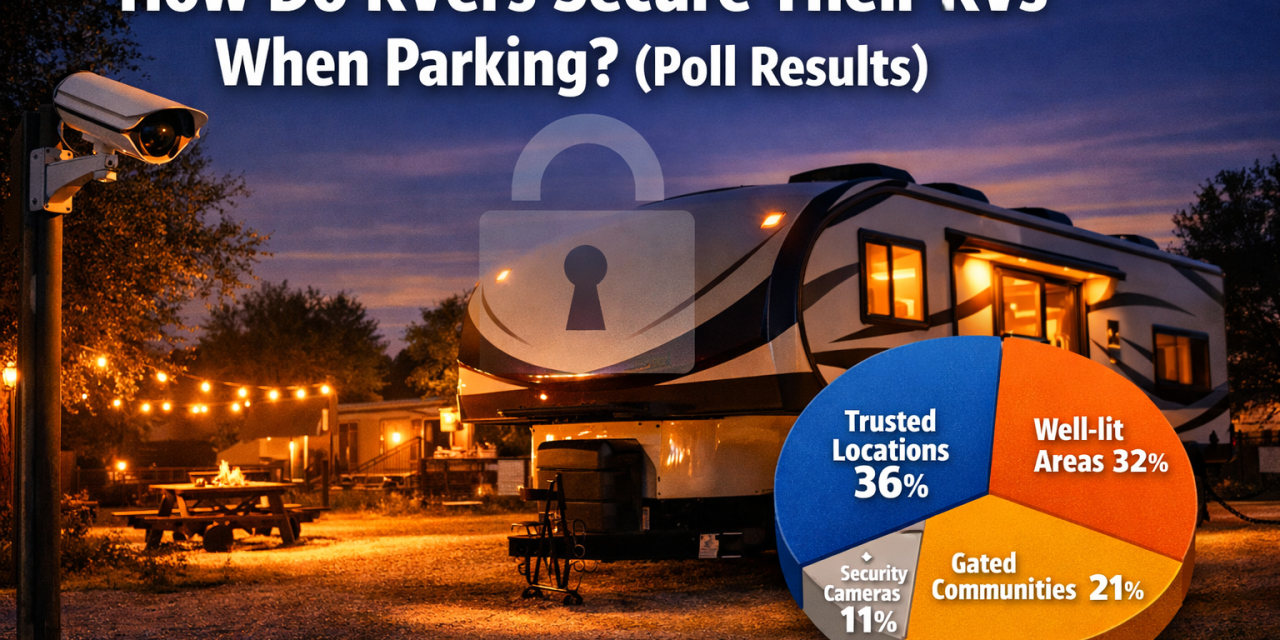
- 36% of RVers say they rely on trusted locations as their top parking security method.
- 32% prefer well-lit areas to deter theft and unwanted visitors.
- Physical locks — like coupler locks, wheel locks, and hitch pins — are some of the most effective anti-theft tools available. [1]
- GPS trackers and motion-activated alarms add a powerful digital layer of protection. [1]
- Layering multiple security methods together gives the best results.
Would you like to save this article?
How Do RVers Secure Their RV’s When Parking? The Poll Results
Before diving into the tips and tools, let’s look at what the RV community actually said. Here are the poll results:
📊 Poll: What’s Your Preferred RV Parking Security?
| Security Method | Votes |
|---|---|
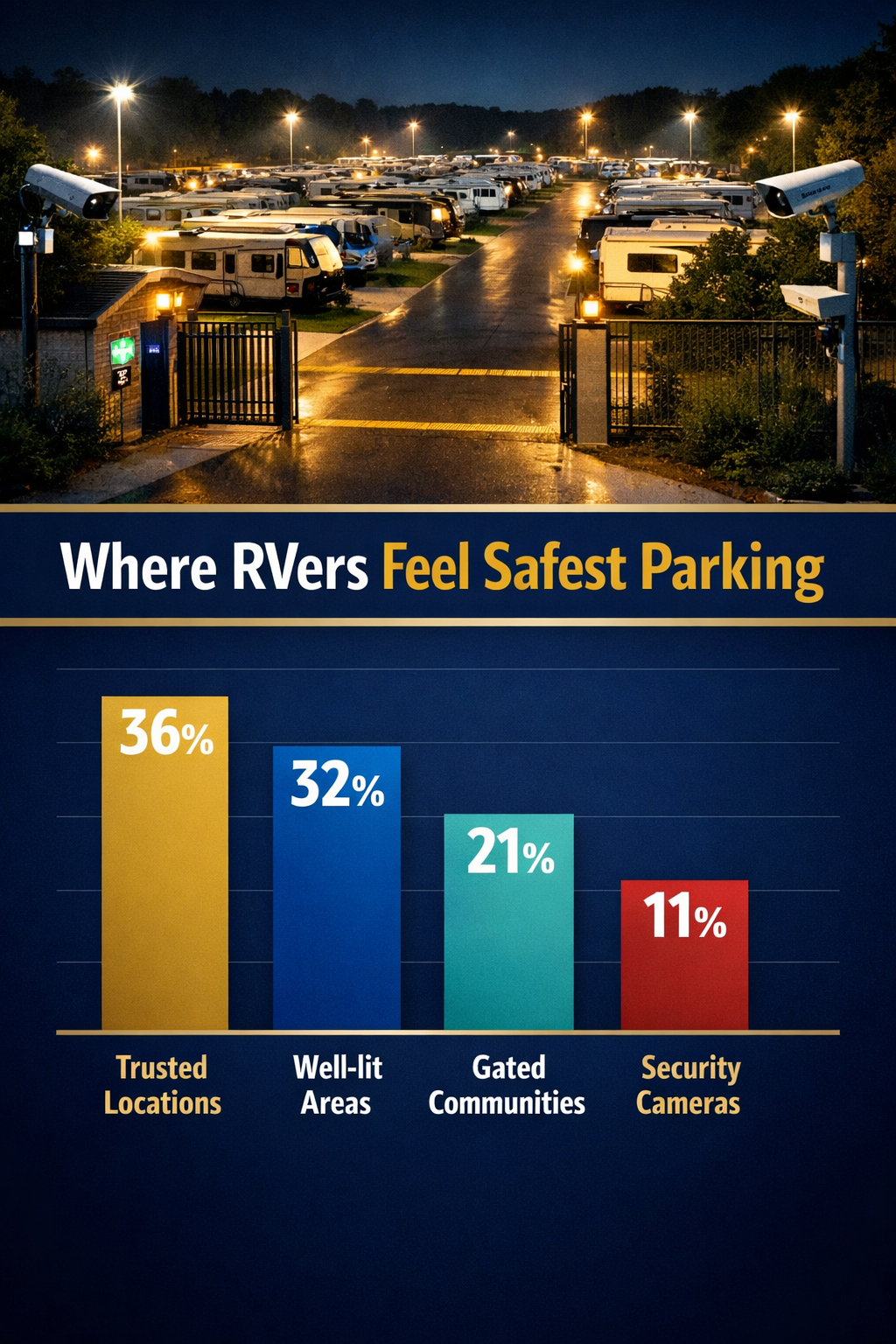
| 🏘️ Trusted Locations | 36% |
| 💡 Well-Lit Areas | 32% |
| 🚪 Gated Communities | 21% |
| 📷 Security Cameras | 11% |
These results tell a clear story. Most RVers lean on location-based strategies — choosing the right spot over relying on gadgets alone. But that doesn’t mean physical security tools don’t matter. In fact, combining location smarts with solid hardware is the winning formula.
💬 “The best security is not being seen as an easy target in the first place.”
🏆 #1 Trusted Locations (36%)
More than one-third of RVers say trusted locations are their go-to security choice. This makes a lot of sense. Parking at a familiar campground, a friend’s property, or a well-known RV park means the environment is already somewhat controlled.
Why trusted locations work:
- Staff or neighbors are nearby and watchful.
- Repeat visits build familiarity with the area.
- Known locations often have existing security features already in place.
💡 #2 Well-Lit Areas (32%)
Coming in close behind, 32% of RVers choose well-lit parking spots as their main defense. Light is one of the simplest and most powerful theft deterrents out there.
Thieves prefer darkness. A brightly lit space makes it much harder to work undetected. Experts recommend choosing spots with strong overhead lighting and regular foot traffic, and avoiding dark corners or isolated areas where someone could tamper with an RV without being seen. [1]
Pro tip: Portable motion-activated lights can be mounted around an RV or campsite quickly. They are energy-efficient and give off a bright flash when someone gets too close — a great surprise for anyone who shouldn’t be there. [2]
🚪 #3 Gated Communities (21%)
21% of RVers feel safest in gated storage facilities or communities. These spots typically offer:
- 24/7 monitoring and security cameras
- Keycard or PIN code gate access
- Fencing that limits who can enter
- The ability to anchor trailers to fixed objects like poles [1]
Professional storage facilities with active camera systems can lower property crime rates by 25–50%, depending on the area. [1] That’s a huge difference — and it explains why gated options are so popular for long-term parking.
📷 #4 Security Cameras (11%)
11% of RVers rely primarily on security cameras. While cameras alone ranked lowest in the poll, they are still a very valuable tool — especially when combined with other methods.
Modern camera systems can include:
- Geofence alerts that notify the owner if the RV leaves a set area [1]
- Real-time location mapping if the RV is moved [1]
- Phone-controlled alarm activation [1]
Cameras work best as part of a bigger security plan, not as a standalone solution.
How Do RVers Secure Their RV’s When Parking? The Best Physical Security Tools
Location matters a lot — but physical security tools are the backbone of keeping an RV safe. Here’s a breakdown of the best options. [1][2]
🔐 Multi-Layer Locking Systems
Using just one lock is like locking only one door in a house. The smartest approach combines several types of locks together:
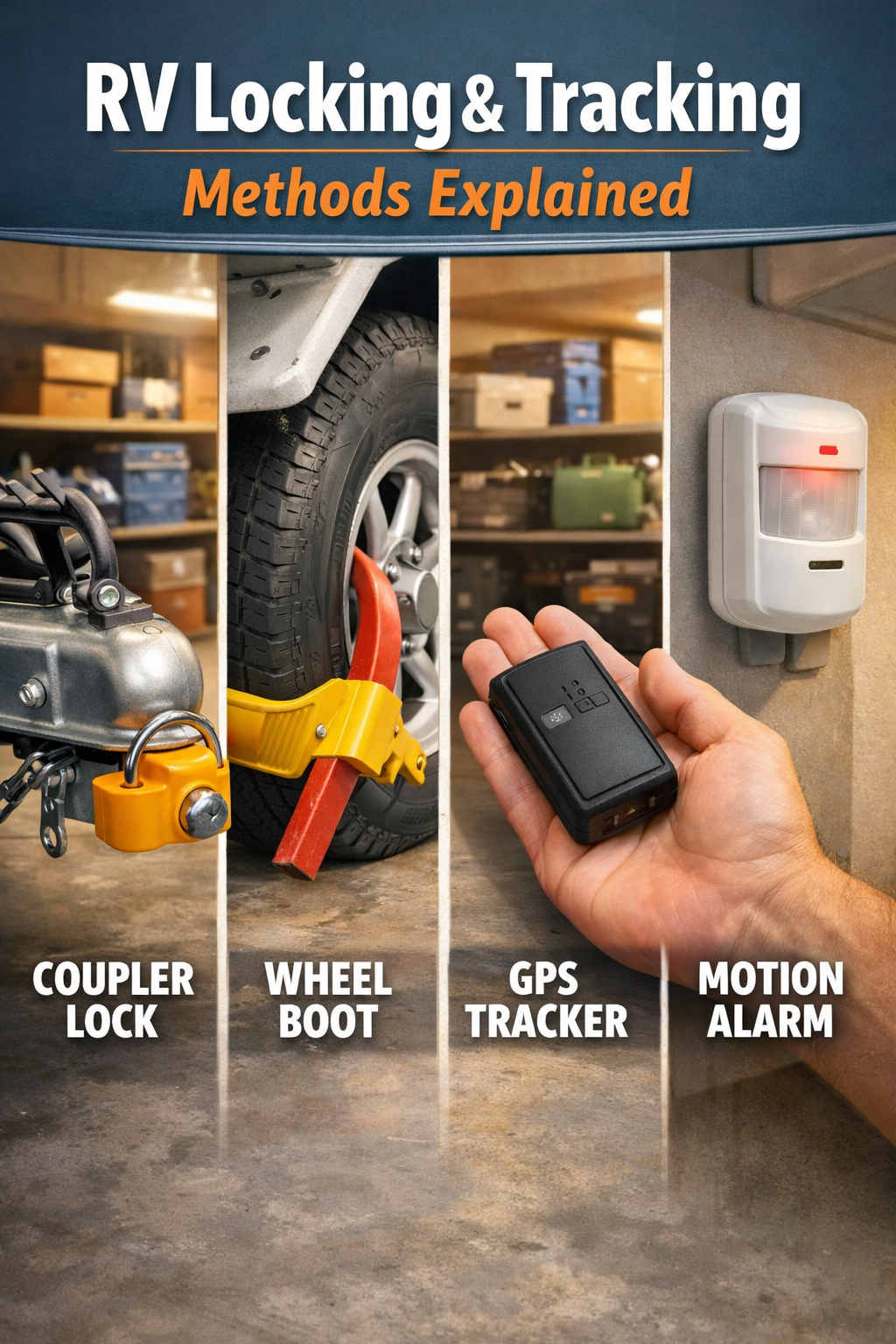
- Coupler locks — attach to the trailer hitch coupling
- Hitch pin locks — secure the hitch pin so the trailer can’t be removed
- Tongue locks — protect the trailer tongue from being hitched
- Cable locks — tie the trailer to a fixed anchor point in high-risk areas [1]
The idea is simple: the more locks, the more time it takes a thief, and most thieves move on when something is too difficult.
🛞 Wheel and Tire Protection
Wheel locks and tire boots are easy to spot — and that’s exactly the point. They send a clear message: this RV is not easy to steal.
Options include:
- Tire locks that wrap around the tire to stop it from rotating
- Lug-nut covers that need a special key to remove
- Valve-stem caps that slow down tire deflation attempts [1]
These tools are affordable, easy to install, and very effective at discouraging quick theft.
📍 GPS Tracking Technology
GPS trackers are a game-changer for RV security. There are three main types: [1]
| Tracker Type | Best For |
|---|---|
| Hardwired | Long-term storage, continuous power |
| Battery-powered | Short trips, portability |
| Solar-powered | Extended outdoor parking |
Even if an RV is stolen, a GPS tracker gives the owner a real-time location — which dramatically improves the chances of recovery.
🚨 Motion-Activated Alarms and Smart Sensors
Smart alarms detect movement, vibration, or tilt — and send an instant alert to a phone. [1] Some systems can even detect when someone tries to hook a trailer to another vehicle.
These alarms work around the clock and don’t need someone to be watching a screen. The phone does the watching instead.
🔑 Upgraded Locks for Doors and Storage Bays
Here’s a fact many RV owners don’t know: factory RV locks often use the same key across many different RVs. That means a stranger could potentially open someone else’s RV with their own key. [2]
Upgrading to keyless entry systems — like digital keypads or key fob access — is a smart and affordable fix. [2]
Storage bays and toolboxes are also common theft targets. Adding upgraded locks to these compartments closes a major security gap. [2]
🚗 Strategic Parking Orientation
This one costs nothing. Simply parking the trailer tongue facing a wall, fence, or another vehicle makes it very hard for a thief to back up and hitch the trailer quickly. [1]
It’s a small habit that can make a big difference.
Conclusion: Layer Up for the Best RV Security 🔒
The poll results make it clear — RVers are smart about security. Most people choose trusted locations and well-lit areas because those choices set the stage for safety before any tools are even needed.
But the best protection combines location smarts with physical locks, digital tracking, and smart alarms. No single method is perfect on its own. Stacking several layers together makes an RV a much harder target.
Actionable next steps for every RV owner:
- ✅ Always park in a well-lit, high-traffic area when possible.
- ✅ Use at least two types of physical locks (coupler + wheel lock is a great combo).
- ✅ Install a GPS tracker — hardwired for storage, battery-powered for travel.
- ✅ Upgrade factory door locks to a keyless entry system.
- ✅ Add motion-activated lighting around the campsite.
- ✅ Consider a gated storage facility for long-term parking.
Staying safe on the road doesn’t have to be complicated. Start with one upgrade, then add more over time. Every layer added is one more reason a thief will move on and look elsewhere. 🚐💪
References
[1] Secure Your Parked Trailer Anti Theft Guide – https://www.recnationstorage.com/blog/secure-your-parked-trailer-anti-theft-guide/
[2] How To Secure Your Campsite Like A Pro Essential Tips For Rvers – https://www.rvlock.com/blogs/on-the-road/how-to-secure-your-campsite-like-a-pro-essential-tips-for-rvers